LipNet: End-to-End Sentence-level Lipreading
Keras implementation of the method described in the paper 'LipNet: End-to-End Sentence-level Lipreading' by Yannis M. Assael, Brendan Shillingford, Shimon Whiteson, and Nando de Freitas (https://arxiv.org/abs/1611.01599).
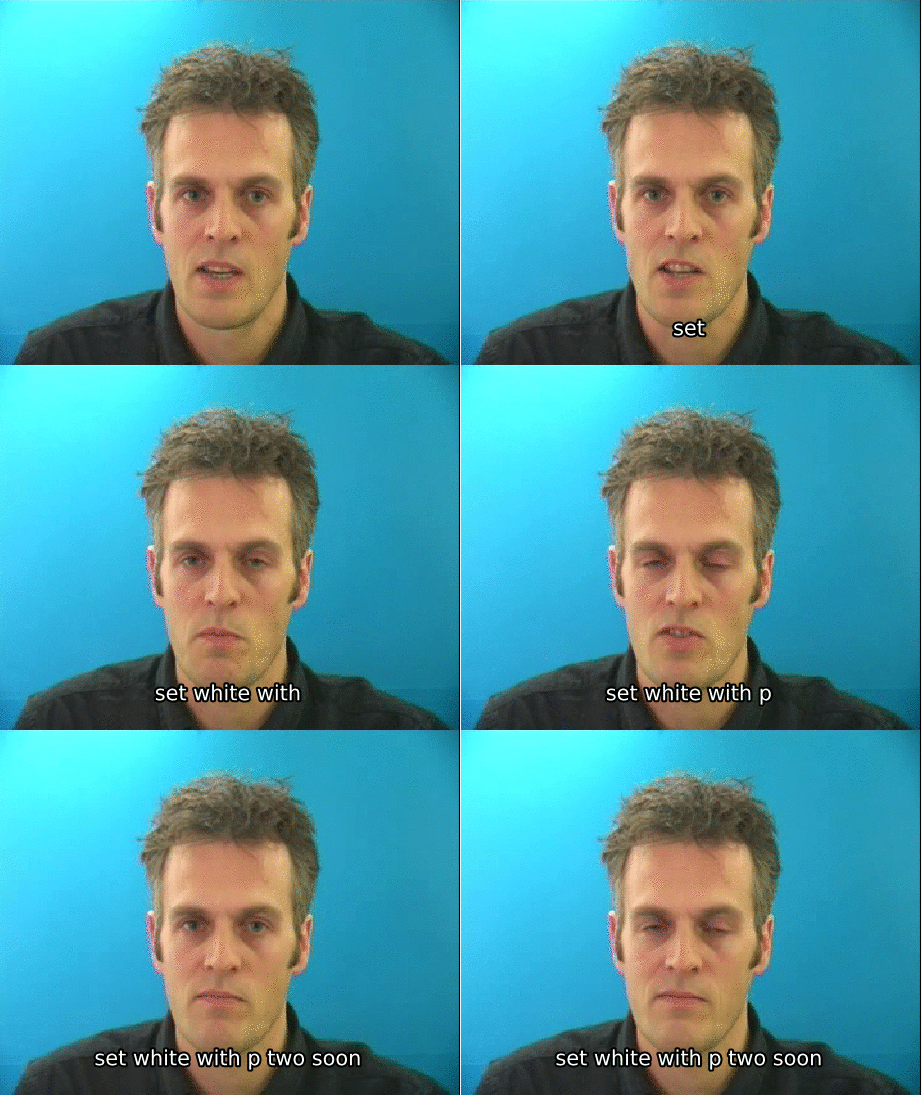
Results
| Scenario | Epoch | CER | WER | BLEU |
|---|---|---|---|---|
| Unseen speakers [C] | N/A | N/A | N/A | N/A |
| Unseen speakers | 178 | 6.19% | 14.19% | 88.21% |
| Overlapped speakers [C] | N/A | N/A | N/A | N/A |
| Overlapped speakers | 368 | 1.56% | 3.38% | 96.93% |
Notes:
- [C] means using curriculum learning.
- N/A means either the training is in progress or haven't been performed.
- Your contribution in sharing the results of this model is highly appreciated :)
Dependencies
- Keras 2.0+
- Tensorflow 1.0+
- PIP (for package installation)
Plus several other libraries listed on setup.py
Usage
To use the model, first you need to clone the repository:
git clone https://github.com/rizkiarm/LipNet
Then you can install the package:
cd LipNet/
pip install -e .
Note: if you don't want to use CUDA, you need to edit the setup.py and change tensorflow-gpu to tensorflow
You're done!
Here is some ideas on what you can do next:
- Modify the package and make some improvements to it.
- Train the model using predefined training scenarios.
- Make your own training scenarios.
- Use pre-trained weights to do lipreading.
- Go crazy and experiment on other dataset! by changing some hyperparameters or modify the model.
Dataset
This model uses GRID corpus (http://spandh.dcs.shef.ac.uk/gridcorpus/)
Pre-trained weights
For those of you who are having difficulties in training the model (or just want to see the end results), you can download and use the weights provided here: https://github.com/rizkiarm/LipNet/tree/master/evaluation/models.
More detail on saving and loading weights can be found in Keras FAQ.
Training
There are five different training scenarios that are (going to be) available:
Prerequisites
- Download all video (normal) and align from the GRID Corpus website.
- Extracts all the videos and aligns.
- Create
datasetsfolder on each training scenario folder. - Create
alignfolder inside thedatasetsfolder. - All current
train.pyexpect the videos to be in the form of 100x50px mouthcrop image frames. You can change this by addingvtype = "face"andface_predictor_path(which can be found inevaluation/models) in the instantiation ofGeneratorinside thetrain.py - The other way would be to extract the mouthcrop image using
scripts/extract_mouth_batch.py(usage can be found inside the script). - Create symlink from each
training/*/datasets/alignto your align folder. - You can change the training parameters by modifying
train.pyinside its respective scenarios.
Random split (Unmaintained)
Create symlink from training/random_split/datasets/video to your video dataset folder (which contains s* directory).
Train the model using the following command:
./train random_split [GPUs (optional)]
Note: You can change the validation split value by modifying the val_split argument inside the train.py.
Unseen speakers
Create the following folder:
training/unseen_speakers/datasets/traintraining/unseen_speakers/datasets/val
Then, create symlink from training/unseen_speakers/datasets/[train|val]/s* to your selection of s* inside of the video dataset folder.
The paper used s1, s2, s20, and s22 for evaluation and the remainder for training.
Train the model using the following command:
./train unseen_speakers [GPUs (optional)]
Unseen speakers with curriculum learning
The same way you do unseen speakers.
Note: You can change the curriculum by modifying the curriculum_rules method inside the train.py
./train unseen_speakers_curriculum [GPUs (optional)]
Overlapped Speakers
Run the preparation script:
python prepare.py [Path to video dataset] [Path to align dataset] [Number of samples]
Notes:
[Path to video dataset]should be a folder with structure:/s{i}/[video][Path to align dataset]should be a folder with structure:/[align].align[Number of samples]should be less than or equal tomin(len(ls '/s{i}/*'))
Then run training for each speaker:
python training/overlapped_speakers/train.py s{i}
Overlapped Speakers with curriculum learning
Copy the prepare.py from overlapped_speakers folder to overlapped_speakers_curriculum folder,
and run it as previously described in overlapped speakers training explanation.
Then run training for each speaker:
python training/overlapped_speakers_curriculum/train.py s{i}
Note: As always, you can change the curriculum by modifying the curriculum_rules method inside the train.py
Evaluation
To evaluate and visualize the trained model on a single video / image frames, you can execute the following command:
./predict [path to weight] [path to video]
Example:
./predict evaluation/models/overlapped-weights368.h5 evaluation/samples/id2_vcd_swwp2s.mpg
Work in Progress
This is a work in progress. Errors are to be expected. If you found some errors in terms of implementation please report them by submitting issue(s) or making PR(s). Thanks!
Some todos:
- [X] Use
Stanford-CTCTensorflow CTC beam search - [X] Auto spelling correction
- [X] Overlapped speakers (and its curriculum) training
- [ ] Integrate language model for beam search
- [ ] RGB normalization over the dataset.
- [X] Validate CTC implementation in training.
- [ ] Proper documentation
- [ ] Unit tests
- [X] (Maybe) better curriculum learning.
- [ ] (Maybe) some proper scripts to do dataset stuff.
License
MIT License