CondenseNets
This repository contains the code (in PyTorch) for "CondenseNet: An Efficient DenseNet using Learned Group Convolutions" paper by Gao Huang*, Shichen Liu*, Laurens van der Maaten and Kilian Weinberger (* Authors contributed equally).
Citation
If you find our project useful in your research, please consider citing:
@inproceedings{huang2018condensenet,
  title={Condensenet: An efficient densenet using learned group convolutions},
  author={Huang, Gao and Liu, Shichen and Van der Maaten, Laurens and Weinberger, Kilian Q},
  booktitle={Proceedings of the IEEE Conference on Computer Vision and Pattern Recognition},
  pages={2752--2761},
  year={2018}
}
Contents
Introduction
CondenseNet is a novel, computationally efficient convolutional network architecture. It combines dense connectivity between layers with a mechanism to remove unused connections. The dense connectivity facilitates feature re-use in the network, whereas learned group convolutions remove connections between layers for which this feature re-use is superfluous. At test time, our model can be implemented using standard grouped convolutions —- allowing for efficient computation in practice. Our experiments demonstrate that CondenseNets are much more efficient than other compact convolutional networks such as MobileNets and ShuffleNets.
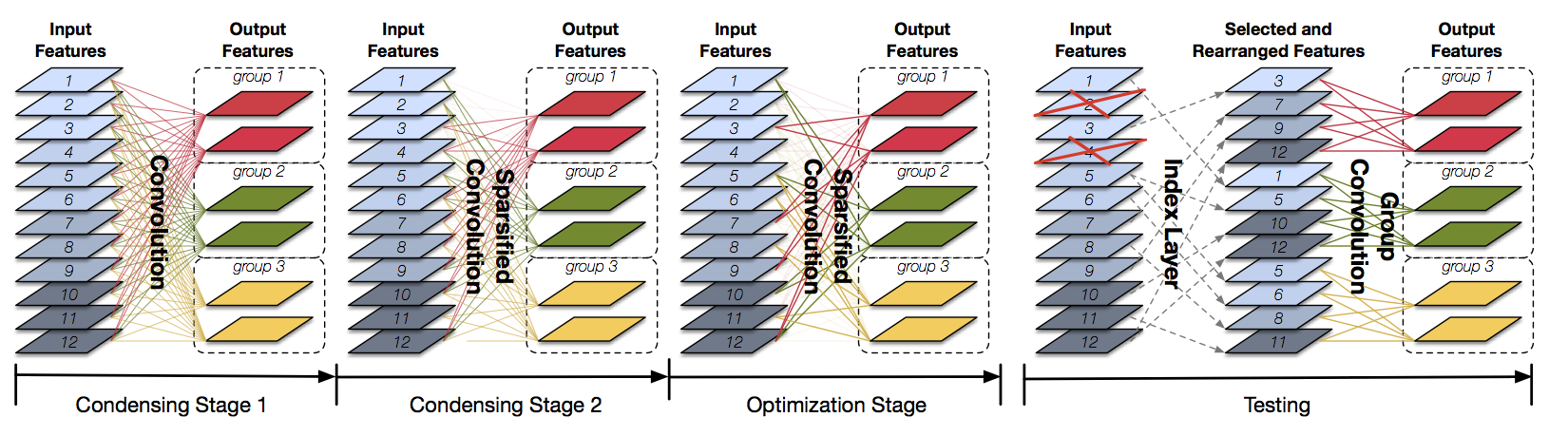
Figure 1: Learned Group Convolution with G=C=3.
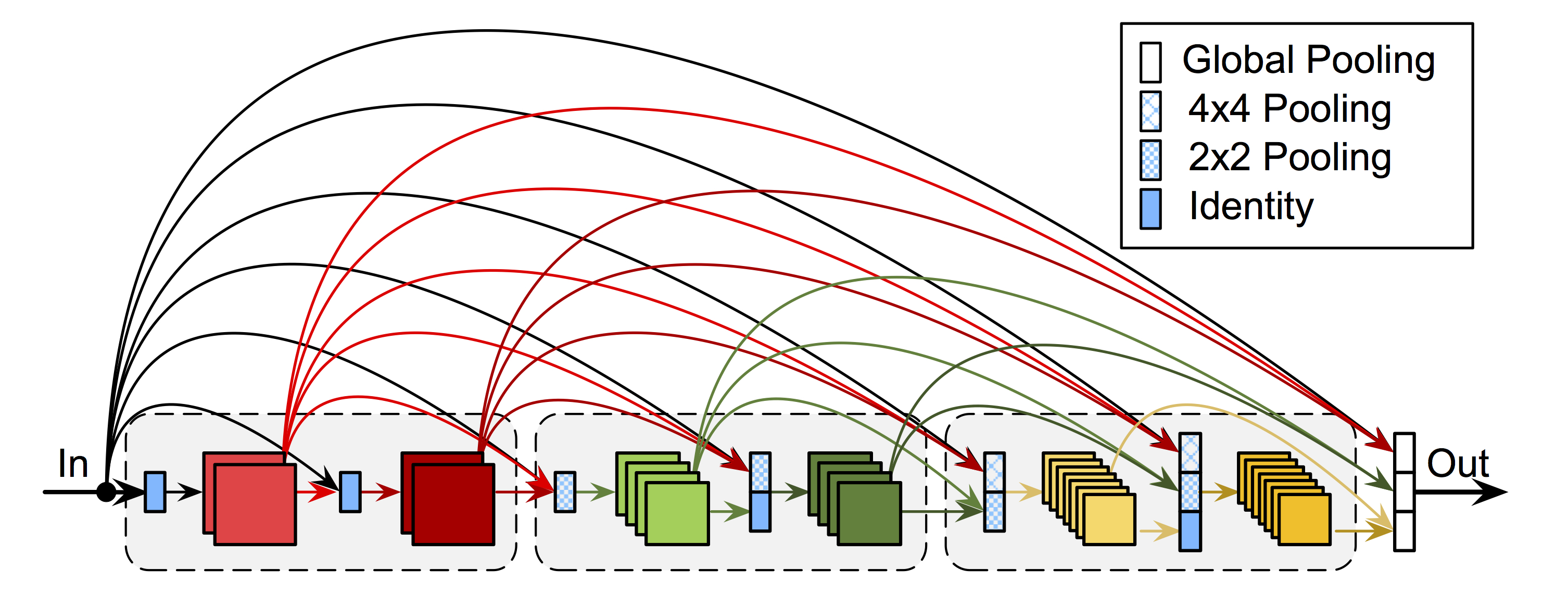
Figure 2: CondenseNets with Fully Dense Connectivity and Increasing Growth Rate.
Usage
Dependencies
Train
As an example, use the following command to train a CondenseNet on ImageNet
python main.py --model condensenet -b 256 -j 20 /PATH/TO/IMAGENET \
--stages 4-6-8-10-8 --growth 8-16-32-64-128 --gpu 0,1,2,3,4,5,6,7 --resume
As another example, use the following command to train a CondenseNet on CIFAR-10
python main.py --model condensenet -b 64 -j 12 cifar10 \
--stages 14-14-14 --growth 8-16-32 --gpu 0 --resume
Evaluation
We take the ImageNet model trained above as an example.
To evaluate the trained model, use evaluate to evaluate from the default checkpoint directory:
python main.py --model condensenet -b 64 -j 20 /PATH/TO/IMAGENET \
--stages 4-6-8-10-8 --growth 8-16-32-64-128 --gpu 0 --resume \
--evaluate
or use evaluate-from to evaluate from an arbitrary path:
python main.py --model condensenet -b 64 -j 20 /PATH/TO/IMAGENET \
--stages 4-6-8-10-8 --growth 8-16-32-64-128 --gpu 0 --resume \
--evaluate-from /PATH/TO/BEST/MODEL
Note that these models are still the large models. To convert the model to group-convolution version as described in the paper, use the convert-from function:
python main.py --model condensenet -b 64 -j 20 /PATH/TO/IMAGENET \
--stages 4-6-8-10-8 --growth 8-16-32-64-128 --gpu 0 --resume \
--convert-from /PATH/TO/BEST/MODEL
Finally, to directly load from a converted model (that is, a CondenseNet), use a converted model file in combination with the evaluate-from option:
python main.py --model condensenet_converted -b 64 -j 20 /PATH/TO/IMAGENET \
--stages 4-6-8-10-8 --growth 8-16-32-64-128 --gpu 0 --resume \
--evaluate-from /PATH/TO/CONVERTED/MODEL
Other Options
We also include DenseNet implementation in this repository.
For more examples of usage, please refer to script.sh
For detailed options, please python main.py --help
Results
Results on ImageNet
| Model | FLOPs | Params | Top-1 Err. | Top-5 Err. | Pytorch Model |
|---|---|---|---|---|---|
| CondenseNet-74 (C=G=4) | 529M | 4.8M | 26.2 | 8.3 | Download (18.69M) |
| CondenseNet-74 (C=G=8) | 274M | 2.9M | 29.0 | 10.0 | Download (11.68M) |
Results on CIFAR
| Model | FLOPs | Params | CIFAR-10 | CIFAR-100 |
|---|---|---|---|---|
| CondenseNet-50 | 28.6M | 0.22M | 6.22 | - |
| CondenseNet-74 | 51.9M | 0.41M | 5.28 | - |
| CondenseNet-86 | 65.8M | 0.52M | 5.06 | 23.64 |
| CondenseNet-98 | 81.3M | 0.65M | 4.83 | - |
| CondenseNet-110 | 98.2M | 0.79M | 4.63 | - |
| CondenseNet-122 | 116.7M | 0.95M | 4.48 | - |
| CondenseNet-182* | 513M | 4.2M | 3.76 | 18.47 |
(* trained 600 epochs)
Inference time on ARM platform
| Model | FLOPs | Top-1 | Time(s) |
|---|---|---|---|
| VGG-16 | 15,300M | 28.5 | 354 |
| ResNet-18 | 1,818M | 30.2 | 8.14 |
| 1.0 MobileNet-224 | 569M | 29.4 | 1.96 |
| CondenseNet-74 (C=G=4) | 529M | 26.2 | 1.89 |
| CondenseNet-74 (C=G=8) | 274M | 29.0 | 0.99 |
Contact
liushichen95@gmail.com
gh349@cornell.com
We are working on the implementation on other frameworks.
Any discussions or concerns are welcomed!