T-MAC

BitNet on M2-Ultra with T-MAC (LUT-based) vs llama.cpp (dequantization-based)

BitNet and Phi-3.5 tokens/s with # of CPU cores on Surface Laptop 7
News
-
05/28/2025 🚀🚀: The idea of T-MAC extends its capabilities to NPU! For more information, check out the t-man README and try BitNet/Qwen3/Llama3 with the demo app!
-
10/21/2024 🎉🎉: BitNet, powered by T-MAC, is open-sourced.
-
10/10/2024 🚀🚀: By updating and rebasing our llama.cpp version, T-MAC now support more models (e.g., qwen2) and the end-to-end performance is further improved by 10~15%! Try qwen2 using the Official GPTQ model.
-
08/21/2024 🎉🎉: T-MAC paper is accepted by EuroSys 2025.
-
08/17/2024 🚀: T-MAC now supports 1/2/4-bit quantized models of (almost) any architecture in GPTQ format.
-
08/14/2024 🚀: The T-MAC GEMM (N>1) kernels are now integrated into llama.cpp to accelerate prefill. Check Prefill speedup for speedup.
-
07/27/2024 ✨: We've noted that T-MAC is even faster than the NPU in token generation speed on the latest Snapdragon X Elite chipset! Check Compared to NPU for more details.
Introduction
T-MAC is a kernel library to directly support mixed-precision matrix multiplication (int1/2/3/4 x int8/fp16/fp32) without the need for dequantization by utilizing lookup tables. T-MAC aims to boost low-bit LLM inference on CPUs. T-MAC already offers support for various low-bit models, including W4A16 from GPTQ/gguf, W2A16 from BitDistiller/EfficientQAT and W1(.58)A8 from BitNet on OSX/Linux/Windows equipped with ARM/Intel CPUs.
T-MAC achieves a token generation throughput of 20 tokens/sec with a single core and 48 tokens/sec with four cores on Surface Laptop 7 for 3B BitNet, which is a 4~5x speedup compared to SOTA CPU low-bit framework (llama.cpp). T-MAC can even reach 11 tokens/sec on lower-end devices like Raspberry Pi 5.
End-2-End Speedup
All of the following data is profiled based on llama.cpp b2794 (May 2024). The latest T-MAC and baseline, after updating the llama.cpp version, is further optimized by 10~15%.
We evaluate the token generation performance of different models on five different devices: Surface Laptop 7, Apple M2-Ultra, Jetson AGX Orin, Raspberry Pi 5 and Surface Book 3. Check datasheet for more details.
We evaluate BitNet-3B and Llama-2-7B (W2) with T-MAC 2-bit and llama.cpp Q2_K, and evaluate Llama-2-7B (W4) with T-MAC 4-bit and llama.cpp Q4_0.
In addition to providing a significant speedup, T-MAC can also match the same performance using fewer CPU cores. For instance, to reach 40 tokens/sec, a throughput that greatly surpasses human reading speed, T-MAC only requires 2 cores, while llama.cpp requires 8 cores. On Jetson AGX Orin, to achieve 10 tokens/sec, a throughput that already meets human reading speed, T-MAC only requires 2 cores, while llama.cpp uses all 12 cores. T-MAC can meet real-time requirements on less powerful devices equipped with fewer CPU cores like Raspberry Pi 5. By using fewer cores, T-MAC can reserve computational resources for other applications and significantly reduce power and energy consumption, both of which are crucial for edge devices.

T-MAC achieves significant speedup at single-threads and consumes much less CPU cores to reach the same throughput
The throughputs of T-MAC are obtained without fast-aggregation. Users can toggle on fast-aggregation through
-fato achieve an additional speedup of 10%~20% with.
The figure above shows that when the model size is increased to 7B-4bit, the multi-threading throughput of llama.cpp on Surface Laptop 7 becomes highly unstable due to the thermal threshold under Better Performance mode. This instability is not observed with T-MAC, as LUT is more energy-efficient compared to multiply-add operations. To establish a more solid baseline, we re-profile the performance under the Best Performance mode:

The throughput of T-MAC and llama.cpp both increase by maximizing CPU frequency
However, under real-world situations, CPUs can't maintain maximum frequency consistently on edge devices. The performance of llama.cpp will degrade as indicated by the results under the Better Performance mode.
Prefill Speedup
TODO: add more results
We have compared the prefill throughput (input_len=256) for Llama-2-7b (W2) on Surface Laptop 7 with two baselines:
- llama.cpp: llama.cpp optimized dequant-based low-bit kernels
- llama.cpp (OpenBLAS): llama.cpp OpenBLAS backend
| Model | NUM_THREADS | Batch Size | T-MAC (tokens/sec) | llama.cpp (OpenBLAS) | llama.cpp |
|---|---|---|---|---|---|
| llama-2-7b (W2) | 4 | 256 | 50.1 | 21.5 | 12.0 |
| llama-2-7b (W2) | 8 | 256 | 94.4 | 37.7 | 21.3 |
Kernel-level Speedup
Our GEMM kernels demonstrate superior performance over SOTA low-bit GEMM on CPU. The following figure shows the speedup compared to llama.cpp for llama-7b kernels during token generation (NUM_THREADS=1):
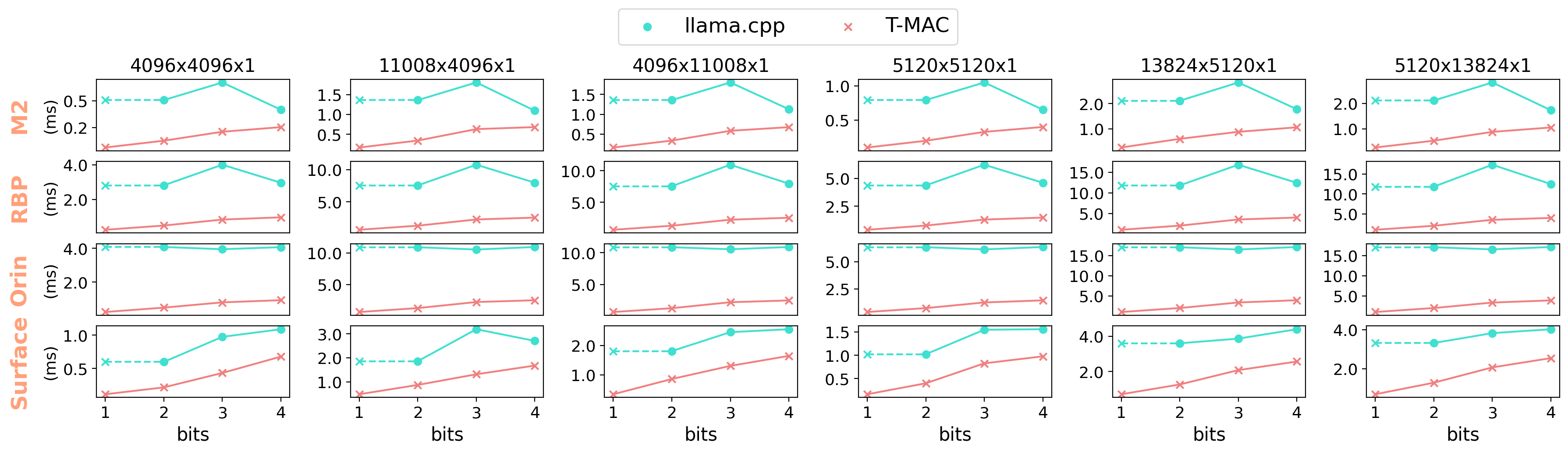
llama.cpp doesn't provide 1-bit kernel implementation, but we can deduce it from the 2-bit, as it won't bring additional speedup according to the 2/3/4-bit results.
Surface stands for Surface Book 3 in this section.
T-MAC can achieve significant speedup for multi-batch (N>1) GEMM due to reduced computaional cost, which ensures superior performance on prompt evaluation and multi-batch token generation. The following figures shows the speedup compared to llama.cpp using OpenBLAS backend (NUM_THREADS=1):
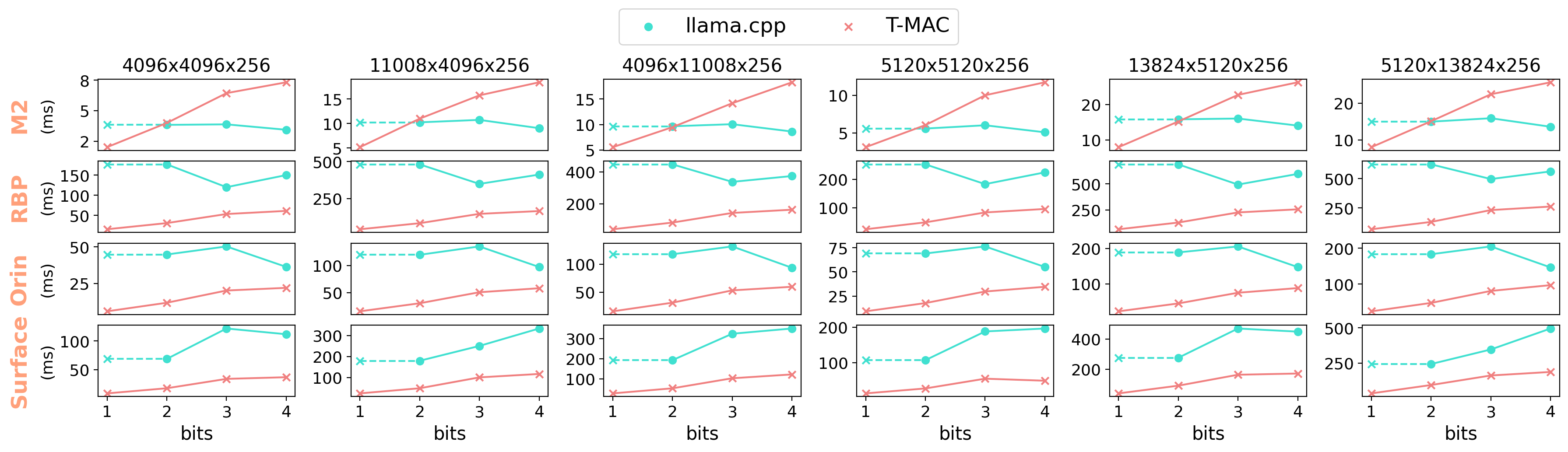
M2-Ultra is an exception as it is equipped with a specially designed AMX coprocessor to accelerate multi-batch GEMM. However, T-MAC can still achieve comparable performance at 2-bit.
Energy and Power Saving
By replacing heavy fused-multiply-add instructions with table lookup instructions, T-MAC significantly reduces power consumption. Combined with the speedup, T-MAC ultimately results in a substantial decrease in total energy consumption.

Multi-threading power/energy consumption on M2-Ultra for three models, M1: Llama-2-7B (W4), M2: Llama-2-7B (W2) and M3: BitNet-3B
Data sampled with powermetrics.
Compared to NPU
On the latest Snapdragon X Elite chipset, CPU through T-MAC achieves better performance compared to NPU through Qualcomm Snapdragon Neural Processing Engine (NPE).
When deploying the llama-2-7b-4bit model on it, the NPU can only generate 10.4 tokens/sec (according to the data released here), while the CPU using T-MAC can reach 12.6 tokens/sec with two cores, and even up to 22 tokens/sec. Considering that T-MAC's computing performance can linearly improve with the number of bits decreases (which is not observable on GPUs and NPUs based on dequantization), T-MAC can even match the NPU with a single-core CPU at 2 bits.
| Framework | Model | NUM_THREADS | Throughput (tokens/sec) |
|---|---|---|---|
| T-MAC (CPU) | llama-2-7b (W4) | 2 | 12.6 |
| T-MAC (CPU) | llama-2-7b (W4) | 4 | 18.7 |
| T-MAC (CPU) | llama-2-7b (W2) | 1 | 9.3 |
| T-MAC (CPU) | llama-2-7b (W2) | 4 | 28.4 |
| NPE (NPU) | llama-2-7b (W4) | - | 10.4 |
For fair comparison, we have aligned our settings with those of the NPU, including a input length of 1024 and an output length of 1024. Although Qualcomms deploy a model of 3.6GB, we deploy a slightly larger model of 3.7GB, due to our token-embed remaining un-quantized.
By maximizing CPU frequency, T-MAC (CPU) can even get better results. Refer to the discussion in End-2-End speedup.
Compared to CUDA GPU
T-MAC achieves comparable 2-bit mpGEMM performance compared to CUDA GPU on Jetson AGX Orin. While the CUDA GPU outperforms the CPU in executing kernels other than mpGEMM, making the end-to-end performance of T-MAC (CPU) slightly slower, T-MAC can deliver considerable savings in power and energy consumption.
| Framework | Throughput (tokens/sec) | Power (W) | Energy (J/token) |
|---|---|---|---|
| llama.cpp (CPU) | 7.08 | 15.0 | 2.12 |
| llama.cpp (GPU) | 20.03 | 30.8 | 1.54 |
| T-MAC (CPU) | 15.62 | 10.4 | 0.66 |
Throughput/power/energy comparison for Llama-2-7B (W2) on NVIDIA Jetson AGX Orin (NUM_THREADS=12 for CPU)
Data sampled with jetson-stats under power mode MAXN.
Installation
Requirements
- Python (3.8 required for TVM)
- virtualenv
- cmake>=3.22
OSX (Apple Silicon)
First, install cmake, zstd (dependency of llvm) and libomp (dependency of tvm). Homebrew is recommended:
brew install cmake zstd libomp
If
zstdis installed through homebrew, thancmakeshould also be installed through homebrew to ensure thatzstdcan be found bycmake.
Install t_mac from the source (please run in a virtualenv):
git clone --recursive https://github.com/microsoft/T-MAC.git
# in virtualenv
pip install -e . -v
source build/t-mac-envs.sh
The command will download clang+llvm and build tvm from source. So it might take a bit of time.
Ubuntu (aarch64/x86_64)
Install cmake>=3.22 from Official Page.
Then install TVM build dependencies:
sudo apt install build-essential libtinfo-dev zlib1g-dev libzstd-dev libxml2-dev
Install t_mac from the source (please run in a virtualenv):
git clone --recursive https://github.com/microsoft/T-MAC.git
# in virtualenv
pip install -e . -v
source build/t-mac-envs.sh
The command will download clang+llvm and build tvm from source. So it might take a bit of time.
Note: We have noticed many users attempting to evaluate T-MAC on old-gen x86 platforms. However, x86 CPUs vary dramatically, and due to unawareness of AI workloads, most of these platforms have extremely low memory bandwidth (even lower than Raspberry Pi 5). Our current tests do not encompass all x86 platforms, particularly older generations. As a result, we cannot guarantee significant speedup (especially for 4-bit token generation) on all x86 platforms. We recommend Surface Book 3 or ARM devices to evaluate T-MAC.
Windows (x86_64)
Due to lack of stable clang+llvm prebuilt on Windows, Conda + Visual Studio is recommended to install dependencies.
First, install Visual Studio 2022(/2019) and toggle on Desk development with C++. DO NOT toggle on C++ Clang tools for Windows because the Clang version is probably not compatible. And then install Clang-17.0.6 from LLVM official release.
Remember adding the installed directory
/path/to/LLVM/bin/into your computer's environment variablePATH.
Then, create conda environment within Developer PowerShell for VS 20XX.
git clone --recursive https://github.com/microsoft/T-MAC.git
cd T-MAC
conda env create --file conda\tvm-build-environment.yaml
conda activate tvm-build
After that, build TVM with:
cd 3rdparty\tvm
mkdir build
cp cmake\config.cmake build
Append set(USE_LLVM llvm-config) to build\config.cmake.
cd build
cmake .. -A x64
cmake --build . --config Release -- /m
If you encounter errors like
string sub-command regex, mode replace: regex "$" matched an empty string.during runningcmake .. -A x64while building TVM, don't worry, and just runcmake .. -A x64again. Check this issue of LLVM for more details.
Install t_mac from the source:
cd ..\..\..\  # back to project root directory
$env:MANUAL_BUILD = "1"
$env:PYTHONPATH = "$pwd\3rdparty\tvm\python"
pip install -e . -v
Windows (ARM64)
The following process could be more complicated. However, if your deployment scenerio doesn't require a native build, you can use WSL/docker and follow the Ubuntu guide.
First, install Visual Studio 2022(/2019) and toggle on Desk development with C++. DO NOT toggle on C++ Clang tools for Windows because the Clang version is probably not compatible. And then install Clang-17.0.6 from LLVM official release.
Remember adding the installed directory
/path/to/LLVM/bin/into your computer's environment variablePATH.
Then, create conda environment within Developer PowerShell for VS 20XX.
git clone --recursive https://github.com/microsoft/T-MAC.git
cd T-MAC
conda env create --file conda\tvm-build-environment.yaml
conda activate tvm-build
After that, build TVM with:
cd 3rdparty\tvm
mkdir build
cp cmake\config.cmake build
Append set(USE_LLVM llvm-config) to build\config.cmake.
cd build
cmake .. -A x64  # Build TVM in x64, as Python and dependencies are x64
cmake --build . --config Release -- /m
If you encounter errors like
string sub-command regex, mode replace: regex "$" matched an empty string.during runningcmake .. -A x64while building TVM, don't worry, and just runcmake .. -A x64again. Check this issue of LLVM for more details.
As clang tools in Visual Studio are in fact emulated x64 tools, please install the native arm64 tools manually.
- Install CMake from Official Windows ARM installer.
- Download Ninja from Release Page and add to Path.
- Install Clang from Release Page.
Run the following commands outside of Developer Command Prompt/Powershell for VS to ensure our native clang tools are used.
Install t_mac from the source:
conda activate tvm-build
conda uninstall cmake  # To prevent potential conflict with the native ARM64 cmake
cd ..\..\..\  # back to project root directory
$env:MANUAL_BUILD = "1"
$env:PYTHONPATH = "$pwd\3rdparty\tvm\python"
pip install wmi  # To detect the native ARM64 CPU within x86_64 python
pip install -e . -v
Android
First, follow the normal workflow to install T-MAC on your PC (OSX/Ubuntu recommended).
Then, refer to Android Cross Compilation Guidance.
Verification
After that, you can verify the installation through: python -c "import t_mac; print(t_mac.__version__); from tvm.contrib.clang import find_clang; print(find_clang())".
Usage
Currently, we supports end-to-end inference through llama.cpp integration.
We have provided an all-in-one script. Invoke it with:
pip install 3rdparty/llama.cpp/gguf-py
huggingface-cli download 1bitLLM/bitnet_b1_58-3B --local-dir ${model_dir}
python tools/run_pipeline.py -o ${model_dir} -q int_n
We have also supported models in GTPQ format from GPTQModel/EfficientQAT. Try it out with officially released EfficientQAT (of GPTQ format) Llama-3-8b-instruct-w2-g128:
huggingface-cli download ChenMnZ/Llama-3-8b-instruct-EfficientQAT-w2g128-GPTQ --local-dir ${model_dir}
python tools/run_pipeline.py -o ${model_dir} -m llama-3-8b-2bit -q int_n
Use
-por-sargument to select the steps you want to run.Use
-uargument to use our prebuilt kernels for ARM.Use
-m gptq-autofor GPTQ models not in preset. The kernel shapes and quantization configurations will be automatically detected and validated.We have supported mainstream LLM models in GPTQ format (e.g., Llama-2, Llama-3, Mistral, Phi-3-mini, etc). Some models are unsupported by convert script. We welcome contributions from community.
An example output:
Running STEP.0: Compile kernels
  Running command in /Users/user/jianyu/T-MAC/deploy:
    python compile.py -o tuned -da -nt 4 -tb -gc -gs 128 -ags 64 -t -m hf-bitnet-3b -r
Running STEP.1: Build T-MAC C++ CMakeFiles
  Running command in /Users/user/jianyu/T-MAC/build:
    cmake -DCMAKE_INSTALL_PREFIX=/Users/user/jianyu/T-MAC/install ..
Running STEP.2: Install T-MAC C++
  Running command in /Users/user/jianyu/T-MAC/build:
    cmake --build . --target install --config Release
Running STEP.3: Convert HF to GGUF
  Running command in /Users/user/jianyu/T-MAC/3rdparty/llama.cpp:
    python convert-hf-to-gguf.py /Users/user/Downloads/test_models/hf-bitnet-3B --outtype i2 --outfile /Users/user/Downloads/test_models/hf-bitnet-3B/ggml-model.i2.gguf --kcfg /Users/user/jianyu/T-MAC/install/lib/kcfg.ini --enable-t-mac
Running STEP.4: Build llama.cpp CMakeFiles
  Running command in /Users/user/jianyu/T-MAC/3rdparty/llama.cpp/build:
    cmake .. -DLLAMA_TMAC=ON -DCMAKE_PREFIX_PATH=/Users/user/jianyu/T-MAC/install/lib/cmake/t-mac -DCMAKE_BUILD_TYPE=Release -DLLAMA_LLAMAFILE_DEFAULT=OFF -DCMAKE_C_COMPILER=clang -DCMAKE_CXX_COMPILER=clang++
Running STEP.5: Build llama.cpp
  Running command in /Users/user/jianyu/T-MAC/3rdparty/llama.cpp/build:
    cmake --build . --target main --config Release
Running STEP.6: Run inference
  Running command in /Users/user/jianyu/T-MAC/3rdparty/llama.cpp/build:
    /Users/user/jianyu/T-MAC/3rdparty/llama.cpp/build/bin/main -m /Users/user/Downloads/test_models/hf-bitnet-3B/ggml-model.i2.gguf -n 128 -t 4 -p Microsoft Corporation is an American multinational corporation and technology company headquartered in Redmond, Washington. -b 1 -ngl 0 -c 2048
Check logs/2024-07-15-17-10-11.log for inference output
Please note that main is used here do demo token generation output. Use 3rdparty/llama.cpp/build/bin/llama-bench to benchmark performance. A benchmark script is also provided at tools/bench_e2e.py.
Upcoming Features
Check T-MAC v1.0.0 release plan for upcoming features.
Techniques
LLM inference incurs significant computational cost. Low-bit quantization, a widely adopted technique, introduces the challenge of mixed-precision GEMM (mpGEMM), which is not directly supported by hardware and requires convert/dequant operations.
We propose the use of a lookup table (LUT) to support mpGEMM. Our method involves the following key technniques:
- Given the low precision of weights, we group one-bit weights (e.g., into groups of 4), precompute all possible partial sums, and then use a LUT to store them.
- We employ shift and accumulate operations to support scalable bits from 1 to 4.
- On a CPU, we utilize tbl/pshuf instructions for fast table lookup.
- We reduce the table size from $2^n$ to $2^{n-1}$, incorporating a sign bit to accelerate LUT precomputation.
Our method exhibits several notable characteristics:
- T-MAC shows a linear scaling ratio of FLOPs and inference latency relative to the number of bits. This contrasts with traditional convert-based methods, which fail to achieve additional speedup when reducing from 4 bits to lower bits.
- T-MAC inherently supports bit-wise computation for int1/2/3/4, eliminating the need for dequantization. Furthermore, it accommodates all types of activations (e.g., fp8, fp16, int8) using fast table lookup and add instructions, bypassing the need for poorly supported fused-multiply-add instructions.
Cite
If you find this repository useful, please use the following BibTeX entry for citation.
@misc{wei2024tmaccpurenaissancetable,
      title={T-MAC: CPU Renaissance via Table Lookup for Low-Bit LLM Deployment on Edge},
      author={Jianyu Wei and Shijie Cao and Ting Cao and Lingxiao Ma and Lei Wang and Yanyong Zhang and Mao Yang},
      year={2024},
      eprint={2407.00088},
      archivePrefix={arXiv},
      primaryClass={cs.DC},
      url={https://arxiv.org/abs/2407.00088},
}