← 开源
TuragaLab

flybody

MuJoCo fruit fly body model and locomotion RL tasks

Model DevelopmentEnvironmentsPython
在 GitHub 打开
增长势头
+024 小时新增 Star0.0%
967
Star
120
Fork
+6
本周
1
贡献者
创建于 2024-01-30 · 更新于 2026-10-15 · 今日第 12332 名
主要开发者

TuragaLab/flybody 排名第 12,332,有 967 个星标。

同类别比较

TuragaLab/flybody 排名第 12,332,此处有 8 个同类条目;data-prep-kit/data-prep-kit 排名第 12,333。

同类别比较
名称排名指标
mir-group/nequip12,307
语言:
Python
星标数:
972
分叉数:
217
简介:
NequIP is a code for building E(3)-equivariant interatomic potentials
huawei-noah/AdderNet12,320
语言:
Python
星标数:
969
分叉数:
183
简介:
Code for paper " AdderNet: Do We Really Need Multiplications in Deep Learning?"
jwyang/fpn.pytorch12,321
语言:
Python
星标数:
969
分叉数:
220
简介:
Pytorch implementation of Feature Pyramid Network (FPN) for Object Detection
brightmart/bert_language_understanding12,328
语言:
Python
星标数:
968
分叉数:
210
简介:
Pre-training of Deep Bidirectional Transformers for Language Understanding: pre-train TextCNN
data-prep-kit/data-prep-kit12,333
语言:
HTML
星标数:
967
分叉数:
256
简介:
Open source project for data preparation for GenAI applications
z814081807/DeepNER12,334
语言:
Python
星标数:
967
分叉数:
238
简介:
天池中药说明书实体识别挑战冠军方案;中文命名实体识别;NER; BERT-CRF & BERT-SPAN & BERT-MRC;Pytorch
Cartucho/OpenLabeling12,335
语言:
Python
星标数:
966
分叉数:
269
简介:
Label images and video for Computer Vision applications
PyGCL/PyGCL12,336
语言:
Python
星标数:
966
分叉数:
98
简介:
PyGCL: A PyTorch Library for Graph Contrastive Learning
关键参数与规格
关键参数与规格
参数值
语言Python
类别Model Development
子类别Environments
关键词Biomedical, RL, Simulation
星标数967
分叉数120
贡献者1
创建日期2024-01-30
更新日期2026-10-15
1 天星标数0
7 天星标数6
排名12,332
上次排名18,837
排名变化6,505
7 天星标排名5,200
上次 7 天星标排名4,504
7 天星标排名变化-696
总星标排名11,437
上次总星标排名11,422
总星标排名变化-15
国家USA
README 摘录

: fruit fly body model for MuJoCo physics is an anatomically-detailed body model of the fruit fly _Drosophila melanogaster_ for MuJoCo physics simulator and reinforcement learning applications. The fly model was developed in a collaborative effort by Google DeepMind and HHMI Janelia Research Campus. We envision our model as a platform for fruit fly biophysics simulations and for modeling neural control of sensorimotor behavior in an embodied context; see our accompanying publication. Getting Started The fruit fly body model lives

in this directory. To visualize it, you can drag-and-drop or to MuJoCo's viewer. Interacting with the fly via Python is as simple as: Also, this notebook shows examples of the flight, walking, and vision-guided flight RL task environments. To train the fly, try the distributed RL training script, which uses Ray to parallelize the DMPO agent training. Installation Follow these steps to install : Option 1: Installation from cloned local repo 1. Clone this repo and create a

new conda environment: can be installed in one of the three modes described next. Also, for installation in editable (developer) mode, use the commands as shown. For installation in regular, not editable, mode, drop the flag. **Core installation**: minimal installation for experimenting with the fly model in MuJoCo or prototyping task environments. ML dependencies such as Tensorflow and Acme are not included and policy rollouts and training are not automatically supported. **ML extension (optional)**: same as core installation, plus ML

dependencies (Tensorflow, Acme) to allow running policy networks, e. for inference or for training using third-party agents not included in this library. **Ray training extension (optional)**: same as core installation and ML extension, plus Ray to also enable distributed policy training in the fly task environments. Option 2: Installation from remote repo 1. Create a new conda environment: Proceed with installation in one of the three modes (described above): 2. **Ray training extension (optional)**: Additional configuring 1. You may

need to set MuJoCo rendering environment varibles, e. Also, for the ML and Ray extensions, may require an update, e. You may want to run to test the main components of the installation. Citing See our accompanying publication. Thank you for your interest in our fly model:)

常见问题

记录了多少星标和分叉?

TuragaLab/flybody 有 967 个星标和 120 个分叉。

仓库排名是多少?

TuragaLab/flybody 排名第 12,332。

记录的语言和类别是什么?

TuragaLab/flybody 有 967 个星标,语言为 Python,类别为 Model Development。

哪个仓库排名最接近?

TuragaLab/flybody 与 data-prep-kit/data-prep-kit 比较,后者排名第 12,333,有 967 个星标。

README

flybody: fruit fly body model for MuJoCo physics
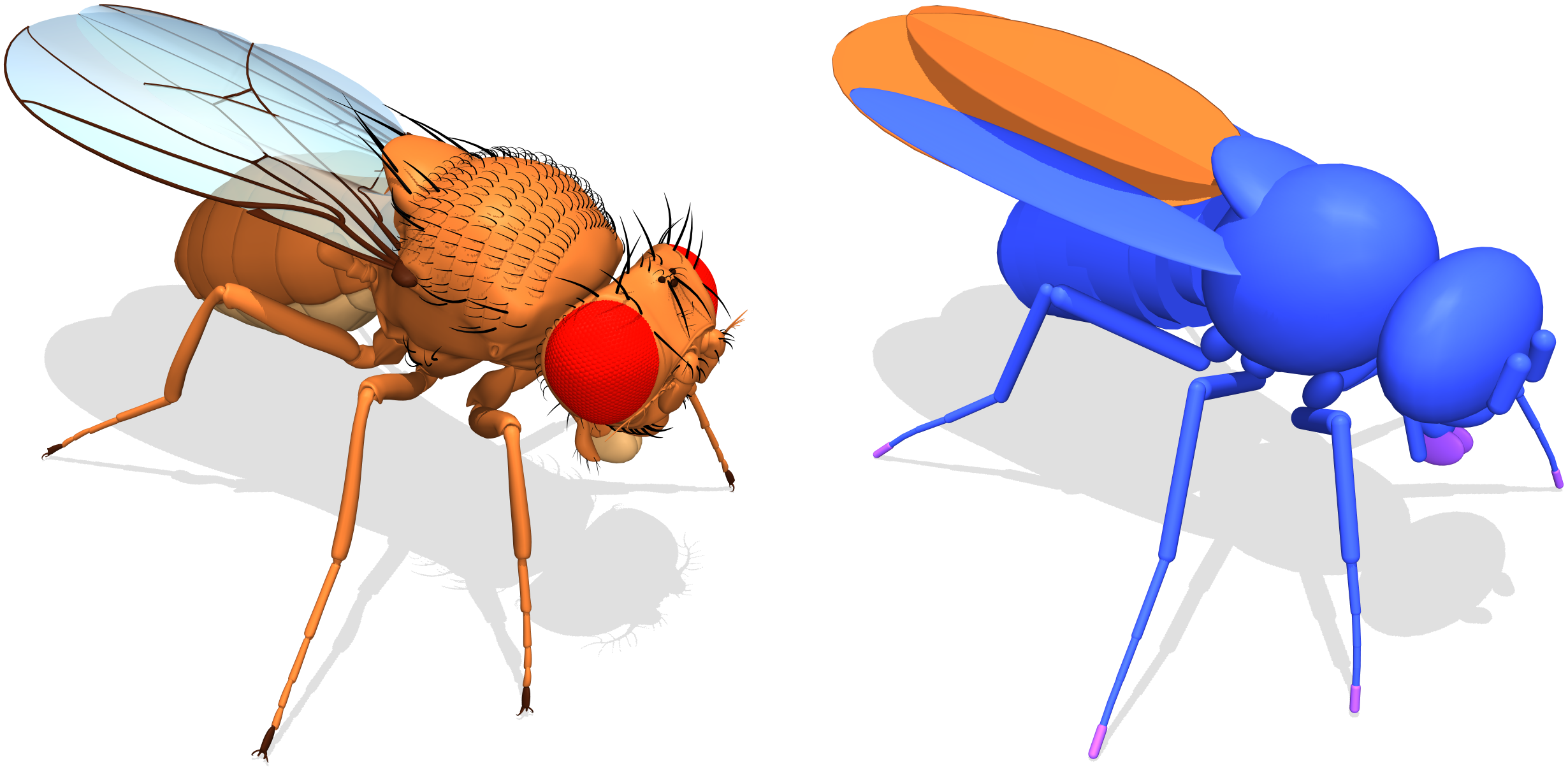
flybody is an anatomically-detailed body model of the fruit fly Drosophila melanogaster for MuJoCo physics simulator and reinforcement learning applications.

The fly model was developed in a collaborative effort by Google DeepMind and HHMI Janelia Research Campus.

We envision our model as a platform for fruit fly biophysics simulations and for modeling neural control of sensorimotor behavior in an embodied context; see our accompanying publication.

Getting Started

The fruit fly body model lives in this directory. To visualize it, you can drag-and-drop fruitfly.xml or floor.xml to MuJoCo's simulate viewer.

Interacting with the fly via Python is as simple as:

import numpy as np
import mediapy

from flybody.fly_envs import walk_imitation

# Create walking imitation environment.
env = walk_imitation()

# Run environment loop with random actions for a bit.
for _ in range(100):
   action = np.random.normal(size=59)  # 59 is the walking action dimension.
   timestep = env.step(action)

# Generate a pretty image.
pixels = env.physics.render(camera_id=1)
mediapy.show_image(pixels)

The quickest way to get started with flybody is to take a look at a tutorial notebook or .

Also, this notebook shows examples of the flight, walking, and vision-guided flight RL task environments.

To train the fly, try the distributed RL training script, which uses Ray to parallelize the DMPO agent training.

Installation

Follow these steps to install flybody:

Option 1: Installation from cloned local repo

  1. Clone this repo and create a new conda environment:

    git clone https://github.com/TuragaLab/flybody.git
    cd flybody
    conda create --name flybody -c conda-forge python=3.10 pip ipython cudatoolkit=11.8.0
    conda activate flybody
    

    flybody can be installed in one of the three modes described next. Also, for installation in editable (developer) mode, use the commands as shown. For installation in regular, not editable, mode, drop the -e flag.

  2. Core installation: minimal installation for experimenting with the fly model in MuJoCo or prototyping task environments. ML dependencies such as Tensorflow and Acme are not included and policy rollouts and training are not automatically supported.

    pip install -e .
    
  3. ML extension (optional): same as core installation, plus ML dependencies (Tensorflow, Acme) to allow running policy networks, e.g. for inference or for training using third-party agents not included in this library.

    pip install -e .[tf]
    
  4. Ray training extension (optional): same as core installation and ML extension, plus Ray to also enable distributed policy training in the fly task environments.

    pip install -e .[ray]
    

Option 2: Installation from remote repo

  1. Create a new conda environment:
    conda create --name flybody -c conda-forge python=3.10 pip ipython cudatoolkit=11.8.0
    conda activate flybody
    
    Proceed with installation in one of the three modes (described above):
  2. Core installation:
    pip install git+https://github.com/TuragaLab/flybody.git
    
  3. ML extension (optional):
    pip install "flybody[tf] @ git+https://github.com/TuragaLab/flybody.git"
    
  4. Ray training extension (optional):
    pip install "flybody[ray] @ git+https://github.com/TuragaLab/flybody.git"
    

Additional configuring

  1. You may need to set MuJoCo rendering environment varibles, e.g.:

    export MUJOCO_GL=egl
    export MUJOCO_EGL_DEVICE_ID=0
    
  2. Also, for the ML and Ray extensions, LD_LIBRARY_PATH may require an update, e.g.:

    CUDNN_PATH=$(dirname $(python -c "import nvidia.cudnn;print(nvidia.cudnn.__file__)"))
    export LD_LIBRARY_PATH=$LD_LIBRARY_PATH:$CONDA_PREFIX/lib/:$CUDNN_PATH/lib
    
  3. You may want to run pytest to test the main components of the flybody installation.

Citing flybody

See our accompanying publication. Thank you for your interest in our fly model:)

@article{flybody,
  title = {Whole-body physics simulation of fruit fly locomotion},
  author = {Roman Vaxenburg and Igor Siwanowicz and Josh Merel and Alice A Robie and
            Carmen Morrow and Guido Novati and Zinovia Stefanidi and Gert-Jan Both and
            Gwyneth M Card and Michael B Reiser and Matthew M Botvinick and
            Kristin M Branson and Yuval Tassa and Srinivas C Turaga},
  journal = {Nature},
  volume = {643},
  pages = {1312--1320},
  year = {2025},
  doi = {https://doi.org/10.1038/s41586-025-09029-4},
  url = {https://www.nature.com/articles/s41586-025-09029-4},
}
排名相邻
同类项目