HISTDATA - Dataset composed of all FX trading pairs / Crude Oil / Stock Indexes. Simple API to retrieve 1 Minute data (and tick data) Historical FX Prices (up to date).
Autonomously train research-agent LLMs on custom data using reinforcement learning and self-verification.
Key parameters and specifications
Key parameters and specifications
Parameter
Value
Language
Python
Category
Model Development
Subcategory
Architecture
Keywords
Computer vision
Stars
690
Forks
128
Contributors
4
Created date
2017-09-26
Updated date
2026-07-20
Stars in 1 day
0
Stars in 7 days
0
Rank
14,957
Previous rank
14,788
Rank change
-169
7-day stars rank
14,738
Previous 7-day stars rank
14,749
7-day stars rank change
11
Total stars rank
15,046
Previous total stars rank
15,021
Total stars rank change
-25
Country
USA
README summary
CondenseNets This repository contains the code (in PyTorch) for "CondenseNet: An Efficient DenseNet using Learned Group Convolutions" paper by Gao Huang\*, Shichen Liu\*, Laurens van der Maaten and Kilian Weinberger (* Authors contributed equally). Citation If you find our project useful in your research, please consider citing: Contents 1. Contacts Introduction CondenseNet is a novel, computationally efficient convolutional network architecture. It combines dense connectivity between layers with a mechanism to remove unused connections. The dense connectivity facilitates feature re-use in
the network, whereas learned group convolutions remove connections between layers for which this feature re-use is superfluous. Our experiments demonstrate that CondenseNets are much more efficient than other compact convolutional networks such as MobileNets and ShuffleNets. Figure 1: Learned Group Convolution with G=C=3. Figure 2: CondenseNets with Fully Dense Connectivity and Increasing Growth Rate. 0) ImageNet Train As an example, use the following command to train a CondenseNet on ImageNet As another example, use the following command
to train a CondenseNet on CIFAR-10 Evaluation We take the ImageNet model trained above as an example. To evaluate the trained model, use to evaluate from the default checkpoint directory: or use to evaluate from an arbitrary path: Note that these models are still the large models. To convert the model to group-convolution version as described in the paper, use the function: Finally, to directly load from a converted model (that is, a CondenseNet), use a **converted model
file** in combination with the option: Other Options We also include DenseNet implementation in this repository. For more examples of usage, please refer to script. sh For detailed options, please Results Results on ImageNet | Model | FLOPs | Params | Top-1 Err. 69M) | | CondenseNet-74 (C=G=8) | 274M | 2. 96 | | CondenseNet-74 (C=G=4) | 529M | 26. 89 | | CondenseNet-74 (C=G=8) | 274M | 29. com We are working on the implementation on other frameworks. Any discussions or concerns are welcomed
!
Frequently asked questions
How many stars and forks are recorded?
ShichenLiu/CondenseNet has 690 stars and 128 forks.
What is the repository rank?
ShichenLiu/CondenseNet is ranked 14,957.
What language and category are recorded?
ShichenLiu/CondenseNet has 690 stars, uses Python and belongs to Model Development.
Which repository is closest in rank?
ShichenLiu/CondenseNet is compared with maxpumperla/betago, ranked 14,959 with 690 stars.
If you find our project useful in your research, please consider citing:
@inproceedings{huang2018condensenet,
  title={Condensenet: An efficient densenet using learned group convolutions},
  author={Huang, Gao and Liu, Shichen and Van der Maaten, Laurens and Weinberger, Kilian Q},
  booktitle={Proceedings of the IEEE Conference on Computer Vision and Pattern Recognition},
  pages={2752--2761},
  year={2018}
}
CondenseNet is a novel, computationally efficient convolutional network architecture. It combines dense connectivity between layers with a mechanism to remove unused connections. The dense connectivity facilitates feature re-use in the network, whereas learned group convolutions remove connections between layers for which this feature re-use is superfluous. At test time, our model can be implemented using standard grouped convolutions —- allowing for efficient computation in practice. Our experiments demonstrate that CondenseNets are much more efficient than other compact convolutional networks such as MobileNets and ShuffleNets.
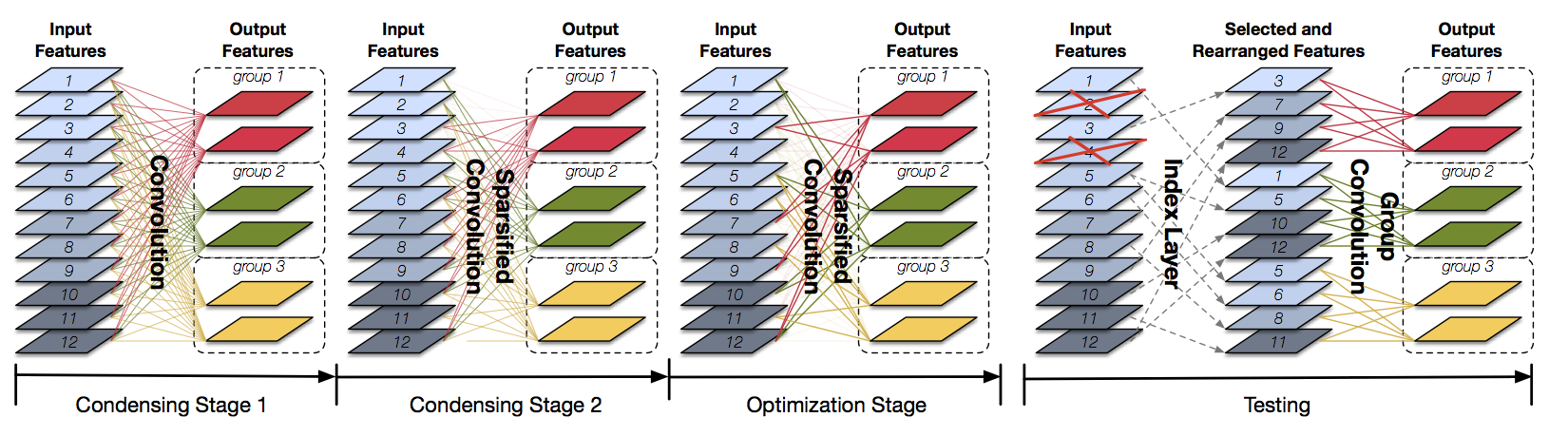
Figure 1: Learned Group Convolution with G=C=3.
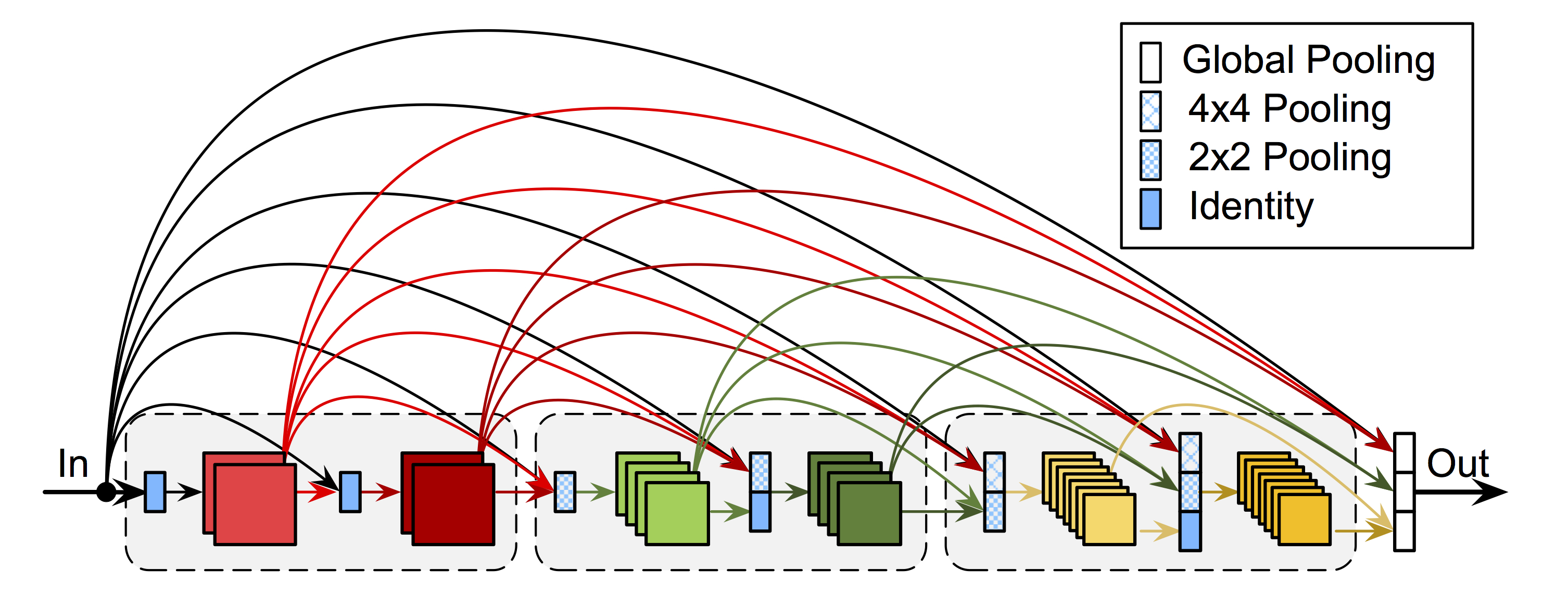
Figure 2: CondenseNets with Fully Dense Connectivity and Increasing Growth Rate.
Note that these models are still the large models. To convert the model to group-convolution version as described in the paper, use the convert-from function:
We also include DenseNet implementation in this repository.
For more examples of usage, please refer to script.sh
For detailed options, please python main.py --help