← Open Source
mit-acl

cadrl_ros

ROS package for dynamic obstacle avoidance for ground robots trained with deep RL.

Model DevelopmentReinforcement LearningPython
Open on GitHub
Momentum
+0stars in 24 hours0.0%
725
Stars
158
Forks
+0
This week
2
Contributors
Created 2018-03-03 · Updated 2026-10-08 · #14512 today
Top developers
mfe7blutjens

mit-acl/cadrl_ros is ranked 14,512 with 725 stars.

Same-category comparison

mit-acl/cadrl_ros is ranked 14,512 among these 8 peers; lucidrains/x-clip is ranked 14,511.

Same-category comparison
NameRankMetrics
ansleliu/LightNet14,504
Language:
Python
Stars:
725
Forks:
174
Description:
LightNet: Light-weight Networks for Semantic Image Segmentation (Cityscapes and Mapillary Vistas Dataset).
hongsukchoi/Pose2Mesh_RELEASE14,507
Language:
Python
Stars:
725
Forks:
72
Description:
Official Pytorch implementation of "Pose2Mesh: Graph Convolutional Network for 3D Human Pose and Mesh Recovery from a 2D Human Pose", ECCV 2020.
inception-project/inception14,508
Language:
Java
Stars:
725
Forks:
171
Description:
INCEpTION provides a semantic annotation platform offering intelligent annotation assistance and knowledge management.
lucidrains/x-clip14,511
Language:
Python
Stars:
725
Forks:
48
Description:
A concise but complete implementation of CLIP with various experimental improvements from recent papers.
ThibaultGROUEIX/AtlasNet14,516
Language:
Python
Stars:
724
Forks:
121
Description:
This repository contains the source codes for the paper "AtlasNet: A Papier-Mâché Approach to Learning 3D Surface Generation ". The network is able to synthesize a mesh (point cloud + connectivity) from a low-resolution point cloud, or from an image.
flymin/MagicDrive-V214,519
Language:
Python
Stars:
724
Forks:
28
Description:
[ICCV 2025] Official implementation of the paper “MagicDrive-V2: High-Resolution Long Video Generation for Autonomous Driving with Adaptive Control”.
ishikota/PyPokerEngine14,522
Language:
Python
Stars:
724
Forks:
203
Description:
Poker engine for poker AI development in Python.
jayroxis/PINNs14,523
Language:
Jupyter Notebook
Stars:
724
Forks:
179
Description:
PyTorch Implementation of Physics-informed Neural Networks.
Key parameters and specifications
ParameterValue
LanguagePython
CategoryModel Development
SubcategoryReinforcement Learning
KeywordsAutonomous vehicles, RL, Robotics
Stars725
Forks158
Contributors2
Created date2018-03-03
Updated date2026-10-08
Stars in 1 day0
Stars in 7 days0
Rank14,512
Previous rank14,356
Rank change-156
7-day stars rank14,513
Previous 7-day stars rank14,526
7-day stars rank change13
Total stars rank14,471
Previous total stars rank14,440
Total stars rank change-31
CountryUSA
README summary

cadrl_ros (Collision Avoidance with Deep RL) ROS implementation of a dynamic obstacle avoidance algorithm trained with Deep RL Paper: M. How, "Motion Planning Among Dynamic, Decision-Making Agents with Deep Reinforcement Learning", IEEE/RSJ International Conference on Intelligent Robots and Systems (IROS), 2018 Paper: Video: Bibtex: Dependencies: TensorFlow is required (tested with version 1. 0) numpy is required ROS is optional (tested with Kinetic on Ubuntu 16. 04) ford_msgs if you're using ROS, for our custom msg definitions
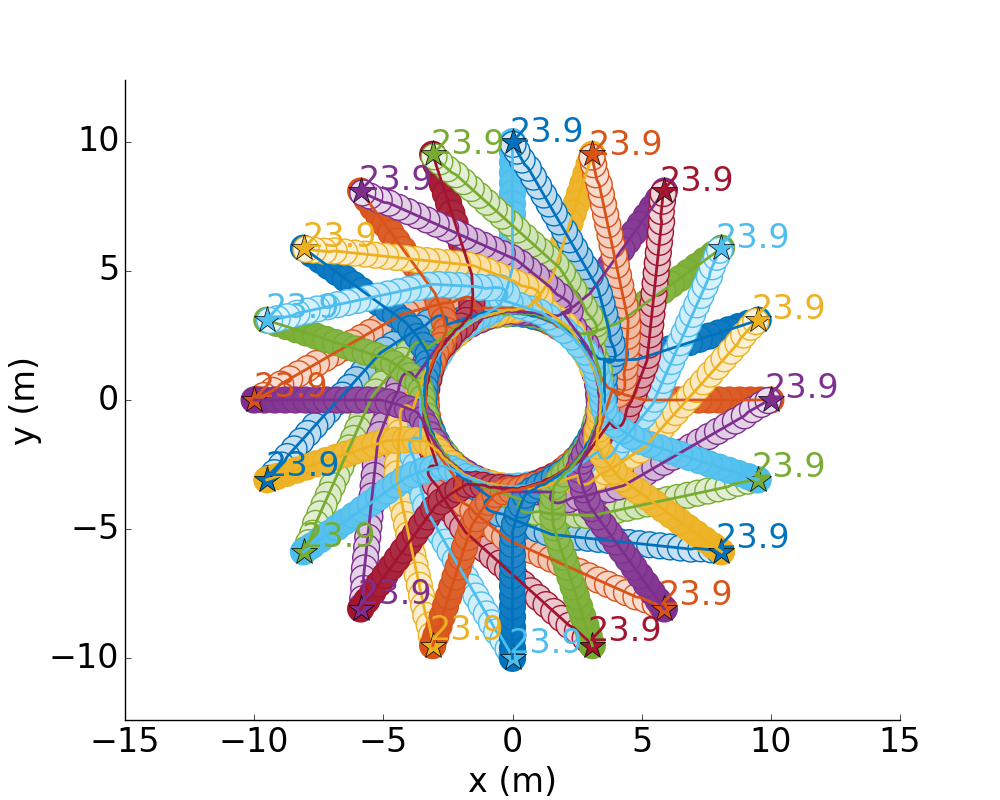
. General Notes: The main contribution of this software is the file and trained model parameters (TensorFlow checkpoints). Those contain the policy as reported in our paper and enables other reasearchers to easily compare future algorithms. To make it easy to understand the flow of the code, we provide an example in , in the form of a Jupyter notebook. This can be used just as a reference, but if you want to edit the file, make sure Jupyter is installed in

your tensorflow virtualenv to be sure it will work. To Run Jupyter Notebook (minimum working example of algorithm) This assumes you have installed already. Might work with regular docker with minor changes. That will start an instance of the docker container, and output a Jupyter notebook URL. Copy the URL into a browser, navigate to and open . Tensorflow and other deps are already installed in the docker container you just built, so the notebook should "just work. " ROS Notes: We

also provide a ROS implementation that we tested on a Clearpath Jackal ground robot. This node is just one module of the software required for autonomous navigation among dynamic obstacles, and much of it is written as to integrate with our system. The ROS node as written may not be particularly useful for other systems, but should provide an example of how one might connect the modules to test our learned collision avoidance policy on hardware. For example, other systems

likely have different representation formats for dynamic obstacles as extracted from their perception system, but it should be straightforward to just replace our method with another one, as long as the same information makes it into the state vector when the policy is queried. We recommend looking at the Jupyter notebook first. The algorithm was trained with goals set to be <10m from the agent's start position, so it would be necessary to provide this system with local subgoals if

it were to be tested in a long journey. For short distances, say in an open atrium, this is probably not necessary. Please find the files in this Dropbox folder, along with instructions for use. The test cases used in the paper are posted in this Dropbox folder. These contain initial positions, goal positions, preferred speed, radius settings for each test case, and are separated by number of agents. They were randomly generated in a way to produce reasonably interesting

scenarios to evaluate the algorithms, but since they are random, some may be really easy or boring. Primary code maintainer

Frequently asked questions

How many stars and forks are recorded?

mit-acl/cadrl_ros has 725 stars and 158 forks.

What is the repository rank?

mit-acl/cadrl_ros is ranked 14,512.

What language and category are recorded?

mit-acl/cadrl_ros has 725 stars, uses Python and belongs to Model Development.

Which repository is closest in rank?

mit-acl/cadrl_ros is compared with lucidrains/x-clip, ranked 14,511 with 725 stars.

README

cadrl_ros (Collision Avoidance with Deep RL)

ROS implementation of a dynamic obstacle avoidance algorithm trained with Deep RL

Paper:

M. Everett, Y. Chen, and J. P. How, "Motion Planning Among Dynamic, Decision-Making Agents with Deep Reinforcement Learning", IEEE/RSJ International Conference on Intelligent Robots and Systems (IROS), 2018

Paper: https://arxiv.org/abs/1805.01956 Video: https://www.youtube.com/watch?v=XHoXkWLhwYQ

Bibtex:

@inproceedings{Everett18_IROS,
  address = {Madrid, Spain},
  author = {Everett, Michael and Chen, Yu Fan and How, Jonathan P.},
  booktitle = {IEEE/RSJ International Conference on Intelligent Robots and Systems (IROS)},
  date-modified = {2018-10-03 06:18:08 -0400},
  month = sep,
  title = {Motion Planning Among Dynamic, Decision-Making Agents with Deep Reinforcement Learning},
  year = {2018},
  url = {https://arxiv.org/pdf/1805.01956.pdf},
  bdsk-url-1 = {https://arxiv.org/pdf/1805.01956.pdf}
}

Dependencies:

  • TensorFlow is required (tested with version 1.4.0)

  • numpy is required

  • ROS is optional (tested with Kinetic on Ubuntu 16.04)

  • ford_msgs if you're using ROS, for our custom msg definitions.

General Notes:

The main contribution of this software is the network.py file and trained model parameters (TensorFlow checkpoints). Those contain the policy as reported in our paper and enables other reasearchers to easily compare future algorithms.

To make it easy to understand the flow of the code, we provide an example in scripts/ga3c_cadrl_demo.ipynb, in the form of a Jupyter notebook. This can be used just as a reference, but if you want to edit the file, make sure Jupyter is installed in your tensorflow virtualenv to be sure it will work.

To Run Jupyter Notebook (minimum working example of algorithm)

This assumes you have nvidia-docker installed already. Might work with regular docker with minor changes.

git clone git@github.com/mfe7/cadrl_ros
./cadrl_ros/docker/build_docker.sh
./cadrl_ros/docker/run_docker.sh

That will start an instance of the docker container, and output a Jupyter notebook URL. Copy the URL into a browser, navigate to cadrl_ros/scripts and open ga3c_cadrl_demo.ipynb.

Tensorflow and other deps are already installed in the docker container you just built, so the notebook should "just work."

ROS Notes:

We also provide a ROS implementation that we tested on a Clearpath Jackal ground robot. This node is just one module of the software required for autonomous navigation among dynamic obstacles, and much of it is written as to integrate with our system. The ROS node as written may not be particularly useful for other systems, but should provide an example of how one might connect the modules to test our learned collision avoidance policy on hardware. For example, other systems likely have different representation formats for dynamic obstacles as extracted from their perception system, but it should be straightforward to just replace our cbClusters method with another one, as long as the same information makes it into the state vector when the policy is queried. We recommend looking at the Jupyter notebook first.

The algorithm was trained with goals set to be <10m from the agent's start position, so it would be necessary to provide this system with local subgoals if it were to be tested in a long journey. For short distances, say in an open atrium, this is probably not necessary.

To Run ROS version:

Clone and build this repo and its dependency (assume destination is ~/catkin_ws/src)

cd ~/catkin_ws/src
git clone git@github.com/mfe7/cadrl_ros
git clone git@bitbucket.org:acl-swarm/ford_msgs.git -b dev
cd ~/catkin_ws && catkin_make

Connect inputs/outputs of your system to launch/cadrl_node.launch

Subscribed Topics:
Published Topics:
  • ~nn_cmd_vel [geometry_msgs/Twist] Robot's commanded twist (linear, angular speed) according to network's output

  • The other published topics are just markers for visualization

    • ~pose_marker shows yellow rectangle at position according to ~pose
    • ~path_marker shows red trajectory according to history of ~pose
    • ~goal_path_marker shows blue arrow pointing toward position of commanded velocity 1 second into future
    • ~agent_markers shows orange cylinders at the positions/sizes of nearby agents
  • TODO: remove other_agents_marker, other_vels

Parameters:
  • ~jackal_speed Robot's preferred speed (m/s) - tested below 1.2m/s (and trained to be optimized near this speed)

Datasets:

As mentioned in the paper, we provide a few datasets that might be useful to researchers hoping to train NNs for collision avoidance. Please find the files in this Dropbox folder, along with instructions for use.

The test cases used in the paper are posted in this Dropbox folder. These contain initial positions, goal positions, preferred speed, radius settings for each test case, and are separated by number of agents. They were randomly generated in a way to produce reasonably interesting scenarios to evaluate the algorithms, but since they are random, some may be really easy or boring.

Primary code maintainer:

Michael Everett (https://github.com/mfe7)

Nearby in the ranking
Similar items