
Multi-layer text annotation with knowledge-base entity linking and machine-assisted suggestions.


[Homepage](https://inception-project.github.io/) ·
[Usage](https://inception-project.github.io/documentation/latest/user-guide) ·
[Demo](https://morbo.ukp.informatik.tu-darmstadt.de/demo)  ·
[FAQ](https://inception-project.github.io/documentation/latest/user-guide#sect_faq)

INCEpTION
Build annotated text corpora with your own annotation scheme, ground them in your own ontology, and let a recommender that learns as you go do the repetitive part.
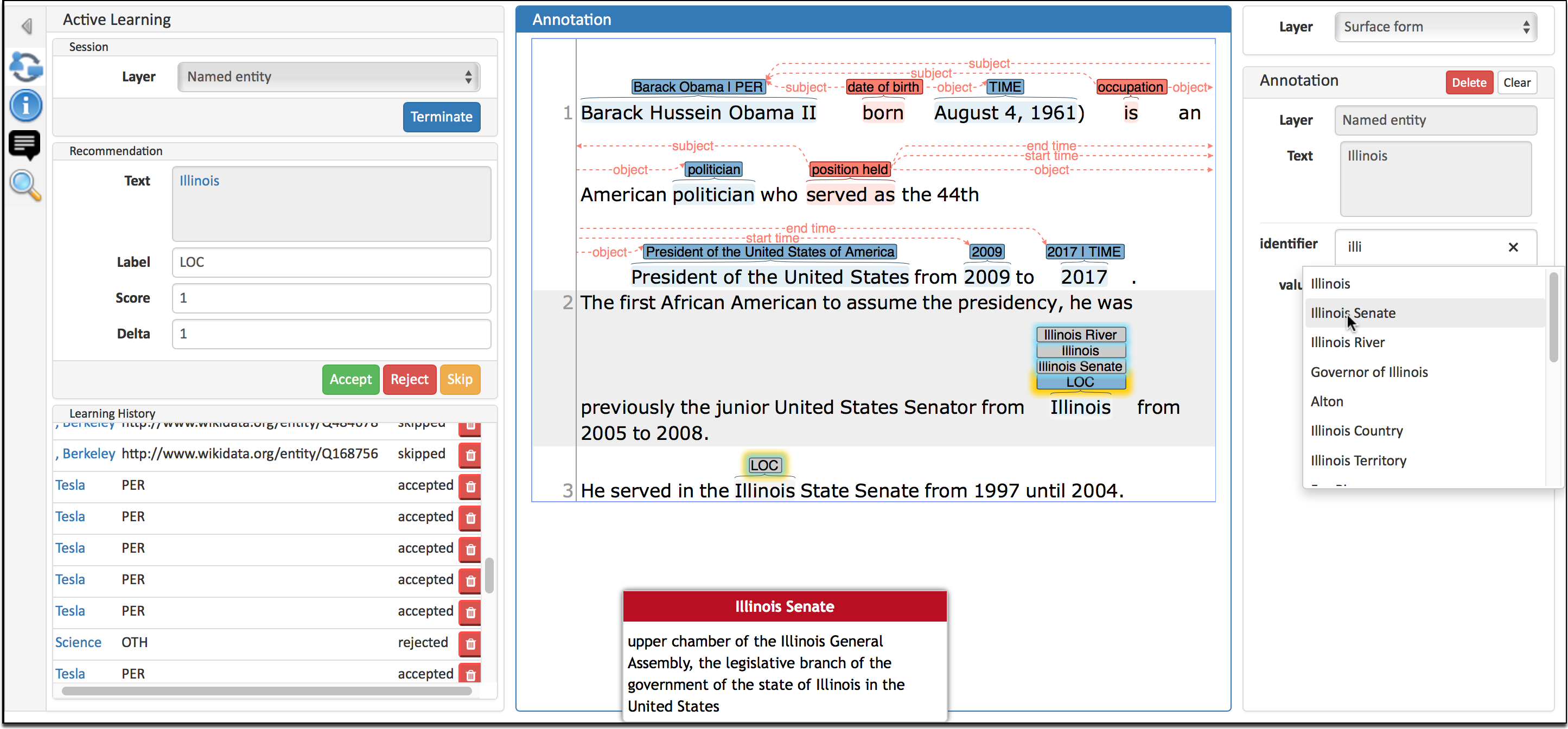
- Annotate against your ontology. Load RDF, OWL, OBO, SKOS or Turtle, or query a remote SPARQL endpoint live. Profiles for Wikidata, SNOMED CT, the Gene Ontology, the Human Phenotype Ontology and GND.
- Stack as many layers as your scheme needs. Entities, relations, coreference, syntax, frames and document labels over the same text, with typed features and slots. Define it all in the browser.
- Get suggestions that improve while you work. Recommenders train on what you have annotated so far; active learning asks about the cases they are least sure of. Nothing is stored until you accept it.
- Know your annotations are good. Curate several annotators into a gold standard, measure inter-annotator agreement, and chart what you collected in the Explorer.
- Runs where you need it to run. A desktop installer for one person, or a server deployment for a whole institution — on your own hardware, with your own single sign-on.
- Drive it from your own code. REST API, webhooks, and your own models as external recommenders.
- Speaks your field's formats. Imports plain text, PDF, HTML and TEI; exports UIMA CAS XMI/JSON with custom layers intact, or CoNLL-U.
More detail, screenshots and example projects are on the INCEpTION website.
Getting started
The best way to get started is to watch our tutorial videos, working through the Getting Started Guide and playing with INCEpTION on the demo server.
Documentation
- User Guide — using INCEpTION.
- Admin Guide — installing and running it for a group of users.
- Developer Guide — building and extending it.
Example projects and use cases are on the website, along with Python scripts and Jupyter notebooks for preparing and post-processing annotations.
Do you have questions or feedback?
INCEpTION is actively developed and maintained, and you are welcome to give us feedback and tell us your wishes and requirements.
- Ask on our Google group inception-users.
- Open an issue on GitHub.
How to cite
Please use the following citation:
@inproceedings{klie-etal-2018-inception,
    title = "The {INCE}p{TION} Platform: Machine-Assisted and Knowledge-Oriented Interactive Annotation",
    author = "Klie, Jan-Christoph and Bugert, Michael  and Boullosa, Beto and Eckart de Castilho, Richard and Gurevych, Iryna",
    booktitle = "Proceedings of the 27th International Conference on Computational Linguistics: System Demonstrations",
    year = "2018",
    address = "Santa Fe, New Mexico",
    url = "https://www.aclweb.org/anthology/C18-2002",
    pages = "5--9"
}
Contributing
Do you miss a feature? We very much appreciate your contribution! Please open an issue before sending a pull request. INCEpTION uses the DKPro Contribution Guidelines.
- Create a fork
- Create your feature branch:
git checkout -b my-feature - Commit your changes:
git commit -am 'Add some feature' - Push to the branch:
git push origin my-new-feature - Submit a pull request 🚀
License
INCEpTION is provided as open source under the Apache License v2.0.


