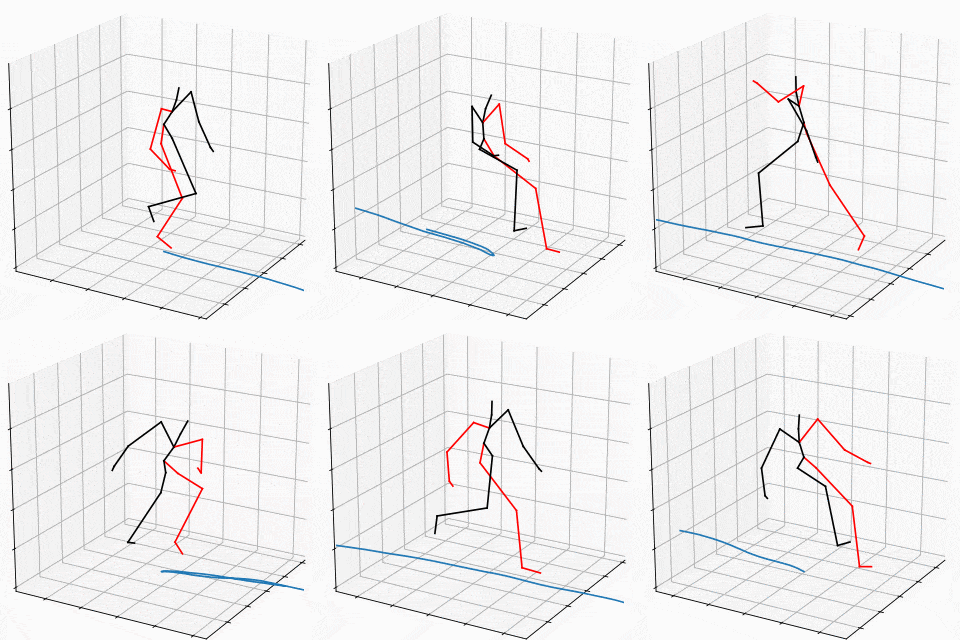
QuaterNet: A Quaternion-based Recurrent Model for Human Motion This is the implementation of the approach described in the paper: Dario Pavllo, David Grangier, and Michael Auli. QuaterNet: A Quaternion-based Recurrent Model for Human Motion. In *British Machine Vision Conference (BMVC)*, 2018. We provide the code for reproducing our results (*short-term prediction*) and generating/rendering locomotion animations (*long-term generation*), as well as pre-trained models. Abstract Deep learning for predicting or generating 3D human pose sequences is
an active research area. Previous work regresses either joint rotations or joint positions. The former strategy is prone to error accumulation along the kinematic chain, as well as discontinuities when using Euler angle or exponential map parameterizations. The latter requires re-projection onto skeleton constraints to avoid bone stretching and invalid configurations. Our recurrent network, *QuaterNet*, represents rotations with quaternions and our loss function performs forward kinematics on a skeleton to penalize absolute position errors instead of angle errors. On
short-term predictions, *QuaterNet* improves the state-of-the-art quantitatively. For long-term generation, our approach is qualitatively judged as realistic as recent neural strategies from the graphics literature. Dependencies Python 3+ distribution PyTorch >= 0. 0 NumPy and SciPy Optional: Matplotlib, if you want to render and display interactive animations. Additionally, you need *ffmpeg* to export MP4 videos, and *imagemagick* to export GIFs. A decent GPU, if you want to train the models in reasonable time. If you plan
on testing the pretrained models, the CPU is fine. The scripts detect automatically if a GPU is available. If you want to force CPU training/generation, you can set the environment variable to an empty value. Within bash, you can limit its scope to a single command by calling . Short-term prediction If you want to train the model from scratch, you have to run the download script first: This will download the Human3. 6M dataset, convert it to our
encoding, and save it in . Then, train the model and test it: If you use the pre-trained model you don't need to download the dataset and you can run the test script directly. Make sure that is in the same directory as the script. The script reproduces the *zero-velocity baseline*, and should yield the same results as Martinez et al. Long-term generation of locomotion For locomotion we rely on Holden's et al. 6M, as the former contains
a wider variety of motion. As before, if you want to train the models yourself instead of using the pretrained ones, download and convert the dataset by launching: The data will be saved in . Then, you have to train the *pace network* and *pose network* separately: If your system has more than one GPU, you can save time by training all models in parallel: Once you have the weight files and in place, take a look at the notebook , which
shows how to render an animation. The script performs predictions across the entire dataset and shows them on an interactive
Frequently asked questions
How many stars and forks are recorded?
facebookresearch/QuaterNet has 709 stars and 85 forks.
What is the repository rank?
facebookresearch/QuaterNet is ranked 14,717.
What language and category are recorded?
facebookresearch/QuaterNet has 709 stars, uses Jupyter Notebook and belongs to Model Development.
Which repository is closest in rank?
facebookresearch/QuaterNet is compared with chainer/chainer-chemistry, ranked 14,715 with 709 stars.
README
QuaterNet: A Quaternion-based Recurrent Model for Human Motion
This is the implementation of the approach described in the paper:
We provide the code for reproducing our results (short-term prediction) and generating/rendering locomotion animations (long-term generation), as well as pre-trained models.
Abstract
Deep learning for predicting or generating 3D human pose sequences is an active research area. Previous work regresses either joint rotations or joint positions. The former strategy is prone to error accumulation along the kinematic chain, as well as discontinuities when using Euler angle or exponential map parameterizations. The latter requires re-projection onto skeleton constraints to avoid bone stretching and invalid configurations. This work addresses both limitations. Our recurrent network, QuaterNet, represents rotations with quaternions and our loss function performs forward kinematics on a skeleton to penalize absolute position errors instead of angle errors. On short-term predictions, QuaterNet improves the state-of-the-art quantitatively. For long-term generation, our approach is qualitatively judged as realistic as recent neural strategies from the graphics literature.
Dependencies
Python 3+ distribution
PyTorch >= 0.4.0
NumPy and SciPy
Optional:
Matplotlib, if you want to render and display interactive animations. Additionally, you need ffmpeg to export MP4 videos, and imagemagick to export GIFs.
A decent GPU, if you want to train the models in reasonable time. If you plan on testing the pretrained models, the CPU is fine.
The scripts detect automatically if a GPU is available. If you want to force CPU training/generation, you can set the CUDA_VISIBLE_DEVICES environment variable to an empty value. Within bash, you can limit its scope to a single command by calling CUDA_VISIBLE_DEVICES= python .
Short-term prediction
If you want to train the model from scratch, you have to run the download script first:
python prepare_data_short_term.py
This will download the Human3.6M dataset, convert it to our encoding, and save it in datasets/dataset_h36m.npz.
Then, train the model and test it:
If you use the pre-trained model you don't need to download the dataset and you can run the test script directly. Make sure that weights_short_term.bin is in the same directory as the script.
The script baseline_short_term.py reproduces the zero-velocity baseline, and should yield the same results as Martinez et al. 2017.
Long-term generation of locomotion
For locomotion we rely on Holden's et al. dataset instead of Human3.6M, as the former contains a wider variety of motion. As before, if you want to train the models yourself instead of using the pretrained ones, download and convert the dataset by launching:
python prepare_data_long_term.py
The data will be saved in datasets/dataset_locomotion.npz. Then, you have to train the pace network and pose network separately:
Once you have the weight files weights_pace_network.bin and weights_long_term.bin in place, take a look at the notebook visualization.ipynb, which shows how to render an animation. The script test_long_term.py performs predictions across the entire dataset and shows them on an interactive 3D plot. You can also generate animations in an offline fashion and export them as MP4 videos or GIFs.
python test_long_term.py: visualize all animations interactively (GUI).
python test_long_term.py --list: list the animations in the dataset.
python test_long_term.py run_1_d0: visualize the animation run_1_d0 interactively (GUI).
python test_long_term.py run_1_d0 output.mp4: render run_1_d0 and save it as output.mp4.
python test_long_term.py run_1_d0 output.gif: render run_1_d0 and save it as output.gif.
Expected training/generation time
NVIDIA Pascal GP100 (Quadro GP100, Tesla P100):
Short-term pose network: 22 min for 3000 epochs (0.44 s/epoch), batch size = 60
Long-term pose network: 2h 10 min for 4000 epochs (1.95 s/epoch), batch size = 40
Pace network: 10 min for 2000 epochs (0.3 s/epoch), batch size = 40
Short-term pose network: 32 min for 3000 epochs (0.64 s/epoch), batch size = 60
Long-term pose network: 2h 45 min for 4000 epochs (2.5 s/epoch), batch size = 40
Pace network: 10 min for 2000 epochs (0.3 s/epoch), batch size = 40
Generation: 820 FPS, batch size = 1
Pre-trained models
You can download them from the Releases section of this repository. You only need to put the weight files weights_pace_network.bin, weights_long_term.bin, and weights_short_term.bin in the root directory.
License
This work is licensed under CC BY-NC. See LICENSE for details. Third-party datasets are subject to their respective licenses.
If you use our code/models in your research, please cite our paper:
@inproceedings{pavllo:quaternet:2018,
  title={QuaterNet: A Quaternion-based Recurrent Model for Human Motion},
  author={Pavllo, Dario and Grangier, David and Auli, Michael},
  booktitle={British Machine Vision Conference (BMVC)},
  year={2018}
}