Diffusion-GAN — Official PyTorch implementation
Diffusion-GAN: Training GANs with Diffusion
Zhendong Wang, Huangjie Zheng, Pengcheng He, Weizhu Chen and Mingyuan Zhou
https://arxiv.org/abs/2206.02262
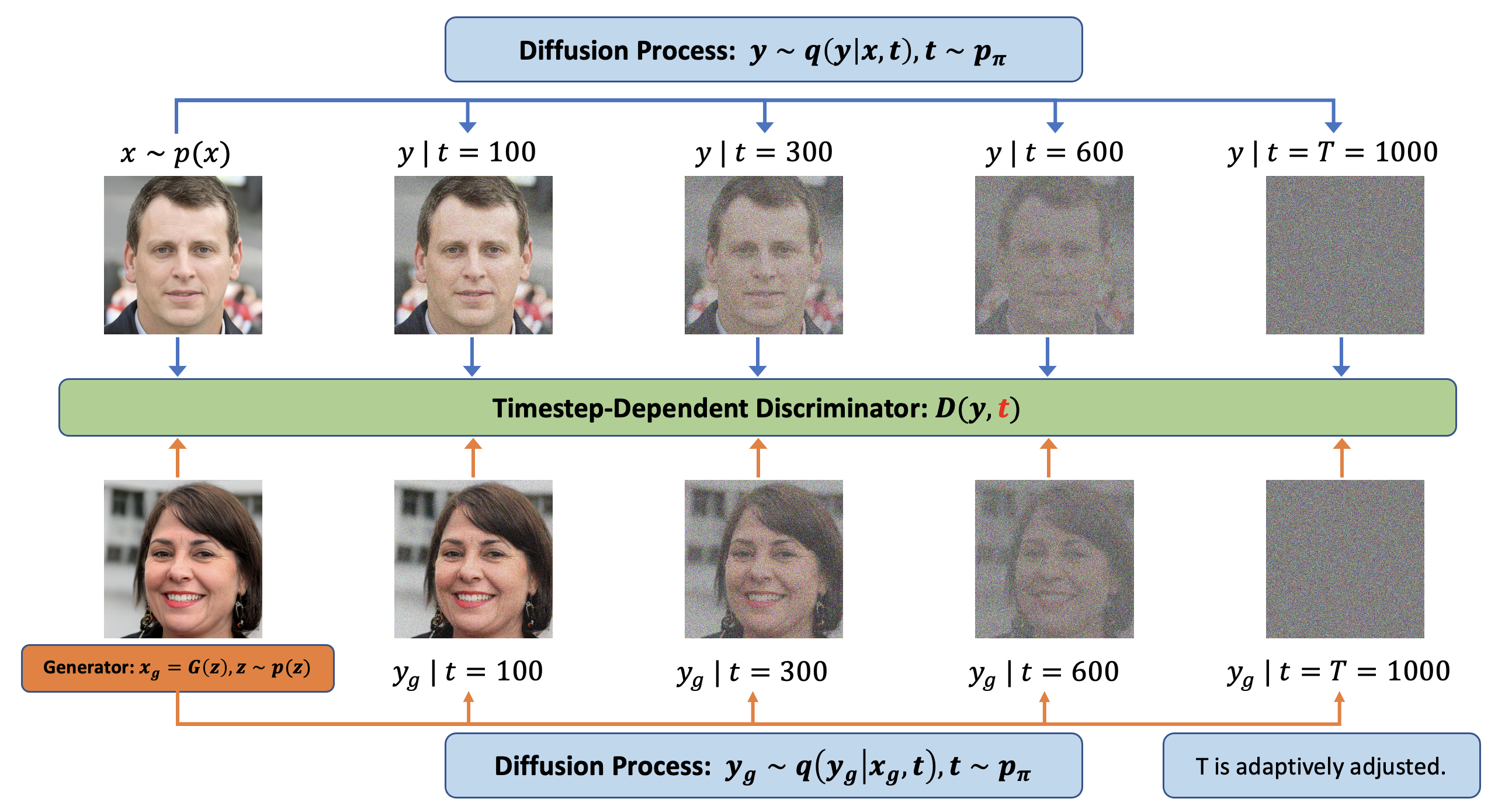
Abstract: For stable training of generative adversarial networks (GANs), injecting instance noise into the input of the discriminator is considered as a theoretically sound solution, which, however, has not yet delivered on its promise in practice. This paper introduces Diffusion-GAN that employs a Gaussian mixture distribution, defined over all the diffusion steps of a forward diffusion chain, to inject instance noise. A random sample from the mixture, which is diffused from an observed or generated data, is fed as the input to the discriminator. The generator is updated by backpropagating its gradient through the forward diffusion chain, whose length is adaptively adjusted to control the maximum noise-to-data ratio allowed at each training step. Theoretical analysis verifies the soundness of the proposed Diffusion-GAN, which provides model- and domain-agnostic differentiable augmentation. A rich set of experiments on diverse datasets show that DiffusionGAN can provide stable and data-efficient GAN training, bringing consistent performance improvement over strong GAN baselines for synthesizing photorealistic images.


ToDos
- [x] Initial code release
- [x] Providing pretrained models
Build your Diffusion-GAN
Here, we explain how to train general GANs with diffusion. We provide two ways: a. plug-in as simple as a data augmentation method; b. training GANs on diffusion chains with a timestep-dependent discriminator. Currently, we didn't find significant empirical differences of the two approaches, while the second approach has stronger theoretical guarantees. We suspect when advanced timestep-dependent structure is applied in the discriminator, the second approach could become better, and we left that for future study.
Simple Plug-in
- Design a proper diffusion process based on the
diffusion.py(example) file - Apply diffusion on the inputs of discriminators,
logits = Discriminator(Diffusion(gen/real_images)) - Add adaptiveness of diffusion into your training iterations
if update_diffusion:  # batch_idx % ada_interval == 0
    adjust = np.sign(sign(Discriminator(real_images)) - ada_target) * C  # C = (batch_size * ada_interval) / (ada_kimg * 1000)
    diffusion.p = (diffusion.p + adjust).clip(min=0., max=1.)
    diffusion.update_T()
Full Version
- Add diffusion timestep
tas an input for discriminatorslogits = Discriminator(images, t). You may need some modifications in your discriminator architecture. - The other steps are the same as Simple Plug-in. Note that since discriminator depends on timesteps,
you need to collect
t.
diffused_images, t = Diffusion(images)
logits = Discrimnator(diffused_images, t)
Train our Diffusion-GAN
Requirements
In each folder, we provide a environment.yml for preparing the running environments. Note here to fit newest PyTorch versions, I made some change in torch_utils folder. The performance might have some small perturbations due to different versions of PyTorch. The provided checkpoints were trained on old environment inherited from StyleGAN2-ADA, and the old environment is detailed as follows:
- 64-bit Python 3.7 and PyTorch 1.7.1/1.8.1. See https://pytorch.org/ for PyTorch install instructions.
- CUDA toolkit 11.0 or later.
- Python libraries:
pip install click requests tqdm pyspng ninja imageio-ffmpeg==0.4.3.
Data Preparation
In our paper, we trained our model on CIFAR-10 (32 x 32), STL-10 (64 x 64), LSUN (256 x 256), AFHQ (512 x 512) and FFHQ (1024 x 1024). You can download the datasets we used in our paper at their respective websites. To prepare the dataset at the respective resolution, run for example
python dataset_tool.py --source=~/downloads/lsun/raw/bedroom_lmdb --dest=~/datasets/lsun_bedroom200k.zip \
    --transform=center-crop --width=256 --height=256 --max_images=200000

python dataset_tool.py --source=~/downloads/lsun/raw/church_lmdb --dest=~/datasets/lsun_church200k.zip \
    --transform=center-crop-wide --width=256 --height=256 --max_images=200000
Training
We show the training commands that we used below. In most cases, the training commands are similar, so below we use CIFAR-10 dataset as an example:
For Diffusion-GAN,
python train.py --outdir=training-runs --data="~/cifar10.zip" --gpus=4 --cfg cifar --kimg 50000 --aug no --target 0.6 --noise_sd 0.05 --ts_dist priority
For Diffusion-ProjectedGAN
python train.py --outdir=training-runs --data="~/cifar10.zip" --gpus=4 --batch 64 --batch-gpu=16 --cfg fastgan --kimg 50000 --target 0.45 --d_pos first --noise_sd 0.5
For Diffusion-InsGen
python train.py --outdir=training-runs --data="~/afhq-wild.zip" --gpus=8 --cfg paper512 --kimg 25000
We follows the config setting from StyleGAN2-ADA
and refer to them for more details. The other major hyperparameters are listed and discussed below:
--targetthe discriminator target, which balances the level of diffusion intensity.--augdomain-specific image augmentation, such as ADA and Differentiable Augmentation, which is used for evaluate complementariness with diffusion.--noise_sddiffusion noise standard deviation, which is set as 0.05 in our case.--ts_distt sampling distribution, $\pi(t)$ in paper.
We evaluated two t sampling distribution ['priority', 'uniform'],
where 'priority' denotes the Equation (11) in paper and 'uniform' denotes random sampling. In most cases, priority works slightly better, while in some cases, such as FFHQ,
'uniform' is better.
Sampling and Evaluation with our checkpoints
We provide our Diffusion-GAN checkpoints on our Hugging Face page. We copy and paste the links below for quick access.
| Model | Dataset | Resolution | FID | Checkpoint |
|---|---|---|---|---|
| Diffusion-StyleGAN2 | CIFAR-10 | 32x32 | 3.19 | download |
| Diffusion-StyleGAN2 | CelebA | 64x64 | 1.69 | download |
| Diffusion-StyleGAN2 | STL-10 | 64x64 | 11.53 | download |
| Diffusion-StyleGAN2 | LSUN-Bedroom | 256x256 | 3.65 | download |
| Diffusion-StyleGAN2 | LSUN-Church | 256x256 | 3.17 | download |
| Diffusion-StyleGAN2 | FFHQ | 1024x1024 | 2.83 | download |
| Diffusion-ProjectedGAN | CIFAR-10 | 32x32 | 2.54 | download |
| Diffusion-ProjectedGAN | STL-10 | 64x64 | 6.91 | download |
| Diffusion-ProjectedGAN | LSUN-Bedroom | 256x256 | 1.43 | download |
| Diffusion-ProjectedGAN | LSUN-Church | 256x256 | 1.85 | download |
| Diffusion-InsGen | AFHQ-Cat | 512x512 | 2.40 | download |
| Diffusion-InsGen | AFHQ-Dog | 512x512 | 4.83 | download |
| Diffusion-InsGen | AFHQ-Wild | 512x512 | 1.51 | download |
To generate samples, run the following commands:
# Generate FFHQ with pretrained Diffusion-StyleGAN2
python generate.py --outdir=out --seeds=1-100 \
    --network=https://tsciencescu.blob.core.windows.net/projectshzheng/DiffusionGAN/diffusion-stylegan2-ffhq.pkl

# Generate LSUN-Church with pretrained Diffusion-ProjectedGAN
python gen_images.py --outdir=out --seeds=1-100 \
    --network=https://tsciencescu.blob.core.windows.net/projectshzheng/DiffusionGAN/diffusion-projectedgan-lsun-church.pkl
The checkpoints can be replaced with any pre-trained Diffusion-GAN checkpoint path downloaded from the table above.
Similarly, the metrics can be calculated with the following commands:
# Pre-trained network pickle: specify dataset explicitly, print result to stdout.
python calc_metrics.py --metrics=fid50k_full --data=~/datasets/ffhq.zip --mirror=1 \
    --network=https://tsciencescu.blob.core.windows.net/projectshzheng/DiffusionGAN/diffusion-stylegan2-ffhq.pkl
Citation
@article{wang2022diffusiongan,
  title     = {Diffusion-GAN: Training GANs with Diffusion},
  author    = {Wang, Zhendong and Zheng, Huangjie and He, Pengcheng and Chen, Weizhu and Zhou, Mingyuan},
  journal   = {arXiv preprint arXiv:2206.02262},
  year      = {2022},
  url       = {https://arxiv.org/abs/2206.02262}
}
Acknowledgements
Our code builds upon the awesome StyleGAN2-ADA repo, InsGen repo and ProjectedGAN repo, respectively by Karras et al, Ceyuan Yang et al and Axel Sauer et al.