← Open Source
wohlert

semi-supervised-pytorch

Implementations of various VAE-based semi-supervised and generative models in PyTorch.

Model DevelopmentArchitecturePython
Open on GitHub
Momentum
+0stars in 24 hours0.0%
709
Stars
121
Forks
+0
This week
1
Contributors
Created 2017-09-28 · Updated 2026-05-21 · #14724 today
Top developers
wohlert

wohlert/semi-supervised-pytorch is ranked 14,724 with 709 stars.

Same-category comparison

wohlert/semi-supervised-pytorch is ranked 14,724 among these 8 peers; pymc-devs/pymc4 is ranked 14,721.

Same-category comparison
NameRankMetrics
chainer/chainer-chemistry14,715
Language:
Python
Stars:
709
Forks:
132
Description:
Chainer Chemistry: A Library for Deep Learning in Biology and Chemistry.
facebookresearch/QuaterNet14,717
Language:
Jupyter Notebook
Stars:
709
Forks:
85
Description:
Proposes neural networks that can generate animation of virtual characters for different actions.
kwsong0113/diffusion-forcing-transformer14,719
Language:
Python
Stars:
709
Forks:
41
Description:
[ICML 2025] Official PyTorch Implementation of "History-Guided Video Diffusion".
pymc-devs/pymc414,721
Language:
Jupyter Notebook
Stars:
709
Forks:
112
Description:
(Deprecated) Experimental PyMC interface for TensorFlow Probability. Official work on this project has been discontinued.
GoodStartLabs/AI_Diplomacy14,728
Language:
Python
Stars:
708
Forks:
99
Description:
Frontier Models playing the board game Diplomacy.
nv-tlabs/ChronoEdit14,734
Language:
Python
Stars:
708
Forks:
42
Description:
[ICLR 2026] ChronoEdit: Towards Temporal Reasoning for Image Editing and World Simulation.
taki0112/StarGAN-Tensorflow14,736
Language:
Python
Stars:
708
Forks:
154
Description:
Simple Tensorflow implementation of StarGAN (CVPR 2018 Oral).
BIGBALLON/CIFAR-ZOO14,737
Language:
Python
Stars:
707
Forks:
173
Description:
PyTorch implementation of CNNs for CIFAR benchmark.
Key parameters and specifications
ParameterValue
LanguagePython
CategoryModel Development
SubcategoryArchitecture
Stars709
Forks121
Contributors1
Created date2017-09-28
Updated date2026-05-21
Stars in 1 day0
Stars in 7 days0
Rank14,724
Previous rank14,569
Rank change-155
7-day stars rank14,622
Previous 7-day stars rank14,632
7-day stars rank change10
Total stars rank14,754
Previous total stars rank14,729
Total stars rank change-25
README summary

Semi-supervised PyTorch A PyTorch-based package containing useful models for modern deep semi-supervised learning and deep generative models. 17* - The Gumbel softmax notebook has been added to show how you can use discrete latent variables in VAEs. 28* - The β-VAE notebook was added to show how VAEs can learn disentangled representations. Semi-supervised learning tries to bridge the gap between supervised and unsupervised learning by learning from both labelled and unlabelled data. Semi-supervised learning can typically be

applied to areas where data is easy to get a hold of, but labelling is expensive. Normally, one would either use an unsupervised method, or just the few labelled examples - both of which would be likely to yield bad results. The current state-of-the-art method in semi-supervised learning achieves an accuracy of over 99% on the MNIST dataset using just **10 labelled examples per class**. Conditional generation Most semi-supervised models simultaneously train an inference network and

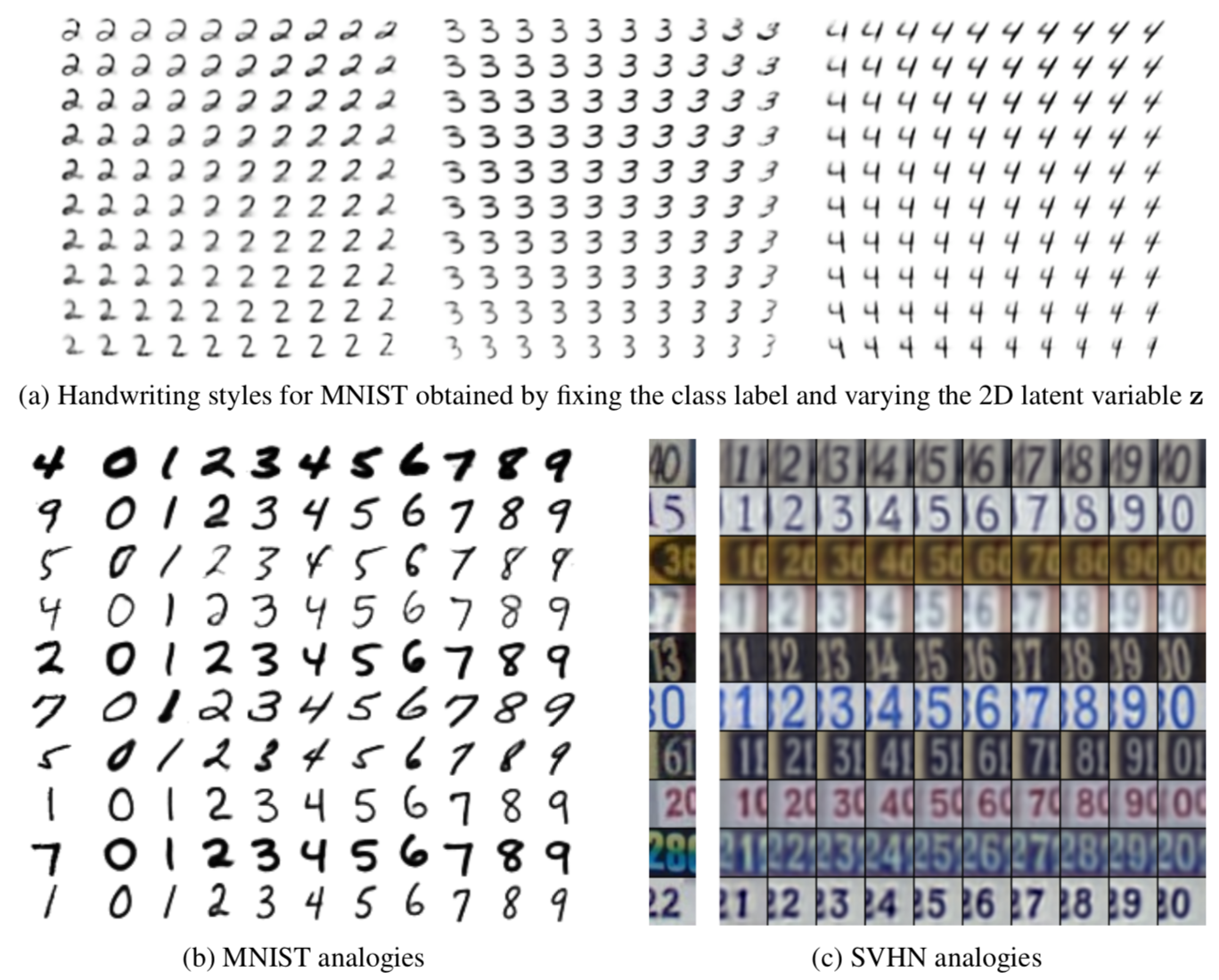
a generator network. This means that it is not only possible to query this models for classification, but also to generate new data from trained model. By seperating label information, one can generate a new sample with the given digit as shown in the image below from Kingma 2014. Implemented models and methods: Variational Autoencoder (Kingma 2013) Importance Weighted Autoencoders (Burda 2015) Variational Inference with Normalizing Flows (Rezende & Mohamed 2015) Semi-supervised Learning with Deep Generative Models (Kingma 2014) Auxiliary

Deep Generative Models (Maaløe 2016) Ladder Variational Autoencoders (Sønderby 2016) β-VAE (Higgins 2017)

Frequently asked questions

How many stars and forks are recorded?

wohlert/semi-supervised-pytorch has 709 stars and 121 forks.

What is the repository rank?

wohlert/semi-supervised-pytorch is ranked 14,724.

What language and category are recorded?

wohlert/semi-supervised-pytorch has 709 stars, uses Python and belongs to Model Development.

Which repository is closest in rank?

wohlert/semi-supervised-pytorch is compared with pymc-devs/pymc4, ranked 14,721 with 709 stars.

README

Semi-supervised PyTorch

A PyTorch-based package containing useful models for modern deep semi-supervised learning and deep generative models. Want to jump right into it? Look into the notebooks.

Latest additions

2018.04.17 - The Gumbel softmax notebook has been added to show how you can use discrete latent variables in VAEs. 2018.02.28 - The β-VAE notebook was added to show how VAEs can learn disentangled representations.

What is semi-supervised learning?

Semi-supervised learning tries to bridge the gap between supervised and unsupervised learning by learning from both labelled and unlabelled data.

Semi-supervised learning can typically be applied to areas where data is easy to get a hold of, but labelling is expensive. Normally, one would either use an unsupervised method, or just the few labelled examples - both of which would be likely to yield bad results.

The current state-of-the-art method in semi-supervised learning achieves an accuracy of over 99% on the MNIST dataset using just 10 labelled examples per class.

Conditional generation

Most semi-supervised models simultaneously train an inference network and a generator network. This means that it is not only possible to query this models for classification, but also to generate new data from trained model. By seperating label information, one can generate a new sample with the given digit as shown in the image below from Kingma 2014.
Implemented models and methods:

Nearby in the ranking
Similar items