[ECCV 2024 Accepted]Goldfish: Vision-Language Understanding of Arbitrarily Long Videos
[CVPR2024W]MiniGPT4-Video: Advancing Multimodal LLMs for Video Understanding with Interleaved Visual-Textual Tokens
This repo contains the codes for MiniGPT4-video for short video understanding and Goldfish for long video understanding.
Online Demos
[](https://goldfishdemo.loophole.site)

[Project Page](https://vision-cair.github.io/Goldfish_website/)
[📝 arXiv Paper](https://arxiv.org/abs/2407.12679)
[🤗 TVQA-Long Dataset](https://huggingface.co/datasets/Vision-CAIR/TVQA-Long/tree/main)
[](https://huggingface.co/spaces/Vision-CAIR/MiniGPT4-video)
[🎞️ Project Page](https://vision-cair.github.io/MiniGPT4-video/)
[📝 arXiv Paper](https://arxiv.org/abs/2404.03413)
Overview
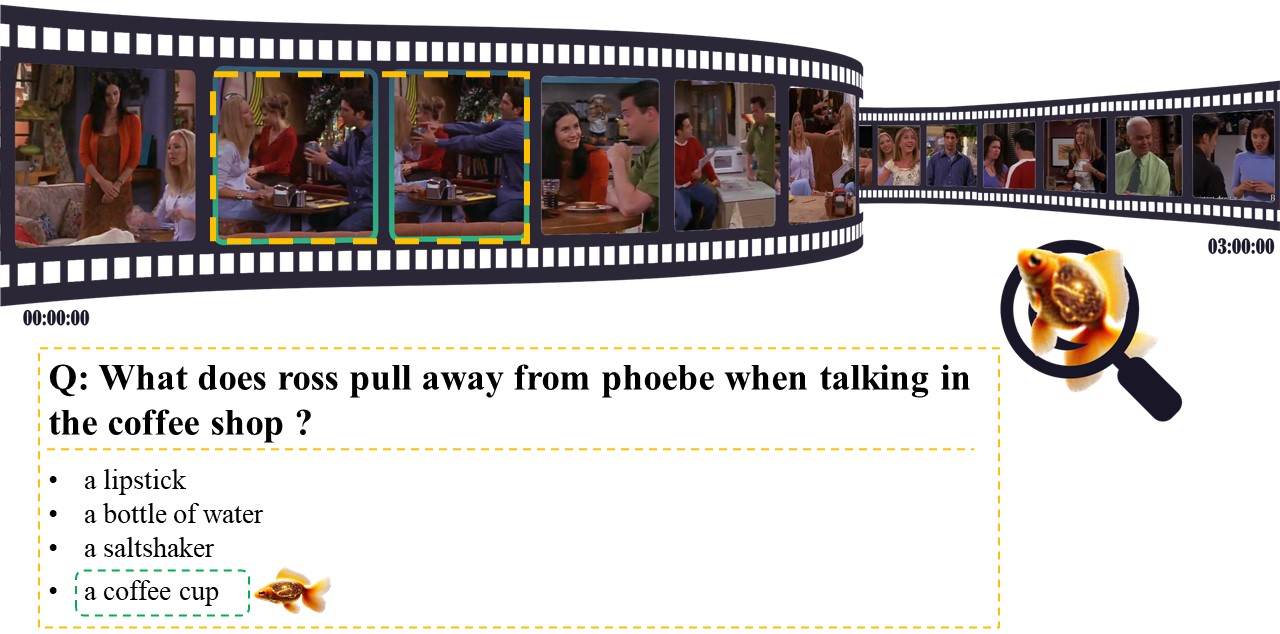
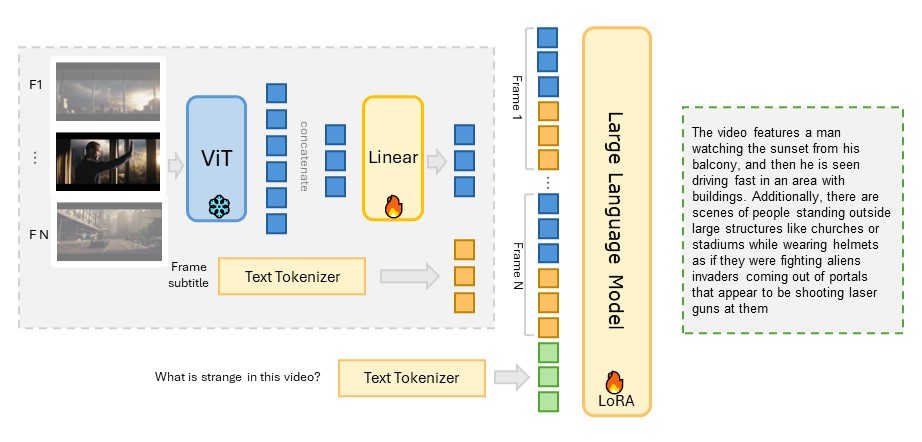
Most current LLM-based models for video understanding can process videos within minutes but struggle with processing lengthy videos due to the “noise and redundancy challenge” and “memory and compu- tation” challenges. In this paper, we present Goldfish, a methodology tailored for comprehending videos of arbitrary lengths. We also introduce the TVQA-long benchmark, specifically designed to evaluate models’ capabilities in understanding long videos with questions in both vision and text content. Goldfish approaches these challenges with an efficient retrieval mechanism that initially gathers the top-k video clips relevant to the instruction before proceeding to provide the desired response. This de- sign of the retrieval mechanism enables the Goldfish to efficiently process arbitrarily long video sequences, facilitating its application in contexts such as movies or television series. To facilitate the retrieval process, we developed MiniGPT4-Video that generates detailed descriptions for the video clips. In addressing the scarcity of benchmarks for long video evalu- ation, we adapted the TVQA short video benchmark for extended content analysis by aggregating questions from entire episodes, thereby shifting the evaluation from partial to full episode comprehension. We attained a 41.78% accuracy rate on the TVQA-long benchmark, surpassing previous methods by 14.94%. Our MiniGPT4-Video also shows exceptional perfor- mance in short video comprehension, exceeding existing state-of-the-art methods by 3.23%, 2.03%, 16.5% and 23.59% on the MSVD, MSRVTT, TGIF,and TVQA short video benchmarks, respectively. These results indicate that our models have significant improvements in both long and short-video understanding.
Goldfish framework (Long videos)


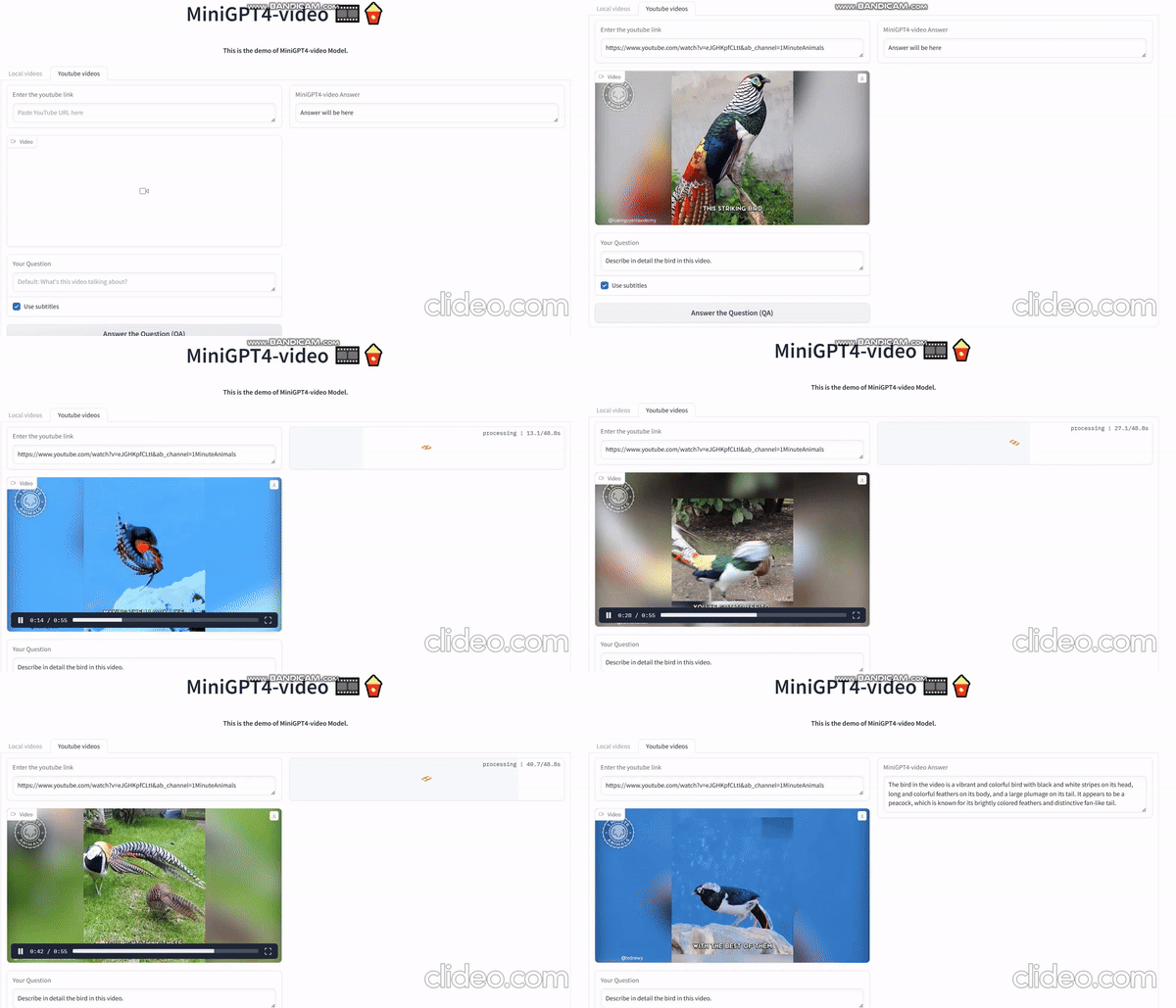
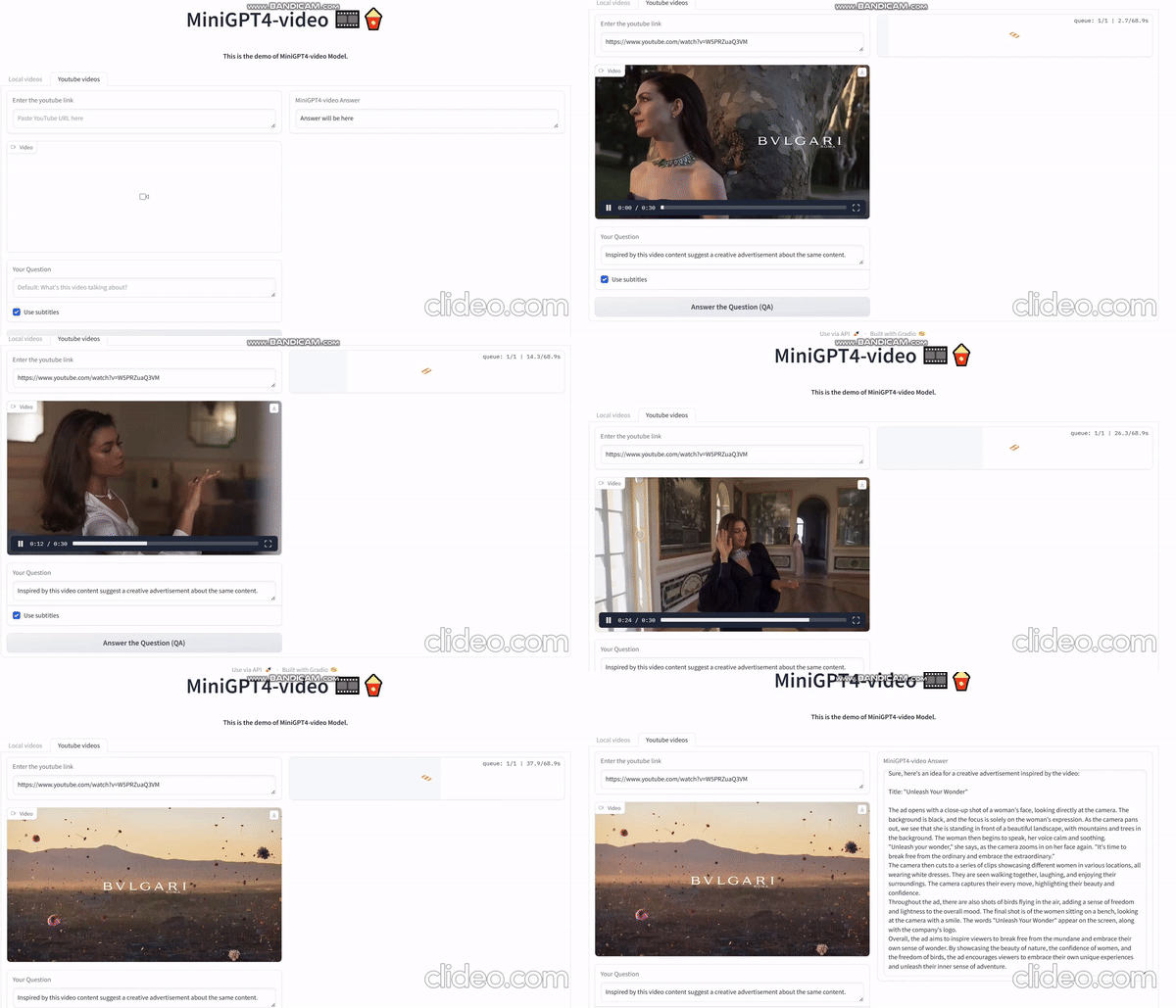
MiniGPT4-Video (Short videos)


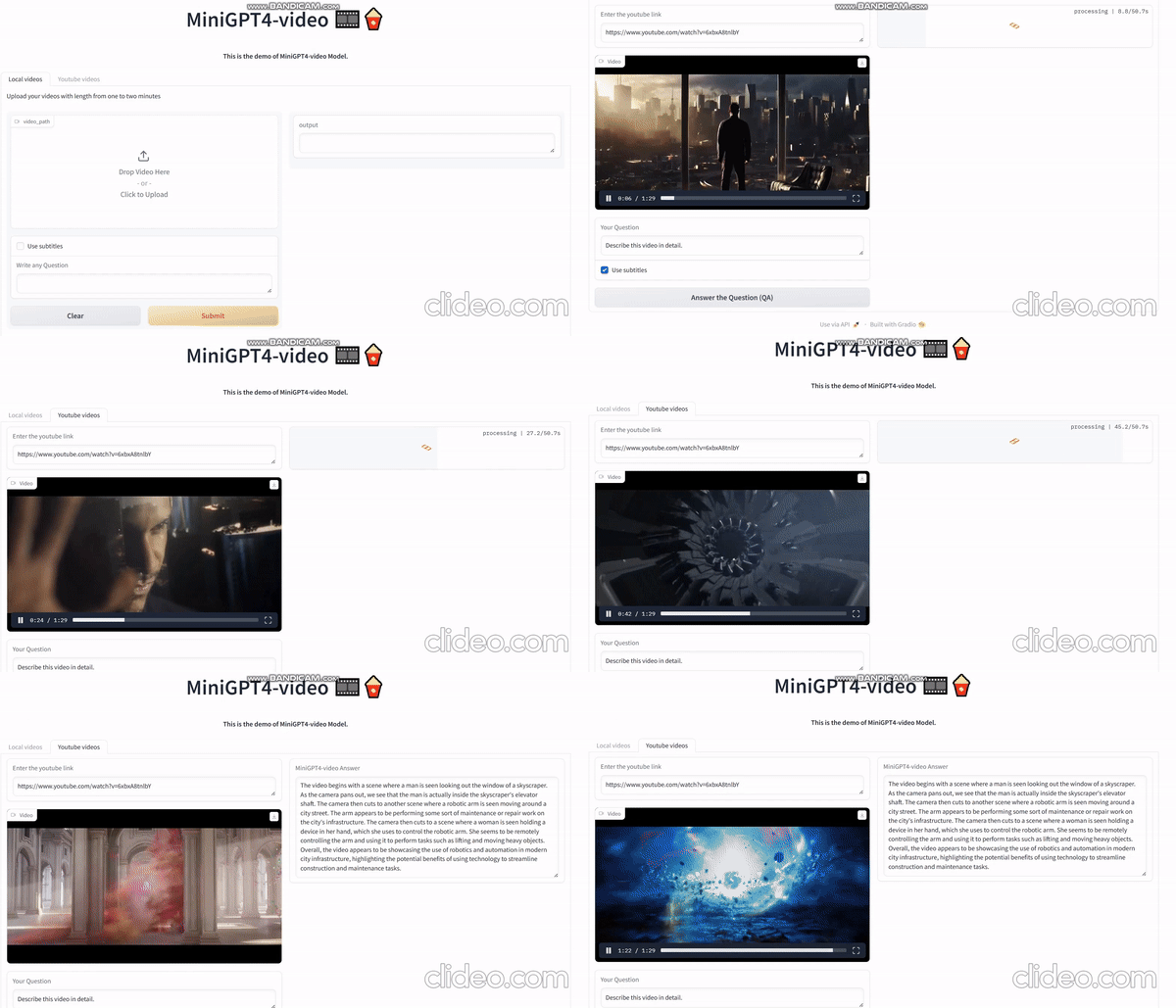
:rocket: Demo
1. Clone the repository
git clone https://github.com/Vision-CAIR/MiniGPT4-video.git
cd MiniGPT4-video
2. Set up the environment
conda env create -f environment.yml
3. Download the checkpoints
| MiniGPT4-Video (Llama2 Chat 7B) | MiniGPT4-Video (Mistral 7B) |
|---|---|
| Download | Download |
4. Run the demo
Goldfish demo
# For recommended performance, add the parameter --use_openai_embedding True to the command below and set the API key in the environment variable OPENAI_API_KEY otherwise the model will use the default embeddings.
export OPENAI_API_KEY="your_openai_key"
# Llama2
python goldfish_demo.py --ckpt path_to_video_checkpoint --cfg-path test_configs/llama2_test_config.yaml
# Mistral
python goldfish_demo.py --ckpt path_to_video_checkpoint --cfg-path test_configs/mistral_test_config.yaml
MiniGPT4-Video demo
# Llama2
python minigpt4_video_demo.py --ckpt path_to_video_checkpoint --cfg-path test_configs/llama2_test_config.yaml
# Mistral
python minigpt4_video_demo.py --ckpt path_to_video_checkpoint --cfg-path test_configs/mistral_test_config.yaml
Inference
Do the previous steps and replace step 4 with this step
Goldfish inference
# For recommended performance, add the parameter --use_openai_embedding True to the command below and set the API key in the environment variable OPENAI_API_KEY otherwise the model will use the default embeddings.
export OPENAI_API_KEY="your_openai_key"
# Llama2
python goldfish_inference.py --ckpt path_to_llama2_checkpoint --cfg-path test_configs/llama2_test_config.yaml --video_path path_to_video --question "Your question here"
# Mistral
python goldfish_inference.py --ckpt path_to_mistral_checkpoint --cfg-path test_configs/mistral_test_config.yaml --video_path path_to_video --question "Your question here"
MiniGPT4-Video inference
# Llama2
python minigpt4_video_inference.py --ckpt path_to_llama2_checkpoint --cfg-path test_configs/llama2_test_config.yaml --video_path path_to_video --question "Your question here"
# Mistral
python minigpt4_video_inference.py --ckpt path_to_mistral_checkpoint --cfg-path test_configs/mistral_test_config.yaml --video_path path_to_video --question "Your question here"
:fire: Training
For both Goldfish and MiniGPT4-Video, the only training part is the MiniGPT4-Video model.
To customize MiniGPT4-Video for your own Video-text dataset
You can find the steps to customize MiniGPT4-Video for your own video-text dataset in Custom_training.md
Training datasets
After downloading the datasets below, you should go to the datasets configuration folder here minigpt4/configs/datasets set the paths for each dataset there.
Image text training
You can find the steps to download the datasets in MiniGPT4
-
LAION
-
Conceptual Captions
-
SBU
Video text training:
You can find the datasets annotation files for video_text datasets here download
Model training:
You can edit the number of gpus in the each script.sh below
Stage 1 (image text pretraining)
You can directly download the pretrained MiniGPT4 checkpoint aligned with Llama2.
Or train by yourself:
# pretrain
# Llama2
torchrun --nproc-per-node NUM_GPU train.py --cfg-path train_configs/224_minigpt4_llama2_image.yaml
# Mistral
torchrun --nproc-per-node NUM_GPU train.py --cfg-path train_configs/224_minigpt4_mistral_image.yaml

# align
# To launch the second stage alignment, first specify the path to the checkpoint file trained in pretrain stage.
# Llama2
torchrun --nproc-per-node NUM_GPU train.py --cfg-path train_configs/224_minigpt4_llama2_image_align.yaml
# Mistral
torchrun --nproc-per-node NUM_GPU train.py --cfg-path train_configs/224_minigpt4_mistral_image_align.yaml
You can download our trained weights for this stage from here Llama2 Mistral
Stage 2 (video captioning pretraining)
For Llama2
set the cfg-path in the script to train_configs/224_v2_llama2_video_stage_2.yaml
set the model name here minigpt4/configs/datasets/cmd_video/default.yaml and minigpt4/configs/datasets/webvid/default.yaml to llama2
For Mistral
set the cfg-path in the script to train_configs/224_v2_mistral_video_stage_2.yaml
set the model name here minigpt4/configs/datasets/cmd_video/default.yaml and minigpt4/configs/datasets/webvid/default.yaml to mistral
bash training_scripts/stage_2.sh
You can download our trained weights for this stage from here Llama2 Mistral
Stage 3 (video Instruction finetuning)
For Llama2
set the cfg-path in the script to train_configs/224_v2_llama2_video_stage_3.yaml
set the model name here minigpt4/configs/datasets/video_chatgpt/default.yaml to llama2
For Mistral
set the cfg-path in the script to train_configs/224_v2_mistral_video_stage_3.yaml
set the model name here minigpt4/configs/datasets/video_chatgpt/default.yaml to mistral
bash training_scripts/stage_3.sh
You can download our trained weights for this stage from here Llama2 Mistral
:zap: MiniGPT4-Video Evaluation
To reproduce the results use the best checkpoints for each model
We used the same evaluation as Video-ChatGPT
| Method | Using Subtitles | Information Correctness | Detailed Orientation | Contextual Understanding | Temporal Understanding | Consistency |
|---|---|---|---|---|---|---|
| LLaMA Adapter | :x: | 2.03 | 2.32 | 2.30 | 1.98 | 2.15 |
| Video LLaMA | :x: | 1.96 | 2.18 | 2.16 | 1.82 | 1.79 |
| Video Chat | :x: | 2.23 | 2.50 | 2.53 | 1.94 | 2.24 |
| Video-ChatGPT | :x: | 2.40 | 2.52 | 2.62 | 1.98 | 2.37 |
| BT-Adapter-7B | :x: | 2.68 | 2.69 | 3.27 | 2.34 | 2.46 |
| LLaMA-VID-7B | :x: | 2.96 | 3.00 | 3.53 | 2.46 | 2.51 |
| Ours-7B Llama2 | :x: | 2.93 | 2.97 | 3.45 | 2.47 | 2.60 |
| Ours-7B Llama2 | :white_check_mark: | 3.08 | 3.02 | 3.57 | 2.65 | 2.67 |
| Ours-7B Mistral | :x: | 2.83 | 2.52 | 3.01 | 2.32 | 2.40 |
| Ours-7B Mistral | :white_check_mark: | 2.91 | 2.57 | 3.11 | 2.33 | 2.39 |
| Method | Using Subtitles | MSVD Acc.↑ | MSVD Score↑ | MSRVTT Acc.↑ | MSRVTT Score↑ | TGIF Acc.↑ | TGIF Score↑ | ActivityNet Acc.↑ | ActivityNet Score↑ | TVQA Acc.↑ |
|---|---|---|---|---|---|---|---|---|---|---|
| FrozenBiLM | :x: | 32.2 | -- | 16.8 | -- | 41 | -- | 24.7 | -- | 29.7 |
| LLaMA Adapter | :x: | 54.9 | 3.1 | 43.8 | 2.7 | -- | -- | 34.2 | 2.7 | -- |
| Video LLaMA | :x: | 51.6 | 2.5 | 29 | 1.8 | -- | -- | 12.4 | 1.1 | -- |
| Video Chat | :x: | 56.3 | 2.8 | 45 | 2.5 | 34.4 | 2.3 | 26.5 | 2.2 | -- |
| Video-ChatGPT | :x: | 64.9 | 3.3 | 49.3 | 2.8 | 51.4 | 3.0 | 35.2 | 2.7 | 23.35 |
| BT-Adapter-7B | :x: | 67.7 | 3.7 | 57 | 3.2 | -- | -- | 45.7 | 3.2 | -- |
| LLaMA-VID-7B | :x: | 69.7 | 3.7 | 57.7 | 3.2 | -- | -- | 47.4 | 3.3 | -- |
| Ours-7B LLama2 | :x: | 72.93 | 3.84 | 58.83 | 3.29 | 67.9 | 3.71 | 45.85 | 3.23 | 36.45 |
| Ours-7B Llama2 | :white_check_mark: | 72.93 | 3.84 | 59.73 | 3.3 | 67.9 | 3.71 | 46.3 | 3.4 | 46.94 |
| Ours-7B Mistral | :x: | 73.92 | 4.06 | 58.26 | 3.52 | 72.22 | 4.08 | 44.25 | 3.35 | 33.90 |
| Ours-7B Mistral | :white_check_mark: | 73.92 | 4.06 | 58.68 | 3.53 | 72.22 | 4.08 | 44.38 | 3.36 | 54.21 |
Download datasets for evaluation
You can find the evaluation datasets annotation files download
Subtitles for MSR-VTT,and ActivityNet are availabe here download note these subtitles are generated using whisper model
TVQA subtitles can be downloaded from here
Run evaluation script
Set the each evaluation script parameters in the script
NAME="" # Name of the experiment
BATCH_SIZE=8 # batch size
CKPT_PATH="" # path to the checkpoint
DATASET="msvd" # dataset name, available datasets: tvqa, msrvtt, msvd, activitynet,tgif ,video_chatgpt_generic,video_chatgpt_temporal,video_chatgpt_consistency
# set the paths to the dataset files
videos_path="" # path to the videos file
subtitles_path="" # path to the subtitles file if the dataset is msrvtt, activitynet or tvqa else set it to ""
ann_path="" # path to the annotations file
cfg_path="" # path to the config file
bash evaluation/minigpt4_video_eval/minigpt4_video_evalualtion.sh
Then Use GPT3.5 turbo to compare the predictions with the ground truth and generate the accuracy and scores
Set these variables in both evaluate_benchmark.sh and evaluate_zeroshot.sh
PRED="path_to_predictions"
OUTPUT_DIR="path_to_output_dir"
API_KEY="openAI_key"
NUM_TASKS=128
Then to evaluate [Video-ChatGPT benchmark] run the following script
bash GPT_evaluation/evaluate_benchmark.sh
To evaluate open ended questions run the following script
bash GPT_evaluation/evaluate_zeroshot.py
:zap: Goldfish Evaluation
Long video benchmarking results on four benchmarks: LLama-Vid, MovieChat, Movie QA, and our proposed TVQA-Long. The "V" modality indicates the use of video frames only, while "V+T" indicates the use of both video frames and subtitles
| Method | Modalities | LLama-Vid Acc.↑ | LLama-Vid Score↑ | MovieChat Acc.↑ | MovieChat Score↑ | Movie QA Acc.↑ | Movie QA Score↑ | TVQA-Long Acc.↑ | TVQA-Long Score↑ |
|---|---|---|---|---|---|---|---|---|---|
| LLAMA-VID | V | 20.68 | 2.41 | 53.2 | 3.81 | 24.42 | 2.19 | 24.63 | 2.16 |
| MovieChat | V | 11.71 | 1.45 | NA | NA | 16.18 | 1.68 | 5.0 | 0.86 |
| Ours | V | 23.09 | 2.19 | 67.6 | 4.23 | 28.49 | 2.8 | 28.61 | 2.78 |
| LLAMA-VID | V+T | 41.4† | 3.07† | NA | NA | 37.65† | 3.03† | 26.86 | 2.21 |
| Ours | V+T | 31.49 | 2.48 | NA | NA | 35.24 | 3.1 | 41.78 | 3.21 |
Note: The dagger † symbol indicates the method used the benchmark during training, which implies unfair comparison.
To reproduce the results use the checkpoints/video_llama_checkpoint_last.pth and use openAI embedding --use_openai_embedding=True
Download datasets for evaluation
For Llama-vid and MovieQA
Dowlnoad the original MovieNet data with movies and annotations from here
This will be the souce videos for LLama-vid and MovieQA
Filtered Annotations same as illestrated in the paper and used for evaluation
For Moviechat the only available videos while implementing this work is 10 % of the training data and this what we used for evalaution and can be found here
Full dataset can be found here
For TVQA-Long
if you want to use TVQA-Long for another model (llama-vid),both videos and annotations can be found here TVQA-Long. For Goldfish evalaution we will use the separated clips from the original TVQA dataset
Run the evaluation scripts
# Llama-vid evalauation
# set these parameters in the script
videos_path="path to the videos"
subtitle_path="path to the subtitles"
video_clips_saving_path="path to save the video clips"
annotation_file="path to the annotation file"
movienet_annotations_dir="path to the movienet annotations directory"
NEIGHBOURS=3
use_openai_embedding="whether to use openai embeddings or not"
# then run the script
bash evaluation/Goldfish_eval/movies/eval_model_summary_llama_vid.sh

# MovieQA evaluation
# same as above but set the parameters in the script to the MovieQA paths
bash evaluation/Goldfish_eval/movies/eval_model_summary_movie_qa.sh

# MovieChat evaluation
# set these parameters in the script
dataset_path="path to the movies folder"
annotation_json_folder="path to the jsons folder"
# then run the script
bash evaluation/Goldfish_eval/movies/eval_model_summary_movie_chat.sh
TVQA-Long
For Goldfish evaluation we can use the original separated clips from the original TVQA dataset
Download the original TVQA videos and clips subtitles for short videos from here
tvqa_long_annotation here
tvqa_json_subtitles here
# set these parameters in the script
tvqa_json_subtitles="path to the tvqa json subtitles file"
tvqa_clips_subtitles="path to the tvqa clips subtitles"
videos_frames="path to the video frames"
tvqa_long_annotation="path to the TVQA-Long annotation file"
NEIGHBOURS= 3
use_openai_embedding="whether to use openai embeddings or not"
# then run the script
bash evaluation/Goldfish_eval/tvqa_eval/eval_model_summary.sh
Then Use GPT3.5 turbo to compare the predictions with the ground truth and generate the accuracy and scores
Set these variables in evaluate_zeroshot.sh
PRED="path_to_predictions"
OUTPUT_DIR="path_to_output_dir"
API_KEY="openAI_key"
NUM_TASKS=128
To evaluate open ended questions run the following script
bash GPT_evaluation/evaluate_zeroshot.sh
Citation
If you're using MiniGPT4-Video or Goldfish in your research or applications, please cite using this BibTeX:
@misc{ataallah2024goldfishvisionlanguageunderstandingarbitrarily,
      title={Goldfish: Vision-Language Understanding of Arbitrarily Long Videos},
      author={Kirolos Ataallah and Xiaoqian Shen and Eslam Abdelrahman and Essam Sleiman and Mingchen Zhuge and Jian Ding and Deyao Zhu and Jürgen Schmidhuber and Mohamed Elhoseiny},
      year={2024},
      eprint={2407.12679},
      archivePrefix={arXiv},
      primaryClass={cs.CV},
      url={https://arxiv.org/abs/2407.12679},
}
@article{ataallah2024minigpt4,
  title={MiniGPT4-Video: Advancing Multimodal LLMs for Video Understanding with Interleaved Visual-Textual Tokens},
  author={Ataallah, Kirolos and Shen, Xiaoqian and Abdelrahman, Eslam and Sleiman, Essam and Zhu, Deyao and Ding, Jian and Elhoseiny, Mohamed},
  journal={arXiv preprint arXiv:2404.03413},
  year={2024}
}
Acknowledgements
License
This repository is under BSD 3-Clause License. Many codes are based on MiniGPT4.