A project for processing neural networks and rendering to gain insights on the architecture and parameters of a model through a decluttered representation.
Evaluating and reproducing real-world robot manipulation policies (e.g., RT-1, RT-1-X, Octo) in simulation under common setups (e.g., Google Robot, WidowX+Bridge) (CoRL 2024)
PyTorch implementation for SDEdit: Image Synthesis and Editing with Stochastic Differential Equations
关键参数与规格
关键参数与规格
参数
值
语言
Python
类别
Model Development
子类别
Domain-specific training
关键词
3D
星标数
1,177
分叉数
110
贡献者
1
创建日期
2022-03-20
更新日期
2026-09-15
1 天星标数
0
7 天星标数
0
排名
11,288
上次排名
11,233
排名变化
-55
7 天星标排名
12,958
上次 7 天星标排名
12,980
7 天星标排名变化
22
总星标排名
9,869
上次总星标排名
9,855
总星标排名变化
-14
国家
China
README 摘录
EPro-PnP 📢 **NEWS:** We have released EPro-PnP-v2. A new updated preprint can be found on arXiv. **EPro-PnP: Generalized End-to-End Probabilistic Perspective-n-Points for Monocular Object Pose Estimation** In CVPR 2022 (Oral, **Best Student Paper**). paper Hansheng Chen\* 1,2 , Pichao Wang† 2 , Fan Wang 2 , Wei Tian† 1 , Lu Xiong 1 , Hao Li 2 1 Tongji University, 2 Alibaba Group \*Part of work done during an internship at Alibaba Group. †Corresponding Authors: Pichao Wang
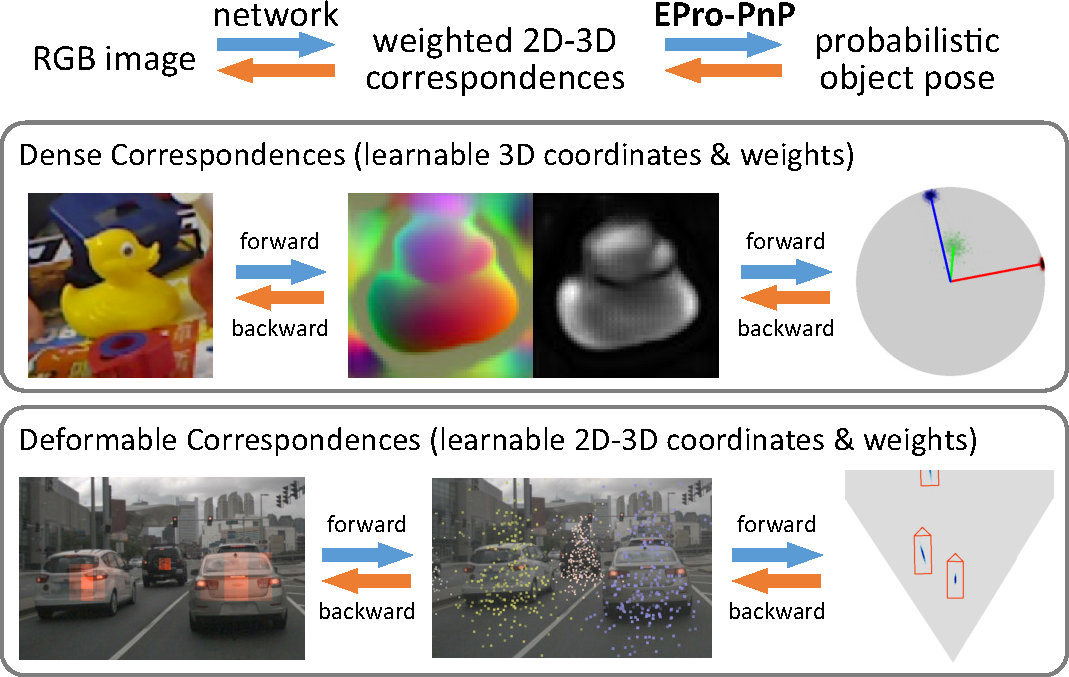
, Wei Tian. Introduction EPro-PnP is a probabilistic Perspective-n-Points (PnP) layer for end-to-end 6DoF pose estimation networks. Broadly speaking, it is essentially a continuous counterpart of the widely used categorical Softmax layer, and is theoretically generalizable to other learning models with nested optimization. Given the layer input: an -point correspondence set consisting of 3D object coordinates , 2D image coordinates , and 2D weights , a conventional PnP solver searches for an optimal pose (rigid transformation in SE(3
)) that minimizes the weighted reprojection error. Previous work tries to backpropagate through the PnP operation, yet is inherently non-differentiable due to the inner operation. This leads to convergence issue if all the components in must be learned by the network. In contrast, our probabilistic PnP layer outputs a posterior distribution of pose, whose probability density can be derived for proper backpropagation. The distribution is approximated via Monte Carlo sampling. With EPro-PnP, the correspondences can be learned from scratch
altogether by minimizing the KL divergence between the predicted and target pose distribution. Models V1 models in this repository **EPro-PnP-6DoF for 6DoF pose estimation** **EPro-PnP-Det for 3D object detection** New V2 models **EPro-PnP-Det v2: state-of-the-art monocular 3D object detector** Main differences to v1b: Use GaussianMixtureNLLLoss as auxiliary coordinate regression loss Add auxiliary depth and bbox losses At the time of submission (Aug 30, 2022), EPro-PnP-Det v2 **ranks 1st** among
all camera-based single-frame object detection models on the official nuScenes benchmark (test split, without extra data). 141 | 24 ep | | BEVDet-Base | Y | Swin-B | 0. 152 | 20 ep | | EPro-PnP-Det v2 (ours) | N | R101 | 0. 115** | 12 ep | | PolarFormer | N | R101 | 0. 139 | 24 ep | | BEVFormer-S | N | R101 | 0. 143 | 24 ep | | EPro-PnP-Det v1 | Y | R101 | 0. 127 | 24+24 ep | | FCOS3D | Y | R101 | 0. 124 | - | **EPro-PnP-6DoF v2 for 6DoF pose estimation
** Main differences to v1b: Fix w2d scale handling **(very important)** Improve network initialization Adjust loss weights With these updates the v2 model can be trained **without 3D models** to achieve better performance (ADD 0. 6), unleashing the full potential of simple end-to-end training. Use EPro-PnP in Your Own Model We provide a demo on the usage of the EPro-PnP layer. Citation If you find this project useful in your research, please consider citing:
常见问题
记录了多少星标和分叉?
tjiiv-cprg/EPro-PnP 有 1,177 个星标和 110 个分叉。
仓库排名是多少?
tjiiv-cprg/EPro-PnP 排名第 11,288。
记录的语言和类别是什么?
tjiiv-cprg/EPro-PnP 有 1,177 个星标,语言为 Python,类别为 Model Development。
*Part of work done during an internship at Alibaba Group.
†Corresponding Authors: Pichao Wang, Wei Tian.
Introduction
EPro-PnP is a probabilistic Perspective-n-Points (PnP) layer for end-to-end 6DoF pose estimation networks. Broadly speaking, it is essentially a continuous counterpart of the widely used categorical Softmax layer, and is theoretically generalizable to other learning models with nested optimization.
Given the layer input: an -point correspondence set consisting of 3D object coordinates , 2D image coordinates , and 2D weights , a conventional PnP solver searches for an optimal pose (rigid transformation in SE(3)) that minimizes the weighted reprojection error. Previous work tries to backpropagate through the PnP operation, yet is inherently non-differentiable due to the inner operation. This leads to convergence issue if all the components in must be learned by the network.
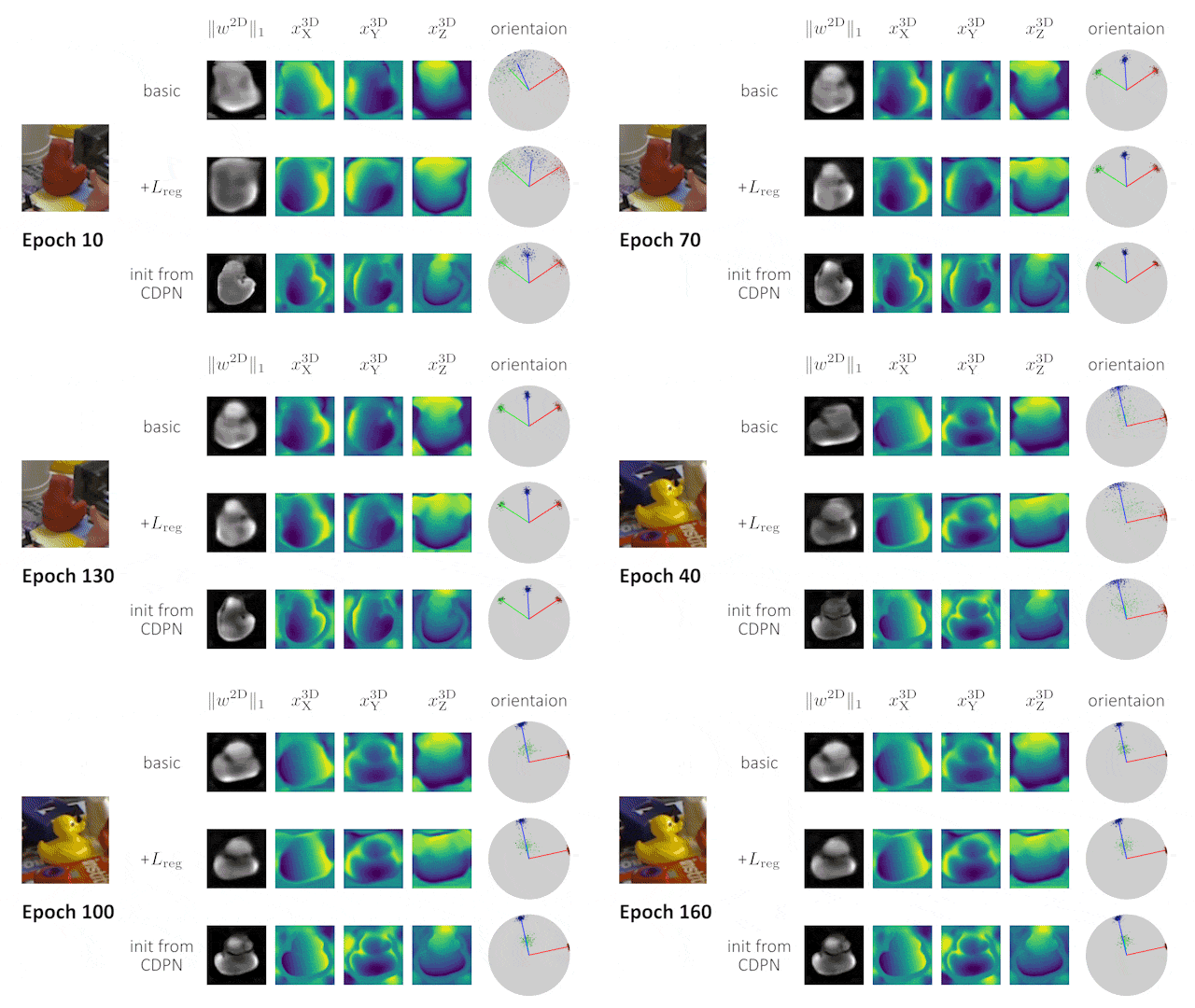
In contrast, our probabilistic PnP layer outputs a posterior distribution of pose, whose probability density can be derived for proper backpropagation. The distribution is approximated via Monte Carlo sampling. With EPro-PnP, the correspondences can be learned from scratch altogether by minimizing the KL divergence between the predicted and target
pose distribution.
Use GaussianMixtureNLLLoss as auxiliary coordinate regression loss
Add auxiliary depth and bbox losses
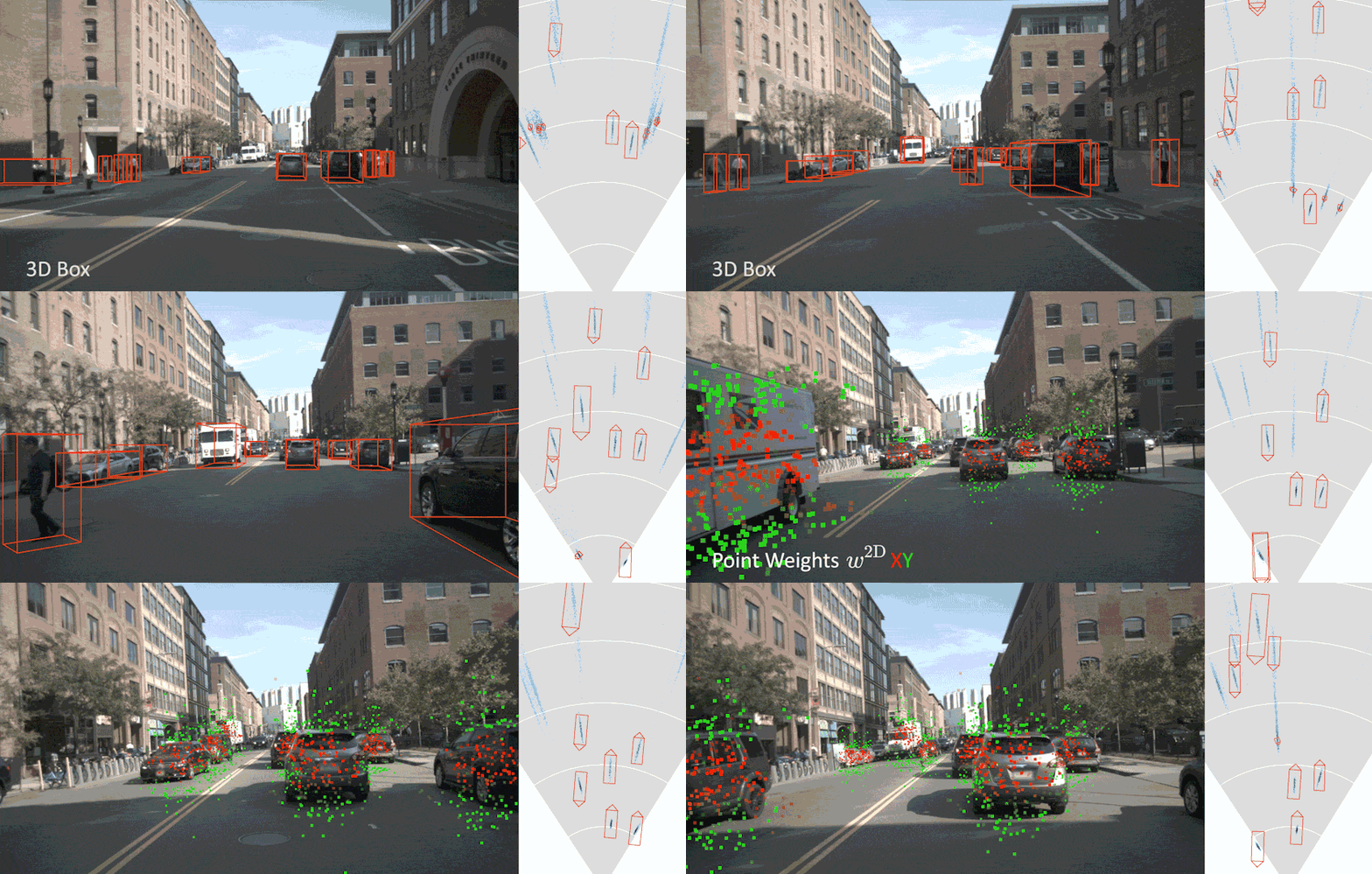
At the time of submission (Aug 30, 2022), EPro-PnP-Det v2 ranks 1st among all camera-based single-frame object detection models on the official nuScenes benchmark (test split, without extra data).
With these updates the v2 model can be trained without 3D models to achieve better performance (ADD 0.1d = 93.83) than GDRNet (ADD 0.1d = 93.6), unleashing the full potential of simple end-to-end training.
Use EPro-PnP in Your Own Model
We provide a demo on the usage of the EPro-PnP layer.
Citation
If you find this project useful in your research, please consider citing:
@inproceedings{epropnp,
  author = {Hansheng Chen and Pichao Wang and Fan Wang and Wei Tian and Lu Xiong and Hao Li,
  title = {EPro-PnP: Generalized End-to-End Probabilistic Perspective-n-Points for Monocular Object Pose Estimation},
  booktitle = {IEEE Conference on Computer Vision and Pattern Recognition (CVPR)},
  year = {2022}
}

@article{epropnpv2,
  author={Chen, Hansheng and Tian, Wei and Wang, Pichao and Wang, Fan and Xiong, Lu and Li, Hao},
  journal={IEEE Transactions on Pattern Analysis and Machine Intelligence},
  title={EPro-PnP: Generalized End-to-End Probabilistic Perspective-N-Points for Monocular Object Pose Estimation},
  year={2024},
  doi={10.1109/TPAMI.2024.3354997}
}