Evaluating and reproducing real-world robot manipulation policies (e.g., RT-1, RT-1-X, Octo) in simulation under common setups (e.g., Google Robot, WidowX+Bridge) (CoRL 2024)
LibCity: An Open Library for Urban Spatial-temporal Data Mining
关键参数与规格
关键参数与规格
参数
值
语言
Python
类别
Model Development
子类别
Architecture
关键词
Image production
星标数
1,172
分叉数
92
贡献者
3
创建日期
2021-05-05
更新日期
2026-10-15
1 天星标数
0
7 天星标数
-1
排名
11,299
上次排名
18,769
排名变化
7,470
7 天星标排名
17,273
上次 7 天星标排名
17,262
7 天星标排名变化
-11
总星标排名
9,891
上次总星标排名
9,880
总星标排名变化
-11
国家
USA
README 摘录
SDEdit: Guided Image Synthesis and Editing with Stochastic Differential Equations **Project** | **Paper** | **Colab** PyTorch implementation of **SDEdit: Guided Image Synthesis and Editing with Stochastic Differential Equations** (ICLR 2022). Chenlin Meng, Yutong He, Yang Song, Jiaming Song, Jiajun Wu, Jun-Yan Zhu, Stefano Ermon Stanford and CMU Recently, SDEdit has also been applied to text-guided image editing with large-scale text-to-image models. Notable examples include Stable Diffusion 's img2img function (see here ), GLIDE , and distilled-SD . The below
example comes from distilled-SD . Overview The key intuition of SDEdit is to "hijack" the reverse stochastic process of SDE-based generative models, as illustrated in the figure below. Given an input image for editing, such as a stroke painting or an image with color strokes, we can add a suitable amount of noise to make its artifacts undetectable, while still preserving the overall structure of the image. We then initialize the reverse SDE with this noisy input, and simulate
the reverse process to obtain a denoised image of high quality. The final output is realistic while resembling the overall image structure of the input. Getting Started The code will automatically download pretrained SDE (VP) PyTorch models on CelebA-HQ, LSUN bedroom, and LSUN church outdoor. Data format We save the image and the corresponding mask in an array format [image, mask] , where "image" is the image with range [0,1] in the PyTorch tensor format, "mask" is the corresponding
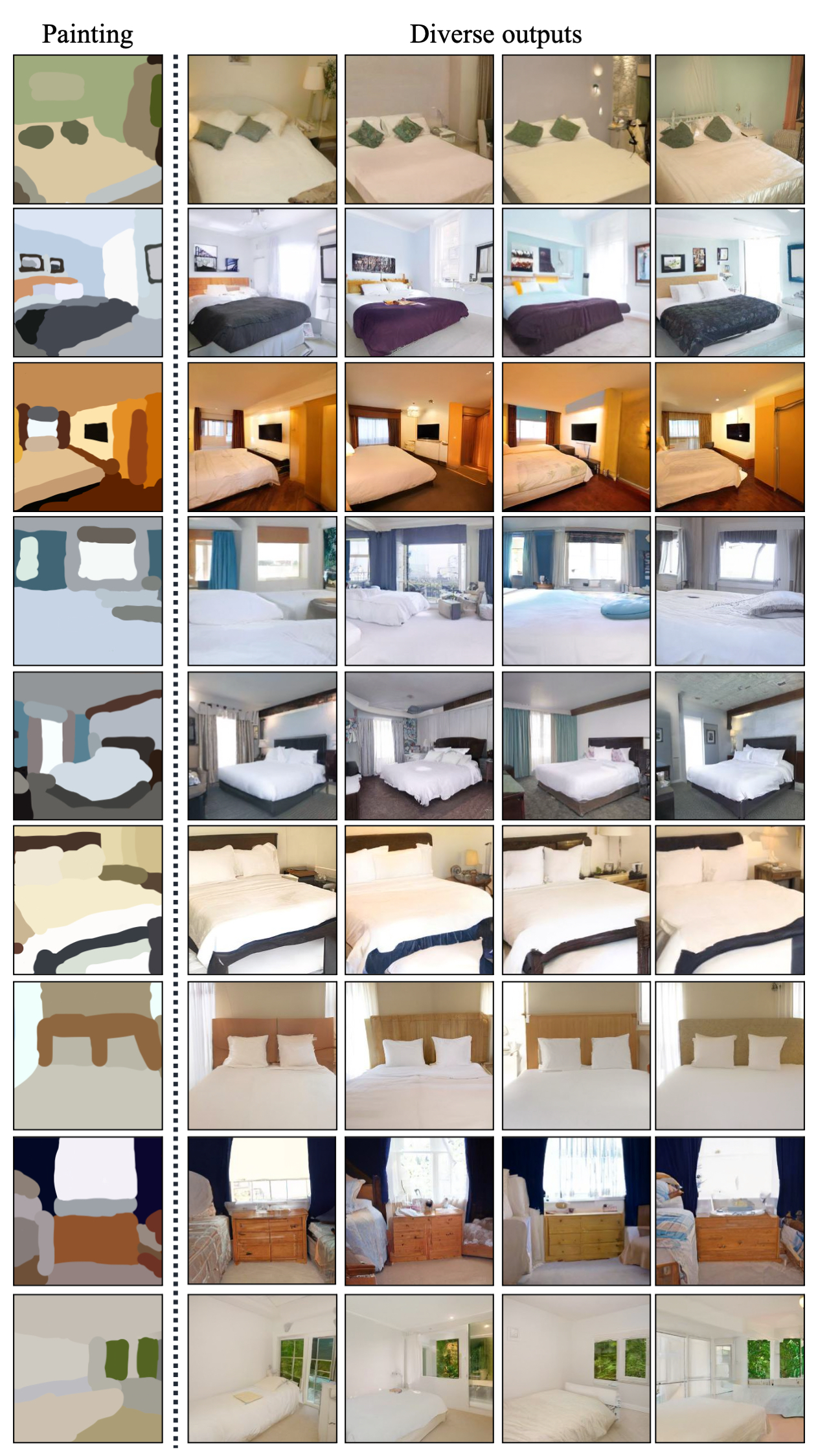
binary mask (also the PyTorch tensor format) specifying the editing region. We provide a few examples, and functions/process_data. py will automatically download the examples to the colab_demo folder. Re-training the model Here is the PyTorch implementation for training the model. Stroke-based image generation Given an input stroke painting, our goal is to generate a realistic image that shares the same structure as the input painting. SDEdit can synthesize multiple diverse outputs for each input on
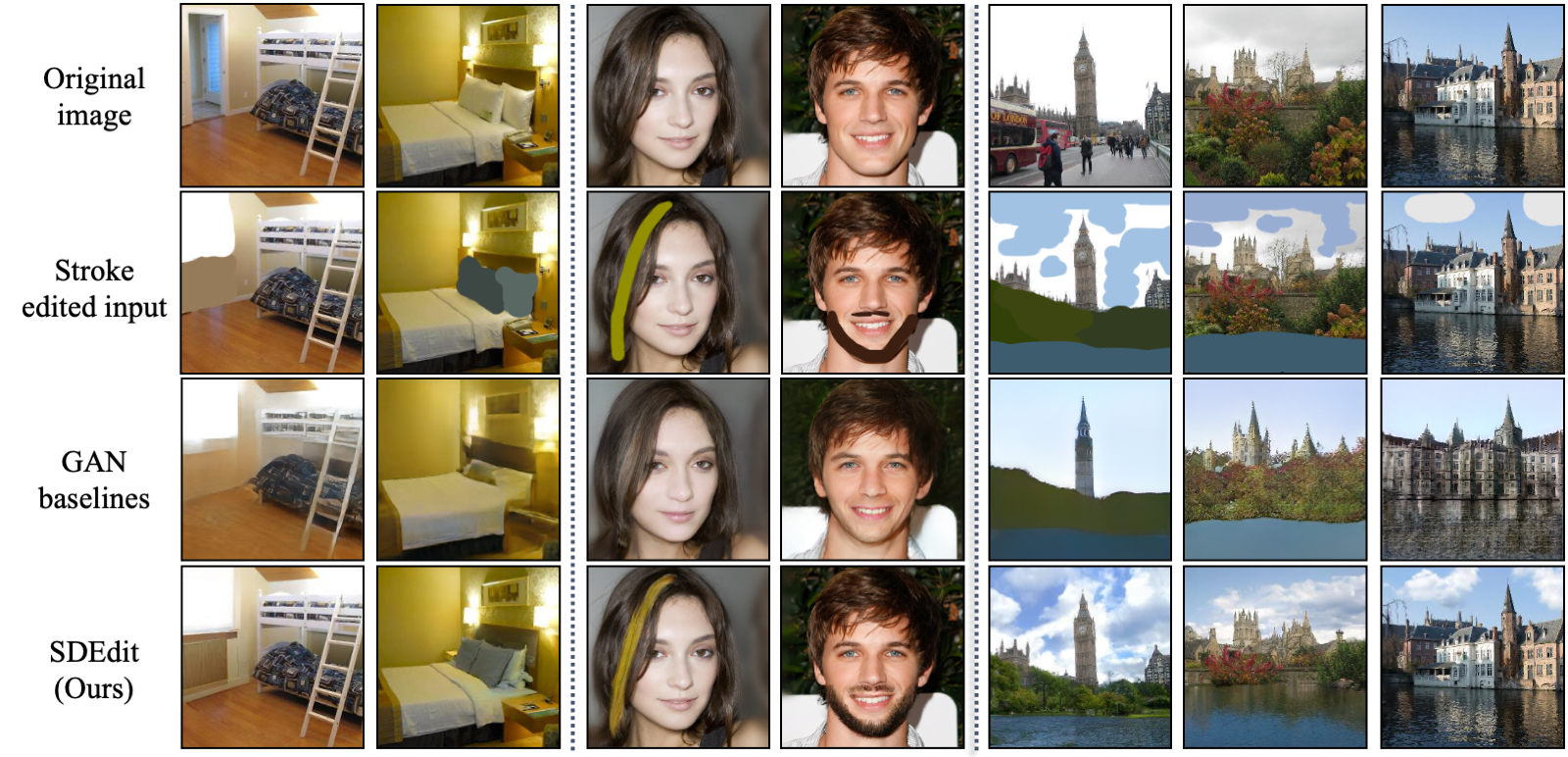
LSUN bedroom, LSUN church and CelebA-HQ datasets. To generate results on LSUN datasets, please run Stroke-based image editing Given an input image with user strokes, we want to manipulate a natural input image based on the user's edit. SDEdit can generate image edits that are both realistic and faithful (to the user edit), while avoid introducing undesired changes. To perform stroke-based image editing, run Additional results References If you find this repository useful for your research, please
cite the following work. This implementation is based on / inspired by: DDIM PyTorch repo. PyTorch helper that loads the DDPM model. Here are also some of the interesting follow-up works of SDEdit: Image Modification with Stable Diffusion
常见问题
记录了多少星标和分叉?
ermongroup/SDEdit 有 1,172 个星标和 92 个分叉。
仓库排名是多少?
ermongroup/SDEdit 排名第 11,299。
记录的语言和类别是什么?
ermongroup/SDEdit 有 1,172 个星标,语言为 Python,类别为 Model Development。
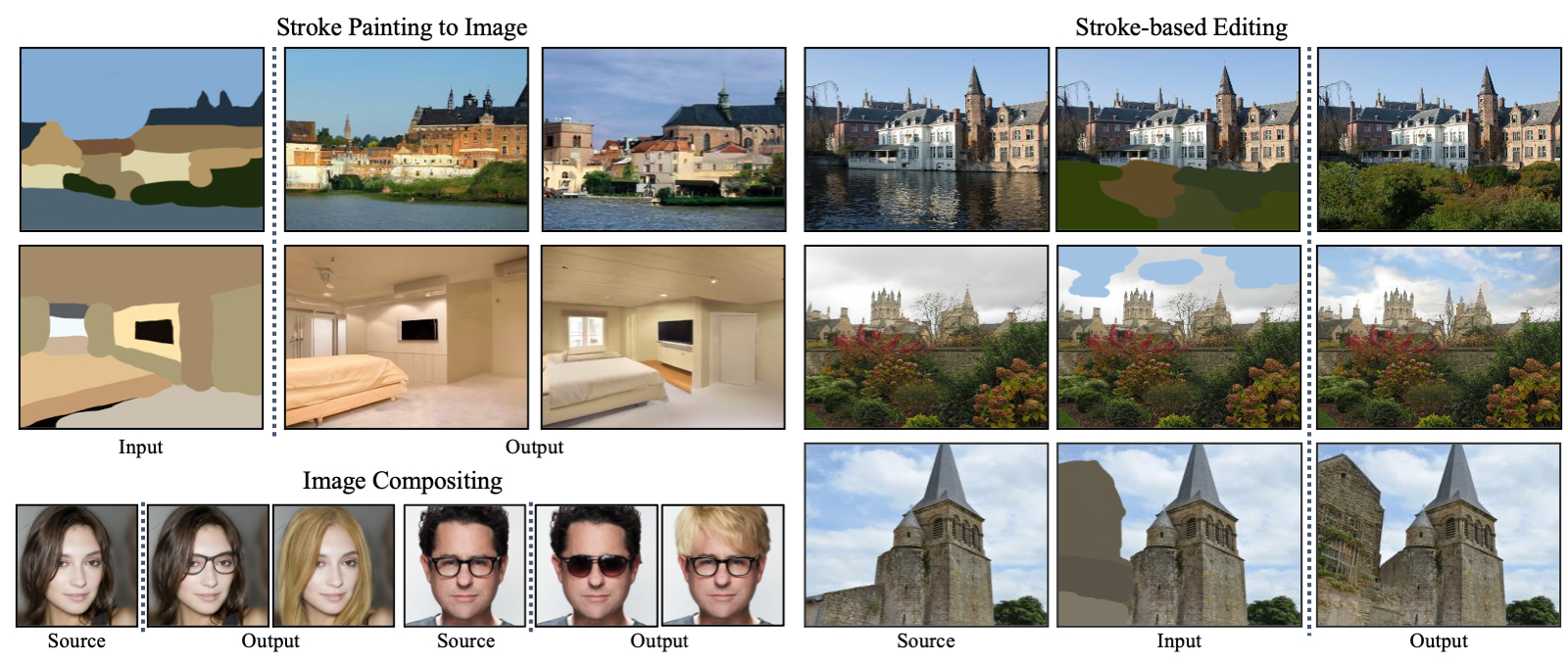
Recently, SDEdit has also been applied to text-guided image editing with large-scale text-to-image models. Notable examples include Stable Diffusion's img2img function (see here), GLIDE, and distilled-SD. The below example comes from distilled-SD.
Overview
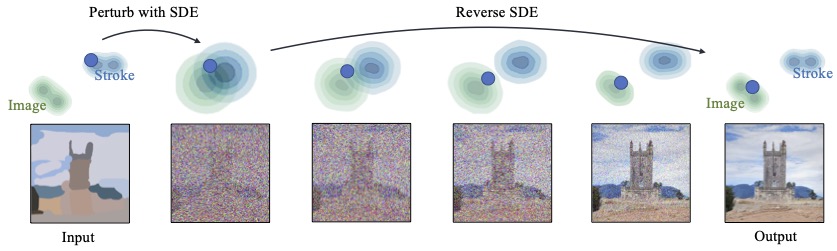
The key intuition of SDEdit is to "hijack" the reverse stochastic process of SDE-based generative models, as illustrated in the figure below. Given an input image for editing, such as a stroke painting or an image with color strokes, we can add a suitable amount of noise to make its artifacts undetectable, while still preserving the overall structure of the image. We then initialize the reverse SDE with this noisy input, and simulate the reverse process to obtain a denoised image of high quality. The final output is realistic while resembling the overall image structure of the input.
We save the image and the corresponding mask in an array format [image, mask], where
"image" is the image with range [0,1] in the PyTorch tensor format, "mask" is the corresponding binary mask (also the PyTorch tensor format) specifying the editing region.
We provide a few examples, and functions/process_data.py will automatically download the examples to the colab_demo folder.
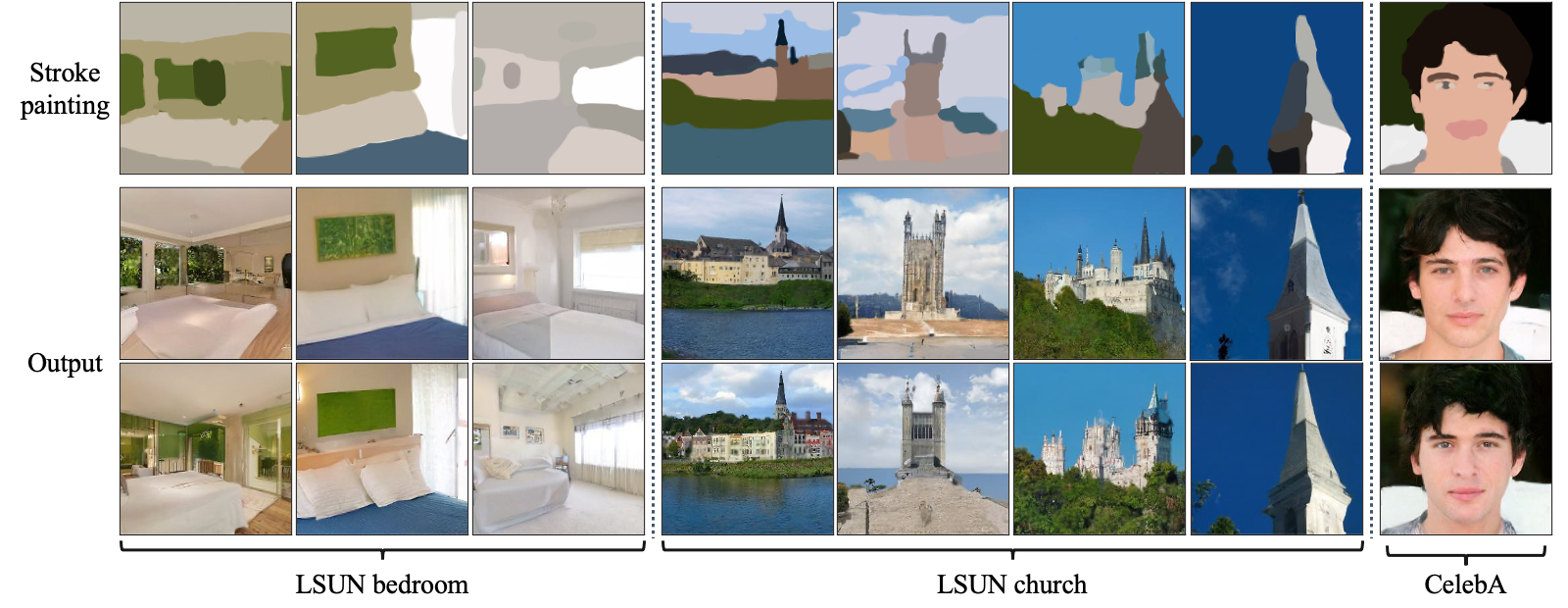
Given an input stroke painting, our goal is to generate a realistic image that shares the same structure as the input painting.
SDEdit can synthesize multiple diverse outputs for each input on LSUN bedroom, LSUN church and CelebA-HQ datasets.
Given an input image with user strokes, we want to manipulate a natural input image based on the user's edit.
SDEdit can generate image edits that are both realistic and faithful (to the user edit), while avoid introducing undesired changes.
If you find this repository useful for your research, please cite the following work.
@inproceedings{
      meng2022sdedit,
      title={{SDE}dit: Guided Image Synthesis and Editing with Stochastic Differential Equations},
      author={Chenlin Meng and Yutong He and Yang Song and Jiaming Song and Jiajun Wu and Jun-Yan Zhu and Stefano Ermon},
      booktitle={International Conference on Learning Representations},
      year={2022},
}