← 开源
rasbt

MachineLearning-QandAI-book

Machine Learning Q and AI book

TutorialsML/AI fundamentalsLLM fundamentalsJupyter Notebook
在 GitHub 打开
增长势头
+024 小时新增 Star0.0%
973
Star
190
Fork
+0
本周
2
贡献者
创建于 2022-10-16 · 更新于 2026-10-09 · 今日第 12300 名
主要开发者
rasbtiamandroiduser

rasbt/MachineLearning-QandAI-book 排名第 12,300,有 973 个星标。

同类别比较

rasbt/MachineLearning-QandAI-book 排名第 12,300,此处有 7 个同类条目;aialgorithm/Blog 排名第 12,292。

同类别比较
名称排名指标
dingran/quant-notes12,259
语言:
Jupyter Notebook
星标数:
979
分叉数:
144
简介:
Quantitative Interview Preparation Guide, updated version here ==>
datawhalechina/dive-into-cv-pytorch12,277
语言:
Python
星标数:
976
分叉数:
189
简介:
动手学CV-Pytorch版
Azure-Samples/contoso-real-estate12,289
语言:
JavaScript
星标数:
974
分叉数:
529
简介:
Intelligent enterprise-grade reference architecture for JavaScript, featuring OpenAI integration, Azure Developer CLI template and Playwright tests.
aialgorithm/Blog12,292
语言:
Jupyter Notebook
星标数:
974
分叉数:
262
简介:
Python机器学习算法技术博客,有原创干货!有code实践! 【更多内容敬请关注公众号 "算法进阶"】
kennethleungty/Llama-2-Open-Source-LLM-CPU-Inference12,311
语言:
Python
星标数:
971
分叉数:
205
简介:
Running Llama 2 and other Open-Source LLMs on CPU Inference Locally for Document Q&A
pixegami/rag-tutorial-v212,325
语言:
Python
星标数:
969
分叉数:
605
简介:
An Improved Langchain RAG Tutorial (v2) with local LLMs, database updates, and testing.
Denis2054/Transformers-for-NLP-2nd-Edition12,326
语言:
Jupyter Notebook
星标数:
968
分叉数:
361
简介:
Transformer models from BERT to GPT-4, environments from Hugging Face to OpenAI. Fine-tuning, training, and prompt engineering examples. A bonus section with ChatGPT, GPT-3.5-turbo, GPT-4, and DALL-E including jump starting GPT-4, speech-to-text, text-to-speech, text to image generation with DALL-E, Google Cloud AI,HuggingGPT, and more
关键参数与规格
关键参数与规格
参数值
语言Jupyter Notebook
类别Tutorials
子类别ML/AI fundamentals,LLM fundamentals
星标数973
分叉数190
贡献者2
创建日期2022-10-16
更新日期2026-10-09
1 天星标数0
7 天星标数0
排名12,300
上次排名12,228
排名变化-72
7 天星标排名13,354
上次 7 天星标排名10,408
7 天星标排名变化-2,946
总星标排名11,391
上次总星标排名11,372
总星标排名变化-19
国家USA
README 摘录

*Machine Learning Q and AI Beyond the Basics* Book The Supplementary Materials for the Machine Learning Q and AI book by Sebastian Raschka. Please use the Discussions for any questions about the book! About the Book If you’ve locked down the basics of machine learning and AI and want a fun way to address lingering knowledge gaps, this book is for you. This rapid-fire series of short chapters addresses 30 essential questions in the field, helping you stay
current on the latest technologies you can implement in your own work. Each chapter of *Machine Learning Q and AI* asks and answers a central question, with diagrams to explain new concepts and ample references for further reading Multi-GPU training paradigms Finetuning transformers Differences between encoder- and decoder-style LLMs Concepts behind vision transformers Confidence intervals for ML And many more! This book is a fully edited and revised version of Machine Learning Q and AI , which was available

on Leanpub. Reviews “One could hardly ask for a better guide than Sebastian, who is, without exaggeration, the best machine learning educator currently in the field. On each page, Sebastian not only imparts his extensive knowledge but also shares the passion and curiosity that mark true expertise. ipynb| || PART II: COMPUTER VISION | | | 11 | Calculating the Number of Parameters | conv-size. ipynb| | 12 | The Equivalence of Fully Connected and Convolutional Layers | fc-cnn-equivalence. ipynb| | 13 | Large Training Sets for Vision

Transformers | | || PART III: NATURAL LANGUAGE PROCESSING | | | 14 | The Distributional Hypothesis | | | 15 | Data Augmentation for Text | backtranslation. ipynb| | 16 | “Self”-Attention | | | 17 | Encoder- And Decoder-Style Transformers | | | 18 | Using and Finetuning Pretrained Transformers | | | 19 | Evaluating Generative Large Language Models | BERTScore. ipynb | || PART IV: PRODUCTION AND DEPLOYMENT | | | 20 | Stateless And Stateful Training | | | 21 | Data-Centric AI | | | 22 | Speeding Up Inference | | | 23 | Data Distribution Shifts | | | | PART V: PREDICTIVE PERFORMANCE AND MODEL EVALUATION | | | 24 | Poisson and Ordinal Regression | | | 25 | Confidence Intervals | four-methods. ipynb

| | 26 | Confidence Intervals Versus Conformal Predictions | conformal_prediction. ipynb | | 27 | Proper Metrics | | | 28 | The K in K-Fold Cross-Validation | | | 29 | Training and Test Set Discordance | | | 30 | Limited Labeled Data | |

常见问题

记录了多少星标和分叉?

rasbt/MachineLearning-QandAI-book 有 973 个星标和 190 个分叉。

仓库排名是多少?

rasbt/MachineLearning-QandAI-book 排名第 12,300。

记录的语言和类别是什么?

rasbt/MachineLearning-QandAI-book 有 973 个星标,语言为 Jupyter Notebook,类别为 Tutorials。

哪个仓库排名最接近?

rasbt/MachineLearning-QandAI-book 与 aialgorithm/Blog 比较,后者排名第 12,292,有 974 个星标。

README

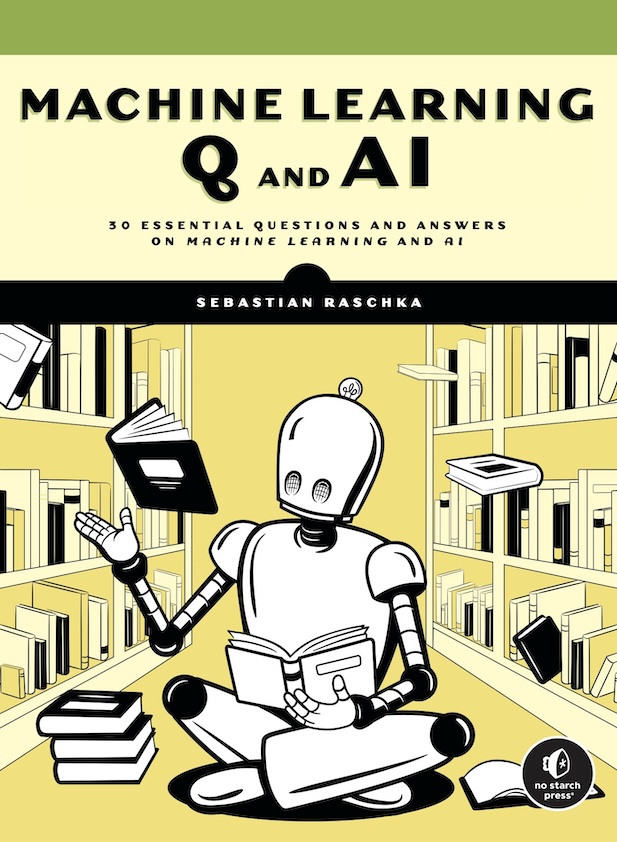
Machine Learning Q and AI Beyond the Basics Book

The Supplementary Materials for the Machine Learning Q and AI book by Sebastian Raschka.

Please use the Discussions for any questions about the book!

About the Book

If you’ve locked down the basics of machine learning and AI and want a fun way to address lingering knowledge gaps, this book is for you. This rapid-fire series of short chapters addresses 30 essential questions in the field, helping you stay current on the latest technologies you can implement in your own work.

Each chapter of Machine Learning Q and AI asks and answers a central question, with diagrams to explain new concepts and ample references for further reading

  • Multi-GPU training paradigms
  • Finetuning transformers
  • Differences between encoder- and decoder-style LLMs
  • Concepts behind vision transformers
  • Confidence intervals for ML
  • And many more!

This book is a fully edited and revised version of Machine Learning Q and AI, which was available on Leanpub.

Reviews

“One could hardly ask for a better guide than Sebastian, who is, without exaggeration, the best machine learning educator currently in the field. On each page, Sebastian not only imparts his extensive knowledge but also shares the passion and curiosity that mark true expertise.”

-- Chris Albon, Director of Machine Learning, The Wikimedia Foundation

Links

Table of Contents

Title URL Link Supplementary Code
1 Embeddings, Representations, and Latent Space
2 Self-Supervised Learning
3 Few-Shot Learning
4 The Lottery Ticket Hypothesis
5 Reducing Overfitting with Data
6 Reducing Overfitting with Model Modifications
7 Multi-GPU Training Paradigms
8 The Keys to the Success of Transformers
9 Generative AI Models
10 Sources of Randomness data-sampling.ipynb
dropout.ipynb
random-weights.ipynb
PART II: COMPUTER VISION
11 Calculating the Number of Parameters conv-size.ipynb
12 The Equivalence of Fully Connected and Convolutional Layers fc-cnn-equivalence.ipynb
13 Large Training Sets for Vision Transformers
PART III: NATURAL LANGUAGE PROCESSING
14 The Distributional Hypothesis
15 Data Augmentation for Text backtranslation.ipynb
noise-injection.ipynb
sentence-order-shuffling.ipynb
synonym-replacement.ipynb
synthetic-data.ipynb
word-deletion.ipynb
word-position-swapping.ipynb
16 “Self”-Attention
17 Encoder- And Decoder-Style Transformers
18 Using and Finetuning Pretrained Transformers
19 Evaluating Generative Large Language Models BERTScore.ipynb
bleu.ipynb
perplexity.ipynb
rouge.ipynb
PART IV: PRODUCTION AND DEPLOYMENT
20 Stateless And Stateful Training
21 Data-Centric AI
22 Speeding Up Inference
23 Data Distribution Shifts
PART V: PREDICTIVE PERFORMANCE AND MODEL EVALUATION
24 Poisson and Ordinal Regression
25 Confidence Intervals four-methods.ipynb
four-methods-vs-true-value.ipynb
26 Confidence Intervals Versus Conformal Predictions conformal_prediction.ipynb
27 Proper Metrics
28 The K in K-Fold Cross-Validation
29 Training and Test Set Discordance
30 Limited Labeled Data
排名相邻
同类项目