Universal LLM Gateway: One API, every LLM. OpenAI/Anthropic-compatible endpoints with multi-provider translation and intelligent load-balancing.
关键参数与规格
关键参数与规格
参数
值
语言
Python
类别
Infrastructure
子类别
Deploy & Serve,Orchestration
星标数
561
分叉数
50
贡献者
10
创建日期
2024-05-20
更新日期
2026-09-24
1 天星标数
0
7 天星标数
0
排名
17,003
上次排名
16,794
排名变化
-209
7 天星标排名
15,853
上次 7 天星标排名
15,859
7 天星标排名变化
6
总星标排名
17,706
上次总星标排名
17,675
总星标排名变化
-31
国家
China
README 摘录
2026) We have refactored and upgraded Llumnix to Llumnix v1, a new architecture designed to be more modular and cloud-native, and better suited for production environments. We will keep iterating Llumnix v1 in the future. , the Ray-based architecture (Llumnix v0), is a better choice for local deployments and quick prototyping and experimentation of scheduling ideas. 5] We created a developer slack for discussion and collaboration. 7] We officially released the first version of Llumnix. 6] We released our
OSDI '24 research paper on arxiv. 🚀 Why Llumnix Llumnix is a cross-instance request scheduling layer built on top of LLM inference engines such as vLLM. Llumnix provides optimized multi-instance serving performance in terms of: *Low latency* **Reduced time-to-first-token** (TTFT) and queuing delays with less memory fragmentation **Reduced time-between-tokens** (TBT) and preemption stalls with better load balancing *High throughput* Integration with state-of-the-art inference engines Support for techniques like prefill-decode disaggregation
Llumnix achieves this with: Dynamic, fine-grained, KV-cache-aware scheduling Continuous **rescheduling** across instances Enabled by a KV cache migration mechanism with near-zero overhead Exploited for continuous load balancing, de-fragmentation, and prefill-decode disaggregation Llumnix is easy to use with: Minimal code changes required for vanilla vLLM deployments Seamless integration with existing multi-instance deployment platforms Fault tolerance, elasticity, and high service availability Extensibility to more inference engines and scheduling policies Getting Started Llumnix provides two entrypoints
and for deploying Llumnix. The entrypoint provides a compatible deployment method with the default single-instance vLLM. By contrast, using the entrypoint, user can easily deploy Llumnix via Ray job submission API. If you are already utilizing vLLM for multi-instance LLM serving deployments, simply replace the vLLM serving deployment command for each instance with the command provided below: During the serving deployment execution, Llumnix will automatically configure itself and serve as the request scheduling layer on top of the
multiple vLLM engine instances. For deploying Llumnix using the module, please refer to QuickStart. Visit our documentation to get started: Quick Start Supported Models Fault Tolerance Simulator Prefill-decode Disaggregation Performance We evaluate the performance of the KV-cache-aware load-balancing scheduler and migration mechanism of Llumnix with 16 Qwen2. 5-7B instances (each using an A10-24GB GPU) and 16 Llama2-13B instances (each using an A800-80GB GPU). We use Poisson distributions with different request rates to
generate request arrivals. For the input/output lengths of requests, we use ShareGPT dataset. Llumnix outperforms a simple round-robin scheduler in TTFT (prefill) by up to 6. 1x for mean and P99, and 12% for P99 TBT (decode). Llumnix also shows significantly shorter average preemption stalls (by two orders of magnitude). With the KV-cache-aware load-balancing scheduler and the migration mechanism, Llumnix also outperforms a simple load balancing scheduler based on queue sizes in TTFT (prefill) by
up to 4. 1x for mean and P99, and 15% for P99 TBT (decode). Roadmap Llumnix is currently in an
We have refactored and upgraded Llumnix to Llumnix v1, a new architecture designed to be more modular and cloud-native, and better suited for production environments. We will keep iterating Llumnix v1 in the future. See the new repository for details!
This repository, i.e., the Ray-based architecture (Llumnix v0), is a better choice for local deployments and quick prototyping and experimentation of scheduling ideas.
🔥 Latest News
[2025.5] We created a developer slack for discussion and collaboration.
[2025.1] We updated vLLM to version v0.6.3.post1.
[2024.11] Llumnix v0.1.0 launched!
[2024.7] We officially released the first version of Llumnix.
[2024.6] We released our OSDI '24 research paper on arxiv.
🚀 Why Llumnix
Llumnix is a cross-instance request scheduling layer built on top of LLM inference engines such as vLLM.
Llumnix provides optimized multi-instance serving performance in terms of:
Low latency
Reduced time-to-first-token (TTFT) and queuing delays with less memory fragmentation
Reduced time-between-tokens (TBT) and preemption stalls with better load balancing
High throughput
Integration with state-of-the-art inference engines
Support for techniques like prefill-decode disaggregation
Llumnix achieves this with:
Dynamic, fine-grained, KV-cache-aware scheduling
Continuous rescheduling across instances
Enabled by a KV cache migration mechanism with near-zero overhead
Exploited for continuous load balancing, de-fragmentation, and prefill-decode disaggregation
Llumnix is easy to use with:
Minimal code changes required for vanilla vLLM deployments
Seamless integration with existing multi-instance deployment platforms
Fault tolerance, elasticity, and high service availability
Extensibility to more inference engines and scheduling policies
Getting Started
Llumnix provides two entrypoints api_server and serve for deploying Llumnix. The api_server entrypoint provides a compatible deployment method with the default single-instance vLLM. By contrast, using the serve entrypoint, user can easily deploy Llumnix via Ray job submission API.
If you are already utilizing vLLM for multi-instance LLM serving deployments, simply replace the vLLM serving deployment command python -m entrypoints.vllm.api_server ... for each instance with the command provided below:
During the serving deployment execution, Llumnix will automatically configure itself and serve as the request scheduling layer on top of the multiple vLLM engine instances.
For deploying Llumnix using the serve module, please refer to QuickStart.
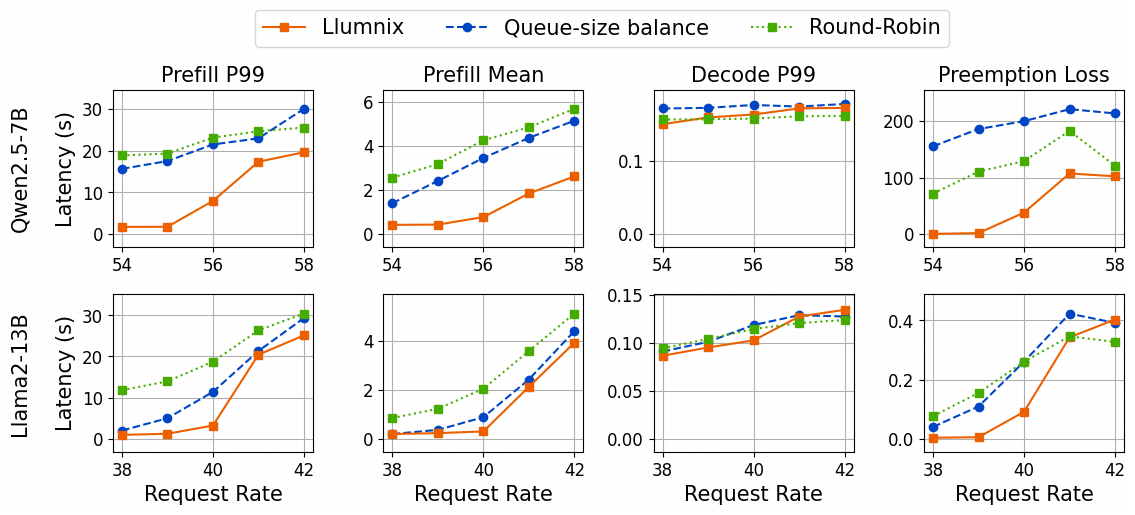
We evaluate the performance of the KV-cache-aware load-balancing scheduler and migration mechanism of Llumnix with 16 Qwen2.5-7B instances (each using an A10-24GB GPU) and 16 Llama2-13B instances (each using an A800-80GB GPU).
We use Poisson distributions with different request rates to generate request arrivals. For the input/output lengths of requests, we use ShareGPT dataset.
Llumnix outperforms a simple round-robin scheduler in TTFT (prefill) by up to 6.4x and 12.1x for mean and P99, and 12% for P99 TBT (decode). Llumnix also shows significantly shorter average preemption stalls (by two orders of magnitude).
With the KV-cache-aware load-balancing scheduler and the migration mechanism, Llumnix also outperforms a simple load balancing scheduler based on queue sizes in TTFT (prefill) by up to 4.6x and 9.1x for mean and P99, and 15% for P99 TBT (decode).
Roadmap
Llumnix is currently in an alpha stage. Moving forward, we have work items planned including but not limited to:
Architectural improvement: improving the scalability and efficiency of distributed serving and coordination;
New features: incorporating more inference engine features;
Engineering: testing, CI/CD, etc.
Publication
Please cite our paper if you use Llumnix in your research:
@inproceedings{sun2024llumnix,
  title={Llumnix: Dynamic Scheduling for Large Language Model Serving},
  author={Biao Sun and Ziming Huang and Hanyu Zhao and Wencong Xiao and Xinyi Zhang and Yong Li and Wei Lin},
  booktitle={18th USENIX Symposium on Operating Systems Design and Implementation (OSDI 24)},
  year={2024}
}