The code for the bark-voicecloning model. Training and inference.
关键参数与规格
关键参数与规格
参数
值
语言
Python
类别
Models
子类别
Audio/Speech models
关键词
Text-to-speech
星标数
717
分叉数
153
贡献者
2
创建日期
2020-05-19
更新日期
2026-10-15
1 天星标数
0
7 天星标数
1
排名
14,613
上次排名
6,563
排名变化
-8,050
7 天星标排名
10,843
上次 7 天星标排名
10,907
7 天星标排名变化
64
总星标排名
14,611
上次总星标排名
14,576
总星标排名变化
-35
国家
South Korea
README 摘录
Glow-TTS: A Generative Flow for Text-to-Speech via Monotonic Alignment Search Jaehyeon Kim, Sungwon Kim, Jungil Kong, and Sungroh Yoon In our recent paper, we propose Glow-TTS: A Generative Flow for Text-to-Speech via Monotonic Alignment Search. Recently, text-to-speech (TTS) models such as FastSpeech and ParaNet have been proposed to generate mel-spectrograms from text in parallel. Despite the advantage, the parallel TTS models cannot be trained without guidance from autoregressive TTS models as
their external aligners. In this work, we propose Glow-TTS, a flow-based generative model for parallel TTS that does not require any external aligner. By combining the properties of flows and dynamic programming, the proposed model searches for the most probable monotonic alignment between text and the latent representation of speech on its own. We demonstrate that enforcing hard monotonic alignments enables robust TTS, which generalizes to long utterances, and employing generative flows enables fast, diverse, and controllable speech
synthesis. Glow-TTS obtains an order-of-magnitude speed-up over the autoregressive model, Tacotron 2, at synthesis with comparable speech quality. We further show that our model can be easily extended to a multi-speaker setting. Update Notes* This result was not included in the paper. Lately, we found that two modifications help to improve the synthesis quality of Glow-TTS. ; 1) moving to a vocoder, HiFi-GAN to reduce noise, 2) putting a blank token between any two
input tokens to improve pronunciation. Specifically, we used a fine-tuned vocoder with Tacotron 2 which is provided as a pretrained model in the HiFi-GAN repo. If you're interested, please listen to the samples in our demo. For adding a blank token, we provide a config file and a pretrained model. We also provide an inference example inference_hifigan. You may need to initialize HiFi-GAN submodule: 1. 0 For Mixed-precision training, we use apex; commit: 37cdaf4 2
. Pre-requisites a) Download and extract the LJ Speech dataset, then rename or create a link to the dataset folder: b) Initialize WaveGlow submodule: Don't forget to download pretrained WaveGlow model and place it into the waveglow folder. c) Build Monotonic Alignment Search Code (Cython): 3. ipynb Acknowledgements Our implementation is hugely influenced by the following repos: WaveGlow Tensor2Tensor Mellotron
Glow-TTS: A Generative Flow for Text-to-Speech via Monotonic Alignment Search
Jaehyeon Kim, Sungwon Kim, Jungil Kong, and Sungroh Yoon
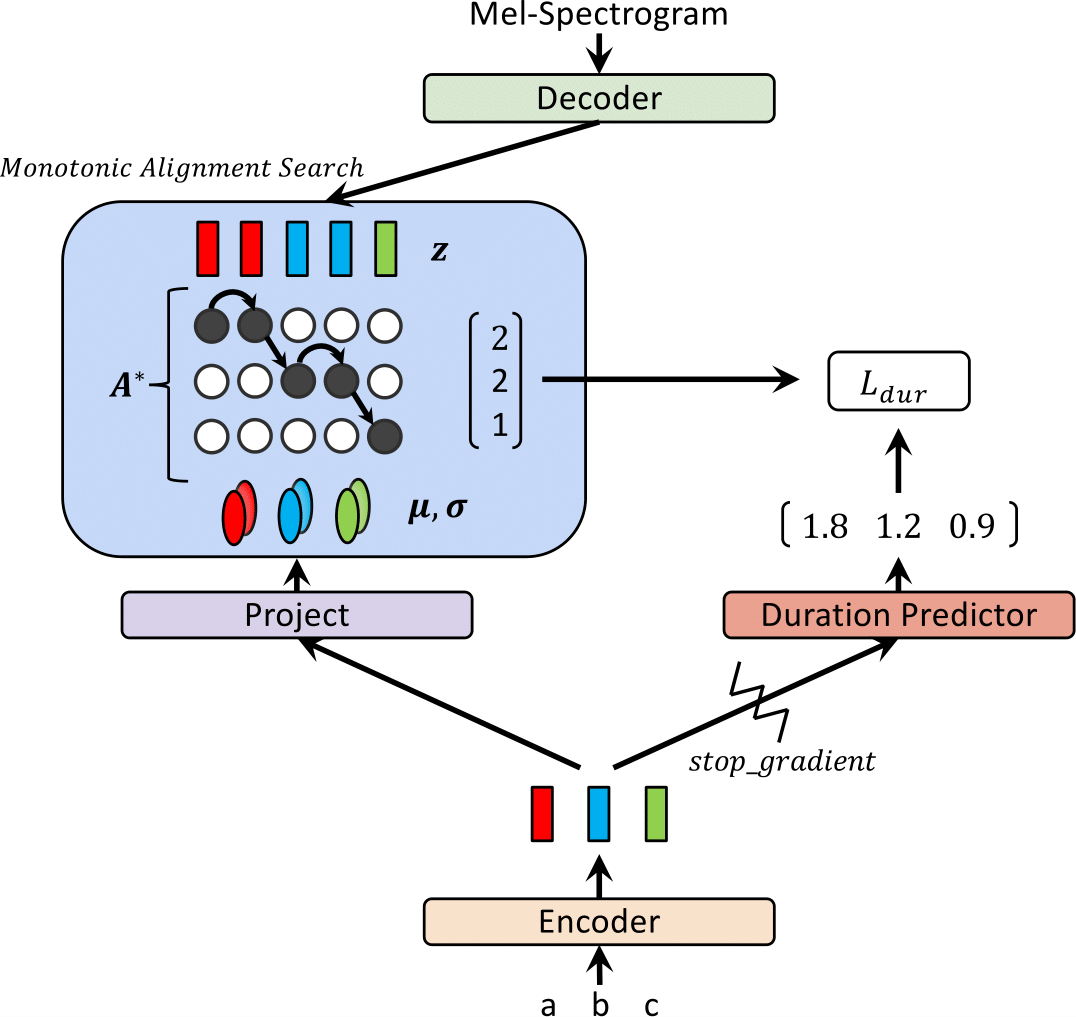
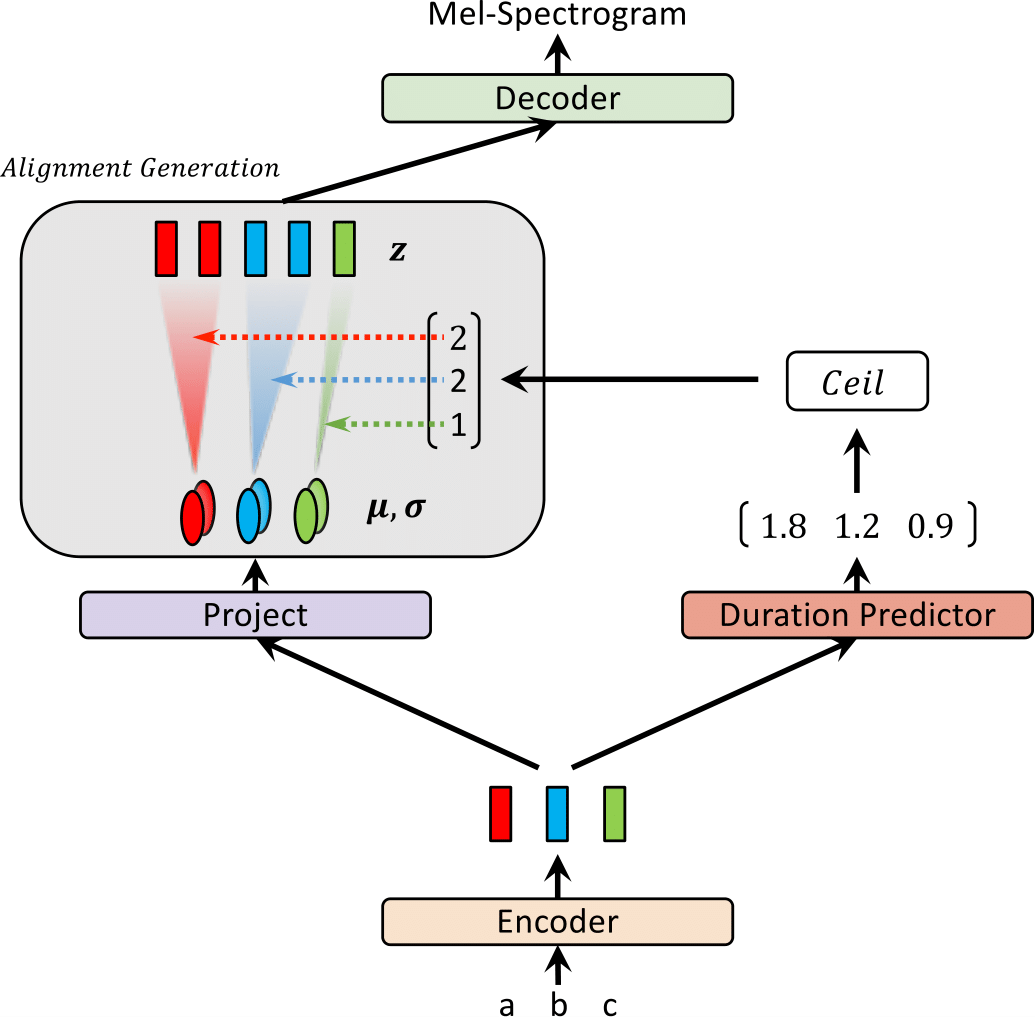
In our recent paper, we propose Glow-TTS: A Generative Flow for Text-to-Speech via Monotonic Alignment Search.
Recently, text-to-speech (TTS) models such as FastSpeech and ParaNet have been proposed to generate mel-spectrograms from text in parallel. Despite the advantage, the parallel TTS models cannot be trained without guidance from autoregressive TTS models as their external aligners. In this work, we propose Glow-TTS, a flow-based generative model for parallel TTS that does not require any external aligner. By combining the properties of flows and dynamic programming, the proposed model searches for the most probable monotonic alignment between text and the latent representation of speech on its own. We demonstrate that enforcing hard monotonic alignments enables robust TTS, which generalizes to long utterances, and employing generative flows enables fast, diverse, and controllable speech synthesis. Glow-TTS obtains an order-of-magnitude speed-up over the autoregressive model, Tacotron 2, at synthesis with comparable speech quality. We further show that our model can be easily extended to a multi-speaker setting.
This result was not included in the paper. Lately, we found that two modifications help to improve the synthesis quality of Glow-TTS.; 1) moving to a vocoder, HiFi-GAN to reduce noise, 2) putting a blank token between any two input tokens to improve pronunciation. Specifically,
we used a fine-tuned vocoder with Tacotron 2 which is provided as a pretrained model in the HiFi-GAN repo. If you're interested, please listen to the samples in our demo.
For adding a blank token, we provide a config file and a pretrained model. We also provide an inference example inference_hifigan.ipynb. You may need to initialize HiFi-GAN submodule: git submodule init; git submodule update
1. Environments we use
Python3.6.9
pytorch1.2.0
cython0.29.12
librosa0.7.1
numpy1.16.4
scipy1.3.0
For Mixed-precision training, we use apex; commit: 37cdaf4
2. Pre-requisites
a) Download and extract the LJ Speech dataset, then rename or create a link to the dataset folder: ln -s /path/to/LJSpeech-1.1/wavs DUMMY
b) Initialize WaveGlow submodule: git submodule init; git submodule update
Don't forget to download pretrained WaveGlow model and place it into the waveglow folder.
c) Build Monotonic Alignment Search Code (Cython): cd monotonic_align; python setup.py build_ext --inplace