TradingGym

TradingGym is a toolkit for training and backtesting the reinforcement learning algorithms. This was inspired by OpenAI Gym and imitated the framework form. Not only traning env but also has backtesting and in the future will implement realtime trading env with Interactivate Broker API and so on.
This training env originally design for tickdata, but also support for ohlc data format. WIP.
Installation
git clone https://github.com/Yvictor/TradingGym.git
cd TradingGym
python setup.py install
Getting Started
import random
import numpy as np
import pandas as pd
import trading_env

df = pd.read_hdf('dataset/SGXTW.h5', 'STW')

env = trading_env.make(env_id='training_v1', obs_data_len=256, step_len=128,
                       df=df, fee=0.1, max_position=5, deal_col_name='Price',
                       feature_names=['Price', 'Volume',
                                      'Ask_price','Bid_price',
                                      'Ask_deal_vol','Bid_deal_vol',
                                      'Bid/Ask_deal', 'Updown'])

env.reset()
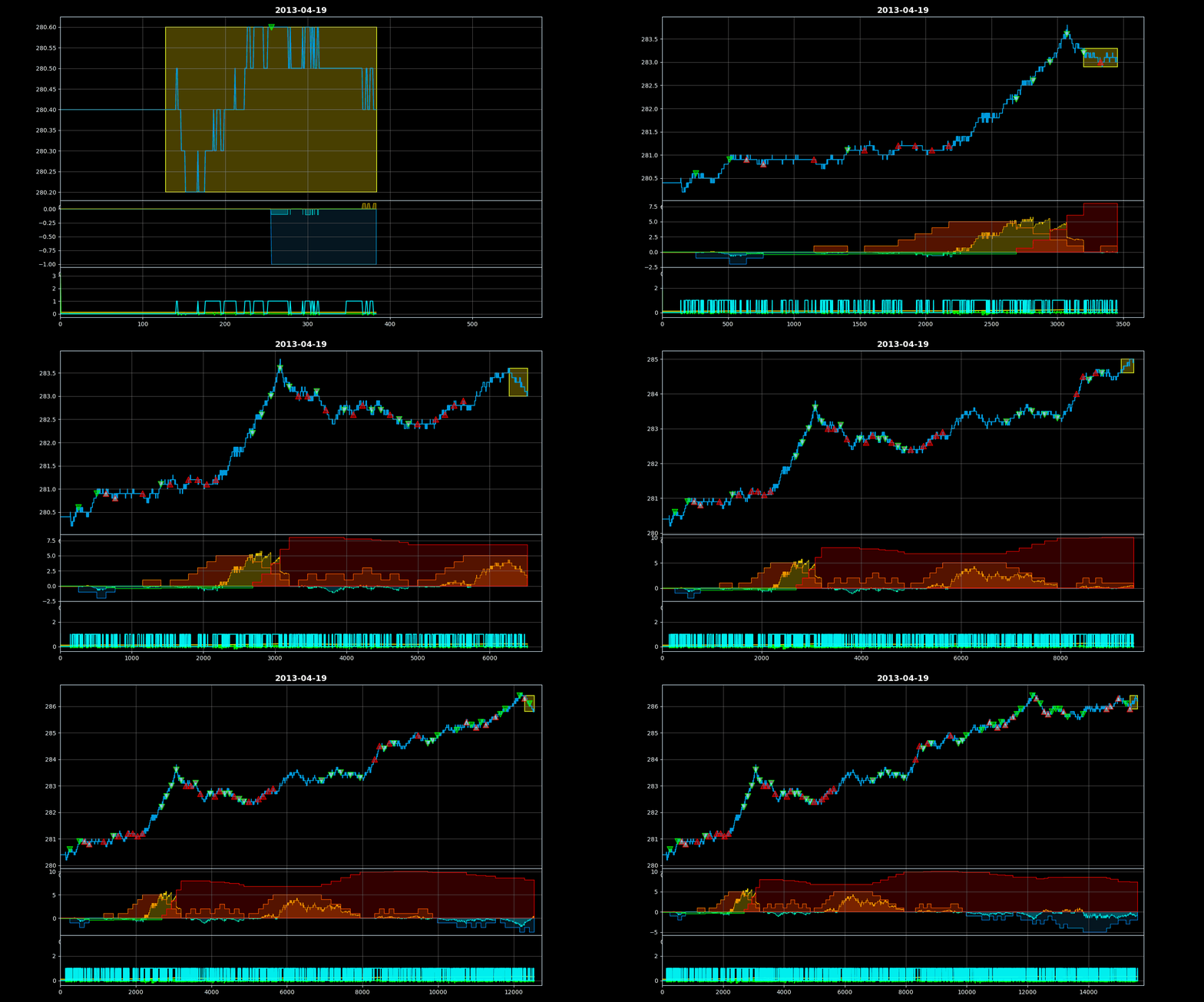
env.render()

state, reward, done, info = env.step(random.randrange(3))

### randow choice action and show the transaction detail
for i in range(500):
    print(i)
    state, reward, done, info = env.step(random.randrange(3))
    print(state, reward)
    env.render()
    if done:
        break
env.transaction_details
- obs_data_len: observation data length
- step_len: when call step rolling windows will + step_len
- df exmaple
index datetime bid ask price volume serial_number dealin 0 2010-05-25 08:45:00 7188.0 7188.0 7188.0 527.0 0.0 0.0 1 2010-05-25 08:45:00 7188.0 7189.0 7189.0 1.0 1.0 1.0 2 2010-05-25 08:45:00 7188.0 7189.0 7188.0 1.0 2.0 -1.0 3 2010-05-25 08:45:00 7188.0 7189.0 7188.0 4.0 3.0 -1.0 4 2010-05-25 08:45:00 7188.0 7189.0 7188.0 2.0 4.0 -1.0
- df: dataframe that contain data for trading
serial_number -> serial num of deal at each day recalculating
- fee: when each deal will pay the fee, set with your product.
- max_position: the max market position for you trading share.
- deal_col_name: the column name for cucalate reward used.
- feature_names: list contain the feature columns to use in trading status.
Training
simple dqn
- WIP
policy gradient
- WIP
actor-critic
- WIP
A3C with RNN
- WIP
Backtesting
- loading env just like training
env = trading_env.make(env_id='backtest_v1', obs_data_len=1024, step_len=512,
                       df=df, fee=0.1, max_position=5, deal_col_name='Price',
                        feature_names=['Price', 'Volume',
                                       'Ask_price','Bid_price',
                                       'Ask_deal_vol','Bid_deal_vol',
                                       'Bid/Ask_deal', 'Updown'])
- load your own agent
class YourAgent:
    def __init__(self):
        # build your network and so on
        pass
    def choice_action(self, state):
        ## your rule base conditon or your max Qvalue action or Policy Gradient action
         # action=0 -> do nothing
         # action=1 -> buy 1 share
         # action=2 -> sell 1 share
        ## in this testing case we just build a simple random policy
        return np.random.randint(3)
- start to backtest
agent = YourAgent()

transactions = []
while not env.backtest_done:
    state = env.backtest()
    done = False
    while not done:
        state, reward, done, info = env.step(agent.choice_action(state))
        #print(state, reward)
        #env.render()
        if done:
            transactions.append(info)
            break
transaction = pd.concate(transactions)
transaction
step
datetime
transact
transact_type
price
share
price_mean
position
reward_fluc
reward
reward_sum
color
rotation
2
1537
2013-04-09 10:58:45
Buy
new
277.1
1.0
277.100000
1.0
0.000000e+00
0.000000e+00
0.000000
1
1
5
3073
2013-04-09 11:47:26
Sell
cover
276.8
-1.0
277.100000
0.0
-4.000000e-01
-4.000000e-01
-0.400000
2
2
10
5633
2013-04-09 13:23:40
Sell
new
276.9
-1.0
276.900000
-1.0
0.000000e+00
0.000000e+00
-0.400000
2
1
11
6145
2013-04-09 13:30:36
Sell
new
276.7
-1.0
276.800000
-2.0
1.000000e-01
0.000000e+00
-0.400000
2
1
...
...
...
...
...
...
...
...
...
...
...
...
...
...
211
108545
2013-04-19 13:18:32
Sell
new
286.7
-1.0
286.525000
-2.0
-4.500000e-01
0.000000e+00
30.650000
2
1
216
111105
2013-04-19 16:02:01
Sell
new
289.2
-1.0
287.416667
-3.0
-5.550000e+00
0.000000e+00
30.650000
2
1
217
111617
2013-04-19 17:54:29
Sell
new
289.2
-1.0
287.862500
-4.0
-5.650000e+00
0.000000e+00
30.650000
2
1
218
112129
2013-04-19 21:36:21
Sell
new
288.0
-1.0
287.890000
-5.0
-9.500000e-01
0.000000e+00
30.650000
2
1
219
112129
2013-04-19 21:36:21
Buy
cover
288.0
5.0
287.890000
0.0
0.000000e+00
-1.050000e+00
29.600000
1
2
128 rows × 13 columns
exmaple of rule base usage
- ma crossover and crossunder
env = trading_env.make(env_id='backtest_v1', obs_data_len=10, step_len=1,
                       df=df, fee=0.1, max_position=5, deal_col_name='Price',
                       feature_names=['Price', 'MA'])
class MaAgent:
    def __init__(self):
        pass

    def choice_action(self, state):
        if state[-1][0] > state[-1][1] and state[-2][0] <= state[-2][1]:
            return 1
        elif state[-1][0] < state[-1][1] and state[-2][0] >= state[-2][1]:
            return 2
        else:
            return 0
# then same as above