
FedLab: A Flexible Federated Learning Framework


Federated learning (FL), proposed by Google at the very beginning, is recently a burgeoning research area of machine learning, which aims to protect individual data privacy in the distributed machine learning processes, especially in finance, smart healthcare, and edge computing. Different from traditional data-centered distributed machine learning, participants in the FL setting utilize localized data to train local models, then leverages specific strategies with other participants to acquire the final model collaboratively, avoiding direct data-sharing behavior.
To relieve the burden of researchers in implementing FL algorithms and emancipate FL scientists from the repetitive implementation of basic FL settings, we introduce a highly customizable framework FedLab in this work. FedLab provides the necessary modules for FL simulation, including communication, compression, model optimization, data partition and other functional modules. Users can build an FL simulation environment with custom modules like playing with LEGO bricks. For better understanding and easy usage, the FL baseline algorithms implemented via FedLab are also presented.
Quick start
Install
- Install the latest version from source code:
$ git clone git@github.com:SMILELab-FL/FedLab.git
$ cd FedLab
$ pip install -r requirements.txt
- Install the stable version (old version) via pip:
# assign the version fedlab==1.3.0
$ pip install fedlab
Learning materials
We provide tutorials in jupyter notebook format for FedLab beginners in FedLab\tutorials. These tutorials include data partition, customized algorithms, and pipeline demos. For the FedLab or FL beginners, we recommend this notebook. Furthermore, we provide reproductions of federated algorithms via FedLab, which are stored in fedlab.contirb.algorithm. We think they are good examples for users to further explore FedLab.
Website Documentations are available:
Run Examples
- Run our quick start examples of different scenarios with a partitioned MNIST dataset.
# example of standalone
$ cd ./examples/standalone/
$ python standalone.py --total_clients 100 --com_round 3 --sample_ratio 0.1 --batch_size 100 --epochs 5 --lr 0.02
Architecture
Files architecture of FedLab. These contents may be helpful for users to understand our repo.
├── fedlab
│   ├── contrib
│   ├── core
│   ├── models
│   └── utils
├── datasets
│   └── ...
├── examples
│   ├── asynchronous-cross-process-mnist
│   ├── cross-process-mnist
│   ├── hierarchical-hybrid-mnist
│   ├── network-connection-checker
│   ├── scale-mnist
│   └── standalone-mnist
└── tutorials
    ├── communication_tutorial.ipynb
    ├── customize_tutorial.ipynb
    ├── pipeline_tutorial.ipynb
    └── ...
Baselines
We provide the reproduction of baseline federated algorthms for users in this repo.
Datasets & Data Partition
Sophisticated in the real world, FL needs to handle various kind of data distribution scenarios, including iid and non-iid scenarios. Though there already exists some datasets and partition schemes for published data benchmark, it still can be very messy and hard for researchers to partition datasets according to their specific research problems, and maintain partition results during simulation. FedLab provides fedlab.utils.dataset.partition.DataPartitioner that allows you to use pre-partitioned datasets as well as your own data. DataPartitioner stores sample indices for each client given a data partition scheme. Also, FedLab provides some extra datasets that are used in current FL researches while not provided by official PyTorch torchvision.datasets yet.
Data Partition
We provide multiple data partition schemes used in recent FL papers[1][2][3]. Here we show the data partition visualization of several common used datasets as the examples.
1. Balanced IID partition
Each client has same number of samples, and same distribution for all class samples.
Given 100 clients and CIFAR10, the data samples assigned to the first 10 clients could be:

2. Unbalanced IID partition
Assign different sample number for each client using Log-Normal distribution $\text{Log-N}(0, \sigma^2)$, while keep same distribution for different class samples.
Given $\sigma=0.3$, 100 clients and CIFAR10, the data samples assigned to the first 10 clients is showed left below. And distribution of sample number for clients is showed right below.


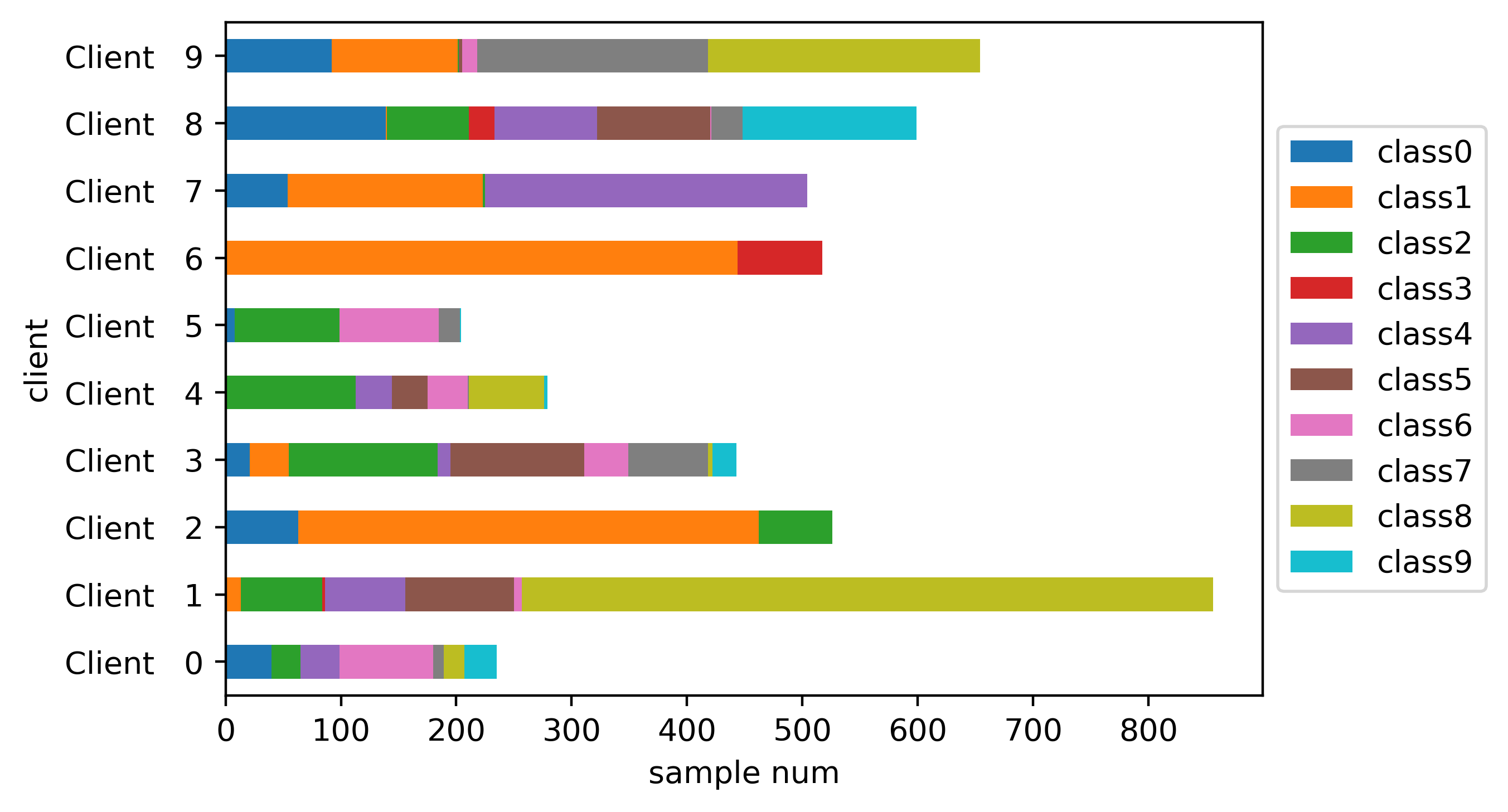
3. Hetero Dirichlet partition
Non-iid partition used in [3] and [6]. Number of data points and class proportions are unbalanced. Samples will be partitioned into $J$ clients by sampling $p_k∼\text{Dir}J(\alpha)$ and allocating a $p{k,j}$ proportion of the samples of class $k$ to local client $j$.
Given 100 clients, $\alpha=0.3$ and CIFAR10, the data samples assigned to the first 10 clients is showed left below. And distribution of sample number for clients is showed right below.

4. Shards partition
Non-iid partition based on shards, used in [4].
Given shard_number=200, 100 clients and CIFAR10, the data samples assigned to the first 10 clients could be:

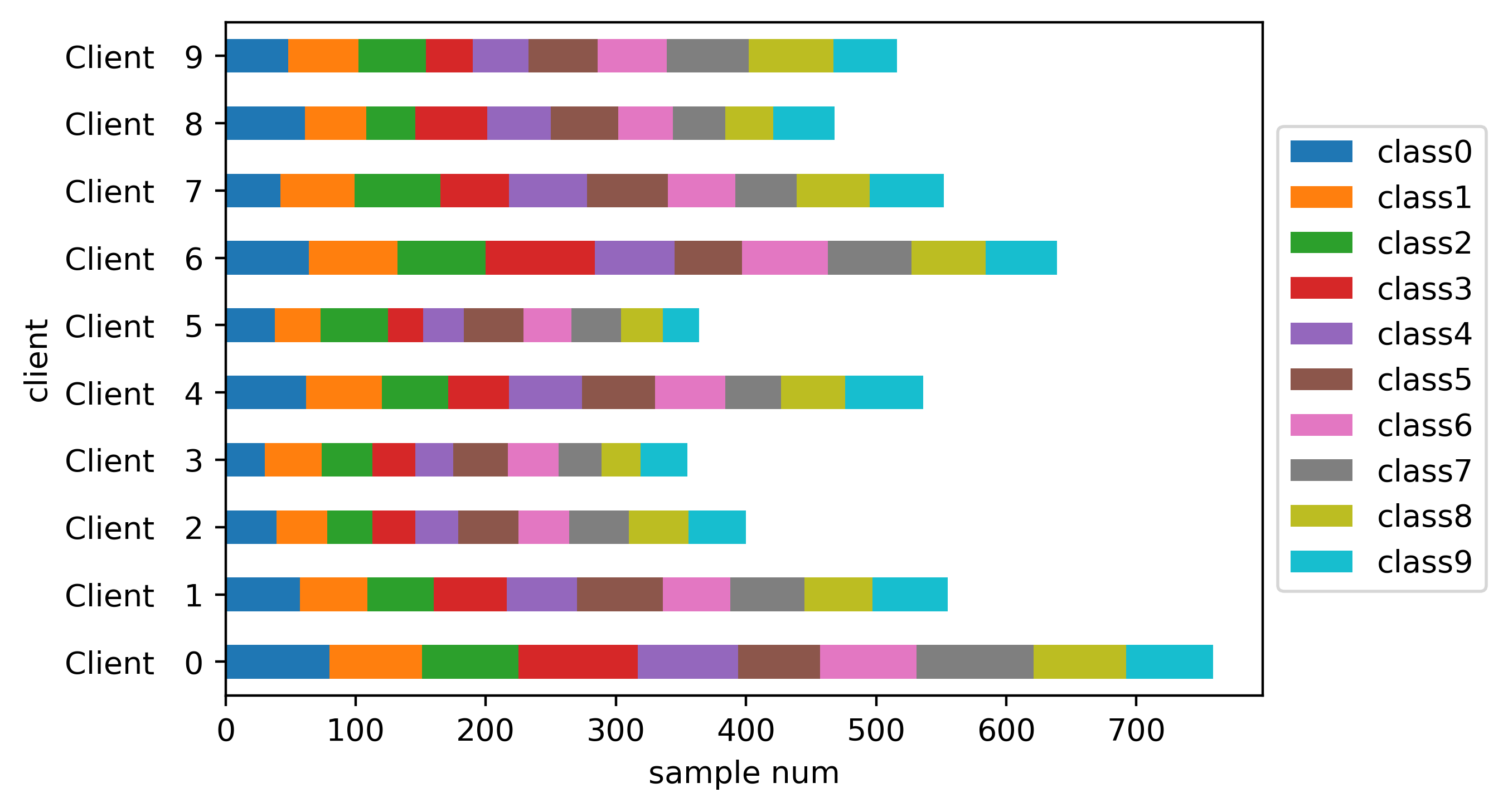
5. Balanced Dirichlet partition
Non-iid partition used in [5]. Each client has same number of samples, while class distribution in each client follows Dirichlet distribution $\text{Dir}{(\alpha)}$.
Given $\alpha=0.3$, 100 clients and CIFAR10, the data samples assigned to the first 10 clients could be:

6. Unbalanced Dirichlet partition
Non-iid partition used in [5]. Sample numbers of clients are drawn from Log-normal distribution $\text{Log-N}(0, \sigma^2)$, while class distribution in each client follows Dirichlet distribution $\text{Dir}{(\alpha)}$.
Given $\sigma=0.3$, $\alpha=0.3$, 100 clients and CIFAR10, the data samples assigned to the first 10 clients is showed left below. And distribution of sample number for clients is showed right below.

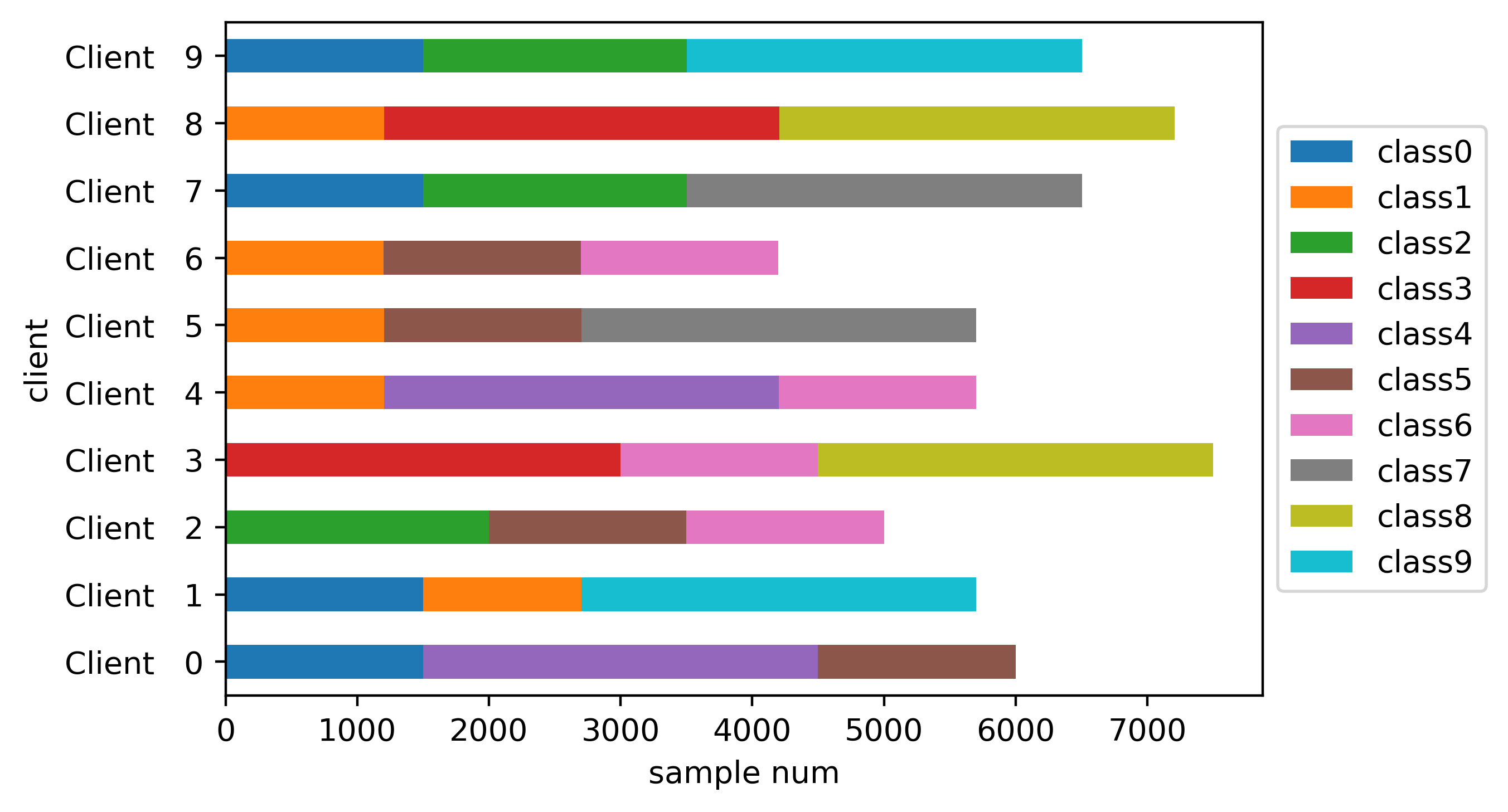
7. Quantity-based Label Distribution Skew partition
Non-iid partition used in [1]. Each client has only specific number of sample class.
Given class number for each client as $3$, 10 clients and FashionMNIST, the data samples assigned to each client could be:
8. Noise-based Feature Distribution Skew partition
Non-iid partition used in [1]. Different client's sample feature has different levels of Gaussian noise. Data example for 10 clients could be:

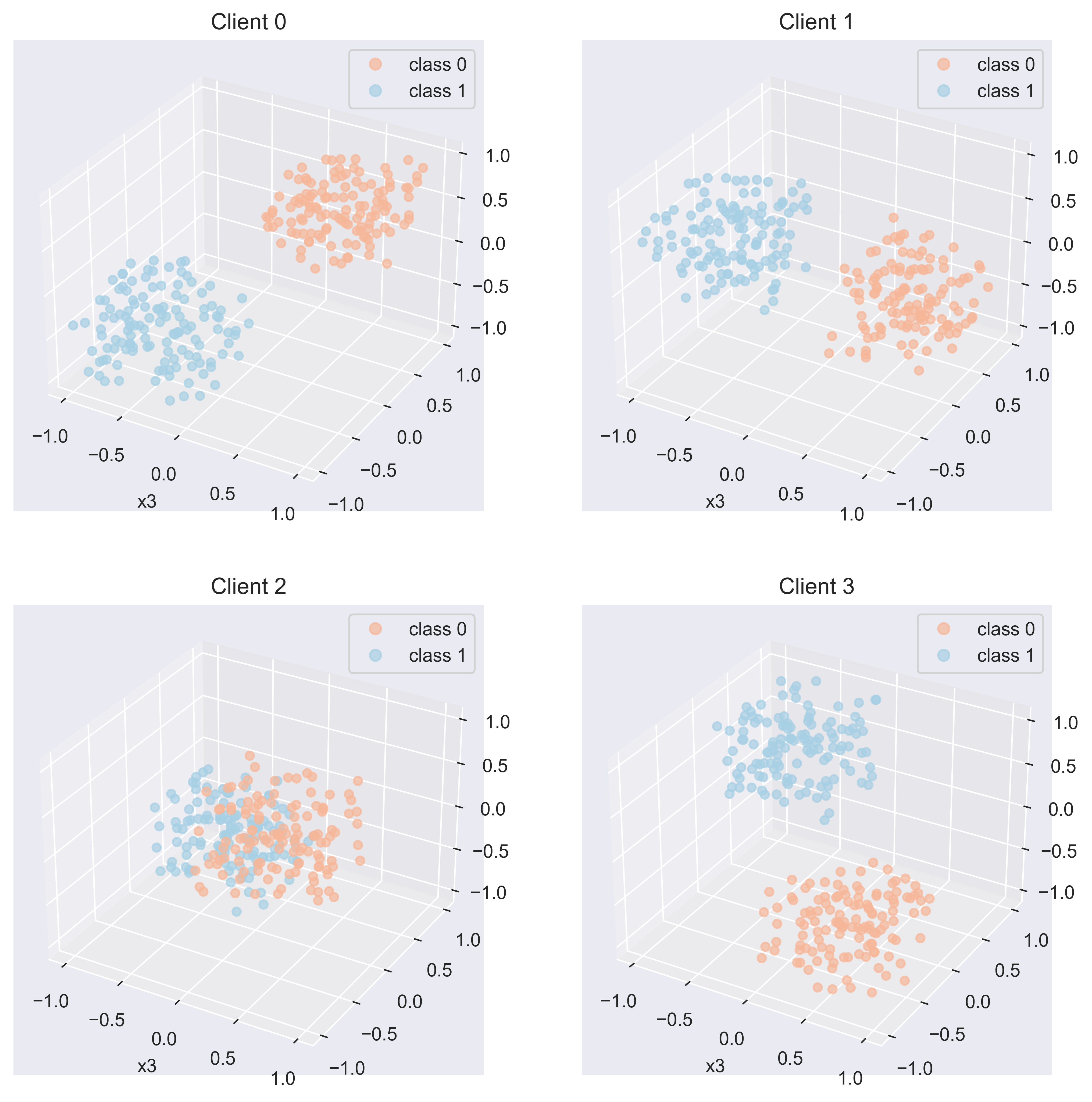
9. FCUBE Synthetic partition
Non-iid partition used in [1]. Data example for 4 clients could be shown as:
Datasets supported
Data Type
Data Name
#Training Samples
#Test Samples
#Label Classes
Vision data
CIFAR10
50K
10K
10
CIFAR100
50K
10K
100
FashionMNIST
60K
10K
10
MNIST
60K
10K
10
SVHN
73K
26K
10
CelebA
200, 288
2
FEMNIST
805, 263
62
Text data
Shakespeare
4, 226, 158
Sent14
1, 600, 498
3
56, 587, 343
Tabular data
32, 561
16, 281
2
581, 012
2
20, 242
677, 399
2
Synthetic data
FCUBE
-
-
2
LEAF-Synthetic
-
-
-
Partition Visualization
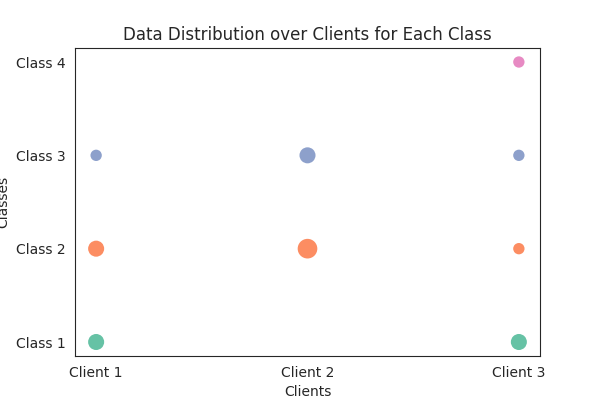
For data distribution visualization in data partition, we provide fedlab.utils.dataset.functional.feddata_scatterplot() for users' convenience.
Visualization for synthetic partition code below:
import numpy as np
from matplotlib import pyplot as plt
from fedlab.utils.dataset.functional import feddata_scatterplot

sample_num = 15
class_num = 4
clients_num = 3
num_per_client = int(sample_num/clients_num)
labels = np.random.randint(class_num, size=sample_num)  # generate 15 labels, each label is 0 to 3
rand_per = np.random.permutation(sample_num)
# partition synthetic data into 3 clients
data_indices = {0: rand_per[0:num_per_client],
                1: rand_per[num_per_client:num_per_client*2],
                2: rand_per[num_per_client*2:num_per_client*3]}
title = 'Data Distribution over Clients for Each Class'
fig = feddata_scatterplot(labels.tolist(),
                          data_indices,
                          clients_num,
                          class_num,
                          figsize=(6, 4),
                          max_size=200,
                          title=title)
plt.show(fig)
fig.savefig(f'imgs/feddata-scatterplot-vis.png')
Visualization result for CIFAR-10 Dirichlet Non-IID with $\alpha=0.6$ on 5 clients:

Performance & Insights
We provide the performance report of several reproduced federated learning algorithms to illustrate the correctness of FedLab in simulation. Furthermore, we describe several insights FedLab could provide for federated learning research. Without loss of generality, this section's experiments are conducted on partitioned MNIST datasets. The conclusions and observations in this section should still be valid in other data sets and scenarios.
Federated Optimization on Non-IID Data
We choose $\alpha = [0.1, 0.3, 0.5, 0.7]$ in label Dirichlet partitioned MNIST with 100 clients. We run 200 rounds of FedAvg with 5 local batches with full batch, learning rate 0.1, and sample ratio 0.1 (10 clients for each FL round). The test accuracy over the communication round is shown below. The results reveal the most vital challenge in federated learning.

We use the same partitioned MNIST dataset in FedAvg[4] to evaluate the corectness of FedLab. The rounds for FedAvg to achieve 97% test accuracy on MNIST using 2NN with E=5 reported in [4] / FedLab:
Sample ratio
IID
Non-IID
B=FULL
B=10
B=FULL
B=10
0.0
1455 / 1293
316 / 77
4278 / 1815
3275 / 1056
0.1
1474 / 1230
87 / 43
1796 / 2778
664 / 439
0.2
1658 / 1234
77 / 37
1528 / 2805
619 / 427
0.5
-- / 1229
75 / 36
-- / 3034
443 / 474
1.0
-- / 1284
70 / 35
-- / 3154
380 / 507
The results are obtained by running the tutorial with random seed 0.
Simulation Efficiency
Time cost in 100 rounds (50 clients are sampled per round) under different acceleration settings. 1M-10P stands for the simulation runs on 1 machine with 4 GPUs and 10 processes. 2M-10P stands for the simulation runs on 2 machines with 4 GPUs and 10 processes (5 processes on each machine).
Hardware platform: Intel(R) Xeon(R) Gold 6240L CPU @ 2.60GHz + Tesla V100 * 4.
| Standalone | Cross-process 1M-10P | Cross-process 2M-10P |
|---|---|---|
| 45.6 Min | 2.9 Min | 4.23 Min |
The results are obtained by running the tutorial and an example of cross-process scenario. Besides, the results reveal the simulation efficiency of FedLab under different simulation modes. Cross-process with 2 machines could be slower in this setting due to communication bottleneck.
Communication Efficiency
We provide a few performance baselines in communication-efficient federated learning including QSGD and top-k. In the experiment setting, we choose $\alpha = 0.5$ in the label Dirichlet partitioned MNIST with 100 clients. We run 200 rounds with a sample ratio of 0.1 (10 clients for each FL round) of FedAvg, where each client performs 5 local epochs of SGD with a full batch and learning rate of 0.1. We report the top-1 test accuracy and its communication volume during the training.
| Setting | Baseline | QSGD-4bit | QSGD-8bit | QSGD-16bit | Top-5% | Top-10% | Top-20% |
|---|---|---|---|---|---|---|---|
| Test Accuracy (%) | 93.14 | 93.03 | 93.27 | 93.11 | 11.35 | 61.25 | 89.96 |
| Communication (MB) | 302.45 | 45.59 | 85.06 | 160.67 | 0.94 | 1.89 | 3.79 |
The above results are obtained by running the tutorial.
Citation
Please cite FedLab if it helps your research:
@article{JMLR:v24:22-0440,
  author  = {Dun Zeng and Siqi Liang and Xiangjing Hu and Hui Wang and Zenglin Xu},
  title   = {FedLab: A Flexible Federated Learning Framework},
  journal = {Journal of Machine Learning Research},
  year    = {2023},
  volume  = {24},
  number  = {100},
  pages   = {1--7},
  url     = {http://jmlr.org/papers/v24/22-0440.html}
}
Contact
Project Investigator: Prof. Zenglin Xu.
For technical issues related to FedLab development, please contact our development team through Github issues or email:
References
[1] Li, Q., Diao, Y., Chen, Q., & He, B. (2022, May). Federated learning on non-iid data silos: An experimental study. In 2022 IEEE 38th International Conference on Data Engineering (ICDE) (pp. 965-978). IEEE.
[2] Caldas, S., Duddu, S. M. K., Wu, P., Li, T., Konečný, J., McMahan, H. B., ... & Talwalkar, A. (2018). Leaf: A benchmark for federated settings. arXiv preprint arXiv:1812.01097.
[3] Yurochkin, M., Agarwal, M., Ghosh, S., Greenewald, K., Hoang, N., & Khazaeni, Y. (2019, May). Bayesian nonparametric federated learning of neural networks. In International Conference on Machine Learning (pp. 7252-7261). PMLR.
[4] McMahan, B., Moore, E., Ramage, D., Hampson, S., & y Arcas, B. A. (2017, April). Communication-efficient learning of deep networks from decentralized data. In Artificial intelligence and statistics (pp. 1273-1282). PMLR.
[5] Acar, D. A. E., Zhao, Y., Navarro, R. M., Mattina, M., Whatmough, P. N., & Saligrama, V. (2021). Federated learning based on dynamic regularization. arXiv preprint arXiv:2111.04263.
[6] Wang, H., Yurochkin, M., Sun, Y., Papailiopoulos, D., & Khazaeni, Y. (2020). Federated learning with matched averaging. arXiv preprint arXiv:2002.06440.