← 开源
Kyubyong

dc_tts

A TensorFlow Implementation of DC-TTS: yet another text-to-speech model

ModelsAudio/Speech modelsPython
在 GitHub 打开
增长势头
+024 小时新增 Star0.0%
1.16k
Star
360
Fork
+0
本周
2
贡献者
创建于 2017-11-23 · 更新于 2026-09-05 · 今日第 11351 名
主要开发者
Kyubyongw19787

Kyubyong/dc_tts 排名第 11,351,有 1,159 个星标。

同类别比较

Kyubyong/dc_tts 排名第 11,351,此处有 8 个同类条目;spring-media/TransformerTTS 排名第 11,341。

同类别比较
名称排名指标
cure-lab/MagicDrive11,331
语言:
Python
星标数:
1,165
分叉数:
52
简介:
[ICLR24] Official implementation of the paper “MagicDrive: Street View Generation with Diverse 3D Geometry Control”
Text-to-Audio/AudioLCM11,333
语言:
Python
星标数:
1,164
分叉数:
158
简介:
PyTorch Implementation of AudioLCM (ACM-MM'24): a efficient and high-quality text-to-audio generation with latent consistency model.
bawangxx/XZVoice11,340
语言:
Vue
星标数:
1,162
分叉数:
319
简介:
Free and open source text-to-speech software
spring-media/TransformerTTS11,341
语言:
Python
星标数:
1,162
分叉数:
222
简介:
🤖💬 Transformer TTS: Implementation of a non-autoregressive Transformer based neural network for text to speech.
shyamsn97/mario-gpt11,368
语言:
Python
星标数:
1,156
分叉数:
105
简介:
[Neurips 2023] Generating Mario Levels with GPT2. Code for the paper "MarioGPT: Open-Ended Text2Level Generation through Large Language Models" https://arxiv.org/abs/2302.05981
OpenGVLab/VisionLLM11,372
语言:
Python
星标数:
1,154
分叉数:
64
简介:
VisionLLM Series
mchong6/GANsNRoses11,400
语言:
Jupyter Notebook
星标数:
1,149
分叉数:
149
简介:
Official PyTorch repo for GAN's N' Roses. Diverse im2im and vid2vid selfie to anime translation.
tech-srl/code2vec11,405
语言:
Python
星标数:
1,148
分叉数:
290
简介:
TensorFlow code for the neural network presented in the paper: "code2vec: Learning Distributed Representations of Code"
关键参数与规格
关键参数与规格
参数值
语言Python
类别Models
子类别Audio/Speech models
关键词Text-to-speech
星标数1,159
分叉数360
贡献者2
创建日期2017-11-23
更新日期2026-09-05
1 天星标数0
7 天星标数0
排名11,351
上次排名11,298
排名变化-53
7 天星标排名12,987
上次 7 天星标排名13,006
7 天星标排名变化19
总星标排名9,975
上次总星标排名9,956
总星标排名变化-19
国家South Korea
README 摘录

A TensorFlow Implementation of DC-TTS: yet another text-to-speech model I implement yet another text-to-speech model, dc-tts, introduced in Efficiently Trainable Text-to-Speech System Based on Deep Convolutional Networks with Guided Attention. My goal, however, is not just replicating the paper. Rather, I'd like to gain insights about various sound projects. 3 (Note that the API of has changed since 1. 3) librosa tqdm matplotlib scipy Data I train English models and an Korean

model on four different speech datasets. KSS Dataset LJ Speech Dataset is recently widely used as a benchmark dataset in the TTS task because it is publicly available, and it has 24 hours of reasonable quality samples. Nick's and Kate's audiobooks are additionally used to see if the model can learn even with less data, variable speech samples. They are 18 hours and 5 hours long, respectively. Finally, KSS Dataset is a Korean single speaker speech dataset that lasts more

than 12 hours. Download LJ Speech Dataset or prepare your own data. (If you want to do preprocessing, set prepro True python train. Notes The paper didn't mention normalization, but without normalization I couldn't get it to work. I tried to train Text2Mel and SSRN simultaneously, but it didn't work. I guess separating those two networks mitigates the burden of training. The authors claimed that the model can be trained within a day, but unfortunately the luck was not mine

. However obviously this is much fater than Tacotron as it uses only convolution layers. Thanks to the guided attention, the attention plot looks monotonic almost from the beginning. I guess this seems to hold the aligment tight so it won't lose track. I applied them as I believe it helps for regularization. Check also other TTS models such as Tacotron and Deep Voice 3.

常见问题

记录了多少星标和分叉?

Kyubyong/dc_tts 有 1,159 个星标和 360 个分叉。

仓库排名是多少?

Kyubyong/dc_tts 排名第 11,351。

记录的语言和类别是什么?

Kyubyong/dc_tts 有 1,159 个星标,语言为 Python,类别为 Models。

哪个仓库排名最接近?

Kyubyong/dc_tts 与 spring-media/TransformerTTS 比较,后者排名第 11,341,有 1,162 个星标。

README

A TensorFlow Implementation of DC-TTS: yet another text-to-speech model

I implement yet another text-to-speech model, dc-tts, introduced in Efficiently Trainable Text-to-Speech System Based on Deep Convolutional Networks with Guided Attention. My goal, however, is not just replicating the paper. Rather, I'd like to gain insights about various sound projects.

Requirements

  • NumPy >= 1.11.1
  • TensorFlow >= 1.3 (Note that the API of tf.contrib.layers.layer_norm has changed since 1.3)
  • librosa
  • tqdm
  • matplotlib
  • scipy

Data

I train English models and an Korean model on four different speech datasets.

  1. LJ Speech Dataset
  2. Nick Offerman's Audiobooks
  3. Kate Winslet's Audiobook
  4. KSS Dataset

LJ Speech Dataset is recently widely used as a benchmark dataset in the TTS task because it is publicly available, and it has 24 hours of reasonable quality samples. Nick's and Kate's audiobooks are additionally used to see if the model can learn even with less data, variable speech samples. They are 18 hours and 5 hours long, respectively. Finally, KSS Dataset is a Korean single speaker speech dataset that lasts more than 12 hours.

Training

  • STEP 0. Download LJ Speech Dataset or prepare your own data.
  • STEP 1. Adjust hyper parameters in hyperparams.py. (If you want to do preprocessing, set prepro True`.
  • STEP 2. Run python train.py 1 for training Text2Mel. (If you set prepro True, run python prepro.py first)
  • STEP 3. Run python train.py 2 for training SSRN.

You can do STEP 2 and 3 at the same time, if you have more than one gpu card.

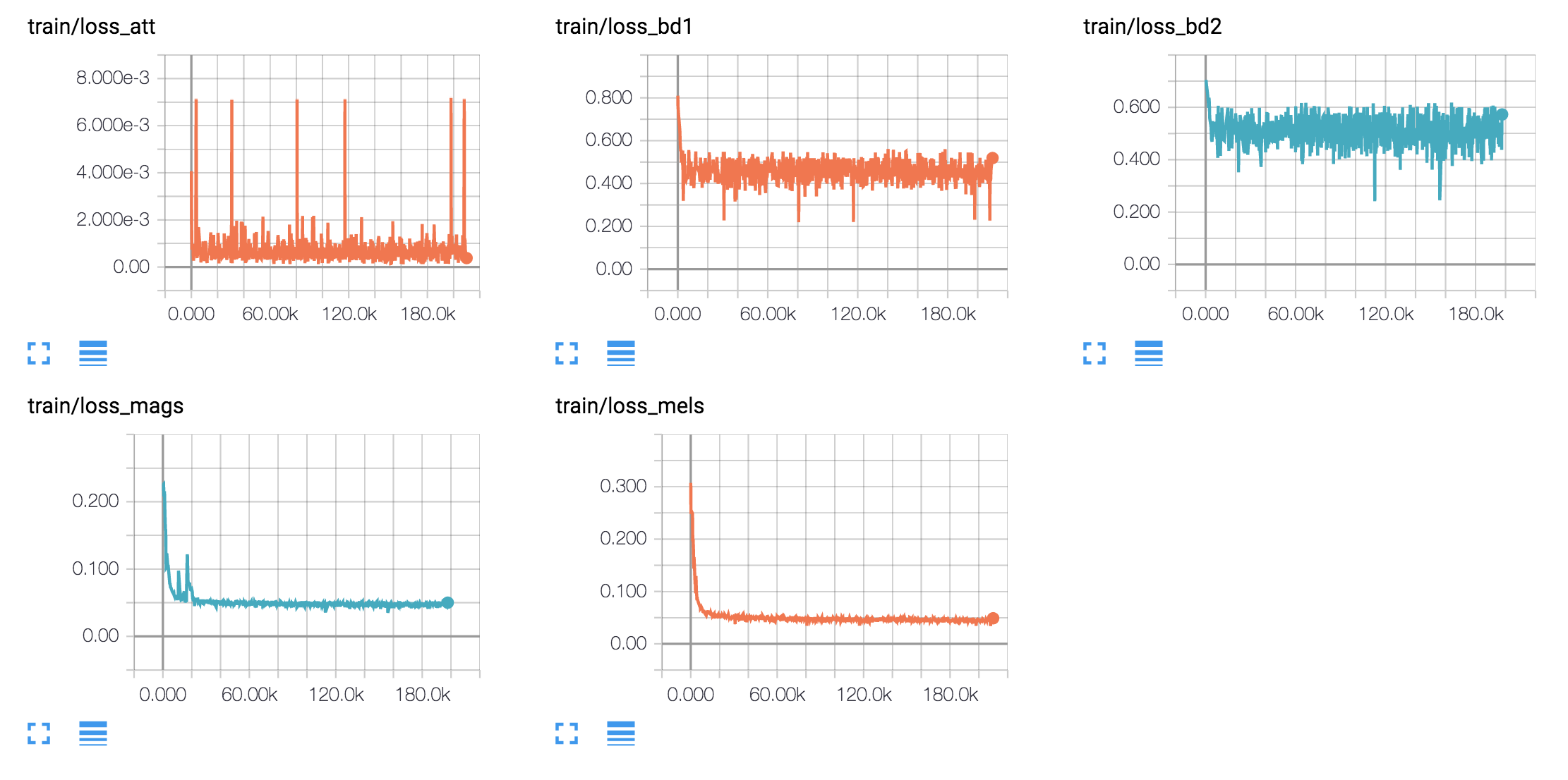
Training Curves
Attention Plot
Sample Synthesis

I generate speech samples based on Harvard Sentences as the original paper does. It is already included in the repo.

  • Run synthesize.py and check the files in samples.

Generated Samples

Dataset Samples
LJ 50k 200k 310k 800k
Nick 40k 170k 300k 800k
Kate 40k 160k 300k 800k
KSS 400k

Pretrained Model for LJ

Download this.

Notes

  • The paper didn't mention normalization, but without normalization I couldn't get it to work. So I added layer normalization.
  • The paper fixed the learning rate to 0.001, but it didn't work for me. So I decayed it.
  • I tried to train Text2Mel and SSRN simultaneously, but it didn't work. I guess separating those two networks mitigates the burden of training.
  • The authors claimed that the model can be trained within a day, but unfortunately the luck was not mine. However obviously this is much fater than Tacotron as it uses only convolution layers.
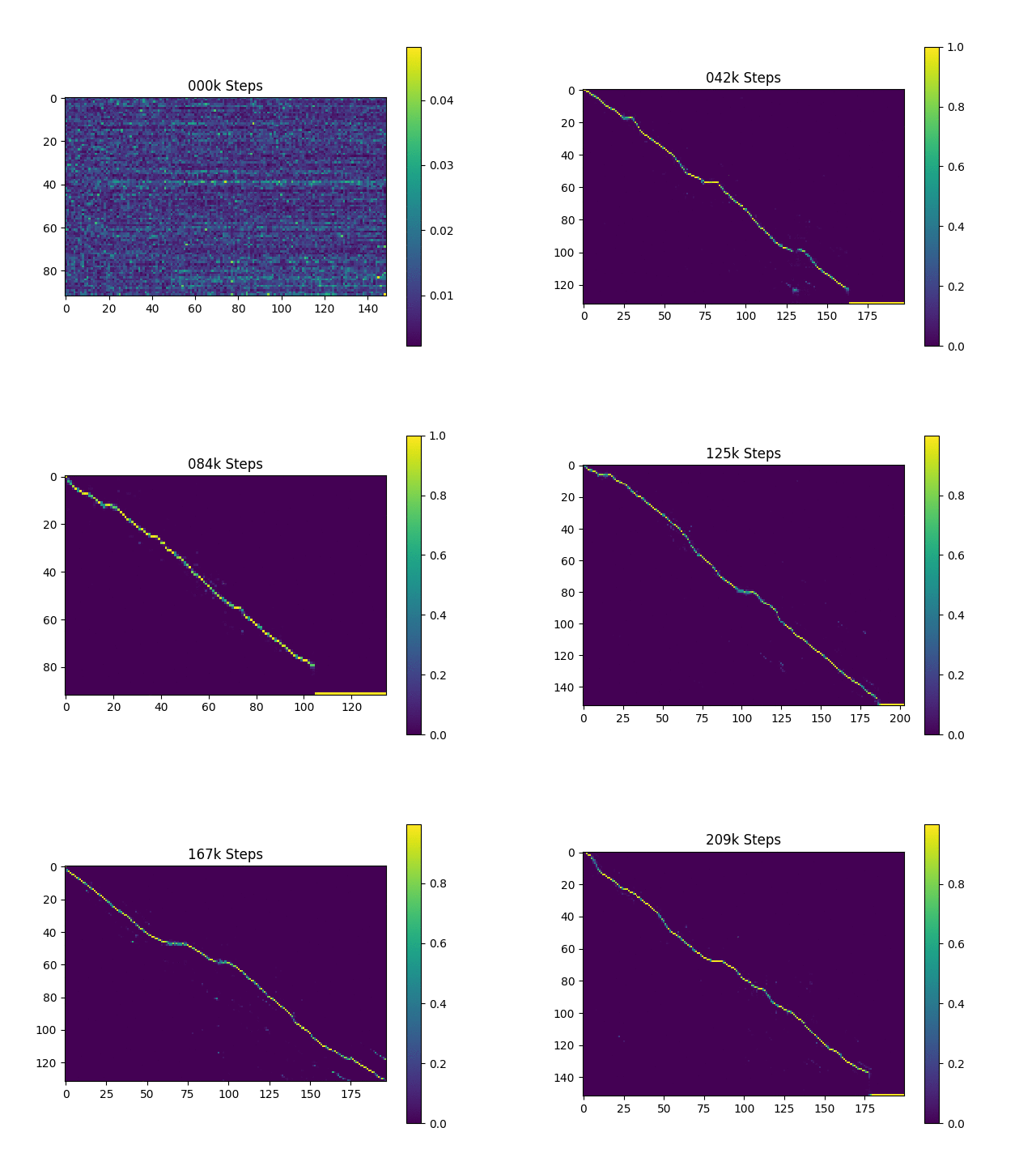
  • Thanks to the guided attention, the attention plot looks monotonic almost from the beginning. I guess this seems to hold the aligment tight so it won't lose track.
  • The paper didn't mention dropouts. I applied them as I believe it helps for regularization.
  • Check also other TTS models such as Tacotron and Deep Voice 3.
排名相邻
同类项目