MagicPose: Realistic Human Poses
and Facial Expressions Retargeting with Identity-aware Diffusion
[Di Chang](https://boese0601.github.io/)1
·
[Yichun Shi](https://seasonsh.github.io/)2
·
[Quankai Gao](https://zerg-overmind.github.io/)1
·
[Hongyi Xu](https://hongyixu37.github.io/homepage/)2
·
[Jessica Fu](https://www.linkedin.com/in/jessica-fu-60a504254/)1
·
Guoxian Song2
·
Qing Yan2
·
Yizhe Zhu2
·
Xiao Yang2
·
Mohammad Soleymani1
·
1University of Southern California 2ByteDance Inc.
[](https://arxiv.org/abs/2311.12052)
[](https://boese0601.github.io/magicdance/)
[)](https://youtu.be/VPJe6TyrT-Y)


GT Pose TPS Disco MagicDance
News
- [2024.04.03] Update comparisons to concurrent works.
- [2024.02.21] Update multi-gpu training, dataloader, and instructions for training on your own data.
- [2024.02.15] Release training and inference code.
- [2024.02.02] Release updated paper - MagicPose. The method and data are exactly the same.
- [2023.11.18] Release MagicDance paper and project page.
Related Open-Source Works
- Disco, from Microsoft
- MagicAnimate, from ByteDance - Singapore
Comparison to Concurrent Works
Comparison to Animate Anyone

Comparison to MagicAnimate
Comparison of MagicPose to MagicAnimate on Facial Expression Editing. MagicAnimate fails to generate diverse facial expressions, while MagicPose is able to.
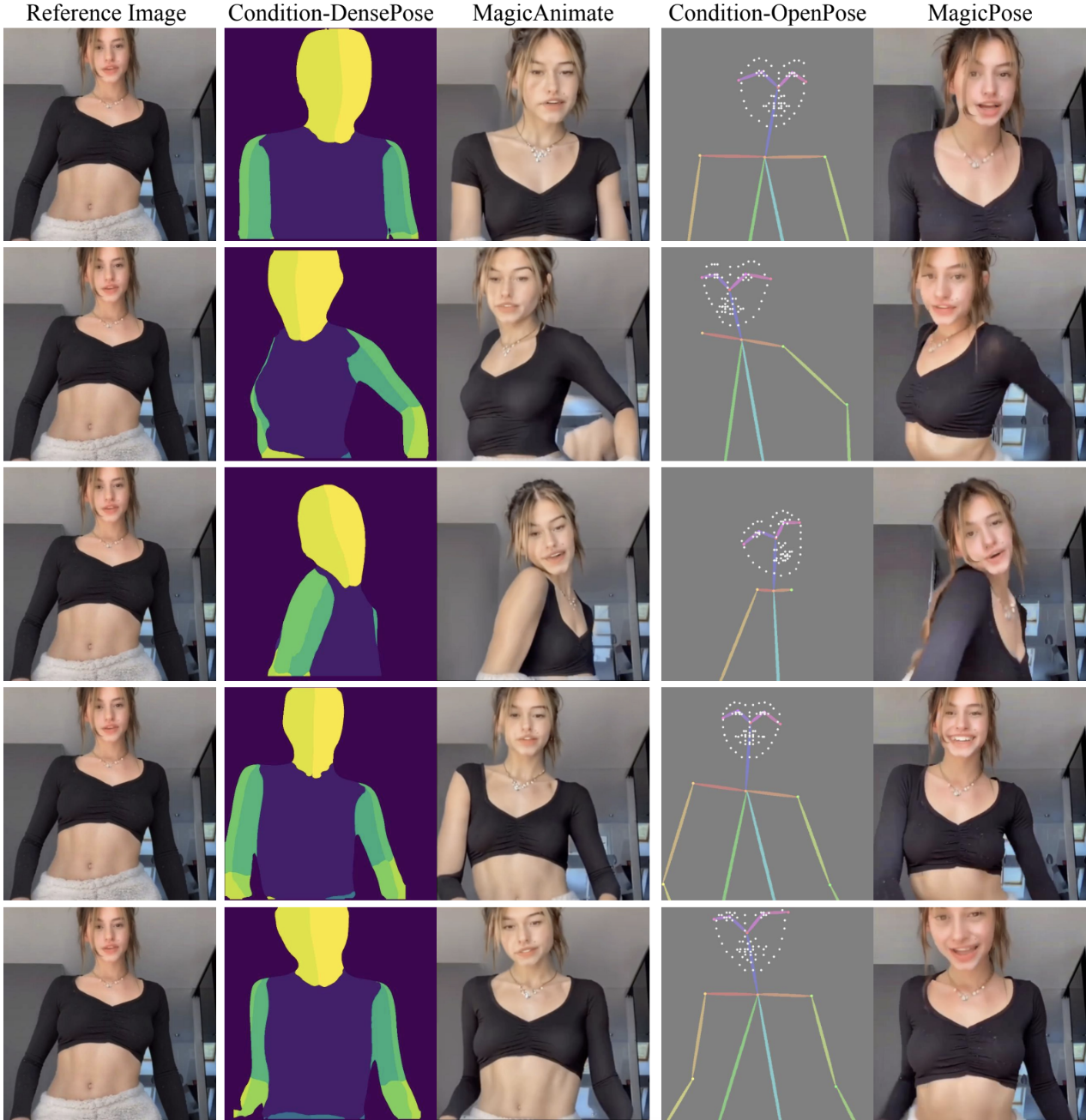
Comparison of MagicPose to MagicAnimate on in-the-wild pose retargeting. MagicAnimate fails to generate the back of the human subject, while MagicPose is able to.

Getting Started
For inference on TikTok dataset or your own image and poses, download our MagicDance checkpoint.
For appearance control pretraining, please download the pretrained model for StableDiffusion V1.5.
For appearance-disentangled Pose Control, please download pretrained Appearance Control Model and pretrained ControlNet OpenPose.
The pre-processed TikTok dataset can be downloaded from here. OpenPose may fail to detect human pose skeletons for some images, so we will filter those failure cases and train our model on clean data.
Place the pretrained weights and dataset as following:
MagicDance
|----TikTok-v4
|----pretrained_weights
  |----control_v11p_sd15_openpose.pth
  |----control_sd15_ini.ckpt
  |----model_state-110000.th
  |----model_state-10000.th
|----...
Environment
The environment from my machine is python==3.9, pytorch==1.13.1, CUDA==11.7. You may use other version of these prerequisites according to your local environment.
conda env create -f environment.yaml
conda activate magicpose
Inference with your own image and pose sequence:
bash scripts/inference_any_image_pose.sh
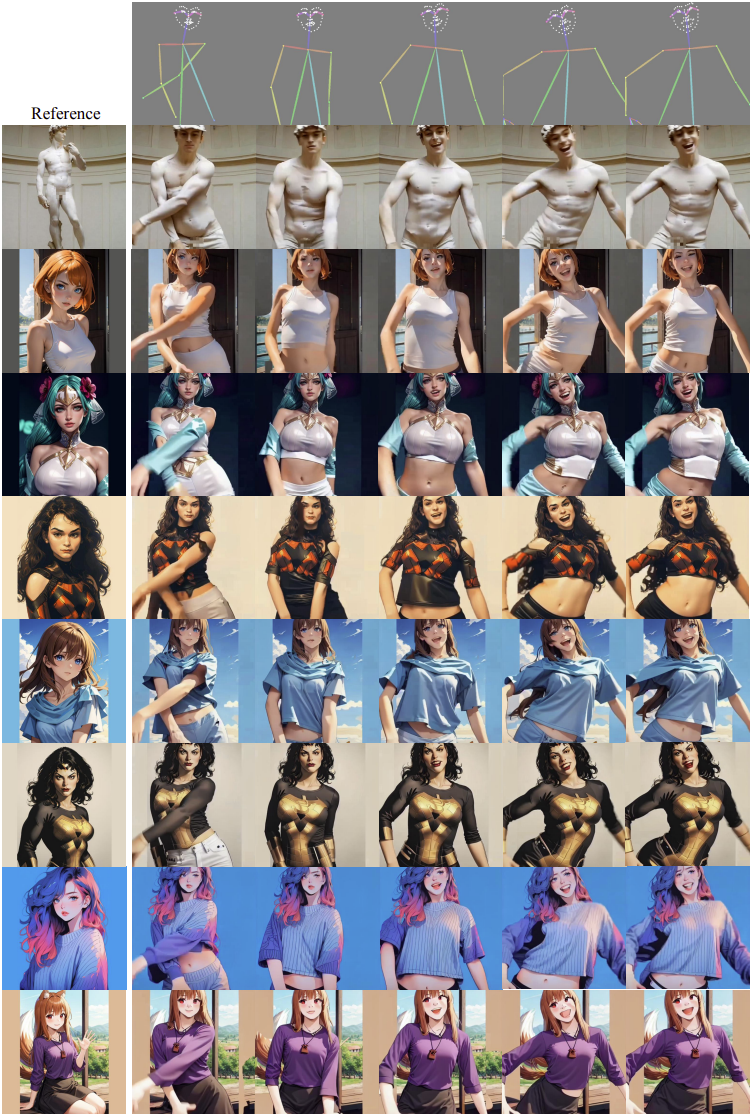
We offer some images and poses in "example_data", you can easily inference with your own image or pose sequence by replacing the arguments "local_cond_image_path" and "local_pose_path" in inference_any_image_pose.sh. Some interesting outputs from out-of-domain images are shown below:
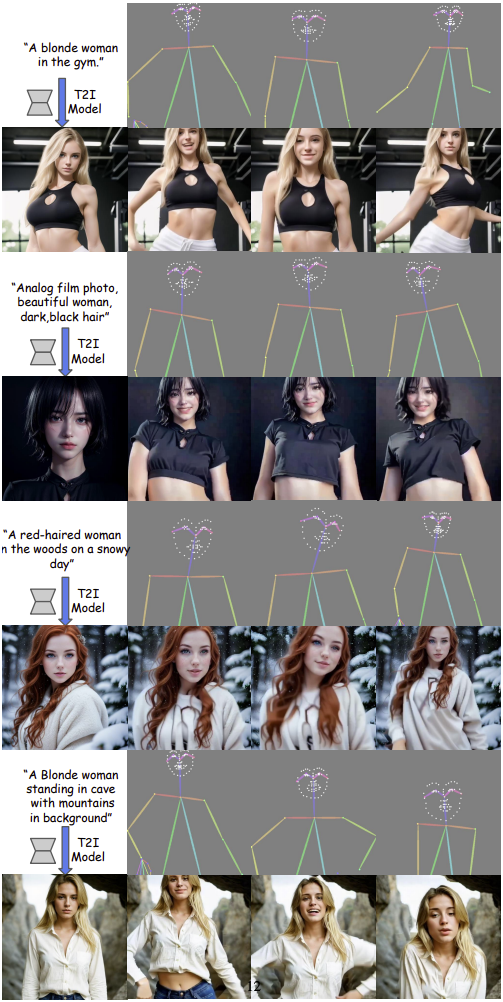
Our model is also able to retarget the pose of generated image from T2I model.
Inference
Inference on the test set:
bash scripts/inference_tiktok_dataset.sh
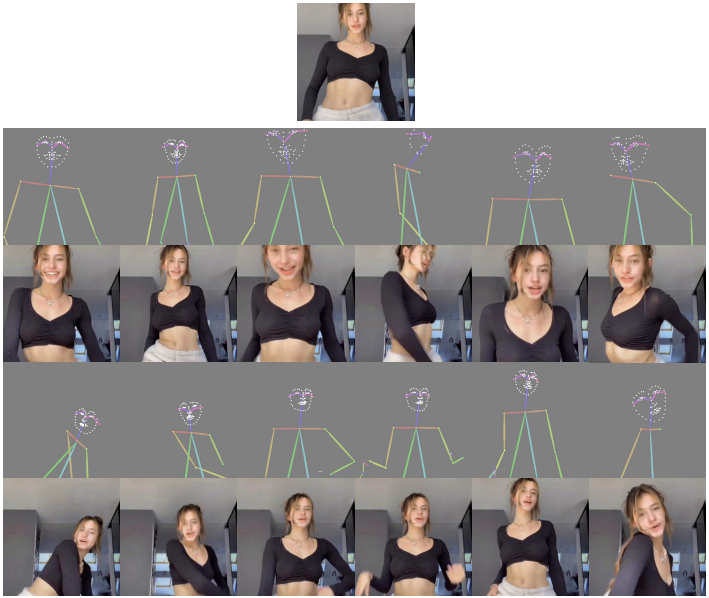
We use exactly same code from DisCo for metrics evaluation. Some example outputs from our model are shown below:
Training
Appearance Control Pretraining:
bash scripts/appearance_control_pretraining.sh
Appearance-Disentangled Pose Control:
bash scripts/appearance_disentangle_pose_control.sh
Multi-GPU training:
We have already implemented DistributedDataParallel in the python training script. If you want to use multi gpu instead of the first gpu on your machine for traning, see the following script for an example:
CUDA_VISIBLE_DEVICES=0,1,2,3,4,5,6,7 torchrun --master_port 10000 --nproc_per_node 8 train_tiktok.py \
This will use 8 GPUs and run 8 processes(nproc_per_node=8) for training.
Using your own video data for training
For training on your own dataset, you first need to run openpose for your input images/videos and save the visualized pose map. Then, organize them as the format shown in the TikTok dataset. You can also refer to DisCo-OpenPose Preprocessing or ControlNet-OpenPose, we use exactly the same Pose ControlNet in our pipeline. Then set the path to your data in dataset/tiktok_video_arnold_copy.py
Your Dataset
|----train_set
  |----video_000
    |----000.jpg
    |----001.jpg
    |----002.jpg
    ...
  |----video_001
  |----video_002
  ...
|----pose_map_train_set
  |----video_000
    |----000.jpg
    |----001.jpg
    |----002.jpg
    ...
  |----video_001
  |----video_002
  ...
|----val_set
|----pose_map_val_set
|----test_set
|----pose_map_test_set
|----...
Some tips
The task
From our experiences with this project, this motion retargeting task is a data-hungry task. Generation result highly depends on the training data, e.g. the quality of pose tracker, the amount of video sequences and frames per video in your training data. You may consider adopt DensePose as in MagicAnimate, DWPose as in Animate Anyone or any other geometry control for better generation quality. We have tried MMPose as well, which produced slightly better pose detection results. Introduce extra training data will yield better performance, consider using any other real-human dataset half-body/full-body dataset, e.g. TaiChi/DeepFashion, for further finetuning.
The code
Most of the arguments are self-explanatory in the codes. Several key arguments are explained below.
model_configA relative or absolute folder path to the config file of your model architecture.img_bin_limitThe maximum step for randomly selecting source and target image during training. During inference, the value is set to be "all".control_modeThis argument controls the Image-CFG during inference. "controlnet_important" denotes Image-CFG is used and "balance" means not.wonoiseThe reference image is fed into the appearance control model without adding noise.with_textWhen "with_text" is given, text is not used for training. (I know it's a bit confusing, lol)finetune_controlFinetune Appearance Control Model (and Pose ControlNet).output_dirA relative or absolute folder for writing checkpoints.local_image_dirA relative or absolute folder for writing image outputs.image_pretrain_dirA relative or absolute folder for loading appearance control model checkpoint.pose_pretrain_dirA relative or absolute path to pose controlnet.
Citing
If you find our work useful, please consider citing:
@article{chang2023magicdance,
  title={MagicDance: Realistic Human Dance Video Generation with Motions \& Facial Expressions Transfer},
  author={Chang, Di and Shi, Yichun and Gao, Quankai and Fu, Jessica and Xu, Hongyi and Song, Guoxian and Yan, Qing and Yang, Xiao and Soleymani, Mohammad},
  journal={arXiv preprint arXiv:2311.12052},
  year={2023}
}
License
Our code is distributed under the USC research license. See LICENSE.txt file for more information.
Acknowledgments
This work was sponsored by the Army Research Office and was accomplished under Cooperative Agreement Number W911NF-20-2-0053. The views and conclusions contained in this document are those of the authors and should not be interpreted as representing the official policies, either expressed or implied, of the Army Research Office or the U.S. Government. The U.S. Government is authorized to reproduce and distribute reprints for Government purposes notwithstanding any copyright notation herein.
Our code follows several excellent repositories. We appreciate them for making their codes available to the public. We also appreciate the help from Tan Wang, who offered assistance to our baselines comparison experiment.