❤️ Lovely Tensors
Read full docs
More lovely stuff
Working with numbers
- Numpy: ❤️ Lovely NumPy
- JAX: 💘 Lovely
JAX - TinyGrad: 🫀 Lovely Grad
Community
Install
pip install lovely-tensors
or
mamba install lovely-tensors
or
conda install -c conda-forge lovely-tensors
How to use
How often do you find yourself debugging PyTorch code? You dump a tensor to the cell output, and see this:
numbers
tensor([[[-0.3541, -0.3369, -0.4054,  ..., -0.5596, -0.4739,  2.2489],
         [-0.4054, -0.4226, -0.4911,  ..., -0.9192, -0.8507,  2.1633],
         [-0.4739, -0.4739, -0.5424,  ..., -1.0390, -1.0390,  2.1975],
         ...,
         [-0.9020, -0.8335, -0.9363,  ..., -1.4672, -1.2959,  2.2318],
         [-0.8507, -0.7822, -0.9363,  ..., -1.6042, -1.5014,  2.1804],
         [-0.8335, -0.8164, -0.9705,  ..., -1.6555, -1.5528,  2.1119]],

        [[-0.1975, -0.1975, -0.3025,  ..., -0.4776, -0.3725,  2.4111],
         [-0.2500, -0.2325, -0.3375,  ..., -0.7052, -0.6702,  2.3585],
         [-0.3025, -0.2850, -0.3901,  ..., -0.7402, -0.8102,  2.3761],
         ...,
         [-0.4251, -0.2325, -0.3725,  ..., -1.0903, -1.0203,  2.4286],
         [-0.3901, -0.2325, -0.4251,  ..., -1.2304, -1.2304,  2.4111],
         [-0.4076, -0.2850, -0.4776,  ..., -1.2829, -1.2829,  2.3410]],

        [[-0.6715, -0.9853, -0.8807,  ..., -0.9678, -0.6890,  2.3960],
         [-0.7238, -1.0724, -0.9678,  ..., -1.2467, -1.0201,  2.3263],
         [-0.8284, -1.1247, -1.0201,  ..., -1.2641, -1.1596,  2.3786],
         ...,
         [-1.2293, -1.4733, -1.3861,  ..., -1.5081, -1.2641,  2.5180],
         [-1.1944, -1.4559, -1.4210,  ..., -1.6476, -1.4733,  2.4308],
         [-1.2293, -1.5256, -1.5081,  ..., -1.6824, -1.5256,  2.3611]]])
Was it really useful for you, as a human, to see all these numbers?
What is the shape? The size?
What are the statistics?
Are any of the values nan or inf?
Is it an image of a man holding a tench?
import lovely_tensors as lt
lt.monkey_patch()
Summary
numbers # torch.Tensor
tensor[3, 196, 196] n=115248 (0.4 MiB) x∈[-2.118 |▂▅█▇▂▁▁▂▂▁| 2.640] μ=-0.388 σ=1.073
numbers.rgb

numbers.plt

Better, huh?
numbers[1,:6,1] # Still shows values if there are not too many.
tensor[6] x∈[-0.443, -0.197] μ=-0.311 σ=0.091 [-0.197, -0.232, -0.285, -0.373, -0.443, -0.338]
spicy = numbers[0,:12,0].clone()

spicy[0] *= 10000
spicy[1] /= 10000
spicy[2] = float('inf')
spicy[3] = float('-inf')
spicy[4] = float('nan')

spicy = spicy.reshape((2,6))
spicy # Spicy stuff
tensor[2, 6] n=12 x∈[-3.541e+03, -4.054e-05] μ=-393.842 σ=1.180e+03 +Inf! -Inf! NaN!
torch.zeros(10, 10) # A zero tensor - make it obvious
tensor[10, 10] n=100 all_zeros
spicy.v # Verbose
tensor[2, 6] n=12 x∈[-3.541e+03, -4.054e-05] μ=-393.842 σ=1.180e+03 +Inf! -Inf! NaN!
tensor([[-3.5405e+03, -4.0543e-05,         inf,        -inf,         nan, -6.1093e-01],
        [-6.1093e-01, -5.9380e-01, -5.9380e-01, -5.4243e-01, -5.4243e-01, -5.4243e-01]])
spicy.p # The plain old way
tensor([[-3.5405e+03, -4.0543e-05,         inf,        -inf,         nan, -6.1093e-01],
        [-6.1093e-01, -5.9380e-01, -5.9380e-01, -5.4243e-01, -5.4243e-01, -5.4243e-01]])
Gradient
torch.manual_seed(1)


# with config(color=False):
grad = torch.randn((10, 10), requires_grad=True, dtype=torch.float64)
grad_plus_one = grad+1

print(f"Before .backward:\n{grad}\n")

# We can't access .grad of non-leaf tensors, unless
print(f"Before .backward, non-leaf node:\n{grad_plus_one}\n")

grad_plus_one.prod().backward()

grad.grad[0,0] = float("-inf")

print(f"After .backward():\n{grad}\n")

grad.grad.zero_()

print(f"After .zero_() on .grad:\n{grad}")
Before .backward:
tensor[10, 10] f64 n=100 x∈[-3.705 |▁ ▂▂▇█▇█▃▂| 2.537] μ=0.105 σ=1.066 grad=None

Before .backward, non-leaf node:
tensor[10, 10] f64 n=100 x∈[-2.705 |▁ ▂▂▇█▇█▃▂| 3.537] μ=1.105 σ=1.066 grad (non-leaf) AddBackward0

After .backward():
tensor[10, 10] f64 n=100 x∈[-3.705 |▁ ▂▂▇█▇█▃▂| 2.537] μ=0.105 σ=1.066 grad={ x∈[-1.351e-05 |▁▁▁▁  ▁█▁▁| 4.236e-06] μ=-1.145e-07 σ=2.284e-06 -Inf! }

After .zero_() on .grad:
tensor[10, 10] f64 n=100 x∈[-3.705 |▁ ▂▂▇█▇█▃▂| 2.537] μ=0.105 σ=1.066 grad={ all_zeros }
Named dimensions
named_numbers = numbers.rename("C", "H","W")
named_numbers
/home/xl0/miniforge3/envs/torch/lib/python3.13/site-packages/torch/_tensor.py:1630: UserWarning: Named tensors and all their associated APIs are an experimental feature and subject to change. Please do not use them for anything important until they are released as stable. (Triggered internally at /pytorch/c10/core/TensorImpl.h:1971.)
  return super().rename(names)

tensor[C=3, H=196, W=196] n=115248 (0.4 MiB) x∈[-2.118 |▂▅█▇▂▁▁▂▂▁| 2.640] μ=-0.388 σ=1.073
Going .deeper
numbers.deeper
tensor[3, 196, 196] n=115248 (0.4 MiB) x∈[-2.118 |▂▅█▇▂▁▁▂▂▁| 2.640] μ=-0.388 σ=1.073
  tensor[196, 196] n=38416 x∈[-2.118 |▂▃▅█▂▁▁▂▃▂| 2.249] μ=-0.324 σ=1.036
  tensor[196, 196] n=38416 x∈[-1.966 |▂▃▅█▁▁▁▁▂▁| 2.429] μ=-0.274 σ=0.973
  tensor[196, 196] n=38416 x∈[-1.804 |▃█▂▁▁▁▁▁▂▁| 2.640] μ=-0.567 σ=1.178
# You can go deeper if you need to
# And we can use `.deeper` with named dimensions.

named_numbers.deeper(2)
tensor[C=3, H=196, W=196] n=115248 (0.4 MiB) x∈[-2.118 |▂▅█▇▂▁▁▂▂▁| 2.640] μ=-0.388 σ=1.073
  tensor[H=196, W=196] n=38416 x∈[-2.118 |▂▃▅█▂▁▁▂▃▂| 2.249] μ=-0.324 σ=1.036
    tensor[W=196] x∈[-1.912 |▃▁▂█▃    ▁| 2.249] μ=-0.673 σ=0.522
    tensor[W=196] x∈[-1.861 |▂▂██▁    ▁| 2.163] μ=-0.738 σ=0.418
    tensor[W=196] x∈[-1.758 |▂▂█▂▁    ▁| 2.198] μ=-0.806 σ=0.397
    tensor[W=196] x∈[-1.656 |▂▆█▁▁    ▁| 2.249] μ=-0.849 σ=0.369
    tensor[W=196] x∈[-1.673 |▁▆█▁▁▁   ▁| 2.198] μ=-0.857 σ=0.357
    tensor[W=196] x∈[-1.656 |▂██▂▁▁   ▁| 2.146] μ=-0.848 σ=0.372
    tensor[W=196] x∈[-1.433 |▃█▅▁▁▁▁  ▁| 2.215] μ=-0.784 σ=0.397
    tensor[W=196] x∈[-1.279 |▆█▄▁▁▁▁▁ ▁| 2.249] μ=-0.695 σ=0.486
    tensor[W=196] x∈[-1.364 |▆██▂▁▁▁▁▁▁| 2.249] μ=-0.637 σ=0.539
    ...
  tensor[H=196, W=196] n=38416 x∈[-1.966 |▂▃▅█▁▁▁▁▂▁| 2.429] μ=-0.274 σ=0.973
    tensor[W=196] x∈[-1.861 |▂▁▁█▁    ▁| 2.411] μ=-0.529 σ=0.556
    tensor[W=196] x∈[-1.826 |▁▁▁█     ▁| 2.359] μ=-0.562 σ=0.473
    tensor[W=196] x∈[-1.756 |▂▁▃█▁    ▁| 2.376] μ=-0.622 σ=0.458
    tensor[W=196] x∈[-1.633 |▂▂█▄     ▁| 2.429] μ=-0.664 σ=0.430
    tensor[W=196] x∈[-1.651 |▂▂█▄     ▁| 2.376] μ=-0.669 σ=0.399
    tensor[W=196] x∈[-1.633 |▂▃█▃▁    ▁| 2.376] μ=-0.701 σ=0.391
    tensor[W=196] x∈[-1.563 |▂▃█▂▁    ▁| 2.429] μ=-0.670 σ=0.380
    tensor[W=196] x∈[-1.475 |▂▄█▁▁    ▁| 2.429] μ=-0.616 σ=0.386
    tensor[W=196] x∈[-1.511 |▁▄█▁▁▁   ▁| 2.429] μ=-0.593 σ=0.399
    ...
  tensor[H=196, W=196] n=38416 x∈[-1.804 |▃█▂▁▁▁▁▁▂▁| 2.640] μ=-0.567 σ=1.178
    tensor[W=196] x∈[-1.717 |▃█▆      ▁| 2.396] μ=-0.982 σ=0.350
    tensor[W=196] x∈[-1.752 |▂█▄      ▁| 2.326] μ=-1.034 σ=0.314
    tensor[W=196] x∈[-1.648 |▂█▁▁     ▁| 2.379] μ=-1.086 σ=0.314
    tensor[W=196] x∈[-1.630 |▃█▁      ▁| 2.466] μ=-1.121 σ=0.305
    tensor[W=196] x∈[-1.717 |▂█▁      ▁| 2.448] μ=-1.120 σ=0.302
    tensor[W=196] x∈[-1.717 |▃█▁▁     ▁| 2.431] μ=-1.166 σ=0.314
    tensor[W=196] x∈[-1.560 |█▆▁▁     ▁| 2.448] μ=-1.124 σ=0.326
    tensor[W=196] x∈[-1.421 |█▂▁▁ ▁   ▁| 2.431] μ=-1.064 σ=0.383
    tensor[W=196] x∈[-1.526 |██▁▁▁ ▁  ▁| 2.396] μ=-1.047 σ=0.417
    ...
Now in .rgb color
The important queston - is it our man?
numbers.rgb

Maaaaybe? Looks like someone normalized him.
in_stats = ( (0.485, 0.456, 0.406),     # mean
             (0.229, 0.224, 0.225) )    # std

# numbers.rgb(in_stats, cl=True) # For channel-last input format
numbers.rgb(in_stats)

# numbers.rgb(denorm="imagenet") # same as above
# numbers.rgb(denorm="symmetric") # [-1 .. 1] input
# numbers.rgb(denorm="minmax") # Use the min/max elements in each channel to scale the input to [0..1]

It’s indeed our hero, the Tenchman!
.plt the statistics
(numbers+3).plt(center="mean", max_s=1000)

(numbers).plt

(numbers+3).plt(center="range")

See the .chans
# .chans will map values betwen [-1,1] to colors.
# Make our values fit into that range to avoid clipping.
mean = torch.tensor(in_stats[0])[:,None,None]
std = torch.tensor(in_stats[1])[:,None,None]
numbers_01 = (numbers*std + mean)
numbers_01
tensor[3, 196, 196] n=115248 (0.4 MiB) x∈[0. |▃▇▆█▂▁▁▂▃▂| 1.000] μ=0.361 σ=0.248
numbers_01.chans

Let’s try with a Convolutional Neural Network
from torchvision.models import vgg11
features: torch.nn.Sequential = vgg11().features

# I saved the first 5 layers in "features.pt"
_ = features.load_state_dict(torch.load("../features.pt", weights_only=True), strict=False)
# Activatons of the second max pool layer of VGG11
acts = (features[:6](numbers[None])[0]/2) # /2 to reduce clipping
acts
tensor[128, 49, 49] n=307328 (1.2 MiB) x∈[0. |█▁▁▁▁▁▁▁▁ | 12.508] μ=0.367 σ=0.634 grad (non-leaf) DivBackward0
acts[:4].chans(cmap="coolwarm", scale=4)

Grouping
# Make 8 images with progressively higher brightness and stack them 2x2x2.
eight_images = (torch.stack([numbers]*8)
                    .add(torch.linspace(-3, 3, 8)[:,None,None,None])
                    .mul(torch.tensor(in_stats[1])[:,None,None])
                    .add(torch.tensor(in_stats[0])[:,None,None])
                    .clamp(0,1)
                    .view(2,2,2,3,196,196)
)
eight_images
tensor[2, 2, 2, 3, 196, 196] n=921984 (3.5 MiB) x∈[0. |█▂▂▂▂▂▂▂▂▄| 1.000] μ=0.411 σ=0.369
eight_images.rgb

# Weights of the second conv layer of VGG11
features[3].weight
Parameter[128, 64, 3, 3] n=73728 (0.3 MiB) x∈[-0.783 | ▁▁██▁▁▁▁| 0.776] μ=-0.004 σ=0.065 grad=None
I want +/- 2σ to fall in the range [-1..1]
weights = features[3].weight.data
weights = weights / (2*2*weights.std()) # *2 because we want 2σ on both sides, so 4σ
# weights += weights.std() * 2
weights.plt

# Weights of the second conv layer (64ch -> 128ch) of VGG11,
# grouped per output channel.
weights.chans(frame_px=1, gutter_px=0)
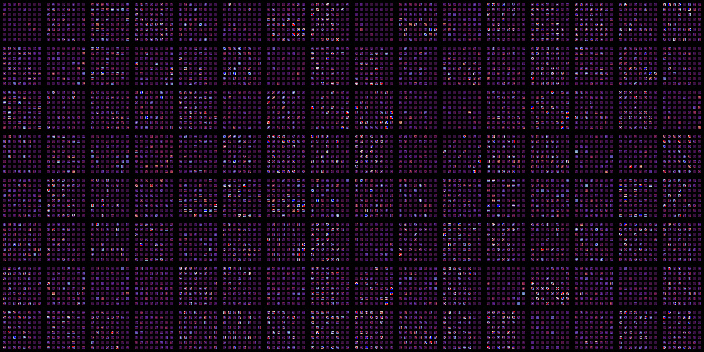
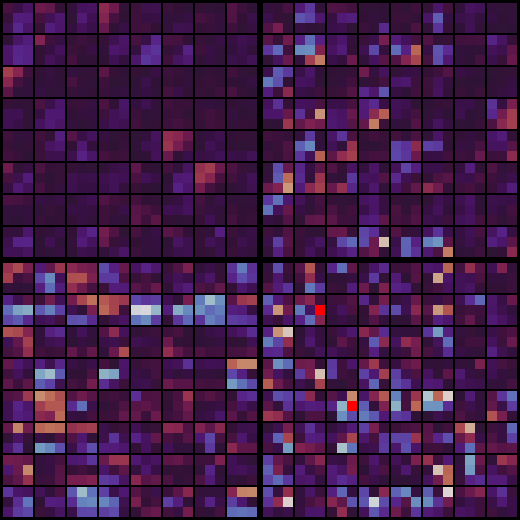
It’s a bit hard to see. Scale up 10x, but onyl show the first 4 filters.
weights[:4].chans(frame_px=1, gutter_px=0, scale=10)
Options | Docs
from lovely_tensors import set_config, config, lovely, get_config
set_config(precision=1, sci_mode=True, color=False)
torch.tensor([1, 2, torch.nan])
tensor[3] μ=1.5e+00 σ=7.1e-01 NaN! [1.0e+00, 2.0e+00, nan]
set_config(precision=None, sci_mode=None, color=None) # None -> Reset to defaults
print(torch.tensor([1., 2]))
# Or with config context manager.
with config(sci_mode=True, precision=5):
    print(torch.tensor([1., 2]))

print(torch.tensor([1., 2]))
tensor[2] μ=1.500 σ=0.707 [1.000, 2.000]
tensor[2] μ=1.50000e+00 σ=7.07107e-01 [1.00000e+00, 2.00000e+00]
tensor[2] μ=1.500 σ=0.707 [1.000, 2.000]
Without .monkey_patch
lt.lovely(spicy)
tensor[2, 6] n=12 x∈[-3.541e+03, -4.054e-05] μ=-393.842 σ=1.180e+03 +Inf! -Inf! NaN!
lt.lovely(spicy, verbose=True)
tensor[2, 6] n=12 x∈[-3.541e+03, -4.054e-05] μ=-393.842 σ=1.180e+03 +Inf! -Inf! NaN!
tensor([[-3.5405e+03, -4.0543e-05,         inf,        -inf,         nan, -6.1093e-01],
        [-6.1093e-01, -5.9380e-01, -5.9380e-01, -5.4243e-01, -5.4243e-01, -5.4243e-01]])
lt.lovely(numbers, depth=1)
tensor[3, 196, 196] n=115248 (0.4 MiB) x∈[-2.118 |▂▅█▇▂▁▁▂▂▁| 2.640] μ=-0.388 σ=1.073
  tensor[196, 196] n=38416 x∈[-2.118 |▂▃▅█▂▁▁▂▃▂| 2.249] μ=-0.324 σ=1.036
  tensor[196, 196] n=38416 x∈[-1.966 |▂▃▅█▁▁▁▁▂▁| 2.429] μ=-0.274 σ=0.973
  tensor[196, 196] n=38416 x∈[-1.804 |▃█▂▁▁▁▁▁▂▁| 2.640] μ=-0.567 σ=1.178
lt.rgb(numbers, in_stats)

lt.plot(numbers, center="mean")

lt.chans(numbers_01)

Matplotlib integration | Docs
numbers.rgb(in_stats).fig # matplotlib figure

(numbers*0.3+0.5).chans.fig # matplotlib figure

numbers.plt.fig.savefig('pretty.svg') # Save it
!file pretty.svg; rm pretty.svg
pretty.svg: SVG Scalable Vector Graphics image
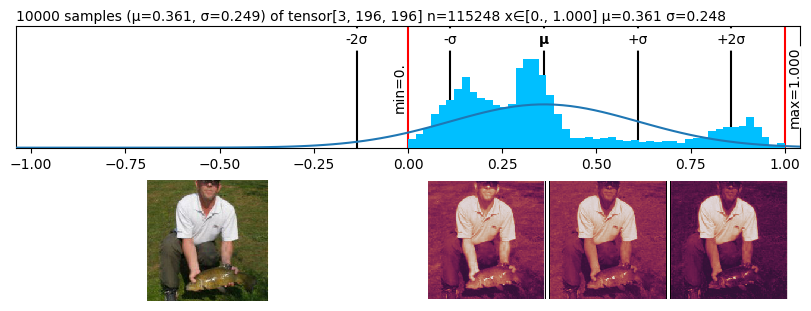
Add content to existing Axes
fig = plt.figure(figsize=(8,3))
fig.set_constrained_layout(True)
gs = fig.add_gridspec(2,2)
ax1 = fig.add_subplot(gs[0, :])
ax2 = fig.add_subplot(gs[1, 0])
ax3 = fig.add_subplot(gs[1,1:])

ax2.set_axis_off()
ax3.set_axis_off()

numbers_01.plt(ax=ax1)
numbers_01.rgb(ax=ax2)
numbers_01.chans(ax=ax3);
torch.compile()
Just works.
def func(x):
    return x*2

if torch.__version__ >= "2.0":
    func = torch.compile(func)

func(torch.tensor([1,2,3]))
tensor[3] i64 x∈[2, 6] μ=4.000 σ=2.000 [2, 4, 6]
Import hook
Lovely tensors installes an import hook. Set LOVELY_TENSORS=1, and it
will load automatically, no need to modify the code: > Note: You can
now set it globally. The installed import hook will triggger only when
torch is imported.
import torch

x = torch.randn(4, 16)
print(x)
LOVELY_TENSORS=1 python test.py
x: tensor[4, 16] n=64 x∈[-1.652, 1.813] μ=-0.069 σ=0.844
This is especially useful in combination with Better Exceptions:
import torch

x = torch.randn(4, 16)
print(f"x: {x}")

w = torch.randn(15, 8)
y = torch.matmul(x, w) # Dimension mismatch
BETTER_EXCEPTIONS=1 LOVELY_TENSORS=1 python test.py
x: tensor[4, 16] n=64 x∈[-1.834, 2.421] μ=0.103 σ=0.896
Traceback (most recent call last):
  File "/home/xl0/work/projects/lovely-tensors/test.py", line 7, in
    y = torch.matmul(x, w)
        │            │  └ tensor[15, 8] n=120 x∈[-2.355, 2.165] μ=0.142 σ=0.989
        │            └ tensor[4, 16] n=64 x∈[-1.834, 2.421] μ=0.103 σ=0.896
        └
RuntimeError: mat1 and mat2 shapes cannot be multiplied (4x16 and 15x8)