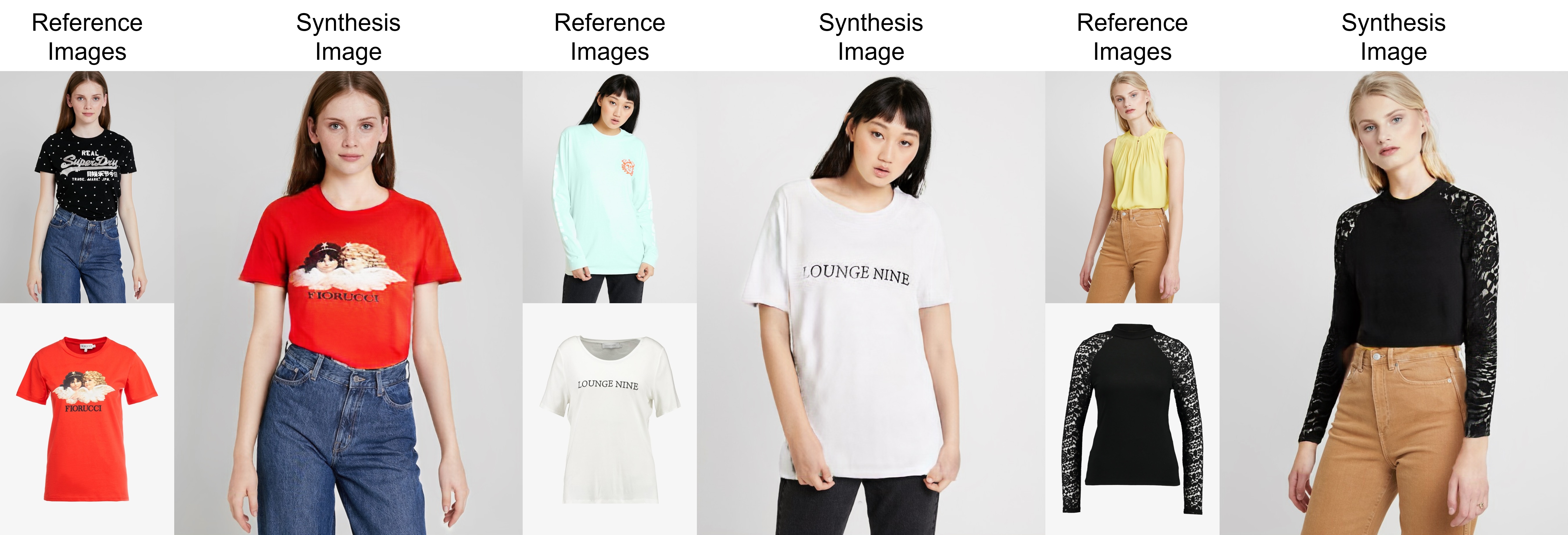
[NeurIPS 2024] A Generalizable World Model for Autonomous Driving.
Key parameters and specifications
Key parameters and specifications
Parameter
Value
Language
Python
Category
Models
Subcategory
Vision models
Keywords
Image production
Stars
917
Forks
192
Contributors
4
Created date
2022-06-25
Updated date
2026-10-05
Stars in 1 day
0
Stars in 7 days
0
Rank
12,656
Previous rank
12,574
Rank change
-82
7-day stars rank
13,537
Previous 7-day stars rank
13,549
7-day stars rank change
12
Total stars rank
11,894
Previous total stars rank
11,876
Total stars rank change
-18
Country
USA
README summary
HR-VITON — Official PyTorch Implementation **\*\*\*\*\* New follow-up research by our team is available at \*\*\*\*\*** Our Team's Researches (1) PromptDresser ( - Arxiv 24. 12 (2) StableVITON ( - CVPR 2024 (3) VITON-HD ( - CVPR 2021 **High-Resolution Virtual Try-On with Misalignment and Occlusion-Handled Conditions** Sangyun Lee\* 1 , Gyojung Gu\* 2,3 , Sunghyun Park 2 , Seunghwan Choi 2 , Jaegul Choo 2 1 Soongsil University, 2 KAIST, 3 Nestyle In ECCV 2022 (* indicates equal contribution) Paper: Project page: **Abstract:** *Image-based virtual
try-on aims to synthesize an image of a person wearing a given clothing item. To solve the task, the existing methods warp the clothing item to fit the person's body and generate the segmentation map of the person wearing the item before fusing the item with the person. However, when the warping and the segmentation generation stages operate individually without information exchange, the misalignment between the warped clothes and the segmentation map occurs, which leads to the artifacts in
the final image. The information disconnection also causes excessive warping near the clothing regions occluded by the body parts, so-called pixel-squeezing artifacts. To settle the issues, we propose a novel try-on condition generator as a unified module of the two stages (i. , warping and segmentation generation stages). A newly proposed feature fusion block in the condition generator implements the information exchange, and the condition generator does not create any misalignment or pixel-squeezing artifacts. We also introduce
discriminator rejection that filters out the incorrect segmentation map predictions and assures the performance of virtual try-on frameworks. Experiments on a high-resolution dataset demonstrate that our model successfully handles the misalignment and occlusion, and significantly outperforms the baselines. * Installation Clone this repository: Install PyTorch and other dependencies: Dataset We train and evaluate our model using the dataset from VITON-HD: High-Resolution Virtual Try-On via Misalignment-Aware Normalization. To download the dataset, please check the following link
We assume that you have downloaded it into . Inference Here are the download links for each model checkpoint: Try-on condition generator: link Try-on condition generator (discriminator): link Try-on image generator: link AlexNet (LPIPS): link, we assume that you have downloaded it into . Train try-on condition generator Train try-on image generator This stage takes approximately 4 days with two RTX 3090 GPUs. License All material is made available under Creative Commons BY-NC 4. You can
**use, redistribute, and adapt** the material for **non-commercial purposes**, as long as you give appropriate credit by **citing our paper** and **indicate any changes** that you've made. Citation If you find this work useful for your research, please cite our paper:
Frequently asked questions
How many stars and forks are recorded?
sangyun884/HR-VITON has 917 stars and 192 forks.
What is the repository rank?
sangyun884/HR-VITON is ranked 12,656.
What language and category are recorded?
sangyun884/HR-VITON has 917 stars, uses Python and belongs to Models.
Which repository is closest in rank?
sangyun884/HR-VITON is compared with huggingface/torchMoji, ranked 12,636 with 920 stars.
Abstract:Image-based virtual try-on aims to synthesize an image of a person wearing a given clothing item. To solve the task, the existing methods warp the clothing item to fit the person's body and generate the segmentation map of the person wearing the item before fusing the item with the person. However, when the warping and the segmentation generation stages operate individually without information exchange, the misalignment between the warped clothes and the segmentation map occurs, which leads to the artifacts in the final image. The information disconnection also causes excessive warping near the clothing regions occluded by the body parts, so-called pixel-squeezing artifacts. To settle the issues, we propose a novel try-on condition generator as a unified module of the two stages (i.e., warping and segmentation generation stages). A newly proposed feature fusion block in the condition generator implements the information exchange, and the condition generator does not create any misalignment or pixel-squeezing artifacts. We also introduce discriminator rejection that filters out the incorrect segmentation map predictions and assures the performance of virtual try-on frameworks. Experiments on a high-resolution dataset demonstrate that our model successfully handles the misalignment and occlusion, and significantly outperforms the baselines.
Installation
Clone this repository:
git clone https://github.com/sangyun884/HR-VITON.git
cd ./HR-VITON/
This stage takes approximately 4 days with two RTX 3090 GPUs. Tested environment: PyTorch 1.8.2+cu111.
To use "--fp16" option, you should install apex library.
License
All material is made available under Creative Commons BY-NC 4.0. You can use, redistribute, and adapt the material for non-commercial purposes, as long as you give appropriate credit by citing our paper and indicate any changes that you've made.
Citation
If you find this work useful for your research, please cite our paper:
@article{lee2022hrviton,
  title={High-Resolution Virtual Try-On with Misalignment and Occlusion-Handled Conditions},
  author={Lee, Sangyun and Gu, Gyojung and Park, Sunghyun and Choi, Seunghwan and Choo, Jaegul},
  journal={arXiv preprint arXiv:2206.14180},
  year={2022}
}