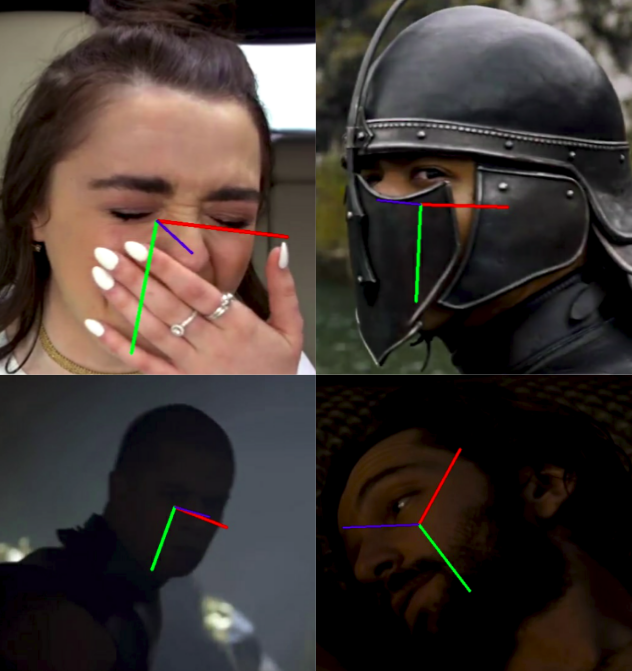
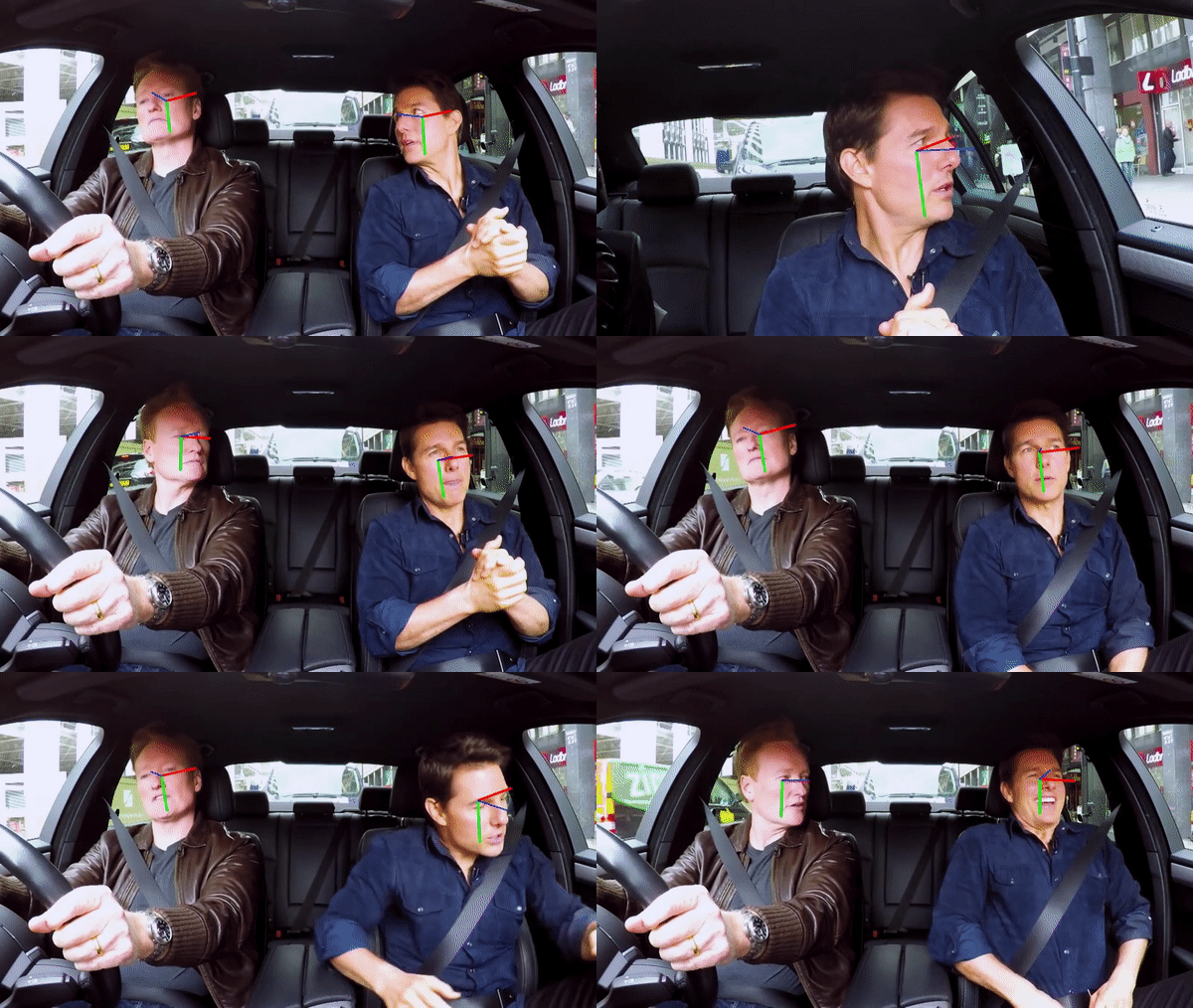
Hopenet # **Hopenet** is an accurate and easy to use head pose estimation network. Models have been trained on the 300W-LP dataset and have been tested on real data with good qualitative performance. For details about the method and quantitative results please check the CVPR Workshop paper. **new** GoT trailer example video **new** Conan-Cruise-Car example video To use please install PyTorch and OpenCV (for video) - I believe that's all you need apart from usual libraries such as numpy
. You need a GPU to run Hopenet (for now). To test on a video using dlib face detections (center of head will be jumpy): To test on a video using your own face detections (we recommend using dockerface, center of head will be smoother): Face bounding box annotations should be in Dockerface format (n_frame x_min y_min x_max y_max confidence). Pre-trained models: 300W-LP, alpha 1 300W-LP, alpha 2 300W-LP, alpha 1, robust
to image quality For more information on what alpha stands for please read the paper. First two models are for validating paper results, if used on real data we suggest using the last model as it is more robust to image quality and blur and gives good results on video. Please open an issue if you have an problem. Some very cool implementations of this work on other platforms by some cool people: Gluon MXNet TensorFlow with Keras A really
cool lightweight version of HopeNet: Deep Head Pose Light If you find Hopenet useful in your research please cite: *Nataniel Ruiz*, *Eunji Chong*, *James M.
Frequently asked questions
How many stars and forks are recorded?
natanielruiz/deep-head-pose has 1,668 stars and 367 forks.
What is the repository rank?
natanielruiz/deep-head-pose is ranked 9,736.
What language and category are recorded?
natanielruiz/deep-head-pose has 1,668 stars, uses Python and belongs to Models.
Which repository is closest in rank?
natanielruiz/deep-head-pose is compared with ry/tensorflow-resnet, ranked 9,741 with 1,664 stars.
README
Hopenet
Hopenet is an accurate and easy to use head pose estimation network. Models have been trained on the 300W-LP dataset and have been tested on real data with good qualitative performance.
For details about the method and quantitative results please check the CVPR Workshop paper.
To use please install PyTorch and OpenCV (for video) - I believe that's all you need apart from usual libraries such as numpy. You need a GPU to run Hopenet (for now).
To test on a video using dlib face detections (center of head will be jumpy):
For more information on what alpha stands for please read the paper. First two models are for validating paper results, if used on real data we suggest using the last model as it is more robust to image quality and blur and gives good results on video.
Please open an issue if you have an problem.
Some very cool implementations of this work on other platforms by some cool people:
If you find Hopenet useful in your research please cite:
@InProceedings{Ruiz_2018_CVPR_Workshops,
author = {Ruiz, Nataniel and Chong, Eunji and Rehg, James M.},
title = {Fine-Grained Head Pose Estimation Without Keypoints},
booktitle = {The IEEE Conference on Computer Vision and Pattern Recognition (CVPR) Workshops},
month = {June},
year = {2018}
}