Customer-run client for Secure MCP Tunnel: connect private or localhost MCP servers to ChatGPT, Codex, the Responses API, and AgentKit without exposing them to the public internet.
**An OpenAI-compatible LLM gateway you own and run. ** Route one endpoint to 40+ providers, issue virtual keys, enforce budgets, and track usage. ai · Launch blog · Discord Otari sits between your applications and model providers. It authenticates requests, resolves provider credentials, enforces budgets before dispatch, and records usage afterwards. Run Otari standalone with your own database and provider keys, or connect a data plane to otari. Why Otari One OpenAI and Anthropic-compatible endpoint for many providers Provider credentials stay
behind the gateway Revocable API keys with user, workspace, and model scope Budget checks before spend and usage records after settlement Local routing policies for failover, weighting, and learned selection Optional code execution, web search, MCP, inference guardrails, and file understanding Quickstart Run an ephemeral standalone gateway with Docker: On the first empty database, Otari creates an API key and prints it once: Send a request with that key: OpenAI clients work by setting to . This container uses SQLite inside
the container and is deleted when it stops. Use the Compose setup below for persistent data. The command a developer runs next to a coding agent ( , ) installs on its own, without the server: See Agent Guardrails and Use with Claude Code. Run the full stack Compose runs Otari with PostgreSQL. Optional profiles add the code sandbox, web search, and guardrail services: The dashboard is served at . To store provider keys through the dashboard, set to a Fernet key generated by
. A one-click deployment template is available for Railway. | | Hosted | A multi-tenant control plane; inference runs on connected gateways. | | Hybrid | A data-plane gateway resolves credentials and reports usage to otari. | When is unset, selects hybrid mode; otherwise Otari defaults to standalone. A mode says what a process serves, not who runs it, so "hosted" is not the opposite of "self-hosted". API and dashboard The core completion routes are: Standalone also serves the broader OpenAI-compatible and management
APIs. The running server publishes Swagger UI at and OpenAPI at . The dashboard manages providers, models, routing, tools, keys, members, budgets, settings, activity, and usage. Its navigation adapts to the deployment mode and the signed-in person's authority. Development For local development without PostgreSQL, change to . Documentation Quickstart Deployment Configuration Models Routing Access control Built-in tools Agent Guardrails SDK and agent integrations Architecture License Apache 2.
Frequently asked questions
How many stars and forks are recorded?
mozilla-ai/otari has 524 stars and 65 forks.
What is the repository rank?
mozilla-ai/otari is ranked 4,299.
What language and category are recorded?
mozilla-ai/otari has 524 stars, uses Python and belongs to Infrastructure.
Which repository is closest in rank?
mozilla-ai/otari is compared with agentregistry-dev/agentregistry, ranked 4,301 with 523 stars.
README
An OpenAI-compatible LLM gateway you own and run.
Route one endpoint to 40+ providers, issue virtual keys, enforce budgets, and
track usage.
Otari sits between your applications and model providers. It authenticates
requests, resolves provider credentials, enforces budgets before dispatch, and
records usage afterwards. Provider calls go through
any-llm.
Run Otari standalone with your own database and provider keys, or connect a data
plane to otari.ai.
Why Otari
One OpenAI and Anthropic-compatible endpoint for many providers
Provider credentials stay behind the gateway
Revocable API keys with user, workspace, and model scope
Budget checks before spend and usage records after settlement
Local routing policies for failover, weighting, and learned selection
Optional code execution, web search, MCP, inference guardrails, and file understanding
git clone https://github.com/mozilla-ai/otari
cd otari
cp config.example.yml config.yml
# Set a master key, provider credentials, and pricing in config.yml.
# Provider copies of attached files need a pepper of their own. Compose reads .env.
grep -qs OTARI_PROVIDER_ACCOUNT_PEPPER .env || echo "OTARI_PROVIDER_ACCOUNT_PEPPER=$(openssl rand -base64 32)" >> .env
docker compose pull
docker compose up -d
Compose runs Otari with PostgreSQL. Optional profiles add the code sandbox,
web search, and guardrail services:
docker compose --profile code-exec --profile web-search --profile guardrails up -d
The dashboard is served at http://localhost:8000/. To store provider keys
through the dashboard, set OTARI_SECRET_KEY to a Fernet key generated by
otari gen-secret-key.
A one-click deployment template is available for
Railway.
Runtime modes
Mode
Purpose
Standalone
One process serves management and inference using local storage.
Hosted
A multi-tenant control plane; inference runs on connected gateways.
Hybrid
A data-plane gateway resolves credentials and reports usage to otari.ai.
When OTARI_MODE is unset, OTARI_AI_TOKEN selects hybrid mode; otherwise
Otari defaults to standalone. A mode says what a process serves, not who runs it,
so "hosted" is not the opposite of "self-hosted". See
Runtime modes.
API and dashboard
The core completion routes are:
POST /api/v1/chat/completions
POST /api/v1/messages
POST /api/v1/responses
Standalone also serves the broader OpenAI-compatible and management APIs. The
running server publishes Swagger UI at /api/v1/docs and OpenAPI at
/api/v1/openapi.json. See API reference.
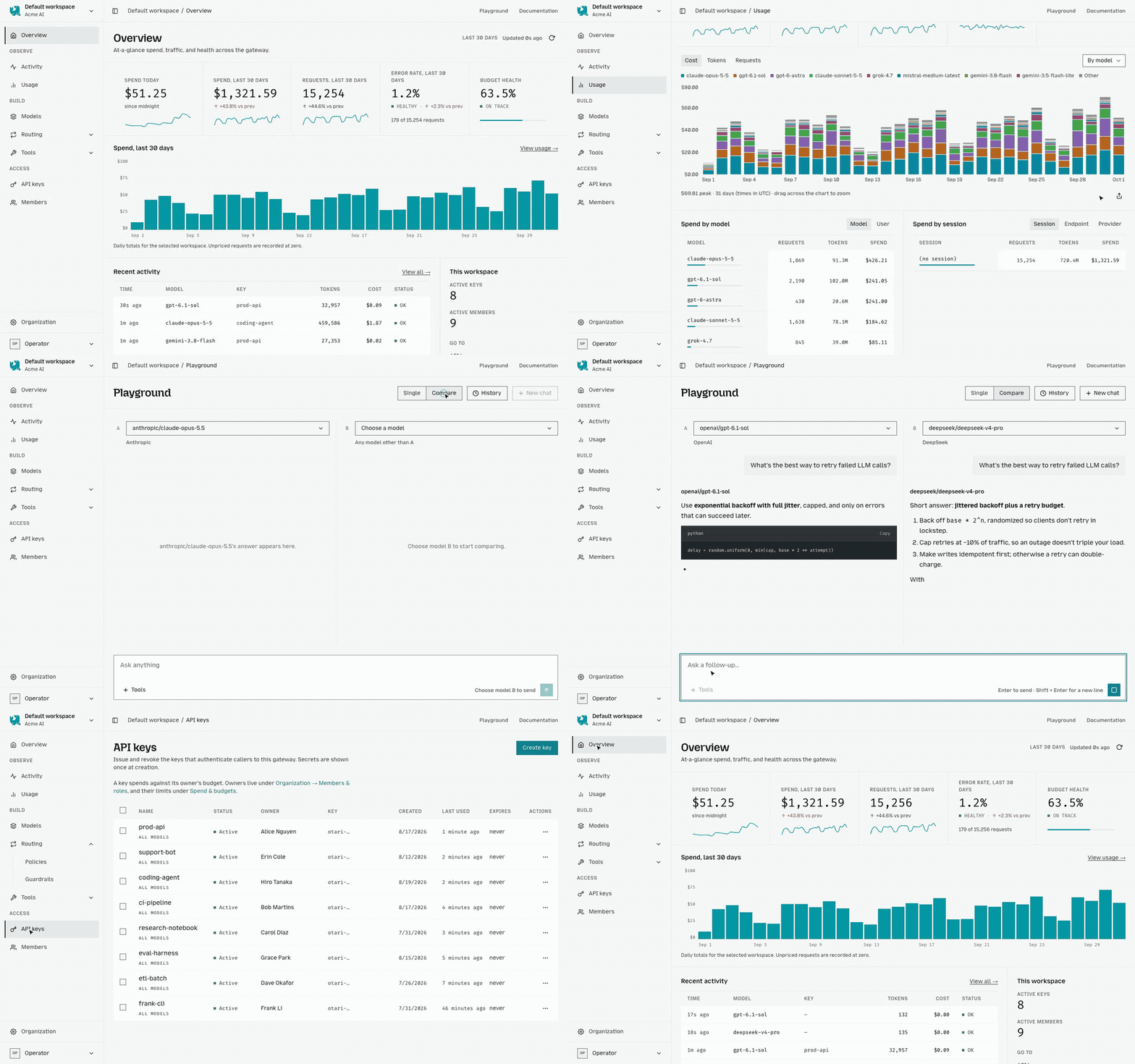
The dashboard manages providers, models, routing, tools, keys, members, budgets,
settings, activity, and usage. Its navigation adapts to the deployment mode and
the signed-in person's authority. See Admin dashboard.
Development
git clone https://github.com/mozilla-ai/otari
cd otari
uv sync --dev
cp config.example.yml config.yml
uv run otari serve --config config.yml
For local development without PostgreSQL, change database_url to
sqlite+aiosqlite:///./otari.db.