A pytorch-based deep learning framework for multi-modal 2D/3D medical image segmentation.
Key parameters and specifications
Key parameters and specifications
Parameter
Value
Language
Lua
Category
Model Development
Subcategory
Architecture
Stars
1,927
Forks
289
Contributors
3
Created date
2017-01-11
Updated date
2026-10-13
Stars in 1 day
0
Stars in 7 days
2
Rank
9,240
Previous rank
9,279
Rank change
39
7-day stars rank
7,886
Previous 7-day stars rank
7,919
7-day stars rank change
33
Total stars rank
6,551
Previous total stars rank
6,544
Total stars rank change
-7
Country
USA
README summary
ResNeXt: Aggregated Residual Transformations for Deep Neural Networks By Saining Xie, Ross Girshick, Piotr Dollár, Zhuowen Tu, Kaiming He UC San Diego, Facebook AI Research Table of Contents 0. Third-party re-implementations News Congrats to the ILSVRC 2017 classification challenge winner WMW. ResNeXt is the foundation of their new SENet architecture (a **ResNeXt-152 (64 x 4d)** with the Squeeze-and-Excitation module)! Check out Figure 6 in the new Memory-Efficient Implementation of DenseNets paper for a
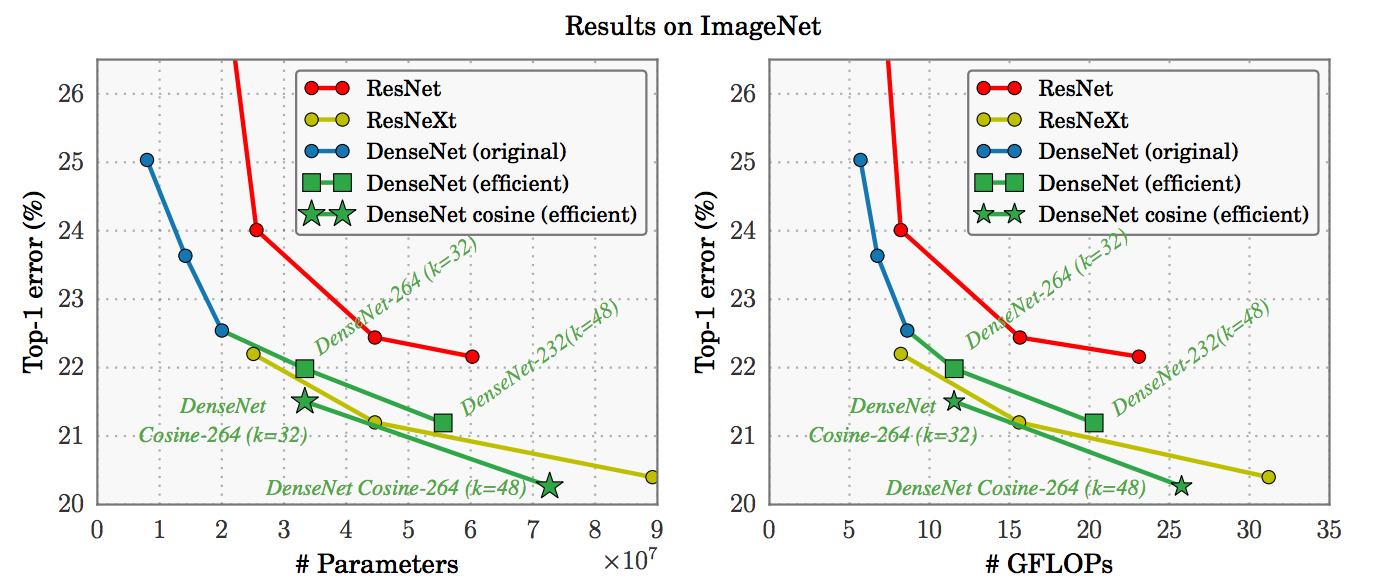
comparision between ResNeXts and DenseNets. (*DenseNet cosine is DenseNet trained with cosine learning rate schedule. *) Introduction This repository contains a Torch implementation for the ResNeXt algorithm for image classification. ResNeXt is a simple, highly modularized network architecture for image classification. Our network is constructed by repeating a building block that aggregates a set of transformations with the same topology. Our simple design results in a homogeneous, multi-branch architecture that has only a few hyper-parameters to set. This strategy
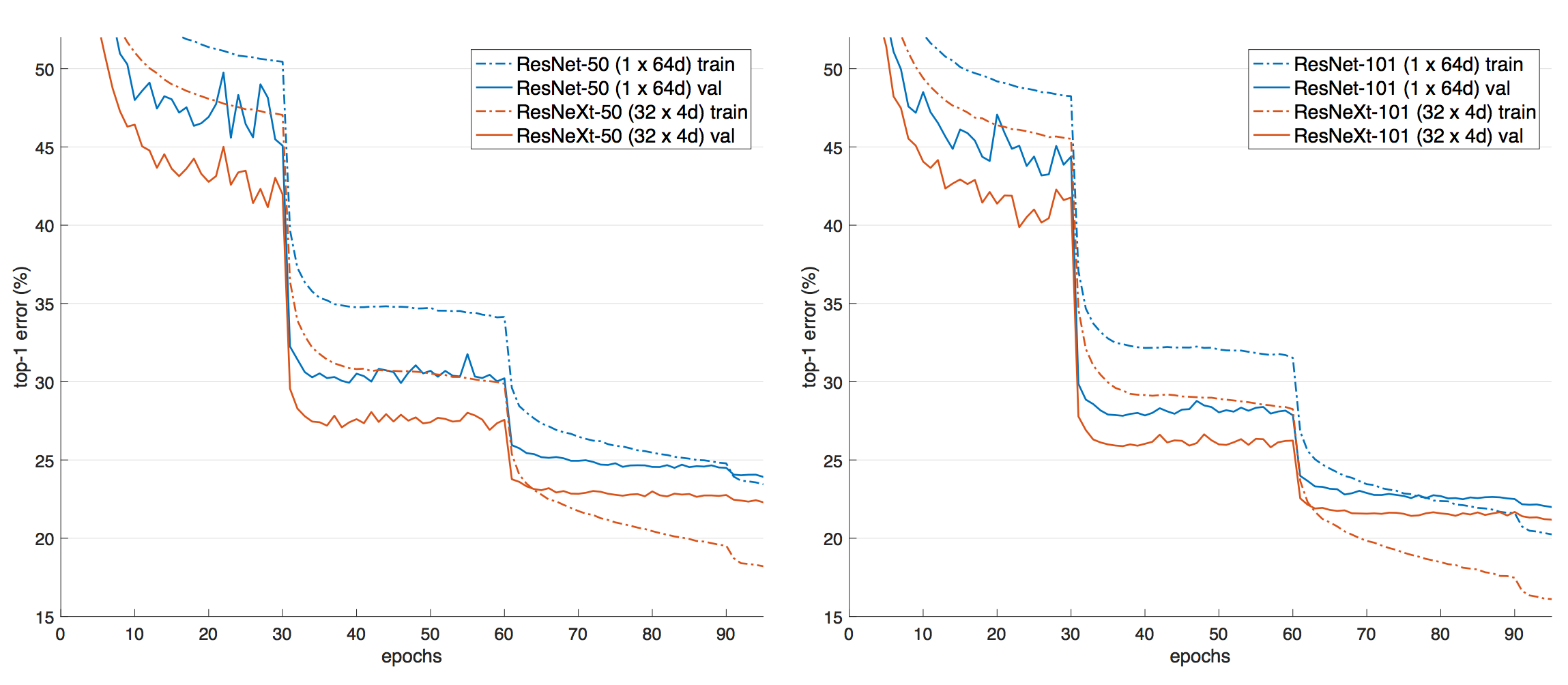
exposes a new dimension, which we call “cardinality” (the size of the set of transformations), as an essential factor in addition to the dimensions of depth and width. (Left): ResNet/ResNeXt-50 with the same complexity (~4. 1 billion FLOPs, ~25 million parameters); (Right): ResNet/ResNeXt-101 with the same complexity (~7. 8 billion FLOPs, ~44 million parameters). torch installation instructions for a step-by-step guide. Install Torch on a machine with CUDA GPU Install cuDNN v4 or v5
and the Torch cuDNN bindings Download the ImageNet dataset and move validation images to labeled subfolders Training Please follow fb. torch for the general usage of the code, including how to use pretrained ResNeXt models for your own task. ResNeXt 16x64d for cifar10) on 8 GPUs: To get comparable results using 2/4 GPUs, you should change the batch size and the corresponding learning rate: Note: CIFAR datasets will be automatically downloaded and processed for the first time. Note that
in the arXiv paper CIFAR results are based on pre-activated bottleneck blocks and a batch size of 256. We found that better CIFAR test acurracy can be achieved using original bottleneck blocks and a batch size of 128. ImageNet Pretrained Models ImageNet pretrained models are licensed under CC BY-NC 4. 9 | Original ResNet-50 | | ResNeXt-50 (32x4d) | ~4. 2 | Download (191MB) | | ResNet-101 (1x64d) | ~7. 0 | Original ResNet-101 | | ResNeXt-101 (32x4d) | ~7. 2 | Download (338MB) | | ResNeXt-101
(64x4d) | ~15. 4 | Download (638MB) | Third-party re-implementations Besides our torch implementation, we recommend to see also the following third-party re-implementations and extensions: 1. Converting ImageNet pretrained model to PyTorch model and source. Training code in MXNet and pretrained ImageNet models code 1. Caffe prototxt, pretrained ImageNet models (with ResNeXt-152), curves codecode
Frequently asked questions
How many stars and forks are recorded?
facebookresearch/ResNeXt has 1,927 stars and 289 forks.
What is the repository rank?
facebookresearch/ResNeXt is ranked 9,240.
What language and category are recorded?
facebookresearch/ResNeXt has 1,927 stars, uses Lua and belongs to Model Development.
Which repository is closest in rank?
facebookresearch/ResNeXt is compared with loujie0822/DeepIE, ranked 9,237 with 1,929 stars.
README
ResNeXt: Aggregated Residual Transformations for Deep Neural Networks
Congrats to the ILSVRC 2017 classification challenge winner WMW.
ResNeXt is the foundation of their new SENet architecture (a ResNeXt-152 (64 x 4d) with the Squeeze-and-Excitation module)!
Check out Figure 6 in the new Memory-Efficient Implementation of DenseNets paper for a comparision between ResNeXts and DenseNets. (DenseNet cosine is DenseNet trained with cosine learning rate schedule.)
Introduction
This repository contains a Torch implementation for the ResNeXt algorithm for image classification. The code is based on fb.resnet.torch.
ResNeXt is a simple, highly modularized network architecture for image classification. Our network is constructed by repeating a building block that aggregates a set of transformations with the same topology. Our simple design results in a homogeneous, multi-branch architecture that has only a few hyper-parameters to set. This strategy exposes a new dimension, which we call “cardinality” (the size of the set of transformations), as an essential factor in addition to the dimensions of depth and width.
Figure: Training curves on ImageNet-1K. (Left): ResNet/ResNeXt-50 with the same complexity (~4.1 billion FLOPs, ~25 million parameters); (Right): ResNet/ResNeXt-101 with the same complexity (~7.8 billion FLOPs, ~44 million parameters).
Citation
If you use ResNeXt in your research, please cite the paper:
@article{Xie2016,
  title={Aggregated Residual Transformations for Deep Neural Networks},
  author={Saining Xie and Ross Girshick and Piotr Dollár and Zhuowen Tu and Kaiming He},
  journal={arXiv preprint arXiv:1611.05431},
  year={2016}
}
Note: CIFAR datasets will be automatically downloaded and processed for the first time. Note that in the arXiv paper CIFAR results are based on pre-activated bottleneck blocks and a batch size of 256. We found that better CIFAR test acurracy can be achieved using original bottleneck blocks and a batch size of 128.
ImageNet Pretrained Models
ImageNet pretrained models are licensed under CC BY-NC 4.0.