Fast and Accurate One-Stage Space-Time Video Super-Resolution (accepted in CVPR 2020).
Key parameters and specifications
Key parameters and specifications
Parameter
Value
Language
Python
Category
Model Development
Subcategory
Architecture
Keywords
Graph
Stars
934
Forks
165
Contributors
3
Created date
2018-07-10
Updated date
2026-09-28
Stars in 1 day
0
Stars in 7 days
0
Rank
12,541
Previous rank
12,462
Rank change
-79
7-day stars rank
13,480
Previous 7-day stars rank
13,488
7-day stars rank change
8
Total stars rank
11,734
Previous total stars rank
11,717
Total stars rank change
-17
Country
UK
README summary
However, many graph analytics tasks such as graph classification and clustering require representing entire graphs as fixed length feature vectors. While the aforementioned approaches are naturally unequipped to learn such representations, graph kernels remain as the most effective way of obtaining them. However, these graph kernels use handcrafted features (e. ) and hence are hampered by problems such as poor generalization. To address this limitation, in this work, we propose a neural embedding framework named graph2vec to learn data-driven distributed
representations of arbitrary sized graphs. graph2vec's embeddings are learnt in an unsupervised manner and are task agnostic. Hence, they could be used for any downstream task such as graph classification, clustering and even seeding supervised representation learning approaches. Our experiments on several benchmark and large real-world datasets show that graph2vec achieves significant improvements in classification and clustering accuracies over substructure representation learning approaches and are competitive with state-of-the-art graph kernels. The model is now also available
in the Karate Club package. This repository provides an implementation for *graph2vec* as it is described in: graph2vec: Learning distributed representations of graphs. Narayanan, Annamalai and Chandramohan, Mahinthan and Venkatesan, Rajasekar and Chen, Lihui and Liu, Yang MLG 2017, 13th International Workshop on Mining and Learning with Graphs (MLGWorkshop 2017). The original TensorFlow implementation is available [[here]]( Requirements The codebase is implemented in Python 3. Package versions used for development are just below. Datasets The code takes an input folder
with json files. Every file is a graph and files have a numeric index as a name. The first key called "edges" corresponds to the edge list of the graph. The second key "features" corresponds to the node features. If the second key is not present the WL machine defaults to use the node degree as a feature. A sample graph dataset from NCI1 is included in the directory. Options Learning of the embedding is handled by the script which
provides the following command line arguments. Input and output options Model options Examples The following commands learn an embedding of the graphs and writes it to disk. The node representations are ordered by the ID. Creating a graph2vec embedding of the default dataset with the default hyperparameter settings. Saving the embedding at the default path. Creating an embedding of an other dataset. Creating an embedding of the default dataset in 32 dimensions.
Frequently asked questions
How many stars and forks are recorded?
benedekrozemberczki/graph2vec has 934 stars and 165 forks.
What is the repository rank?
benedekrozemberczki/graph2vec is ranked 12,541.
What language and category are recorded?
benedekrozemberczki/graph2vec has 934 stars, uses Python and belongs to Model Development.
Which repository is closest in rank?
benedekrozemberczki/graph2vec is compared with ImprintLab/Medical-SAM2, ranked 12,540 with 934 stars.
README
Graph2Vec
Abstract
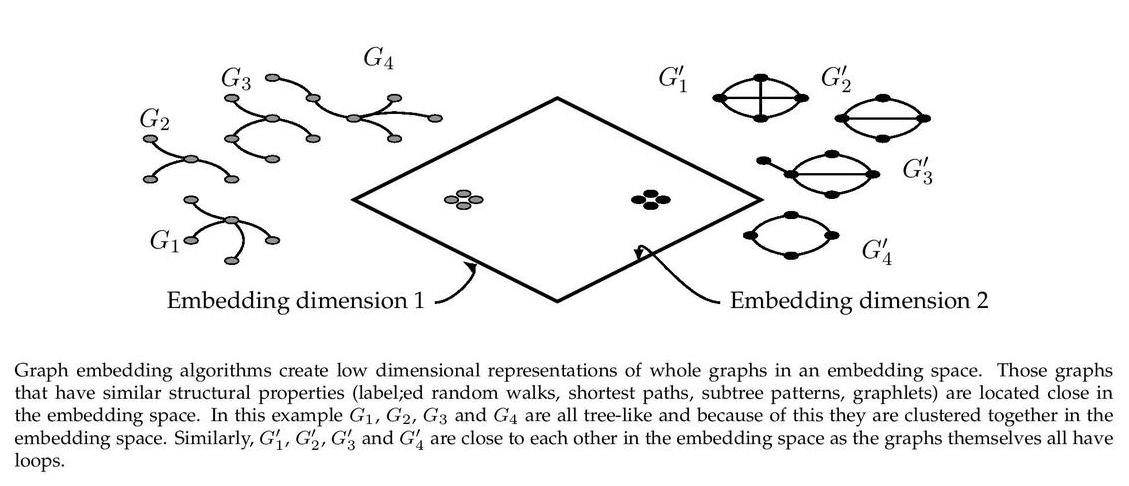
Recent works on representation learning for graph structured data predominantly focus on learning distributed representations of graph substructures such as nodes and subgraphs. However, many graph analytics tasks such as graph classification and clustering require representing entire graphs as fixed length feature vectors. While the aforementioned approaches are naturally unequipped to learn such representations, graph kernels remain as the most effective way of obtaining them. However, these graph kernels use handcrafted features (e.g., shortest paths, graphlets, etc.) and hence are hampered by problems such as poor generalization. To address this limitation, in this work, we propose a neural embedding framework named graph2vec to learn data-driven distributed representations of arbitrary sized graphs. graph2vec's embeddings are learnt in an unsupervised manner and are task agnostic. Hence, they could be used for any downstream task such as graph classification, clustering and even seeding supervised representation learning approaches. Our experiments on several benchmark and large real-world datasets show that graph2vec achieves significant improvements in classification and clustering accuracies over substructure representation learning approaches and are competitive with state-of-the-art graph kernels.
The model is now also available in the Karate Club package.
This repository provides an implementation for graph2vec as it is described in:
graph2vec: Learning distributed representations of graphs.
Narayanan, Annamalai and Chandramohan, Mahinthan and Venkatesan, Rajasekar and Chen, Lihui and Liu, Yang
MLG 2017, 13th International Workshop on Mining and Learning with Graphs (MLGWorkshop 2017).
The original TensorFlow implementation is available [here].
Requirements
The codebase is implemented in Python 3.5.2 | Anaconda 4.2.0 (64-bit). Package versions used for development are just below.
The code takes an input folder with json files. Every file is a graph and files have a numeric index as a name. The json files have two keys. The first key called "edges" corresponds to the edge list of the graph. The second key "features" corresponds to the node features. If the second key is not present the WL machine defaults to use the node degree as a feature. A sample graph dataset from NCI1 is included in the dataset/ directory.
Options
Learning of the embedding is handled by the src/graph2vec.py script which provides the following command line arguments.
Input and output options
  --input-path   STR    Input folder.           Default is `dataset/`.
  --output-path  STR    Embeddings path.        Default is `features/nci1.csv`.
Model options
  --dimensions     INT          Number of dimensions.                             Default is 128.
  --workers        INT          Number of workers.                                Default is 4.
  --epochs         INT          Number of training epochs.                        Default is 1.
  --min-count      INT          Minimal feature count to keep.                    Default is 5.
  --wl-iterations  INT          Number of feature extraction recursions.          Default is 2.
  --learning-rate  FLOAT        Initial learning rate.                            Default is 0.025.
  --down-sampling  FLOAT        Down sampling rate for frequent features.         Default is 0.0001.
Examples
The following commands learn an embedding of the graphs and writes it to disk. The node representations are ordered by the ID. Creating a graph2vec embedding of the default dataset with the default hyperparameter settings. Saving the embedding at the default path.
$ python src/graph2vec.py
Creating an embedding of an other dataset. Saving the output in a custom place.