The official repository of the paper "(Perhaps) Beyond Human Translation: Harnessing Multi-Agent Collaboration for Translating Ultra-Long Literary Texts".
Key parameters and specifications
Key parameters and specifications
Parameter
Value
Language
Python
Category
Applications
Subcategory
Research & knowledge
Keywords
RAG, Unstructured data extraction
Stars
607
Forks
71
Contributors
36
Created date
2023-07-07
Updated date
2026-10-05
Stars in 1 day
0
Stars in 7 days
0
Rank
16,191
Previous rank
15,978
Rank change
-213
7-day stars rank
15,393
Previous 7-day stars rank
15,401
7-day stars rank change
8
Total stars rank
16,645
Previous total stars rank
16,618
Total stars rank change
-27
README summary
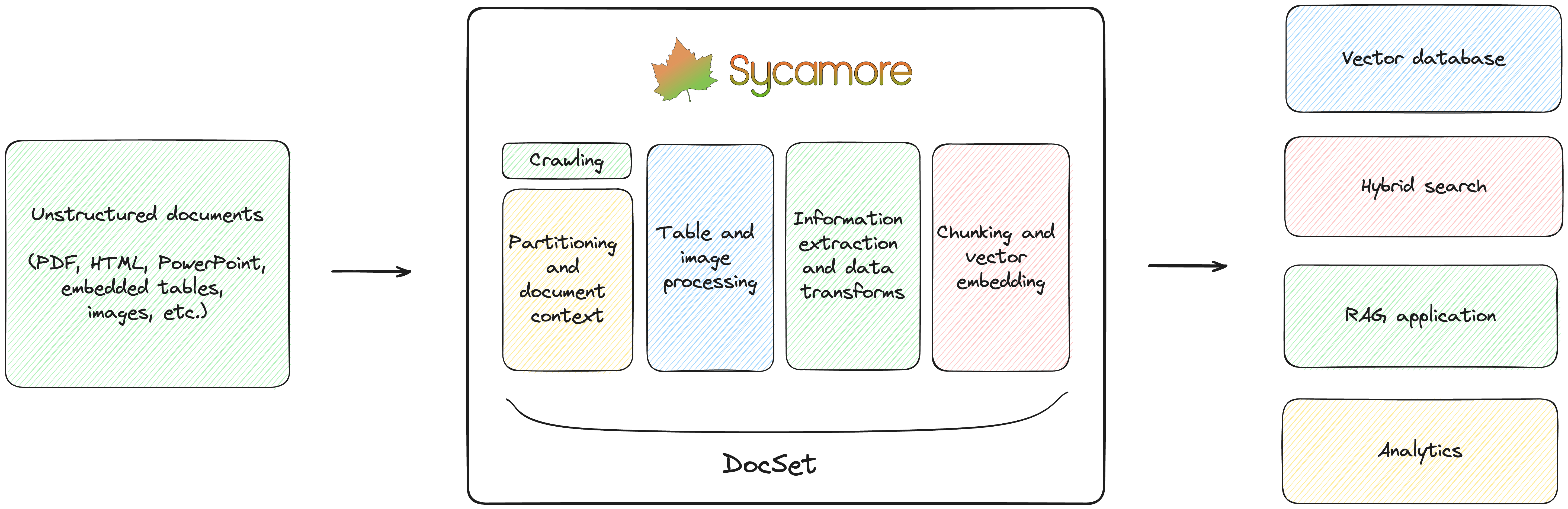
Sycamore is an open source, AI-powered document processing engine for ETL, RAG, LLM-based applications, and analytics on unstructured data. Sycamore can partition and enrich a wide range of document types including reports, presentations, transcripts, manuals, and more. It can analyze and chunk complex documents such as PDFs and images with embedded tables, figures, graphs, and other infographics. For processing documents, Sycamore leverages Aryn DocParse (formerly known as the Aryn Partitioning Service), a serverless, GPU-powered API for segmenting
and labeling documents, doing OCR, extracting tables and images, and more. It leverages Aryn's state-of-the-art, open source deep learning DETR AI model trained on 80k+ enterprise documents, and it can lead to 6x more accurate data chunking and 2x improved recall on hybrid search or RAG when compared to alternate systems. You can sign-up for free here, or choose to run the Aryn Partitioner locally. Aryn DocParse takes documents and returns the partitioned output in JSON
, and you can use Sycamore for additional data extraction, enrichment, transforms, cleaning, and loading into downstream databases. You can choose the LLMs to use with these transforms. Sycamore reliably loads your vector databases and hybrid search engines, including as OpenSearch, ElasticSearch, Pinecone, DuckDB, Qdrant and Weaviate, with higher quality data. The Sycamore framework is built around a scalable and robust abstraction for document processing called a DocSet, and includes powerful high-level transformations in Python for data processing, enrichment, and
cleaning. DocSets also encapsulate scalable data processing techniques removing the undifferentiated heavy lifting of reliably loading chunks. DocSets' functional programming approach allows you to rapidly customize and experiment with your chunking for better quality RAG results. Features Integrated with Aryn DocParse, using a state-of-the art vision AI model for segmentation and preserving the semantic structure of documents DocSet abstraction to scalably and reliably transform and manipulate unstructured documents High-quality table extraction, OCR, visual summarization, LLM-powered UDFs
, and other performant Python data transforms Quickly create vector embeddings using your choice of AI model Helpful features like automatic data crawlers (Amazon S3 and HTTP), Jupyter notebook for writing and iterating on jobs, and an OpenSearch hybrid search and RAG engine for testing Scalable Ray backend Demo Introduction to Aryn DocParse (formerly known as the Aryn Partitioning Service) Get Started Sycamore currently runs on Linux and Mac OS. To install , run: Sycamore provides connectors to vector databases via Python
extras. To install a connector, include it as an extra with your pip install. For example, Supported connectors include , , , , , and . To use Aryn DocParse, sign-up for free here and use the API key. Resources Documentation: Example notebook: Slack: Data preparation libraries (PyPi): Contact us: info@aryn. ai Contributing Check out our Contributing Guide for more information about how to contribute to Sycamore and set up your environment for development.
Frequently asked questions
How many stars and forks are recorded?
aryn-ai/sycamore has 607 stars and 71 forks.
What is the repository rank?
aryn-ai/sycamore is ranked 16,191.
What language and category are recorded?
aryn-ai/sycamore has 607 stars, uses Python and belongs to Applications.
Which repository is closest in rank?
aryn-ai/sycamore is compared with yanx27/EverybodyDanceNow_reproduce_pytorch, ranked 16,194 with 607 stars.
README
Sycamore is an open source, AI-powered document processing engine for ETL, RAG, LLM-based applications, and analytics on unstructured data. Sycamore can partition and enrich a wide range of document types including reports, presentations, transcripts, manuals, and more. It can analyze and chunk complex documents such as PDFs and images with embedded tables, figures, graphs, and other infographics. Check out an example notebook.
For processing documents, Sycamore leverages Aryn DocParse (formerly known as the Aryn Partitioning Service), a serverless, GPU-powered API for segmenting and labeling documents, doing OCR, extracting tables and images, and more. It leverages Aryn's state-of-the-art, open source deep learning DETR AI model trained on 80k+ enterprise documents, and it can lead to 6x more accurate data chunking and 2x improved recall on hybrid search or RAG when compared to alternate systems. You can sign-up for free here, or choose to run the Aryn Partitioner locally.
Aryn DocParse takes documents and returns the partitioned output in JSON, and you can use Sycamore for additional data extraction, enrichment, transforms, cleaning, and loading into downstream databases. You can choose the LLMs to use with these transforms.
Sycamore reliably loads your vector databases and hybrid search engines, including as OpenSearch, ElasticSearch, Pinecone, DuckDB, Qdrant and Weaviate, with higher quality data.
The Sycamore framework is built around a scalable and robust abstraction for document processing called a DocSet, and includes powerful high-level transformations in Python for data processing, enrichment, and cleaning. DocSets also encapsulate scalable data processing techniques removing the undifferentiated heavy lifting of reliably loading chunks. DocSets' functional programming approach allows you to rapidly customize and experiment with your chunking for better quality RAG results.
DocSet abstraction to scalably and reliably transform and manipulate unstructured documents
High-quality table extraction, OCR, visual summarization, LLM-powered UDFs, and other performant Python data transforms
Quickly create vector embeddings using your choice of AI model
Helpful features like automatic data crawlers (Amazon S3 and HTTP), Jupyter notebook for writing and iterating on jobs, and an OpenSearch hybrid search and RAG engine for testing