A ground-up and standalone reimplementation of TensorFlow for ruby. Comes with a pure ruby and OpenCL opcode evaluator.
Key parameters and specifications
Key parameters and specifications
Parameter
Value
Language
Python
Category
Model Development
Subcategory
Environments
Keywords
Agent sandbox, Datasets, Deep Research, Recommender system
Stars
504
Forks
62
Contributors
3
Created date
2023-10-12
Updated date
2026-10-13
Stars in 1 day
0
Stars in 7 days
1
Rank
18,223
Previous rank
17,977
Rank change
-246
7-day stars rank
11,605
Previous 7-day stars rank
11,653
7-day stars rank change
48
Total stars rank
19,240
Previous total stars rank
19,215
Total stars rank change
-25
README summary
These agents are initialized from the MovieLens-1M dataset, embodying varied social traits and preferences. Each agent interacts with personalized movie recommendations in a page-by-page manner and undertakes various actions such as watching, rating, evaluating, exiting, and interviewing. With Agent4Rec, we would like to explore the potential of LLM-empowered generative agents in simulating the behavior of genuine, independent humans in recommendation environments. 📋 Catalogue Catalogue Preparations Simulation Quick Start Explore Various Recommender Settings See the result Simulation Cost
⚙️ Preparations Step 1. txt Set up a virtualenv and install the pytorch manually. After that, install all the dependencies listed in the file by running the following command: Our experiments have been tested on **Python 3. 10 may lead to some bugs in the package 'reckit'. Set up necessary environments Make sure you are in the directory of (where can be found), and run the following code. The command will install necessary tools for accelerating recommender evaluation. ⌛️ Simulation Make sure
you are in the **main directory** (where can be found). Export your OpenAI API key first: Replace \ with **your own OpenAI API key**. Quick Start By running the following command, you will start a toy simulation with **3 agents**. The response of agents to recommended items will be printed in the terminal. This simulation will take around **3 minutes** to finish. Explore Various Recommender Settings Agent4Rec supports various recommendation systems and different simulation configurations. By running this code, you will
start a simulation named with 10 agents, each agent will browse max to 5 pages with 4 items on a single page. The recommender used in this example is Matrix Factorization (short for MF). And the experiment will be executed in parallel model to speed up the simulation. You can choose the employed recommender by modifying in the command. You can replace with the following supported recommenders: : Randomly recommend items to users. : Randomly recommend popular items to users. : Pretrained Matrix
Factorization model with BPR loss. : Pretrained LightGCN model with BPR loss. As for the command in Section Explore Various Recommender Settings, the results will be saved in directory. All the interaction history of agent 0 is documented in 💰 Simulation Cost 🛎️ Note that all the experiments are powered by ChatGPT-3. 5, and a complete simulation involving 1000 users would cost approximately $16.
Frequently asked questions
How many stars and forks are recorded?
LehengTHU/Agent4Rec has 504 stars and 62 forks.
What is the repository rank?
LehengTHU/Agent4Rec is ranked 18,223.
What language and category are recorded?
LehengTHU/Agent4Rec has 504 stars, uses Python and belongs to Model Development.
Which repository is closest in rank?
LehengTHU/Agent4Rec is compared with KaiyangZhou/pytorch-vsumm-reinforce, ranked 18,222 with 504 stars.
README
On Generative Agents in Recommendation
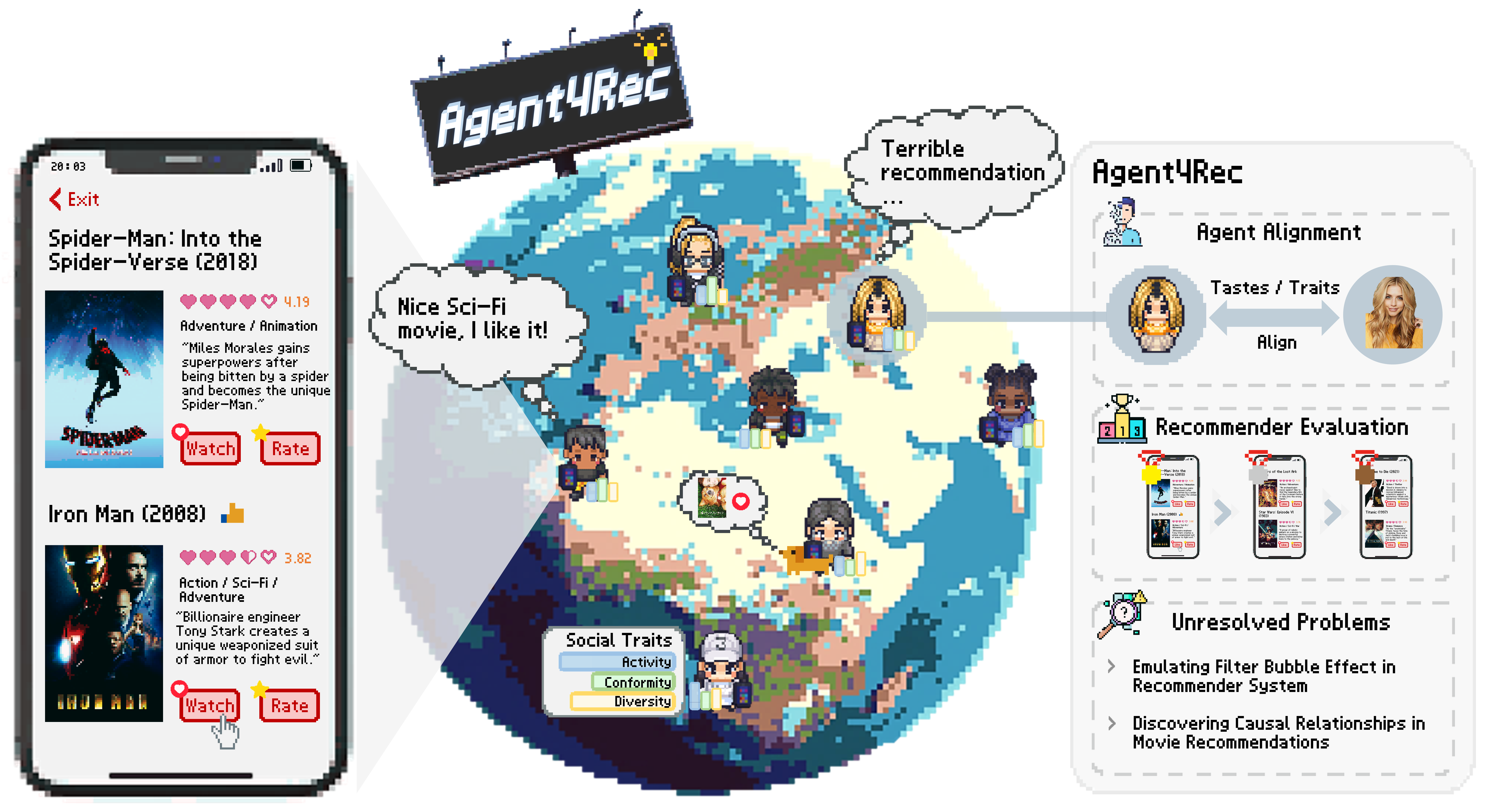
Agent4Rec, a recommender system simulator with 1,000 LLM-empowered generative agents. These agents are initialized from the MovieLens-1M dataset, embodying varied social traits and preferences. Each agent interacts with personalized movie recommendations in a page-by-page manner and undertakes various actions such as watching, rating, evaluating, exiting, and interviewing. With Agent4Rec, we would like to explore the potential of LLM-empowered generative agents in simulating the behavior of genuine, independent humans in recommendation environments.
Set up a virtualenv and install the pytorch manually. After that, install all the dependencies listed in the requirements.txt file by running the following command:
pip install -r requirements.txt
Our experiments have been tested on Python 3.9.12 with PyTorch 1.13.1+cu117. Python version over 3.10 may lead to some bugs in the package 'reckit'.
Step 2. Set up necessary environments
Make sure you are in the directory of recommenders/ (where setup.py can be found), and run the following code.
python setup.py build_ext --inplace
The command will install necessary tools for accelerating recommender evaluation.
⌛️ Simulation
Make sure you are in the main directory (where main.py can be found).
Export your OpenAI API key first:
export OPENAI_API_KEY=
Replace \ with your own OpenAI API key.
Quick Start
By running the following command, you will start a toy simulation with 3 agents.
python main.py
The response of agents to recommended items will be printed in the terminal. This simulation will take around 3 minutes to finish.
Explore Various Recommender Settings
Agent4Rec supports various recommendation systems and different simulation configurations.
By running this code, you will start a simulation named MyExp with 10 agents, each agent will browse max to 5 pages with 4 items on a single page. The recommender used in this example is Matrix Factorization (short for MF). And the experiment will be executed in parallel model to speed up the simulation.
You can choose the employed recommender by modifying --modeltype in the command. You can replace `` with the following supported recommenders:
LightGCN: Pretrained LightGCN model with BPR loss.
See the Results
The results of the simulation will be saved in storage/ml-1m// directory. As for the command in Section Explore Various Recommender Settings, the results will be saved in storage/ml-1m/MyExp directory. All the interaction history of agent 0 is documented in storage/ml-1m/MF/MyExp/running_logs/0.txt
💰 Simulation Cost
🛎️ Note that all the experiments are powered by ChatGPT-3.5, and a complete simulation involving 1000 users would cost approximately $16. ($0.016/User)