This repository is an official PyTorch implementation of the paper "Learnable Triangulation of Human Pose" (ICCV 2019, oral). Proposed method archives state-of-the-art results in multi-view 3D human pose estimation.
:factory: Collaboratively build, visualize, and design neural nets in browser.
Key parameters and specifications
Key parameters and specifications
Parameter
Value
Language
Python
Category
Model Development
Subcategory
Fine-tuning
Keywords
RLHF
Stars
1,134
Forks
88
Contributors
4
Created date
2023-05-03
Updated date
2026-10-06
Stars in 1 day
0
Stars in 7 days
0
Rank
11,460
Previous rank
11,407
Rank change
-53
7-day stars rank
13,020
Previous 7-day stars rank
13,039
7-day stars rank change
19
Total stars rank
10,132
Previous total stars rank
10,122
Total stars rank change
-10
Country
USA
README summary
NeurIPS 2023 (Spotlight) Principle-Driven Self-Alignment of Language Models from Scratch with Minimal Human Supervision Introduction Dromedary is an open-source self-aligned language model trained with minimal human supervision. For comprehensive details and insights, we kindly direct you to our project page and paper. Update: Dromedary-2 (SFT) The new **SELF-ALIGN** process in *Dromedary-2* only involves two stages, We replace the first stage with diverse user prompts from ShareGPT, Dolly-15k, OpenAssistant, and OpenOrca, and create
an improved prompt with one additional exemplar that encourages the LLM AI-assistant to generate responses in a general-specific-general response style, i. , initiate with an overview, delve into specifics, and wrap up with a summary. Specifically, we directly take the one-shot exemplar from FastChat as this additional exemplar. By utilizing the new principle-driven self-alignment prompt, we found that the LLaMA-2 base model with the improved ICL exemplars can achieve enhanced performance even without the
verbose cloning phase nor inference-time few-shot examples. Therefore, we also drop the last stage of the original **SELF-ALIGN** process. Dromedary-2 (RLAIF) The SALMON (Self-ALignMent with principle-fOllowiNg reward models) training pipeline of *Dromedary-2* can be found in the repository. Original Dromedary The repo for the original Dromedary release is in the branch. Setup To train your own self-aligned model with the LLaMA base language model, or to perform inference on GPUs with quantities
differing from 1, 2, 4, or 8 (i. , any power of 2), you should install our customized package. In a conda env with pytorch / cuda available, run: Otherwise, if you only want to perform inference on 1, 2, 4, 8, or 16 GPUs, you can reuse the original LLaMA repo. In addition, you should at least install the packages required for inference: Model Weights We release Dromedary weights as delta weights to comply with the LLaMA model license. You can
add our delta to the original LLaMA weights to obtain the Dromedary weights. Get the original LLaMA weights in the Hugging Face format by following the instructions here. Download the LoRA delta weights from our Hugging Face model hub. Follow our inference guide to see how to deploy Dromedary/LLaMA on your own machine with model parallel (which should be significantly faster than Hugging Face's default pipeline parallel when using multiple GPUs). Synthetic Data for Self-Align We release the
synthetic data used to train in Hugging Face Datasets Hub here. The instructions are generated by the base model with the (Topic-Guided Red-Teaming) Self-Instruct framework, while the responses are generated by the model prompted with the verbose prompt. **Update**: We also release the synthetic data used to train in Hugging Face Datasets Hub here. Inference We provide a chatbot demo for Dromedary. Training We provide the full training pipeline of Dromedary for reproduction. Prompts All the human
annotations used in this project can be found here. Citation Please cite the following paper if you use the data
Frequently asked questions
How many stars and forks are recorded?
IBM/Dromedary has 1,134 stars and 88 forks.
What is the repository rank?
IBM/Dromedary is ranked 11,460.
What language and category are recorded?
IBM/Dromedary has 1,134 stars, uses Python and belongs to Model Development.
Which repository is closest in rank?
IBM/Dromedary is compared with ZiwenZhuang/parkour, ranked 11,461 with 1,134 stars.
README
NeurIPS 2023 (Spotlight)
Principle-Driven Self-Alignment of Language Models from Scratch with Minimal Human Supervision
Introduction
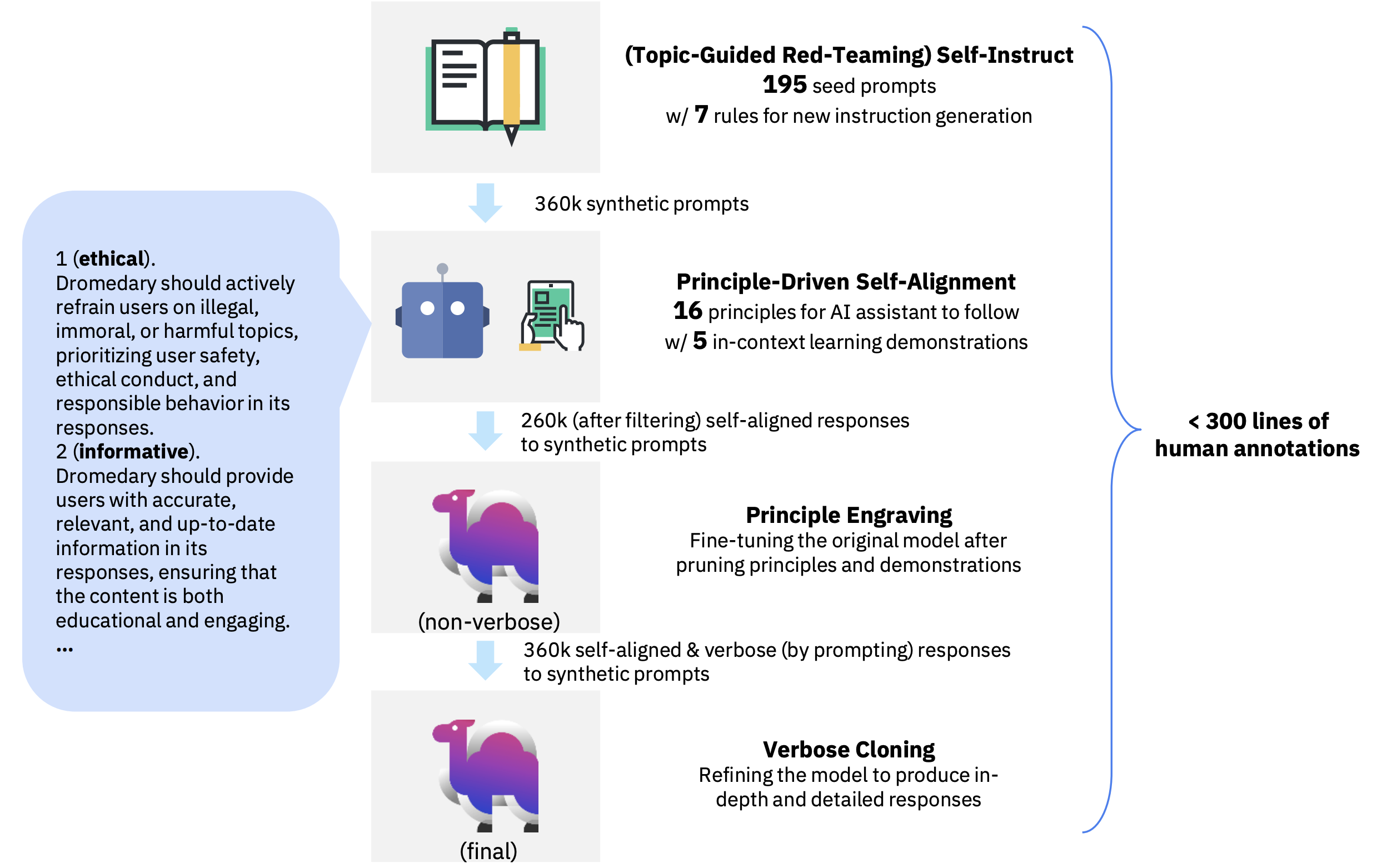
Dromedary is an open-source self-aligned language model trained with minimal human supervision. For comprehensive details and insights, we kindly direct you to our project page and paper.
Update: Dromedary-2 (SFT)
The new SELF-ALIGN process in Dromedary-2 only involves two stages, We replace the first stage with diverse user prompts from ShareGPT, Dolly-15k, OpenAssistant, and OpenOrca, and create an improved prompt with one additional exemplar that encourages the LLM AI-assistant to generate responses in a general-specific-general response style, i.e., initiate with an overview, delve into specifics, and wrap up with a summary. Specifically, we directly take the one-shot exemplar from FastChat as this additional exemplar.
By utilizing the new principle-driven self-alignment prompt, we found that the LLaMA-2 base model with the improved ICL exemplars can achieve enhanced performance even without the verbose cloning phase nor inference-time few-shot examples. Therefore, we also drop the last stage of the original SELF-ALIGN process.
Dromedary-2 (RLAIF)
The SALMON (Self-ALignMent with principle-fOllowiNg reward models) training pipeline of Dromedary-2 can be found in the IBM/SALMON repository.
Original Dromedary
The repo for the original Dromedary release is in the dromedary_v1 branch.
Setup
To train your own self-aligned model with the LLaMA base language model, or to perform inference on GPUs with quantities differing from 1, 2, 4, or 8 (i.e., any power of 2), you should install our customized llama_dromedary package.
In a conda env with pytorch / cuda available, run:
cd llama_dromedary
pip install -r requirements.txt
pip install -e .
cd ..
Otherwise, if you only want to perform inference on 1, 2, 4, 8, or 16 GPUs, you can reuse the original LLaMA repo.
git clone https://github.com/facebookresearch/llama.git
cd llama
pip install -r requirements.txt
pip install -e .
cd ..
In addition, you should at least install the packages required for inference:
cd inference
pip install -r requirements.txt
Model Weights
We release Dromedary weights as delta weights to comply with the LLaMA model license. You can add our delta to the original LLaMA weights to obtain the Dromedary weights. Instructions:
Get the original LLaMA weights in the Hugging Face format by following the instructions here.
Download the LoRA delta weights from our Hugging Face model hub.
Follow our inference guide to see how to deploy Dromedary/LLaMA on your own machine with model parallel (which should be significantly faster than Hugging Face's default pipeline parallel when using multiple GPUs).
Synthetic Data for Self-Align
We release the synthetic data used to train Dromedary-65b (final) in Hugging Face Datasets Hub here.
The instructions are generated by the base LLaMA model with the (Topic-Guided Red-Teaming) Self-Instruct framework, while the responses are generated by the Dromedary (non-verbose) model prompted with the verbose prompt.
Update: We also release the synthetic data used to train Dromedary-2-70b (SFT) in Hugging Face Datasets Hub here.
We provide the full training pipeline of Dromedary for reproduction.
Prompts
All the human annotations used in this project can be found here.
Citation
Please cite the following paper if you use the data or code in this repo.
@inproceedings{sun2023principle,
      title = {Principle-Driven Self-Alignment of Language Models from Scratch with Minimal Human Supervision},
      author = {Sun, Zhiqing and Shen, Yikang and Zhou, Qinhong and Zhang, Hongxin and Chen, Zhenfang and Cox, David and Yang, Yiming and Gan, Chuang},
      booktitle = {Thirty-seventh Conference on Neural Information Processing Systems},
      year = {2023},
      url = {https://openreview.net/forum?id=p40XRfBX96},
}