Aligning Superhuman AI with Human Behavior: Chess as a Model System
website/paper/code/lichess
🆕♟️🤖🚀✨ Maia-3 is now available! The state of the art in human chess modeling built with our new Chessformer architecture. Outperforms all prior models with significantly fewer parameters.
- 📄 Paper@ICML '26: Chessformer: A Unified Architecture for Chess Modeling
- 🤖 Models: HuggingFace models
- 💻 Code: Maia-3
🆕♟️🤖🚀✨ Maia-2 is now available! The next generation of human-like chess AI with a unified model that coherently captures human play across skill levels.
- 📄 Paper@NeurIPS '24: Maia-2: A Unified Model for Human-AI Alignment in Chess
- 💻 Code: Maia-2
A collection of chess engines that play like humans, from ELO 1100 to 1900.
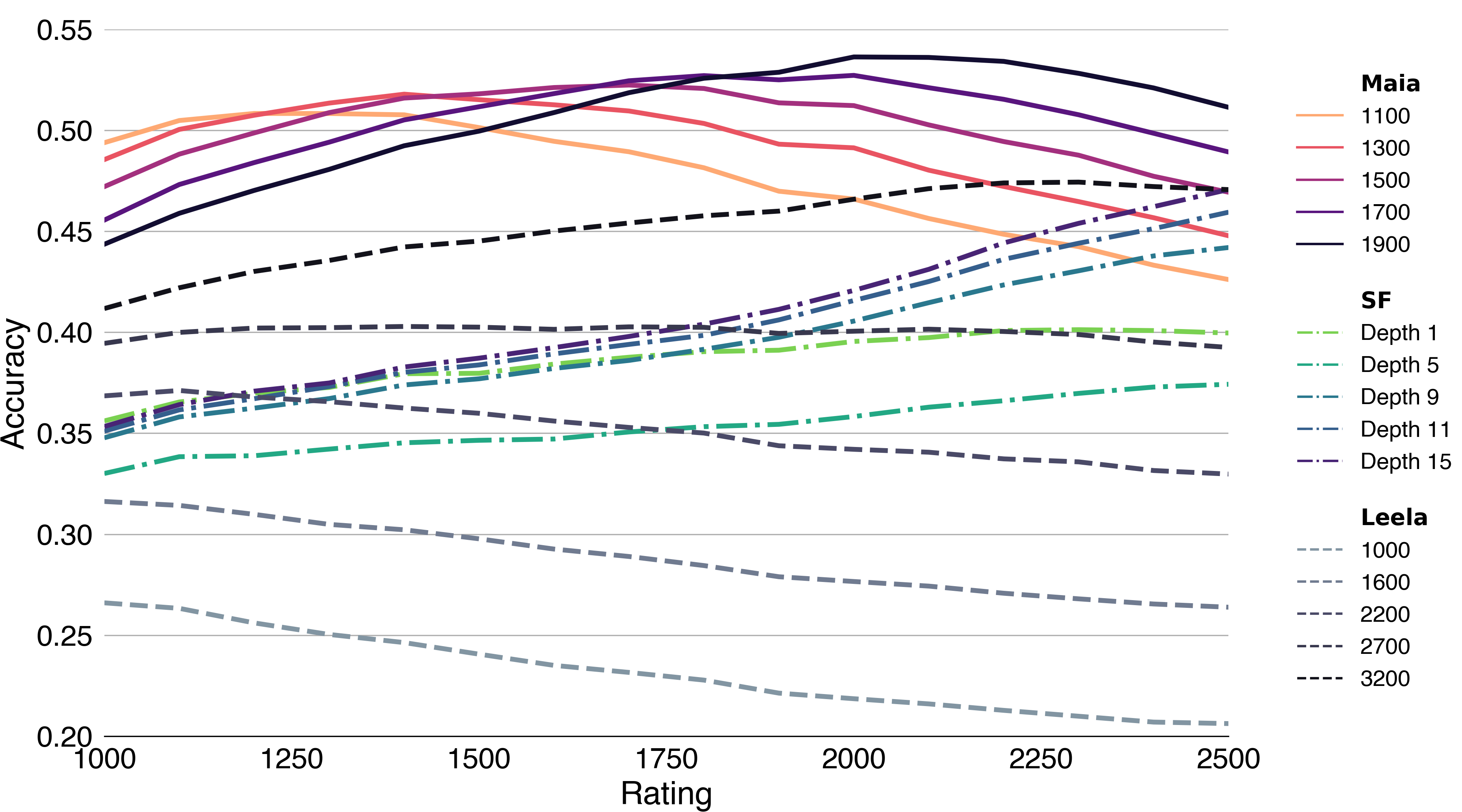
In this repo is our 9 final maia models saved as Leela Chess neural networks, and the code to create more and reproduce our results.
Our website has information about the project and team.
You can also play against three of of our models on Lichess:
maia1is targeting ELO 1100maia5is targeting ELO 1500maia9is targeting ELO 1900MaiaMysteryis for testing new versions of Maia
We also have a Lichess team, maia-bots, that we will add more bots to.
How to Run Maia
The Maias are not a full chess framework chess engines, they are just brains (weights) and require a body to work. So you need to load them with lc0 and follow the instructions here. Then unlike most other engines you want to disable searching, a nodes limit of 1 is what we use. This looks like go nodes 1 in UCI. Note also, the models are also stronger than the rating they are trained on since they make the average move of a player at that rating.
The links to download the models directly are:
Models with Lichess Bots
| Targeted Rating | lichess name | link |
|---|---|---|
| 1100 | maia1 | maia-1100.pb.gz |
| 1500 | maia5 | maia-1500.pb.gz |
| 1900 | maia9 | maia-1900.pb.gz |
The bots on Lichess use opening books that are still in development, since the models play the same move every time.
Other Models
| Targeted Rating | link |
|---|---|
| 1200 | maia-1200.pb.gz |
| 1300 | maia-1300.pb.gz |
| 1400 | maia-1400.pb.gz |
| 1600 | maia-1600.pb.gz |
| 1700 | maia-1700.pb.gz |
| 1800 | maia-1800.pb.gz |
We also have all the models in the maia_weights folder of the repo.
Example
When running the models on the command line it should look like this:
:~/maia-chess$ lc0 --weights=model_files/maia-1100.pb.gz
       _
|   _ | |
|_ |_ |_| v0.26.3 built Dec 18 2020
go nodes 1
Loading weights file from: model_files/maia-1100.pb.gz
Creating backend [cudnn-auto]...
Switching to [cudnn]...
...
info depth 1 seldepth 1 time 831 nodes 1 score cp 6 tbhits 0 pv e2e4
bestmove e2e4
move_prediction/maia_chess_backend also has the LeelaEngine class that uses the config files move_prediction/model_files/*/config.yaml to wrap python-chess and allow the models to be used in Python.
Datasets
As part of our analysis all the game on Lichess with stockfish analysis were processed into csv files. These can be found here
Code
Move Prediction
To create your own maia from a set of chess games in the PGN format:
- Setup your environment
- (optional) Install the
condaenvironment,maia_env.yml - Make sure all the required packages are installed from
requirements.txt
- (optional) Install the
- Convert the PGN into the training format
- Add the
pgn-extracttool to your path - Add the
trainingdata-toolto your path - Run
move_prediction/pgn_to_trainingdata.sh PGN_FILE_PATH OUTPUT_PATH - Wait a bit as the processing is both IO and CPU intense
- The script will create a training and validation set, if you wish to train on the whole set copy the files from
OUTPUT_PATH/validationtoOUTPUT_PATH/training
- Add the
- Edit
move_prediction/maia_config.yml- Add
OUTPUT_PATH/training/*/*toinput_train - Add
OUTPUT_PATH/validation/*/*toinput_test - (optional) If you have multiple GPUS change the
gpufiled to the one you are using - (optional) You can also change all the other training parameters here, like the number of layers
- Add
- Run the training script
move_prediction/train_maia.py PATH_TO_CONFIG - (optional) You can use tensorboard to watch the training progress, the logs are in
runs/CONFIG_BASENAME/ - Once complete the final model will be in
models/CONFIG_BASENAME/directory. It will be the one with the largest number
Replication
To train the models we present in the paper you need to download the raw files from Lichess then cut them into the training sets and process them into the training data format. This is a similar format to the general training instructions just with our specified data, so you will need to have trainingdata-tool and pgn-extract on your PATH.
Also note that running the scripts manually line by line might be necessary as they do not have any flow control logic. And that move_prediction/replication-move_training_set.py is where the main shuffling and games selection logic is.
- Download the games from Lichess between January 2017 and November 2019 to
data/lichess_raw - Run
move_prediction/replication-generate_pgns.sh - Run
move_prediction/replication-make_leela_files.sh - Edit
move_prediction/maia_config.ymland add the elo you want to train:- input_test :
../data/elo_ranges/${elo}/test - output_train :
../data/elo_ranges/${elo}/train
- input_test :
- Run the training script
move_prediction/train_maia.py PATH_TO_CONFIG
We also include some other (but not all) config files that we tested. Although, we still recommend using the final config move_prediction/maia_config.yml.
If you wish to generate the testing set we used you can download the December 2019 data and run move_prediction/replication-make_testing_pgns.sh. The data is also avaible for download as a CSV here. The script for running models on the dataset is replication-run_model_on_csv.py and requires the lc0 binary on the path.
Blunder Prediction
To train the blunder prediction models follow these instructions:
- Setup your environment
- (optional) Install the
condaenvironment,maia_env.yml
- (optional) Install the
- Make sure all the required packages are installed from
requirements.txt - Run
blunder_prediction/make_csvs.sh- You will probably need to update the paths, and may want to change the targets or use a for loop
- Run
blunder_prediction/mmap_csv.pyon all the csv files - Select a config from
blunder_prediction/configsand update the paths - Run `blunder_prediction/train_model.py CONFIG_PATH
Citation
Maia (this repo):
@inproceedings{mcilroyyoung2020maia,
  title={Aligning Superhuman AI with Human Behavior: Chess as a Model System},
  author={McIlroy-Young, Reid and  Sen, Siddhartha and Kleinberg, Jon and Anderson, Ashton},
  year={2020},
  booktitle={Proceedings of the 25th ACM SIGKDD international conference on Knowledge discovery and data mining}
}
@inproceedings{tang2024maia,
       title={Maia-2: A Unified Model for Human-{AI} Alignment in Chess},
       author={Zhenwei Tang and Difan Jiao and Reid McIlroy-Young and Jon Kleinberg and Siddhartha Sen and Ashton Anderson},
       booktitle={The Thirty-eighth Annual Conference on Neural Information Processing Systems},
       year={2024},
       url={https://openreview.net/forum?id=XWlkhRn14K}
}
License
The software is available under the GPL License.
Contact
Please open an issue or email Reid McIlroy-Young to get in touch