ViDoRAG: Visual Document Retrieval-Augmented Generation via Dynamic Iterative Reasoning Agents
🔥 News
- 🎉 We have released the evaluation code, allowing you to customize your own evaluation pipeline.
- 🎉 Our framework integrates various embedding models, enabling you to create your own retriever.
- 🎉 We have released the ViDoSeek dataset, which is suitable for Retrieval-augmented Generation in the large visually rich document collection.
🚀Overview
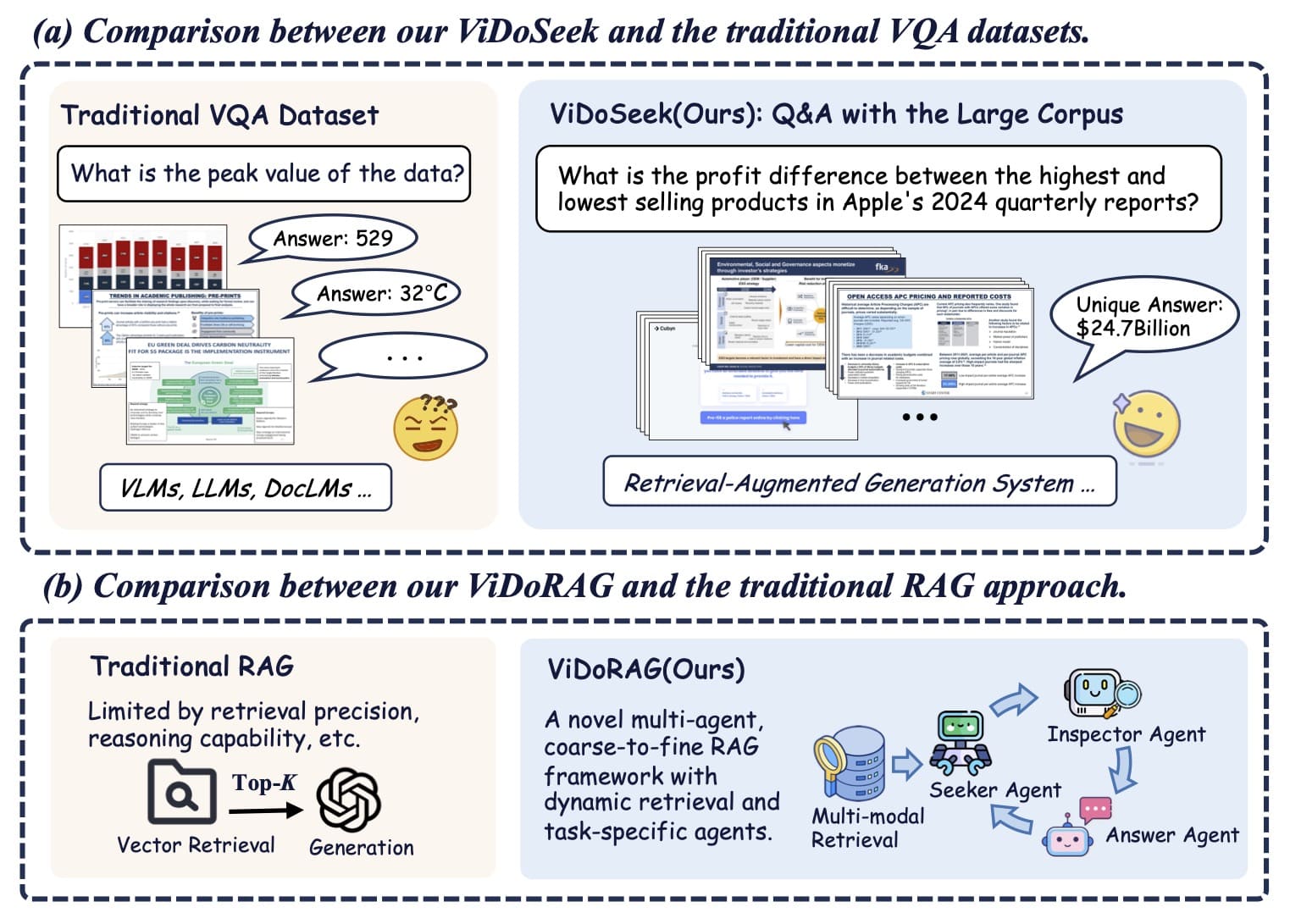
- We introduce ViDoSeek, a benchmark specifically designed for visually rich document retrieval-reason-answer, fully suited for evaluation of RAG within large document corpus.
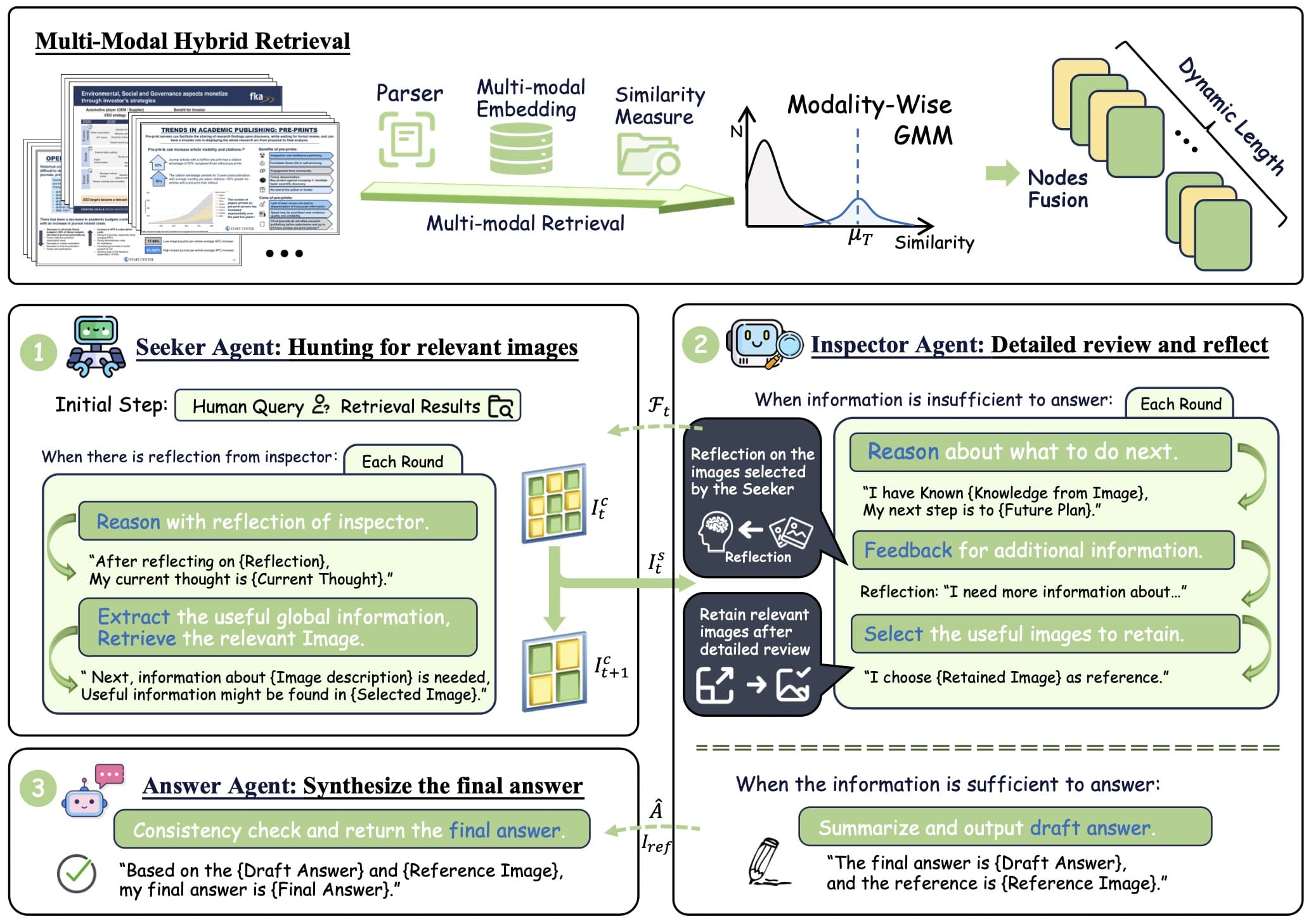
- We propose ViDoRAG, a novel RAG framework that utilizes a multi-agent, actor-critic paradigm for iterative reasoning, enhancing the noise robustness of generation models.
- We introduce a GMM-based multi-modal hybrid retrieval strategy to effectively integrate visual and textual pipelines.
- Extensive experiments demonstrate the effectiveness of our method. ViDoRAG significantly outperforms strong baselines, achieving over 10% improvement, thus establishing a new state-of-the-art on ViDoSeek.
🔍ViDoSeek Dataset
We release our ViDoSeek dataset which designed for visually rich document retrieval-reason-answer. In ViDoSeek, each query has a unique answer and specific reference pages.
The provided JSON structure includes a unique identifier (uid) to distinguish queries, the query content (query), a reference answer (reference_answer), and metadata (meta_info) containing the original file name (file_name), reference page numbers (reference_page), data source type (source_type), and query type (query_type):
{
    "uid": "04d8bb0db929110f204723c56e5386c1d8d21587_2",
    "query": "What is the temperature of Steam explosion of Pretreatment for Switchgrass and Sugarcane bagasse preparation?",
    "reference_answer": "195-205 Centigrade",
    "meta_info": {
        "file_name": "Pretreatment_of_Switchgrass.pdf",
        "reference_page": [10, 11],
        "source_type": "Text",
        "query_type": "Multi-Hop"
    }
}
You can use Git LFS to download annotation files and original documents from Hugging Face or ModelScope. The format of the files can refer to ./data/ExampleDataset.
Download the dataset
bash scripts/ViDoSeek_down.sh
Then, you can use the following script to convert the original file into images:
python ./scripts/pdf2images.py
Optionally, you can use OCR models or Vision-Language Models (VLMs) to recognize text within images:
## triditional OCR models
python ./scripts/ocr_triditional.py
## VLMs as ocr models (Optional)
python ./scripts/ocr_vlms.py
💻 Running ViDoRAG
ViDoRAG is a novel multi-agent RAG framework tailored for complex reasoning across visual documents. ViDoRAG employs a Gaussian Mixture Model (GMM)-based hybrid strategy to effectively handle multi-modal retrieval.
Dependencies
# Create environment
conda create -n vidorag python=3.10
# Clone project
git clone https://github.com/alibaba-nlp/ViDoRAG.git
cd ViDoRAG
# Install requirements
pip install -r requirements.txt
Or you can use uv to install the dependencies:
pip install uv
uv venv -p 3.10
uv sync
We recommend following the guidance of the Colpali-engine and the Transformer library to install the most suitable version.
Below is a step-by-step guide to help you run the entire framework on your own dataset. You can also use individual modules independently:
Step1. Build the Index Database
Our framework is built on the foundation of the Llama-Index. We preprocess the corpus in advance and then establish an index database.
Before embedding the whole dataset, you can run ./llms/vl_embedding.py to check whether the embedding model is loaded correctly:
python ./llms/vl_embedding.py
Then, you can run ingestion.py to embedding the whole dataset:
# Document ingestion and Multi-Modal Embedding
python ./ingestion.py
Step2. Run Multi-Modal Retriever
Try using the basic single-modal search engine:
from search_engine import SearchEngine
# initial engine
search_engine = SearchEngine(dataset='ViDoSeek', node_dir_prefix='colqwen_ingestion',embed_model_name='vidore/colqwen2-v1.0')
# Retrieve some results
recall_results = search_engine.search('some query')
Try using the dynamic single-modal search engine with GMM:
from search_engine import SearchEngine
# initial engine
search_engine = SearchEngine(dataset='ViDoSeek', node_dir_prefix='colqwen_ingestion',embed_model_name='vidore/colqwen2-v1.0')
# Set parameters of dynamic retriever
search_engine.gmm = True
search_engine.input_gmm = 20 # The default setting is K
# Retrieve some results using dynamic recall
recall_results = search_engine.search('some query')
Try using the dynamic hybrid multi-modal search engine:
from search_engine import HybridSearchEngine
# initial engine
hybrid_search_engine = HybridSearchEngine(dataset='ViDoSeek', embed_model_name_vl='vidore/colqwen2-v0.1', embed_model_name_text='BAAI/bge-m3', gmm=True)
# Retrieve some results using dynamic recall
hybrid_recall_results = hybrid_search_engine.search('some query')
Optionally, you can choose to test these features in search_engine.py.
Step3. Run Multi-Agent Generation
You can directly use our script for generation in vidorag_agents.py, or you can integrate it into your own framework:
from llms.llm import LLM
vlm = LLM('qwen-vl-max')
agent = ViDoRAG_Agents(vlm)
answer=agent.run_agent(query='Who is Tim?', images_path=['./data/ExampleDataset/img/00a76e3a9a36255616e2dc14a6eb5dde598b321f_1.jpg','./data/ExampleDataset/img/00a76e3a9a36255616e2dc14a6eb5dde598b321f_2.jpg'])
print(answer)
Step4. Run Evaluation
For our end-to-end evaluation, we employed a LLM-based assessment:
python eval.py \
  --experiment_type retrieval_infer ## choose from retrieval_infer/dynamic_hybird_retrieval_infer/vidorag
  --dataset ViDoSeek ## dataset folder name
  --embed_model_name_vl ## vl embedding model name
  --embed_model_name_text ## text embedding model name
  --embed_model_name ## only for single embedding model eval, when you need not use vl or text above
  --generate_vlm ## VLMs name eg. gpt-4o/qwen-max-vl
📝 Citation
@article{wang2025vidorag,
  title={ViDoRAG: Visual Document Retrieval-Augmented Generation via Dynamic Iterative Reasoning Agents},
  author={Wang, Qiuchen and Ding, Ruixue and Chen, Zehui and Wu, Weiqi and Wang, Shihang and Xie, Pengjun and Zhao, Feng},
  journal={arXiv preprint arXiv:2502.18017},
  year={2025}
}