MARS: Unleashing the Power of Variance Reduction for Training Large Models
This repository contains the official code for the paper MARS: Unleashing the Power of Variance Reduction for Training Large Models.
Authors: Huizhuo Yuan*, Yifeng Liu*, Shuang Wu, Xun Zhou, Quanquan Gu
🔔 NEWS
- [03/04/2025] MARS-AdamW CUDA implementation is available.
- [05/01/2025] Our paper is accepted by ICML 2025 🎉🎉.
- [02/10/2025] Our paper is updated on ArXiv: https://arxiv.org/pdf/2411.10438v2.
- [01/12/2025] Update scripts for reproducing GPT-2 XL results and FineWeb-Edu results.
- [01/12/2025] Our pretraining results on FineWeb-Edu are available. GPT-2 XL reaches a Hellaswag accuracy of 56.52 in 50B tokens.
- [11/26/2024] Vision tasks added.
- [11/18/2024] Our code is open-sourced!
- [11/15/2024] Our paper is released on arXiv: https://arxiv.org/abs/2411.10438.
About MARS
MARS (Make vAriance Reduction Shine) is a unified optimization framework designed to address the inherent challenges of training large models. Traditional adaptive gradient methods like Adam and AdamW often suffer from high stochastic gradient variance, while variance reduction techniques have struggled to gain practical impact in deep learning. At its core, MARS comprises two major components: (1) a scaled stochastic recursive momentum, which provides a variance-reduced estimator of the full gradient for better gradient complexity; and (2) the preconditioned update, which approximates the second-order Newton's method for better per-iteration complexity. By combining preconditioned gradient methods with variance reduction, MARS achieves the best of both worlds, accelerating the search for critical points in optimization.
The MARS framework is built on the following preconditioned variance-reduced updates
$$ \mathbf{c}_t = \nabla f(\mathbf{x}_t, \mathbf{\xi}_t)+\underbrace{{\color{red}\gamma_t} \frac{\beta_{1}}{1-\beta_{1}} \left(\nabla f(\mathbf{x}_t, \mathbf{\xi}_t)-\nabla f(\mathbf{x}_{t-1}, \mathbf{\xi}_t)\right)}_{\text{scaled gradient correction}} $$
$$ \tilde{\mathbf{c}}_t = \text{Clip}(\mathbf{c}_t,1) = \begin{cases} \frac{\mathbf{c}_t}{\|\mathbf{c}_t\|_2} & \text{if } \|\mathbf{c}_t\|_2 > 1,\ \mathbf{c}_t & \text{otherwise}. \end{cases} $$
$$ \mathbf{m}_t = \beta_1 \mathbf{m}_{t-1} + (1-\beta_{1})\tilde{\mathbf{c}}_t $$
$$ \mathbf{x}_{t+1} = \arg\min_{\mathbf{x} \in \mathbb{R}^d} \left\{\eta_t \left\langle \mathbf{m}_t, \mathbf{x} \right\rangle + \frac{1}{2} \|\mathbf{x} - \mathbf{x}_t \|_{\mathbf{H}_t}^2\right\} $$
Here ${\color{red}\gamma_t}$ is a scaling parameter that controls the strength of gradient correction.
Instantiations of MARS
Under the MARS framework, we provide three instantiations based on different Hessian matrix approximations: MARS-AdamW, MARS-Lion, and MARS-Shampoo. Please note that the hyperparameters in this framework are tuned on MARS-AdamW. When using other instantiations, it is essential to tune the hyperparameters—particularly the learning rates—for optimal performance.
MARS-AdamW
(Enable with mars_type="mars-adamw" in mars.py)
The Hessian matrix approximation is defined as:
$$ \mathbf{v}_t =\beta_2 \mathbf{v}_{t-1}+(1-\beta_2) \big(\nabla f(\mathbf{x}_t, \mathbf{\xi}_t)\big)^2 $$
$$ \mathbf{H}_t := \sqrt{\text{diag}\Big(\mathbf{v}_t\Big)}\cdot \frac{1 - \beta_1^t}{\sqrt{1 - \beta_2^t}}. $$
MARS-Lion
(Enable with mars_type="mars-lion" in mars.py)
The Hessian matrix approximation is defined as:
$$ \mathbf{H}_t := \sqrt{\text{diag}(\mathbf{m}_t^2)}. $$
MARS-Shampoo
(Enable with mars_type="mars-shampoo" in mars.py)
The preconditioner can be seen as an orthogonal mapping operator:
$$ \mathbf{U}_t, \mathbf{\Sigma}_t, \mathbf{V}_t = \text{SVD}(\mathbf{G}_t),\qquad \mathbf{x}_{t+1} =\mathbf{x}_t-\eta_t\mathbf{U}_t\mathbf{V}_t^\top. $$
In practice, we use the Newton-Schulz iteration to accelerate and approximate the solution of SVD problem.
Performance of MARS Compared to Baselines
Experiments on OpenWebText
Experimental results for MARS are based on the MARS-AdamW instantiation, unless otherwise stated. In our experiments, gradients are calculated once per sample and per update (MARS-approx in our paper). Performing exact gradient computation with two evaluations per update, as in the exact form of MARS, can slightly enhance performance but at the cost of doubling the computational expense. For more details, refer to our paper.
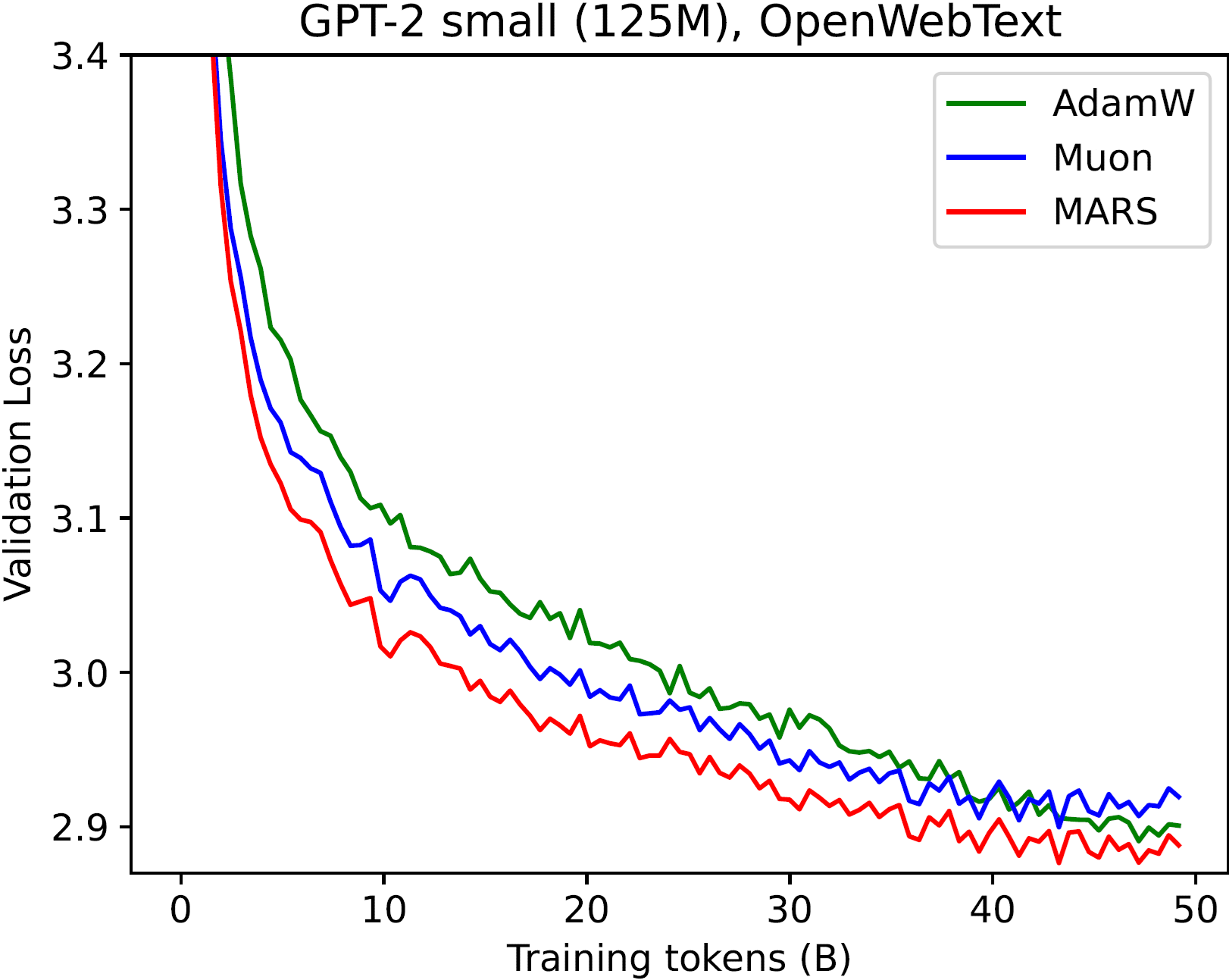
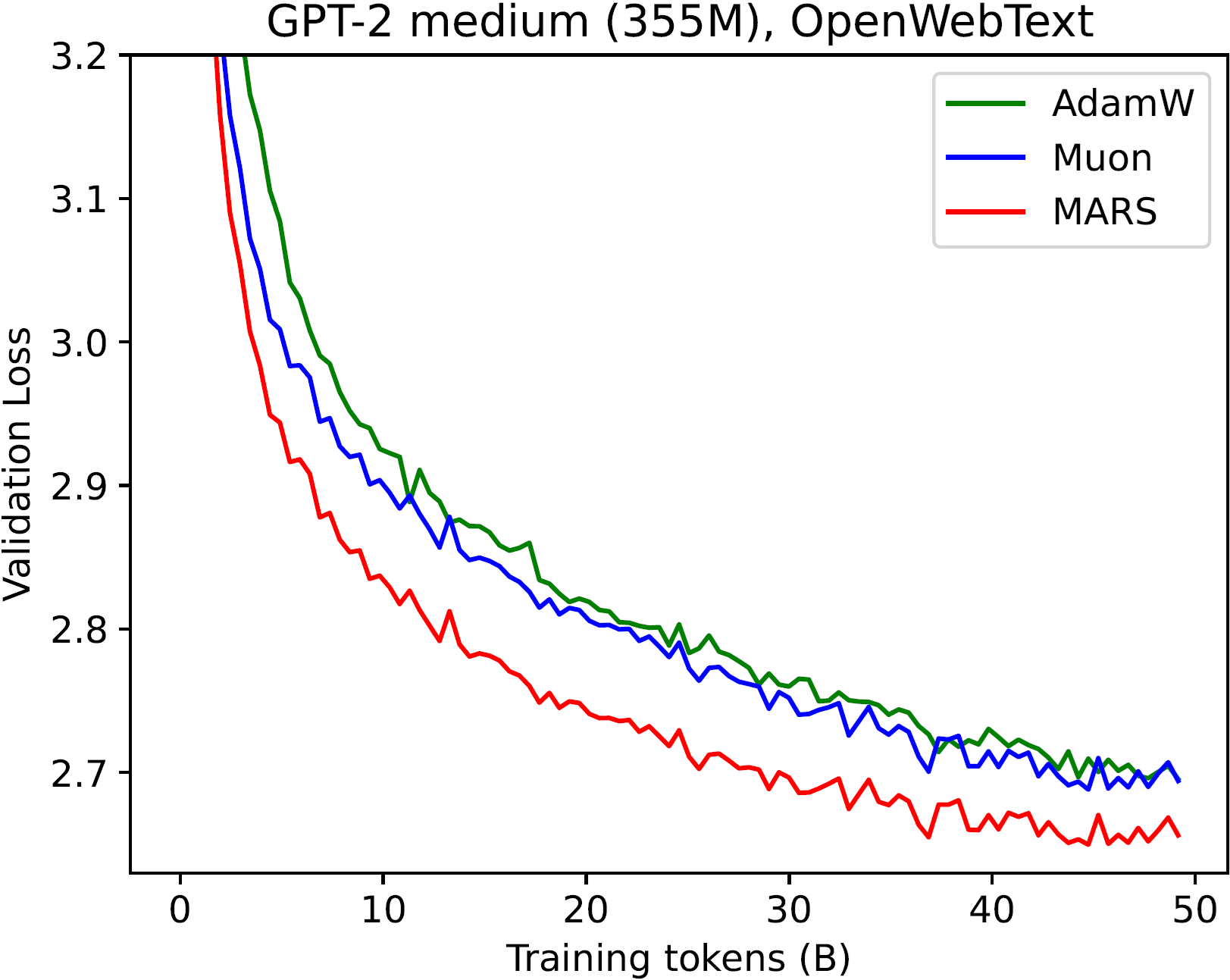
MARS consistently outperforms AdamW and the Muon optimizers across GPT-2 models:
| GPT-2 small | GPT-2 medium | GPT-2 large |
|---|---|---|
 |
 |
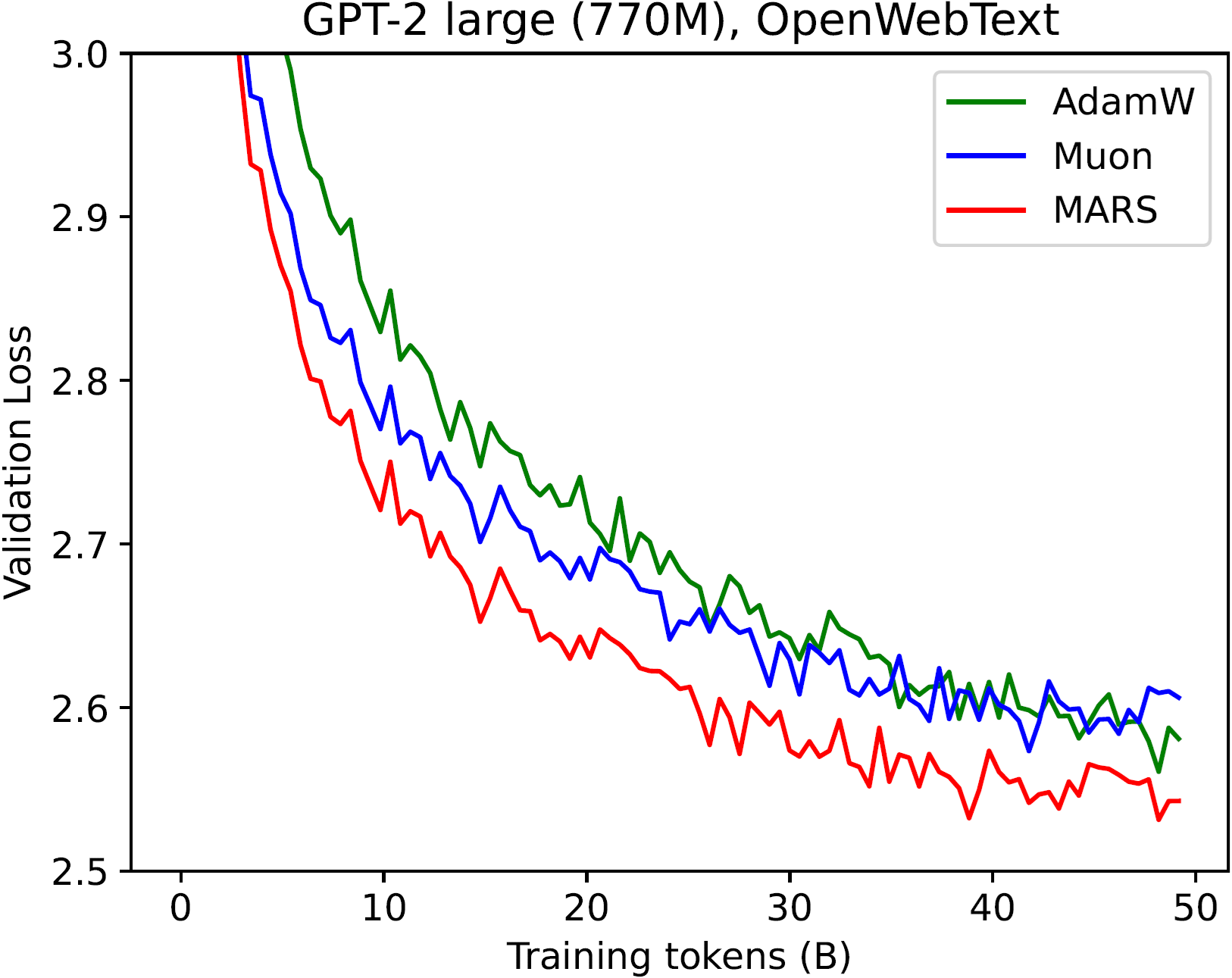 |
| Best Val Loss | GPT-2 Small (5B tokens) | GPT-2 Medium (5B tokens) | GPT-2 Large (5B tokens) | GPT-2 Small (20B tokens) | GPT-2 Medium (20B tokens) | GPT-2 Large (20B tokens) | GPT-2 Small (50B tokens) | GPT-2 Medium (50B tokens) | GPT-2 Large (50B tokens) |
|---|---|---|---|---|---|---|---|---|---|
| AdamW | 3.193 | 3.084 | 3.013 | 3.024 | 2.821 | 2.741 | 2.885 | 2.691 | 2.561 |
| Muon | 3.165 | 3.009 | 2.915 | 3.006 | 2.813 | 2.691 | 2.901 | 2.688 | 2.573 |
| MARS-exact | 3.107 | - | - | 2.980 | - | - | 2.847 | - | - |
| MARS-approx | 3.108 | 2.969 | 2.876 | 2.981 | 2.763 | 2.647 | 2.849 | 2.636 | 2.518 |
Efficiency of MARS
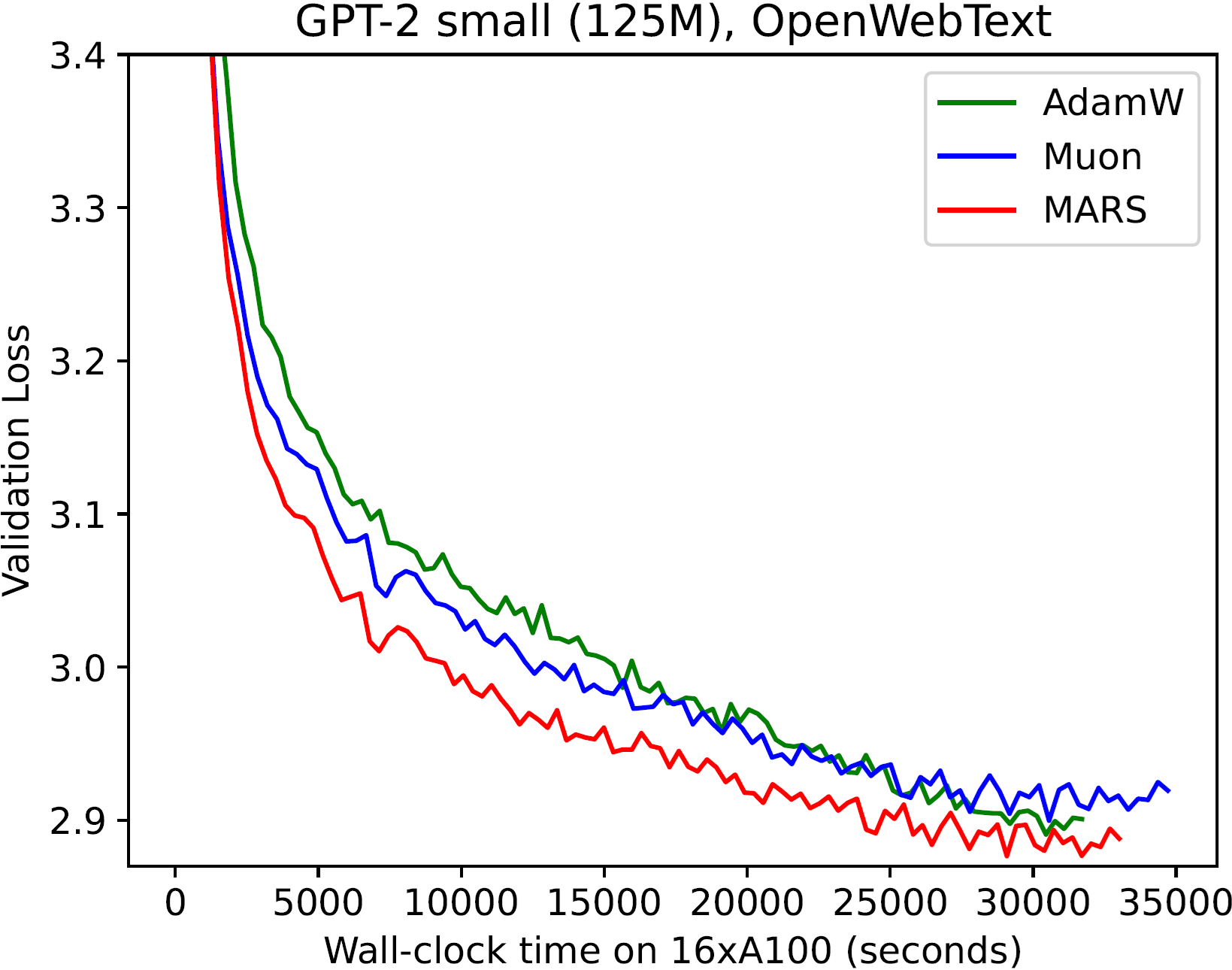
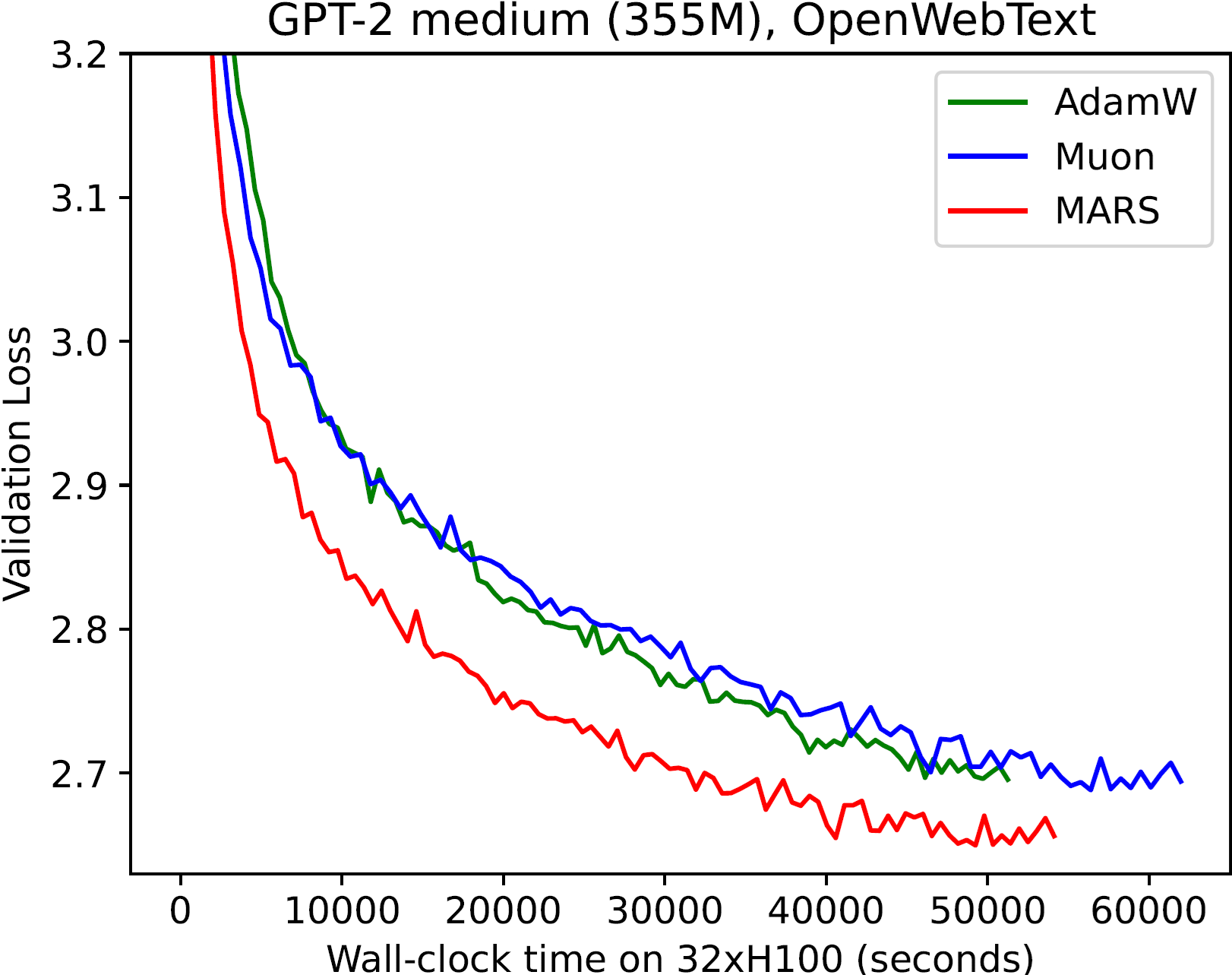
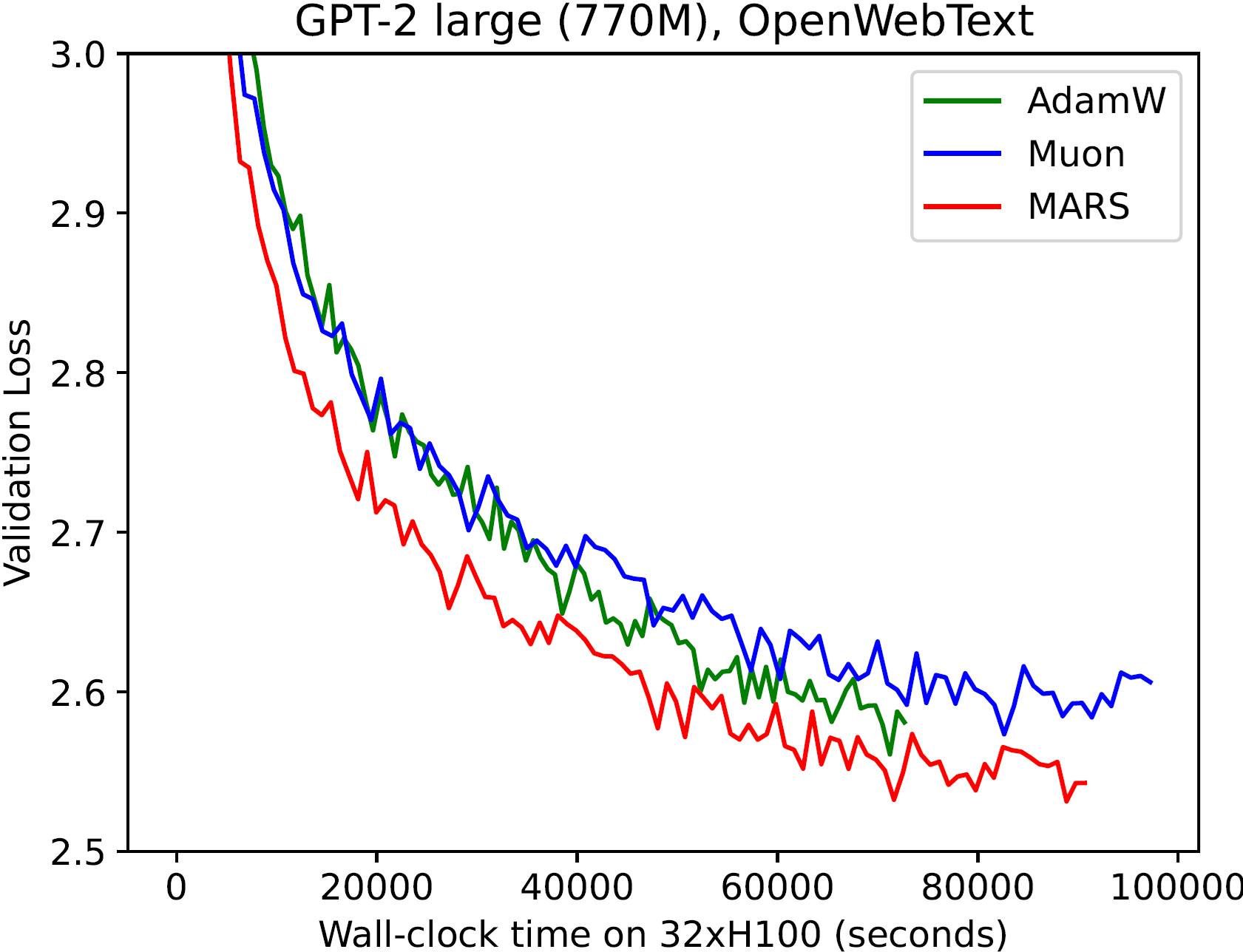
The MARS algorithm can achieve better performance not only within the same number of training steps, but also within the same training time:
| GPT-2 small | GPT-2 medium | GPT-2 large |
|---|---|---|
 |
 |
 |
Experiments on FineWeb-Edu
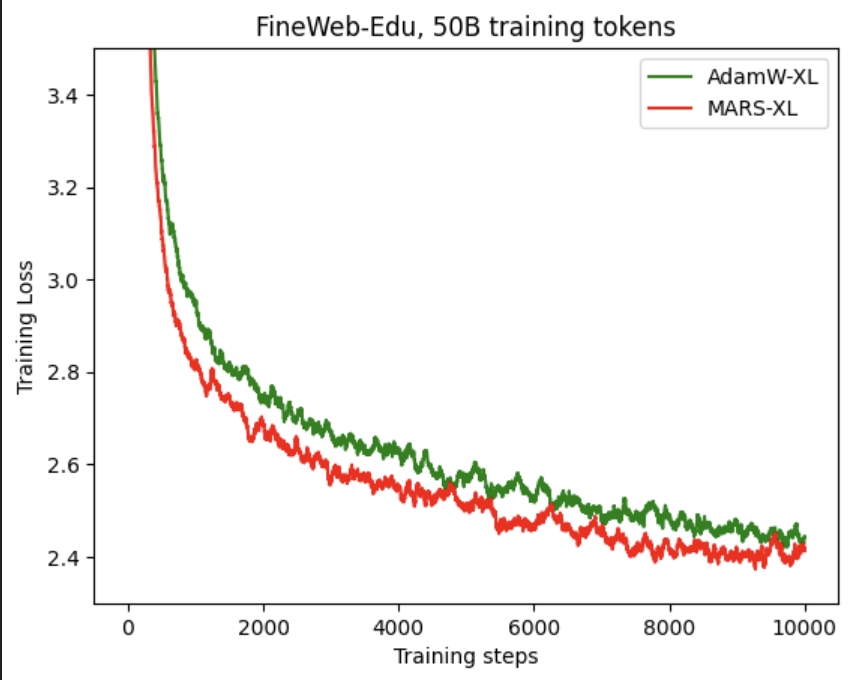
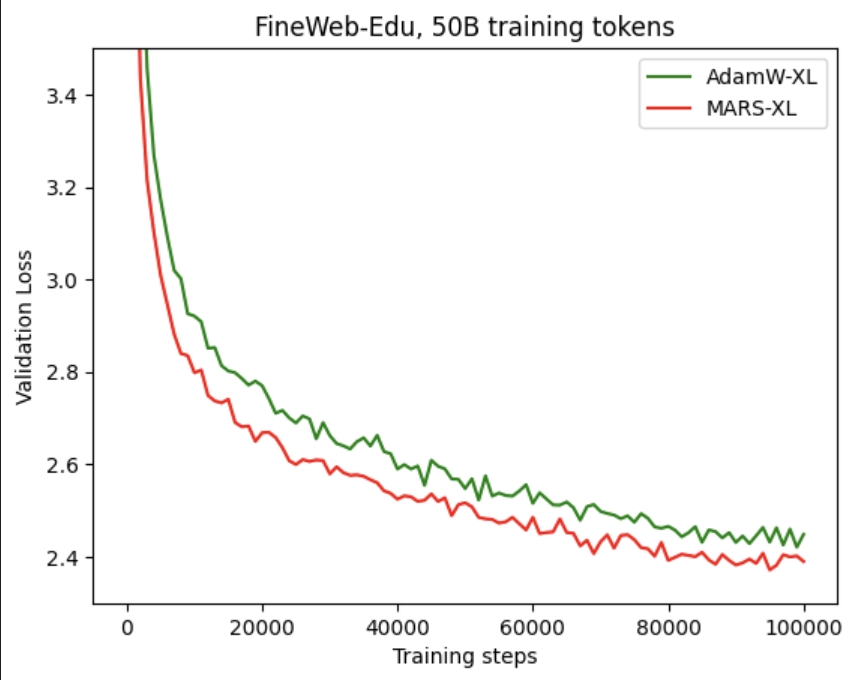
Below are the training and validation loss curves for both GPT‑2 Small and GPT‑2 XL when using our MARS approach versus AdamW. As you can see, MARS often yields faster convergence and consistently lower losses across different training steps.
| Model | GPT-2 small | GPT-2 XL |
|---|---|---|
| Train Loss | 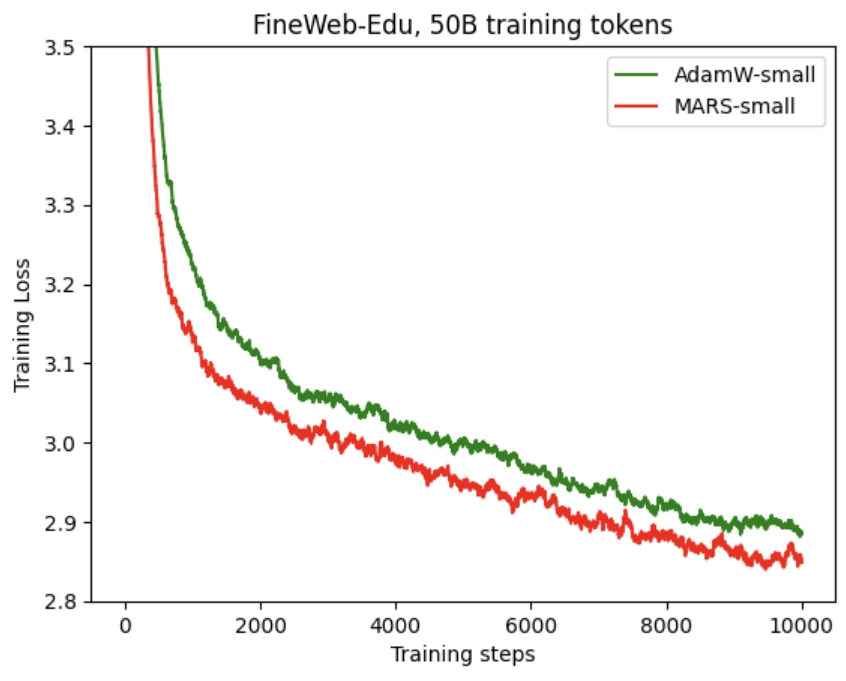 |
 |
| Validation Loss | 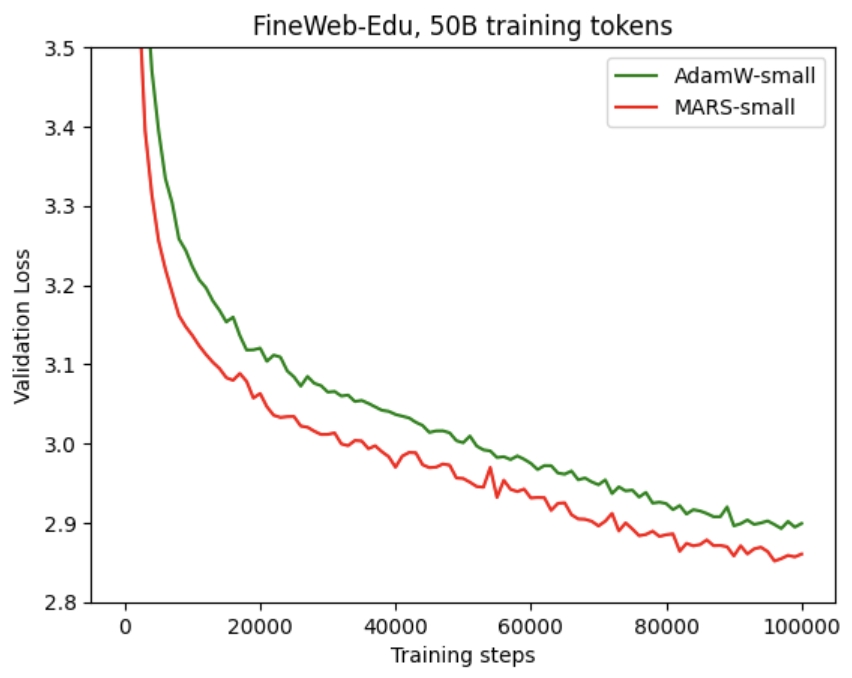 |
 |
Evaluation Metrics
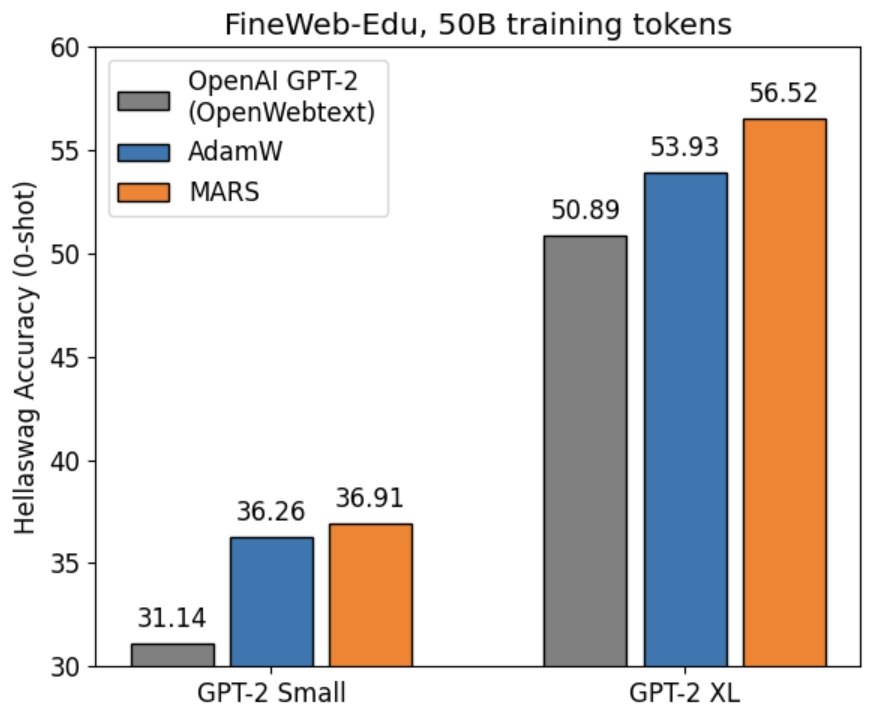
Below, we present the evaluation metrics on the FineWeb-Edu dataset for both GPT‑2 Small and GPT‑2 XL, comparing OpenAI GPT2 baseline, AdamW, and our MARS-AdamW optimizer.
Results on GPT-2 small
MARS-AdamW shows a clear improvement over AdamW and the OpenAI baseline across multiple tasks, with the highest average score of 45.93 on GPT‑2 Small.
| Method/Task | ARC-E | ARC-C | BoolQ | HellaSwag | OBQA | PIQA | WG | MMLU | SciQ | Avg. |
|---|---|---|---|---|---|---|---|---|---|---|
| OpenAI-Comm. | 39.48 | 22.70 | 48.72 | 31.14 | 27.20 | 62.51 | 51.62 | 22.92 | 64.40 | 41.19 |
| AdamW | 51.43 | 26.54 | 55.78 | 36.26 | 30.60 | 64.53 | 50.36 | 24.49 | 71.50 | 45.72 |
| MARS-AdamW | 52.23 | 27.39 | 55.84 | 36.91 | 32.20 | 64.80 | 49.96 | 22.95 | 71.10 | 45.93 |
Results on GPT-2 XL
On GPT‑2 XL, MARS-AdamW continues to outperform AdamW across most tasks, delivering an impressive HellaSwag accuracy of 56.52.
| Method/Task | ARC-E | ARC-C | BoolQ | HellaSwag | OBQA | PIQA | WG | MMLU | SciQ | Avg. |
|---|---|---|---|---|---|---|---|---|---|---|
| OpenAI-Comm. | 51.05 | 28.50 | 61.77 | 50.89 | 32.00 | 70.51 | 58.33 | 25.24 | 76.00 | 50.48 |
| AdamW | 68.22 | 38.40 | 61.13 | 53.93 | 39.00 | 72.69 | 54.78 | 25.47 | 85.30 | 55.43 |
| MARS-AdamW | 66.54 | 39.85 | 63.82 | 56.52 | 41.20 | 73.34 | 56.59 | 23.86 | 86.00 | 56.41 |
Experiments on Vision Tasks
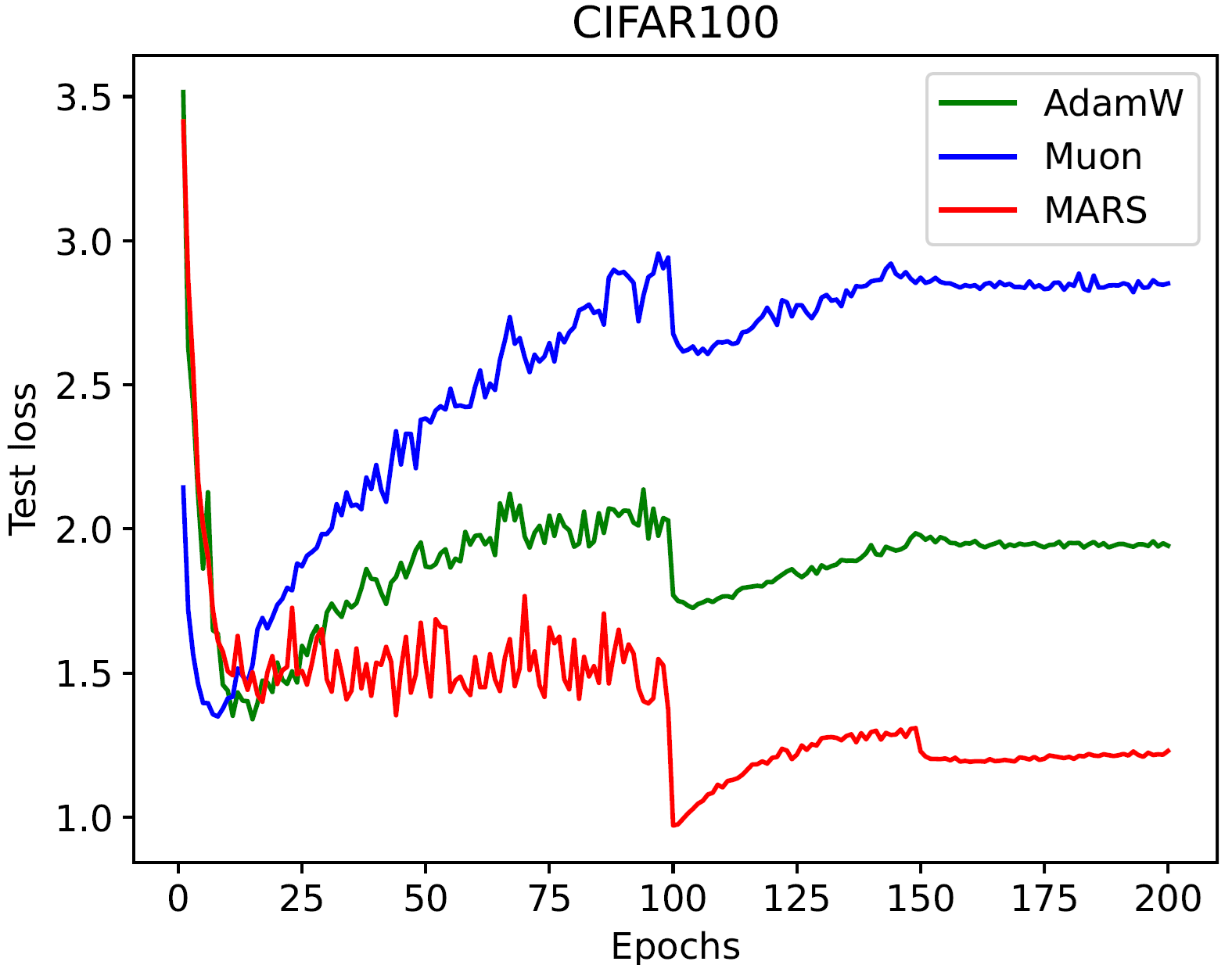
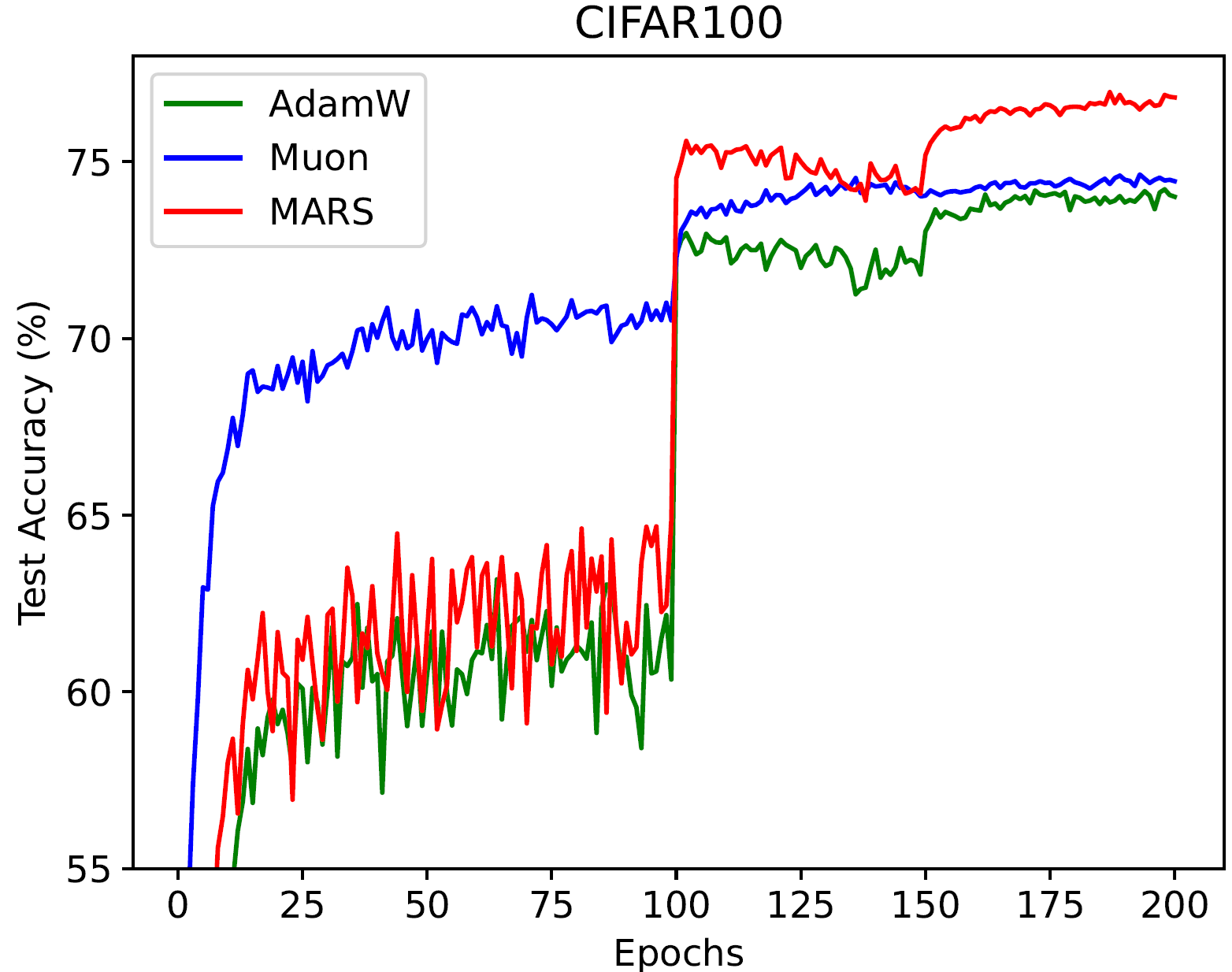
MARS can achieve better test loss and accuracy than AdamW and the Muon optimizers on CIFAR-10 and CIFAR-100 datasets with ResNet-18 and MultiStepLR(optimizer, milestones=[100, 150], gamma=0.1) scheduler (We display the best results for each optimizer with grid search of base learning rate within [1e-5, ..., 1e-1]):
| Dataset | CIFAR-10 | CIFAR-100 |
|---|---|---|
| Test loss | 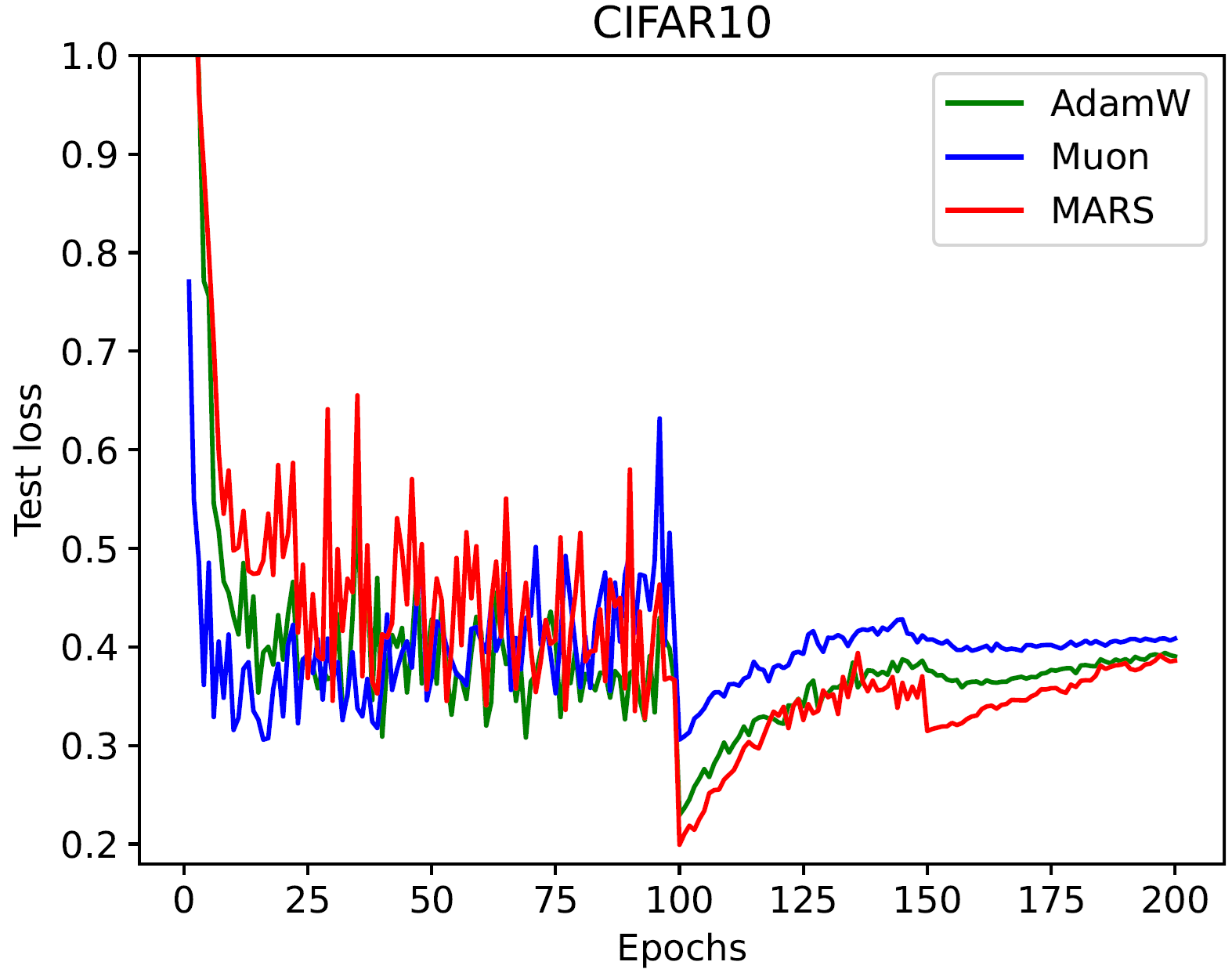 |
 |
| Test Accuracy | 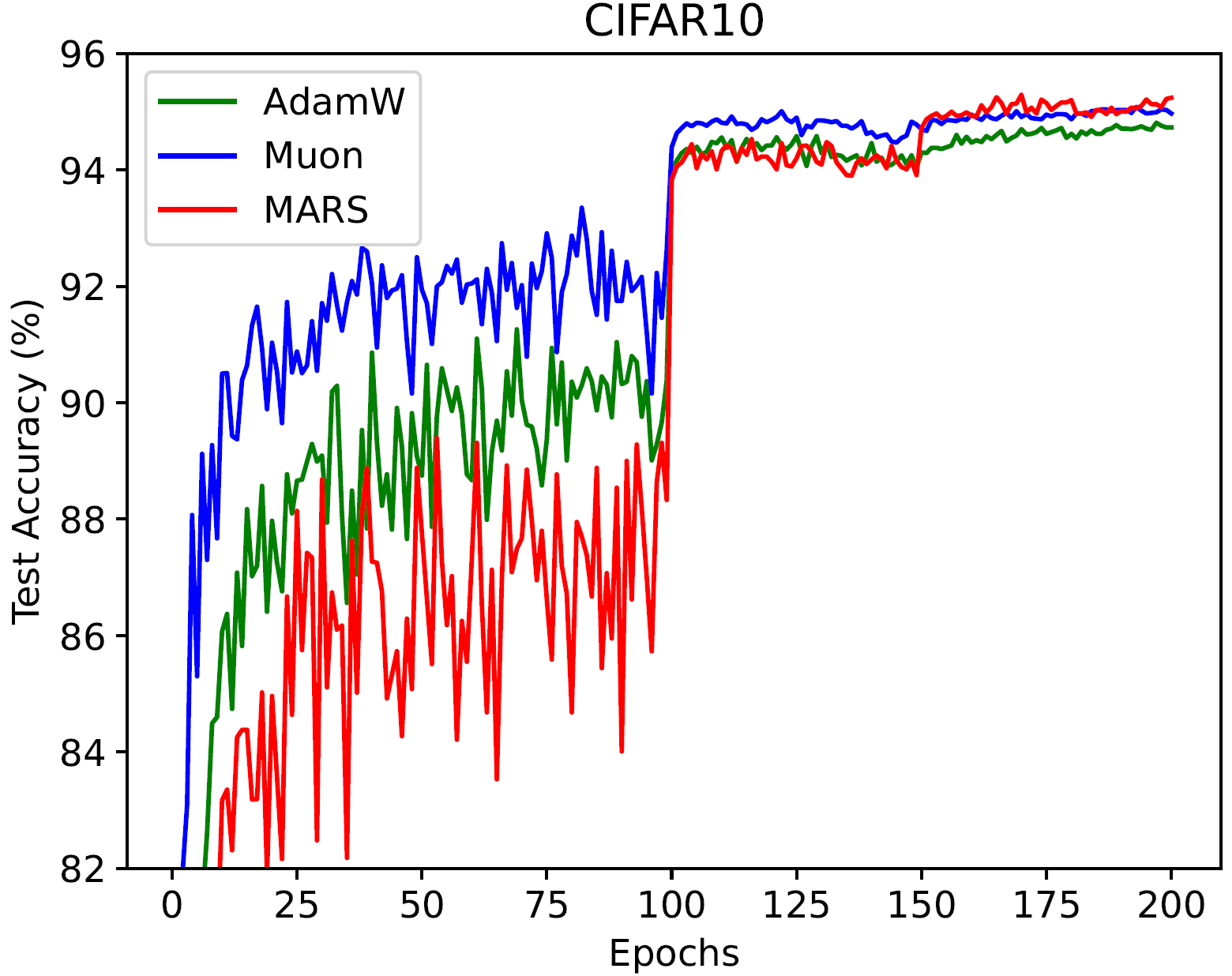 |
 |
| Best Test loss | CIFAR-10 | CIFAR-100 |
|---|---|---|
| AdamW | 0.306 | 2.608 |
| Muon | 0.230 | 1.726 |
| MARS-approx | 0.199 | 0.971 |
| Best Test Accuracy (%) | CIFAR-10 | CIFAR-100 |
|---|---|---|
| AdamW | 94.81 | 73.7 |
| Muon | 95.08 | 74.64 |
| MARS-approx | 95.29 | 76.97 |
Training GPT-2 from Scratch:
Install Dependencies
$ pip install torch==2.1.2 transformers==4.33.0 datasets tiktoken numpy==1.26.4 wandb
Data Preparation
Prepare the OpenWebText data following nanoGPT:
$ python data/openwebtext/prepare.py
Start Training
To train a model using the MARS optimizer, run the following command:
$ torchrun --standalone --nproc_per_node=8 MARS/train_mars.py config/${your_config_file}
This command initiates the training of a GPT-2 model on the OpenWebText dataset using the MARS optimizer. All relevant hyperparameters—training, model, and optimizer—are specified in the configuration file (${your_config_file}). These parameters can be adjusted directly in the configuration file or through the bash script.
Hyperparameter Details
Model Hyperparameters:
- n_layer: Layers of networks, 12 for GPT2 Small, 24 for GPT2 Medium, 36 for GPT2 Large
- n_head: Number of heads, 12 for GPT2 small, 16 for GPT2 Medium, 20 for GPT2 Large
- n_embd: Embedding dimension, 768 for GPT2 small, 1024 for GPT2 Medium, 1280 for GPT2 Large
Optimizer Hyperparameters:
learning_rate: Learning rate for the MARS optimizer.weight_decay: Weight decay for the MARS optimizer.beta1, beta2: Weights for exponential moving average.- Default:
beta1=0.95, beta2=0.99
- Default:
mars_type: Type of optimizer to use:- Options:
mars-adamw,mars-lion,mars-shampoo - Default:
mars-adamw
- Options:
optimize_1d: Whether MARS should optimize 1D parameters (e.g., layer norm parameters in GPT-2).- If
False, AdamW will be used for optimizing 1D parameters. - Default:
False
- If
lr_1d: Learning rate for AdamW whenoptimize_1dis set toFalse.betas_1d: Weights for exponential moving average in AdamW optimizer.- Default:
(0.9, 0.95)
- Default:
is_approx: Whether to use approximate gradient calculation (MARS-approx).- Default:
True
- Default:
gamma: The scaling parameter that controls the strength of gradient correction.- Default: 0.025
Training Hyperparameters:
batch_size: Mini-batch size per device. (for example GPT-2 Small on an A100 GPU typically uses a batch size of 15.)gradient_accumulation_steps: Gradient accumulation steps to ensure the total effective batch size matches the desired scale. (for example, for a total batch size of 480: $15 \times 4 \times 8 , \text{GPUs}$.)schedule: learning rate schedule.- Default:
cosine
- Default:
For more detailed hyperparameter examples, refer to:
config/train_gpt2_small_mars.pyscripts/run_mars_small.sh
Reproducing Our Results
Reproducing GPT-2 Small (125M) Results
Training with MARS using
$ bash scripts/run_mars_small.sh
or
$ torchrun --standalone --nproc_per_node=8 \
      MARS/train_mars.py \
      config/train_gpt2_small_mars.py \
      --batch_size=15 \
      --gradient_accumulation_steps=4
Reproducing GPT2 Medium (355M) Results
Training with MARS using
$ bash scripts/run_mars_medium.sh
or
$ torchrun --standalone --nproc_per_node=8 \
      MARS/train_mars.py \
      config/train_gpt2_medium_mars.py \
      --batch_size=15 \
      --gradient_accumulation_steps=4
Reproducing GPT2 Large (770M) Results
Training with MARS using
$ bash scripts/run_mars_large.sh
or
$ torchrun --standalone --nproc_per_node=8 \
      MARS/train_mars.py \
      config/train_gpt2_large_mars.py \
      --batch_size=5 \
      --gradient_accumulation_steps=12
Reproducing GPT-2 XL (1.5B) Results on FineWeb-Edu
$ bash scripts/run_mars_xl_fw.sh
or
$ torchrun --standalone --nproc_per_node=8 \
      MARS/train_mars_fw.py \
      config/train_gpt2_xl_mars.py \
      --batch_size=5 \
      --gradient_accumulation_steps=12
Reproducing Baseline Results
To reproduce the AdamW baseline:
bash scripts/run_adamw_{small/medium/large}.sh
To reproduce the AdamW baseline on FineWeb-Edu:
bash scripts/run_adamw_{small/xl}_fw.sh
To reproduce the Muon baseline following modded-nanogpt:
bash scripts/run_muon_{small/medium/large}.sh
Please adjust nproc_per_node, batch_size, and gradient_accumulation_steps accordingly if you use other hardware setup. Make sure their product equals 480.
Hyperparameters for GPT-2 models
| Model Name | Model Size | lr for AdamW | lr for Muon | lr for MARS | lr_1d for MARS | wd for AdamW | wd for Muon | wd for MARS |
|---|---|---|---|---|---|---|---|---|
| GPT-2 small | 125M | 6e-4 | 2e-2 | 6e-3 | 3e-3 | 1e-1 | 0.0 | 1e-2 |
| GPT-2 medium | 355M | 3e-4 | 1e-2 | 3e-3 | 1.5e-3 | 1e-1 | 0.0 | 1e-2 |
| GPT-2 large | 770M | 2e-4 | 6.67e-3 | 2e-3 | 1e-3 | 1e-1 | 0.0 | 1e-2 |
| GPT-2 xl | 1.5B | 2e-4 | - | 2e-3 | 1e-3 | 1e-1 | - | 1e-2 |
Customized Training
To build your own training pipeline on other architectures and datasets, use the following template as an example:
import torch
import torch.nn.functional as F
from mars import MARS

# init model loss function and input data
model = Model()
data_loader = ...

# init the optimizer
optimizer = MARS(model.parameters(), lr=1e-3, betas=(0.9, 0.95), gamma=0.025)

total_bs = len(data_loader)
bs = total_bs * block_size
k = 10
iter_num = -1

# training loop
for epoch in range(epochs):
    for X, Y in data_loader:
        # standard training code
        logits, loss = model(X, Y)
        loss.backward()
        optimizer.step(bs=bs)
        optimizer.zero_grad(set_to_none=True)
        optimizer.update_last_grad()
        iter_num += 1
Star History
Citation
If you find this repo useful for your research, please consider citing the paper
@article{yuan2024mars,
  title={MARS: Unleashing the Power of Variance Reduction for Training Large Models},
  author={Yuan, Huizhuo and Liu, Yifeng and Wu, Shuang and Zhou, Xun and Gu, Quanquan},
  journal={arXiv preprint arXiv:2411.10438},
  year={2024}
}
Acknowledgements
This repo is built upon nanoGPT, levanter and Sophia, we thank the authors for their great work!