LIA: Latent Image Animator
Yaohui Wang, Di Yang, François Brémond, Antitza Dantcheva
Project Page | Paper
This is the official PyTorch implementation of the ICLR 2022 paper "Latent Image Animator: Learning to Animate Images via Latent Space Navigation" and TPAMI 2024 paper "LIA: Latent Image Animator".
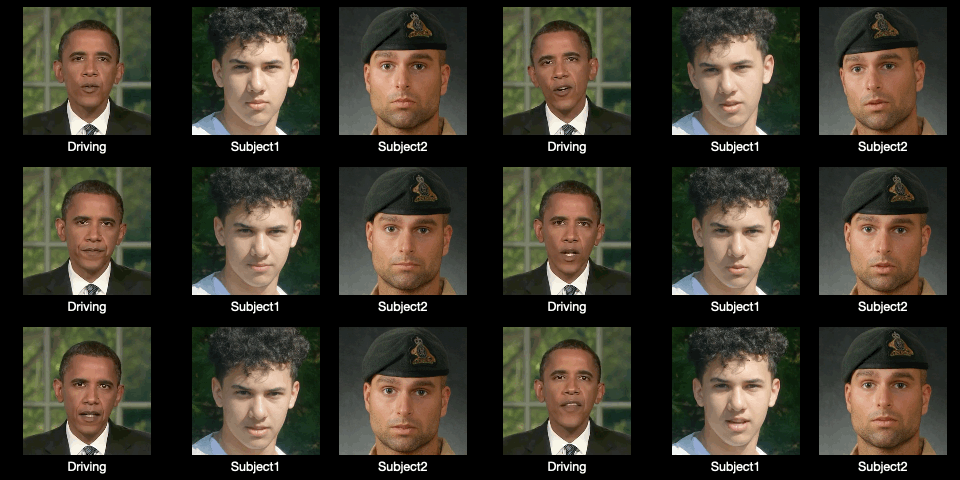


Abstract: Due to the remarkable progress of deep generative models, animating images has become increasingly efficient, whereas associated results have become increasingly realistic. Current animation-approaches commonly exploit structure representation extracted from driving videos. Such structure representation is instrumental in transferring motion from driving videos to still images. However, such approaches fail in case the source image and driving video encompass large appearance variation. Moreover, the extraction of structure information requires additional modules that endow the animation-model with increased complexity. Deviating from such models, we here introduce the Latent Image Animator (LIA), a self-supervised autoencoder that evades need for structure representation. LIA is streamlined to animate images by linear navigation in the latent space. Specifically, motion in generated video is constructed by linear displacement of codes in the latent space. Towards this, we learn a set of orthogonal motion directions simultaneously, and use their linear combination, in order to represent any displacement in the latent space. Extensive quantitative and qualitative analysis suggests that our model systematically and significantly outperforms state-of-art methods on VoxCeleb, Taichi and TED-talk datasets w.r.t. generated quality.
Requirements
- Python 3.7
- PyTorch 1.5+
- tensorboard
- moviepy
- av
- tqdm
- lpips
1. Animation demo
Download pre-trained checkpoints from here and put models under ./checkpoints. We have provided several demo source images and driving videos in ./data.
To obtain demos, you could run following commands, generated results will be saved under ./res.
python run_demo.py --model vox --source_path ./data/vox/macron.png --driving_path ./data/vox/driving1.mp4 # using vox model
python run_demo.py --model taichi --source_path ./data/taichi/subject1.png --driving_path ./data/taichi/driving1.mp4 # using taichi model
python run_demo.py --model ted --source_path ./data/ted/subject1.png --driving_path ./data/ted/driving1.mp4 # using ted model
If you would like to use your own image and video, indicate (source image), (driving video), `` and run
python run_demo.py --model --source_path --driving_path
2. Evaluation
To obtain reconstruction and LPIPS results, put checkpoints under ./checkpoints and run
python evaluation.py --dataset --save_path
Generated videos will be save under ``. For other evaluation metrics, we use the code from here.
3. Linear manipulation
To obtain linear manipulation results of a single image, run
python linear_manipulation.py --model --img_path --save_folder
By default, results will be saved under ./res_manipulation.
Acknowledgement
Part of the code is adapted from FOMM and MRAA. We thank authors for their contribution to the community.
BibTex
@inproceedings{
wang2022latent,
title={Latent Image Animator: Learning to Animate Images via Latent Space Navigation},
author={Yaohui Wang and Di Yang and Francois Bremond and Antitza Dantcheva},
booktitle={International Conference on Learning Representations},
year={2022}
}

@ARTICLE{10645735,
  author={Wang, Yaohui and Yang, Di and Bremond, Francois and Dantcheva, Antitza},
  journal={IEEE Transactions on Pattern Analysis and Machine Intelligence},
  title={LIA: Latent Image Animator},
  year={2024},
  pages={1-16},
}