Code of our winning entry to NTIRE super-resolution challenge, CVPR 2018
关键参数与规格
关键参数与规格
参数
值
语言
Python
类别
Model Development
子类别
Architecture
关键词
Embodied
星标数
601
分叉数
351
贡献者
31
创建日期
2024-11-13
更新日期
2026-10-16
1 天星标数
0
7 天星标数
4
排名
16,291
上次排名
6,801
排名变化
-9,490
7 天星标排名
6,457
上次 7 天星标排名
5,304
7 天星标排名变化
-1,153
总星标排名
16,776
上次总星标排名
16,728
总星标排名变化
-48
国家
USA
README 摘录
*An open-source, sensorimotor learning system following the principles of the neocortex. * This repository contains the first implementation of a **sensorimotor learning system** from the **Thousand Brains Project**. We lovingly call it **Monty** after Vernon Mountcastle, who proposed cortical columns as a repeating functional unit across the neocortex. This is an open-source project that was initially started at Numenta. The Thousand Brains Project is now an independent non-profit, partially funded by the Gates Foundation. Please find our **full
documentation** here Our **API documentation** here. Getting Started You can find detailed instructions on how to install the project requirements and how to get started here Current Performance We regularly evaluate this system against a set of sensorimotor tasks, and report results in **benchmark experiments**. Any time a functional change is made to the code, these experiments are rerun, and results are updated. Configs for these experiments can be found in the src/tbp/monty/conf/experiment/ folder. You can
find our current performance on these benchmarks as well as an explanation of them here. Contributing Are you interested in contributing? Before contributing, please sign our Contributor License Agreement (CLA). You can find the CLA and guidelines here. Disclaimer This is not production-ready code. It is an **early beta version** that is under active development. This early beta version is functional but evolving. Expect frequent changes as we develop core features. You can find a list of the systems
**current capabilities and application criteria** here. You can find our **project road map** and details on the next features we are working on here. More Information and Updates As mentioned above, we have extensive **documentation** of this project here. We also publish our meeting recordings on **YouTube** on the Thousand Brains Project channel. If you want to use this code, contribute to it, ask questions or propose ideas, please consider joining our discourse channel. If you would like to receive
updates, follow us on Bluesky or Twitter or LinkedIn. If you have further questions or suggestions for collaborations, don't hesitate to contact us directly at **info@thousandbrains. Citing the Project If you're writing a publication that references the Thousand Brains Project, please cite TBP white paper: If you would like to refer to Monty's capabilities and advantages over deep learning, please cite Thousand-Brains Systems: Sensorimotor Intelligence for Rapid, Robust Learning and Inference: If you would like to reference the
theory behind this novel AI approach, here you can find a list of neuroscience theory papers.
An open-source, sensorimotor learning system following the principles of the neocortex.
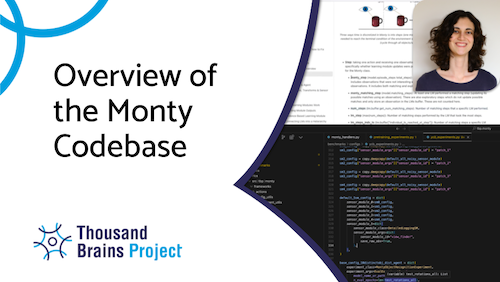
This repository contains the first implementation of a sensorimotor learning system from the Thousand Brains Project. We lovingly call it Monty after Vernon Mountcastle, who proposed cortical columns as a repeating functional unit across the neocortex.
This is an open-source project that was initially started at Numenta. The Thousand Brains Project is now an independent non-profit, partially funded by the Gates Foundation.
You can find detailed instructions on how to install the project requirements and how to get started here
Current Performance
We regularly evaluate this system against a set of sensorimotor tasks, and report results in benchmark experiments. Any time a functional change is made to the code, these experiments are rerun, and results are updated. Configs for these experiments can be found in the src/tbp/monty/conf/experiment/ folder.
You can find our current performance on these benchmarks as well as an explanation of them here.
Contributing
Are you interested in contributing? Check out our tips and guidelines here.
Before contributing, please sign our Contributor License Agreement (CLA). You can find the CLA and guidelines here.
Disclaimer
This is not production-ready code. It is an early beta version that is under active development. This early beta version is functional but evolving. Expect frequent changes as we develop core features.
You can find a list of the systems current capabilities and application criteriahere.
You can find our project road map and details on the next features we are working on here.
More Information and Updates
As mentioned above, we have extensive documentation of this project here.
@misc{thousandbrainsproject2024,
      title={The Thousand Brains Project: A New Paradigm for Sensorimotor Intelligence},
      author={Viviane Clay and Niels Leadholm and Jeff Hawkins},
      year={2024},
      eprint={2412.18354},
}
If you would like to refer to Monty's capabilities and advantages over deep learning, please cite