1D, 2D, and 3D Sinusoidal Postional Encoding (Pytorch and Tensorflow)


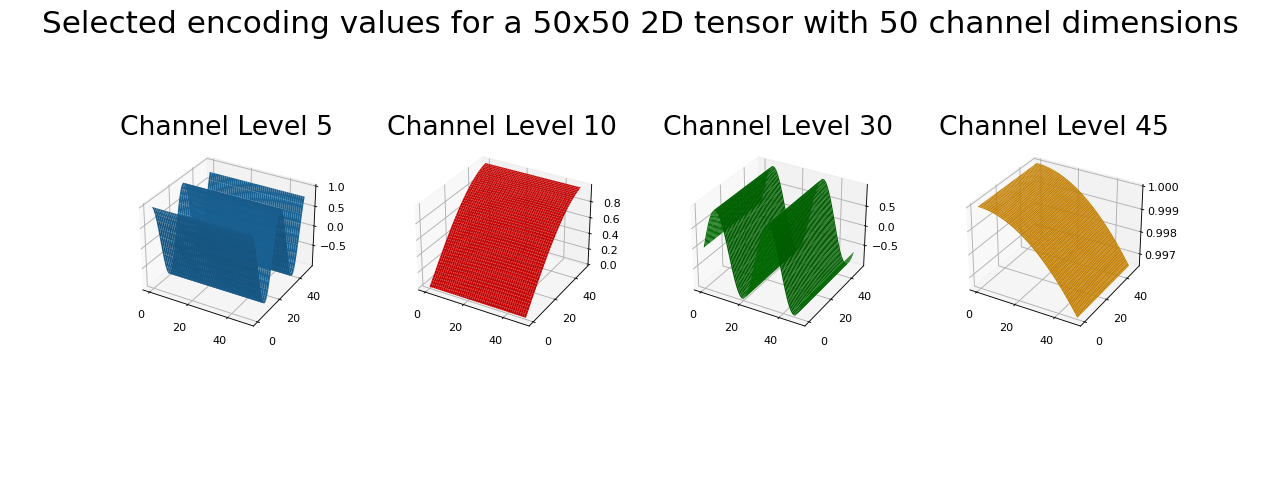
This is a practical, easy to download implemenation of 1D, 2D, and 3D sinusodial positional encodings for PyTorch and Tensorflow.
It is able to encode on tensors of the form (batchsize, x, ch), (batchsize, x, y, ch), and (batchsize, x, y, z, ch), where the positional encodings will
be calculated along the ch dimension. The Attention is All You
Need allowed for positional encoding in
only one dimension, however, this works to extend this to 2 and 3 dimensions.
This also works on tensors of the form (batchsize, ch, x), etc. See the usage for more information.
NOTE: The import syntax has changed as of version 6.0.1. See the section for details.
To install, simply run:
pip install positional-encodings[pytorch,tensorflow]
You can also install the pytorch and tf encodings individually with the following commands.
- For a PyTorch only installation, run
pip install positional-encodings[pytorch] - For a TensorFlow only installation, run
pip install positional-encodings[tensorflow]
Usage:
Pytorch
The repo comes with the three main positional encoding models,
PositionalEncoding{1,2,3}D. In addition, there are a Summer class that adds
the input tensor to the positional encodings.
import torch
from positional_encodings.torch_encodings import PositionalEncoding1D, PositionalEncoding2D, PositionalEncoding3D, Summer

# Returns the position encoding only
p_enc_1d_model = PositionalEncoding1D(10)

# Return the inputs with the position encoding added
p_enc_1d_model_sum = Summer(PositionalEncoding1D(10))

x = torch.rand(1,6,10)
penc_no_sum = p_enc_1d_model(x) # penc_no_sum.shape == (1, 6, 10)
penc_sum = p_enc_1d_model_sum(x)
print(penc_no_sum + x == penc_sum) # True
p_enc_2d = PositionalEncoding2D(8)
y = torch.zeros((1,6,2,8))
print(p_enc_2d(y).shape) # (1, 6, 2, 8)

p_enc_3d = PositionalEncoding3D(11)
z = torch.zeros((1,5,6,4,11))
print(p_enc_3d(z).shape) # (1, 5, 6, 4, 11)
And for tensors of the form (batchsize, ch, x) or their 2D and 3D
counterparts, include the word Permute before the number in the class; e.g.
for a 1D input of size (batchsize, ch, x), do PositionalEncodingPermute1D
instead of PositionalEncoding1D.
import torch
from positional_encodings.torch_encodings import PositionalEncodingPermute3D

p_enc_3d = PositionalEncodingPermute3D(11)
z = torch.zeros((1,11,5,6,4))
print(p_enc_3d(z).shape) # (1, 11, 5, 6, 4)
Note to override the output dtype you can specify it when creating the encoding:
p_enc_3d = PositionalEncodingPermute3D(11, dtype_override=torch.float64)
This is particularly useful when the input tensor is of an int type since the
output will always be zero (see issue #39).
Tensorflow Keras
This also supports Tensorflow. Simply prepend all class names with TF.
import tensorflow as tf
from positional_encodings.tf_encodings import TFPositionalEncoding2D, TFSummer

# Returns the position encoding only
p_enc_2d = TFPositionalEncoding2D(170)
y = tf.zeros((1,8,6,2))
print(p_enc_2d(y).shape) # (1, 8, 6, 2)

# Return the inputs with the position encoding added
add_p_enc_2d = TFSummer(TFPositionalEncoding2D(170))
y = tf.ones((1,8,6,2))
print(add_p_enc_2d(y) - p_enc_2d(y)) # tf.ones((1,8,6,2))
Changes as of version 6.0.1
Before 6.0.1, users had to install both the tensorflow and the
torch packages, both of which are quite large. Now, one can install the
packages individually, but now the code has to be changed:
If using PyTorch:
from positional_encodings import * -> from positional_encodings.torch_encodings import *
If using TensorFlow:
from positional_encodings import * -> from positional_encodings.tf_encodings import *
Formulas
The formula for inserting the positional encoding are as follows:
1D:
PE(x,2i) = sin(x/10000^(2i/D))
PE(x,2i+1) = cos(x/10000^(2i/D))

Where:
x is a point in 2d space
i is an integer in [0, D/2), where D is the size of the ch dimension
2D:
PE(x,y,2i) = sin(x/10000^(4i/D))
PE(x,y,2i+1) = cos(x/10000^(4i/D))
PE(x,y,2j+D/2) = sin(y/10000^(4j/D))
PE(x,y,2j+1+D/2) = cos(y/10000^(4j/D))

Where:
(x,y) is a point in 2d space
i,j is an integer in [0, D/4), where D is the size of the ch dimension
3D:
PE(x,y,z,2i) = sin(x/10000^(6i/D))
PE(x,y,z,2i+1) = cos(x/10000^(6i/D))
PE(x,y,z,2j+D/3) = sin(y/10000^(6j/D))
PE(x,y,z,2j+1+D/3) = cos(y/10000^(6j/D))
PE(x,y,z,2k+2D/3) = sin(z/10000^(6k/D))
PE(x,y,z,2k+1+2D/3) = cos(z/10000^(6k/D))

Where:
(x,y,z) is a point in 3d space
i,j,k is an integer in [0, D/6), where D is the size of the ch dimension
The 3D formula is just a natural extension of the 2D positional encoding used in this paper.
Don't worry if the input is not divisible by 2 (1D), 4 (2D), or 6 (3D); all the necessary padding will be taken care of.
Thank you
Thank you for this repo for inspriration of this method.
Citations
1D:
@inproceedings{vaswani2017attention,
  title={Attention is all you need},
  author={Vaswani, Ashish and Shazeer, Noam and Parmar, Niki and Uszkoreit, Jakob and Jones, Llion and Gomez, Aidan N and Kaiser, {\L}ukasz and Polosukhin, Illia},
  booktitle={Advances in neural information processing systems},
  pages={5998--6008},
  year={2017}
}
2D:
@misc{wang2019translating,
    title={Translating Math Formula Images to LaTeX Sequences Using Deep Neural Networks with Sequence-level Training},
    author={Zelun Wang and Jyh-Charn Liu},
    year={2019},
    eprint={1908.11415},
    archivePrefix={arXiv},
    primaryClass={cs.LG}
}
3D: Coming soon!