⚡ New here? Walk through setup in 60 seconds →
English · 한국어 · 中文 · setup guide in 13 languages
oh-my-zsh for Claude Code — one install, full professional kit
What is it? • Why bother? • Install • What's inside • How to use • Architecture • FAQ • 한국어
v4.3.0 (September 2026, latest) — session-time-report now reads Codex too. Same hook, same report; it detects whether a transcript is a Claude Code transcript or a Codex rollout log and counts either. Wiring for Codex is two entries you add to
~/.codex/hooks.json(how).v4.2.0 (September 2026) — Adds session-time-report (22nd hook): measures each session as it closes and tells you at your next start what time it ended, how long it actually ran, and how much you got through. Resume-aware, so a session you picked back up days later reports that sitting rather than a bogus 400-hour total.
v4.1.0 (August 2026) — Adds harness-diet (33rd skill): measure your always-loaded context (CLAUDE.md + rules) and shrink it back under budget without losing governance.
v4.0.0 (August 2026) — Introduces the adversarial verification loop: every behavioral change is checked by a second, independent agent that did not write the code and never sees the first agent's reasoning — maker≠checker until it issues
APPROVE. Building v4.0 itself, the loop caught three real defects in the maintainer's own PRs (#58, #61); worked example:docs/VERIFICATION-LOOP.md. Also ships a reliability pack (API-error auto-resume, session relay across/compact, doom-loop guard —docs/RELIABILITY.md), a debugging escalation chain, task-grade routing, and Korean prose quality guardrails. Details: What's New in v4.0 · MIGRATION.md.If
/plugin install claude-forgeever showed✘ failed to load(Hook load failed: expected record, received undefined), that bug is fixed as of v4.0.0 — see #52, #57.
v3.1.0 (June 2026) — Adds loop-forge (turn a repetitive task into a reusable, self-guarding slash command) and a full beginner-friendly rewrite of this README with diagrams. Built on v3.0.2 (LLM-readable install) and v3.0.1 (Anthropic 2026 standard alignment: Hooks 21+ events, Subagent frontmatter v2, Skills/Commands hybrid policy, 4-server MCP minimum). See MIGRATION.md.
What is Claude Forge?
Plain English version: Claude Code is an AI coding assistant that lives in your terminal. Out of the box it is capable but bare — like a new employee who knows how to code but has no company procedures, no safety checklists, no templates, and no specialist colleagues to call on.
Claude Forge is the equipment pack for that assistant. One install gives it:
- 16 specialist "colleagues" (agents) it can delegate to — planner, security reviewer, TDD guide, adversarial reviewer, and more
- 35 one-word shortcuts (commands like
/plan,/tdd,/code-review) that trigger full workflows - 33 saved procedures (skills) it follows automatically
- 22 safety checks (hooks) that run silently in the background every time it touches your code — including an unattended API-error auto-resume, a doom-loop guard, and an end-of-session time report
- 14 rule files that define how it should behave
- 4 external tool connections (browser automation, live docs search, and more)
The oh-my-zsh analogy: oh-my-zsh is a free add-on that turns a plain terminal into a colorful, plugin-packed power tool — without changing what the terminal fundamentally does. Claude Forge does the same thing for Claude Code.
✨ Why bother?
| Without Claude Forge | With Claude Forge |
|---|---|
| Claude Code writes code, but you have to remind it about tests, security, and docs every time | Automated pipeline: plan → test → review → verify → ship, all connected |
| No safety net — Claude can run dangerous commands or leak secrets by accident | 6-layer hook system blocks risky actions before they happen |
| One AI doing everything alone | 16 specialist agents working in parallel (planner, architect, security reviewer, adversarial reviewer…) |
| Hours assembling your own config | 5-minute install, everything pre-wired |
| Updates require manual copy-paste | git pull — done |
📥 Install in Minutes
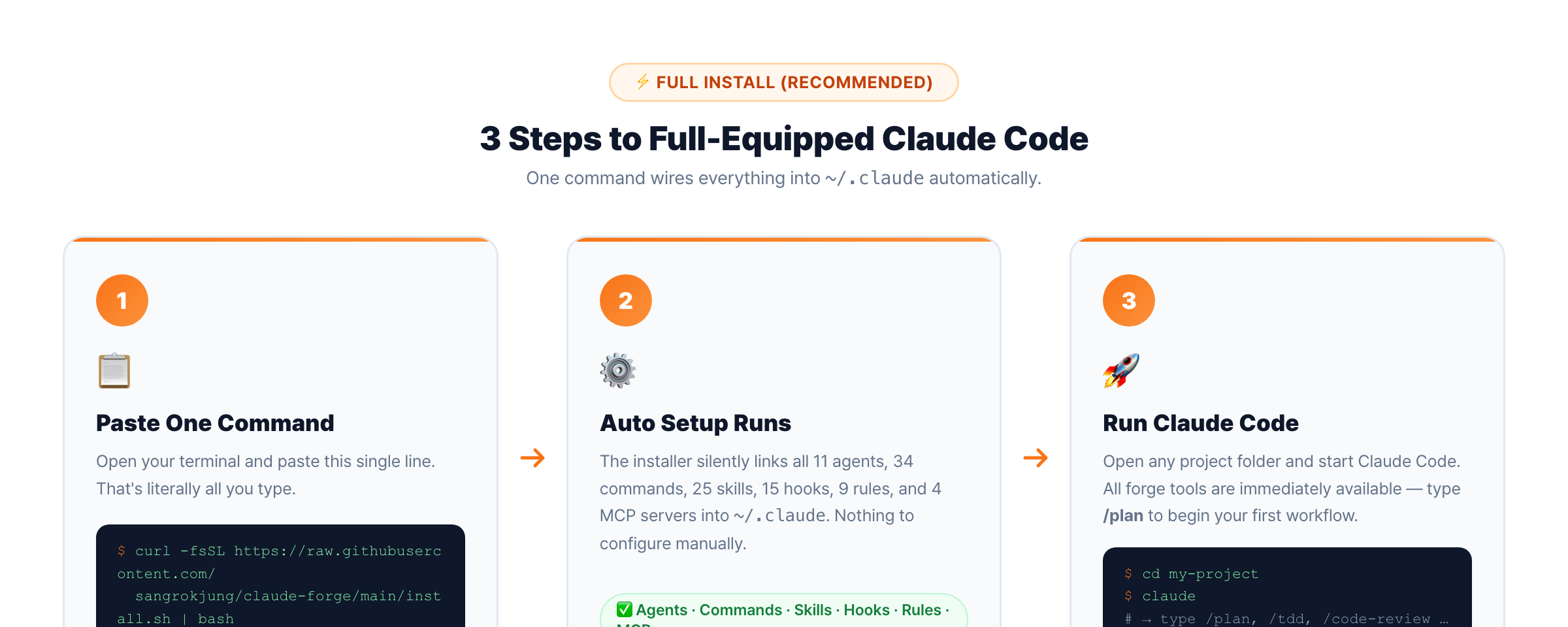
Option A — Claude Code Plugin (quick start, partial features)
Open a Claude Code session and run two commands:
/plugin marketplace add sangrokjung/claude-forge
/plugin install claude-forge
This gets you commands and most skills right away. Agents, hooks, rules, and MCP connections need Option B.
Update later: /plugin update claude-forge
Option B — Full Install (recommended, everything included)
One line in your terminal:
curl -fsSL https://raw.githubusercontent.com/sangrokjung/claude-forge/main/install.sh | bash
Or if you prefer to clone first:
git clone --recurse-submodules https://github.com/sangrokjung/claude-forge.git
cd claude-forge
./install.sh        # fresh install
# or
./install.sh --upgrade   # safe migration from v2.1
Windows users: Run .\install.ps1 in PowerShell as Administrator.
Which option should I pick?
| What you get | Option A (/plugin install) |
Option B (./install.sh) |
|---|---|---|
| Commands (35 shortcuts) | ✅ | ✅ |
| Skills (33 saved procedures) | ⚠️ partial | ✅ |
| Agents (16 specialists) | ❌ | ✅ |
| Hooks (22 safety checks) | ❌ | ✅ |
| Rules (14 behavior guidelines) | ❌ | ✅ |
| MCP connections (4 tools) | ❌ | ✅ |
Recommendation: Use Option B unless you only need a taste of commands and skills.
If Claude Forge helps you, a star on GitHub helps others find it.
📦 What's Inside
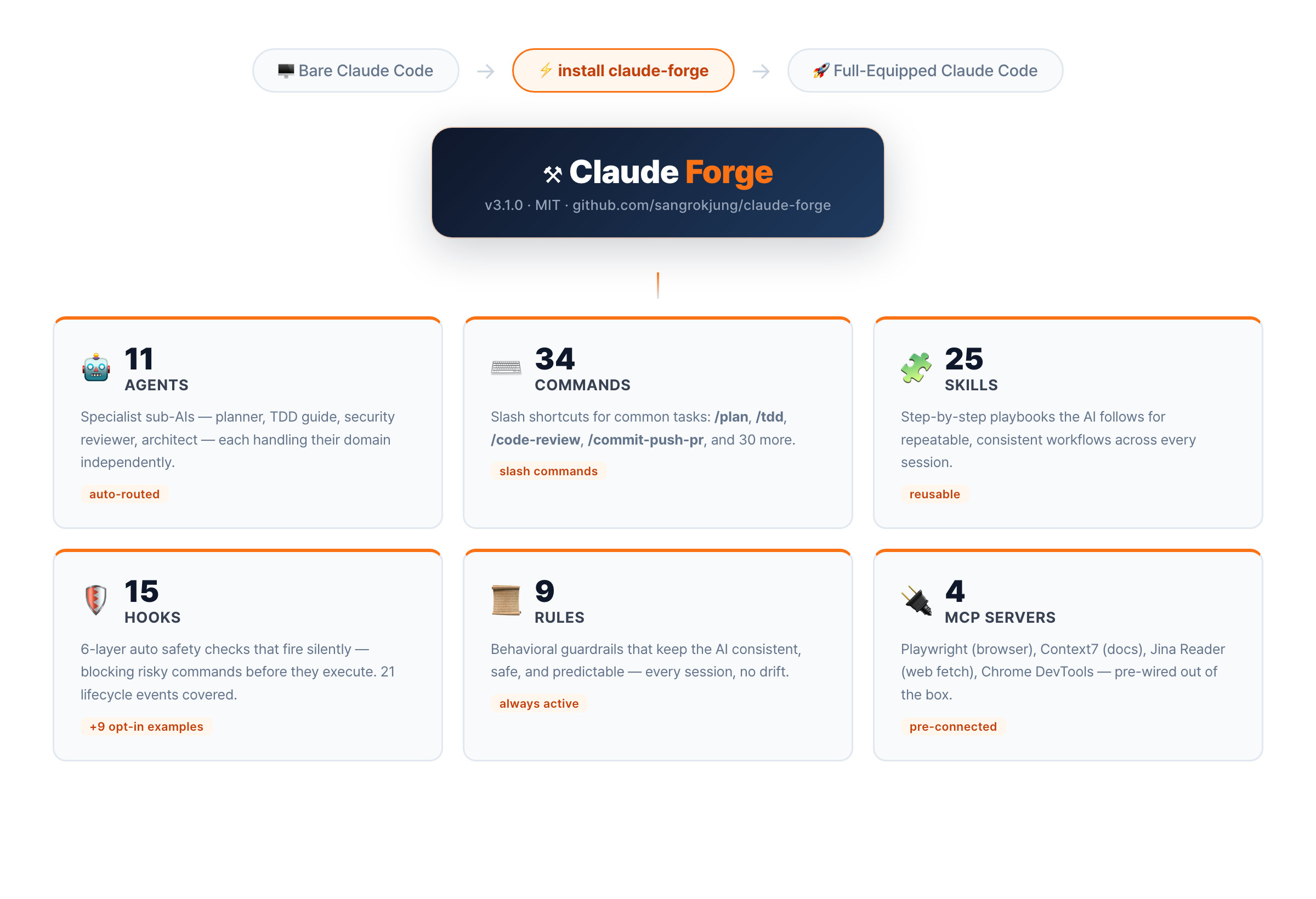
Here is everything bundled in Claude Forge, explained in plain language:
| What | Count | Plain English |
|---|---|---|
| Agents (specialist colleagues) | 16 | Each one is an AI focused on a single job — planner, architect, security checker, test guide, database expert, adversarial reviewer, and more. Claude calls the right one automatically. |
| Commands (shortcut buttons) | 35 | Type /plan and Claude creates a full implementation plan. Type /tdd and it writes tests first, then code. All 35 are pre-built shortcuts for common developer tasks. |
| Skills (saved procedures) | 33 | Step-by-step playbooks Claude follows automatically — like a recipe it has memorized. loop-forge turns any repetitive task into a reusable slash command in seconds; review-loop runs the maker≠checker verification cycle. |
| Hooks (silent safety checks) | 22 built-in + 9 opt-in examples | These run before and after every action Claude takes. They block leaked passwords, dangerous database commands, and unsafe remote scripts — and, new in v4.0, they auto-resume a session after a retryable API error and nudge you when you're stuck editing the same file. Covers 21 lifecycle events. |
| Rules (behavior guidelines) | 14 | Written instructions Claude reads at the start of every session — coding style, security principles, git workflow conventions, when the verification loop is mandatory, and more. |
| MCP connections (external tools) | 4 | Browser automation (Playwright), live library docs (context7), web page reader (jina-reader), and Chrome DevTools for performance audits. |
Full list: 16 Agents
Deep Analysis Agents (use the most capable model)
| Agent | What it does |
|---|---|
| planner | Creates detailed implementation plans for complex features. Waits for your sign-off before any code is written. |
| architect | Designs system structure, makes scalability decisions, reviews technical architecture. |
| code-reviewer | Checks code quality, security, and maintainability after you write it. |
| security-reviewer | Scans for OWASP Top 10 vulnerabilities, leaked secrets, injection risks. |
| tdd-guide | Enforces test-first development: RED (failing test) → GREEN (passing) → IMPROVE (refactor). |
| database-reviewer | Optimizes PostgreSQL/Supabase queries, reviews schema design. |
Fast Execution Agents (use a quicker model)
| Agent | What it does |
|---|---|
| build-error-resolver | Fixes TypeScript and build errors with minimal changes to surrounding code. |
| e2e-runner | Generates and runs Playwright end-to-end browser tests. |
| refactor-cleaner | Finds and removes dead code using knip, depcheck, ts-prune. |
| doc-updater | Keeps documentation and code maps in sync after changes. |
| verify-agent | Opens a fresh context to verify build, lint, and tests all pass — like a second pair of eyes. |
Verification & Debugging Agents (v4.0)
| Agent | What it does |
|---|---|
| adversarial-reviewer | Independent, read-only checker for the verification loop. Never wrote the change, never sees the maker's reasoning — tries to break the claim rather than confirm it. Returns APPROVE, REQUEST_CHANGES, or UNVERIFIED. |
| skeptical-auditor | Re-audits a pass another agent already claimed: re-runs each step that was reported green and compares the real exit codes against the claim. Runs after verification, not instead of it — an independent verdict on the change itself is adversarial-reviewer's job. |
| systematic-debugger | Reproduce → bisect → hypothesize → verify. Never guesses at a fix without a failing test that proves the hypothesis. |
| rca-debugger | Escalation from systematic-debugger for multi-system failures — 5-why + fishbone analysis when bisection alone is inconclusive. |
| escalation-fixer | Last resort when build-error-resolver can't close a build error — allowed architectural-level changes, reads the escalation log to avoid repeating failed approaches. |
Full list: 35 Commands
Core Workflow
| Command | What it does |
|---|---|
/plan |
AI creates an implementation plan. Waits for your confirmation before coding. |
/tdd |
Write tests first, then code. One unit of work at a time. |
/code-review |
Security + quality check on the code you just wrote. |
/handoff-verify |
Auto-verify build/test/lint all at once. |
/commit-push-pr |
Commit, push, create PR, and optionally merge — all in one. |
/quick-commit |
Fast commit for simple, well-tested changes. |
/verify-loop |
Auto-retry build/lint/test up to 3x with auto-fix. |
/auto |
One-button automation: plan to PR without stopping. |
/guide |
Interactive 3-minute tour for first-time users. |
/loop-forge |
Turn a repetitive task into a reusable, self-guarding slash command. |
/workflow-classify |
Size a task S/M/L/XL and route documentation depth + verification rigor accordingly. |
Exploration & Analysis
| Command | What it does |
|---|---|
/explore |
Navigate and analyze codebase structure. |
/build-fix |
Incrementally fix TypeScript and build errors. |
/next-task |
Recommend next task based on project state. |
/suggest-automation |
Analyze repetitive patterns and suggest automation. |
/agent-router |
Route a request to the specialist agent best suited for the task. |
Security
| Command | What it does |
|---|---|
/security-review |
CWE Top 25 + STRIDE threat modeling. |
Testing & Evaluation
| Command | What it does |
|---|---|
/e2e |
Generate and run Playwright end-to-end tests. |
/test-coverage |
Analyze coverage gaps and generate missing tests. |
/eval |
Eval-driven development workflow management. |
Documentation & Sync
| Command | What it does |
|---|---|
/update-codemaps |
Analyze codebase and update architecture docs. |
/update-docs |
Sync documentation from source-of-truth. |
/sync-docs |
Sync prompt_plan.md, spec.md, CLAUDE.md + rules. |
/sync |
Pull latest changes and sync all project docs. Use after any workflow or at session start. |
/pull |
Quick git pull origin main. |
/forge-update |
Update Claude Forge itself to the latest version from the remote. |
/show-setup |
Show the current install status and project info. |
Project Management
| Command | What it does |
|---|---|
/init-project |
Scaffold new project with standard structure. |
/orchestrate |
Agent Teams parallel orchestration. |
/checkpoint |
Save/restore work state. |
/learn |
Record lessons learned + suggest automation. |
/web-checklist |
Post-merge web testing checklist. |
Refactoring & Debugging
| Command | What it does |
|---|---|
/refactor-clean |
Identify and remove dead code with test verification. |
Git Worktree
| Command | What it does |
|---|---|
/worktree-start |
Create git worktree for parallel development. |
/worktree-cleanup |
Clean up worktrees after PR completion. |
The 8 commands that moved to
skills/in v3.0 (debugging-strategies,dependency-upgrade,evaluating-code-models,evaluating-llms-harness,extract-errors,security-compliance,stride-analysis-patterns,summarize) are listed once, under Skills below — see MIGRATION.md Step 5.install.shstill creates compatibility symlinks undercommands/for them.
Full list: 33 Skills
| Skill | What it does |
|---|---|
| blind-spot-pass | Before starting work in an unfamiliar domain, surface what you don't know you don't know (unknown unknowns) and teach just enough to prompt well. Shift-left discovery. |
| build-system | Auto-detect and run project build systems. |
| cache-components | Next.js Cache Components and Partial Prerendering (PPR) guidance. |
| cc-dev-agent | Claude Code development workflow optimization (context engineering, sub-agents, TDD). |
| continuous-learning-v2 | Instinct-based learning: observe sessions via hooks, create atomic instincts with confidence scoring. |
| debugging-strategies | Systematic debugging techniques and profiling. |
| dependency-upgrade | Major dependency upgrades with compatibility analysis. |
| eval-harness | Formal evaluation framework for eval-driven development (EDD). |
| evaluating-code-models | Benchmark code generation models (HumanEval, MBPP). |
| evaluating-llms-harness | Benchmark LLMs across 60+ academic benchmarks. |
| extract-errors | Extract and catalog error messages. |
| frontend-code-review | Frontend file review (.tsx, .ts, .js) with checklist rules. |
| harness-diet | Measure and shrink always-loaded context (CLAUDE.md + rules) back under budget: migrate narrative to references, path-scope or skill-ify rules, verify zero governance loss with deterministic preservation checks. |
| humanize-korean | Strip translation-ese and AI idioms from Korean prose without changing facts, numbers, or register. |
| korean-character-count | Count Korean characters/syllables for length-constrained copy (titles, SMS, ad copy). |
| korean-spell-check | Check Korean spelling and spacing. Sends the text to the third-party service nara-speller.co.kr, so keep client names and personal data out of it. |
| loop-forge | Turn a one-line repetitive task into a reusable, self-guarding slash command (5 loop shapes + auto verifier & hardstop). |
| manage-skills | Analyze session changes, detect missing verification skills, create/update skills. |
| prompts-chat | Skill/prompt exploration, search, and improvement. |
| relay | Session handoff across /compact: writes a /compact one-liner plus a "baton" file with the next task, key files, and facts pulled verbatim from git/plan/session-summary state. |
| review-loop | The adversarial verification loop procedure: dispatch adversarial-reviewer, act on REQUEST_CHANGES, stop only on APPROVE against the current revision. |
| security-compliance | SOC2, ISO27001, GDPR, HIPAA compliance checks. |
| security-pipeline | CWE Top 25 + STRIDE automated security verification pipeline. |
| session-wrap | End-of-session cleanup: 4 parallel subagents detect docs, patterns, learnings, follow-ups. |
| skill-factory | Convert reusable session patterns into Claude Code skills automatically. |
| strategic-compact | Suggest manual context compaction at logical intervals to preserve context. |
| stride-analysis-patterns | Systematic STRIDE methodology for threat identification. |
| summarize | Summarize URLs, podcasts, transcripts, local files. |
| systematic-debugging | 6-phase structured debugging procedure — reproduce, isolate, hypothesize, test, fix, verify. |
| team-orchestrator | Agent Teams engine: team composition, task distribution, dependency management. |
| using-superpowers | Discover and invoke installed skills before responding to any request. |
| verification-engine | Integrated verification engine: fresh-context subagent verification loop. |
| verify-implementation | Run all project verify skills and generate unified pattern verification report. |
Full list: 22 Hooks (safety checks)
Security Hooks — block dangerous actions automatically
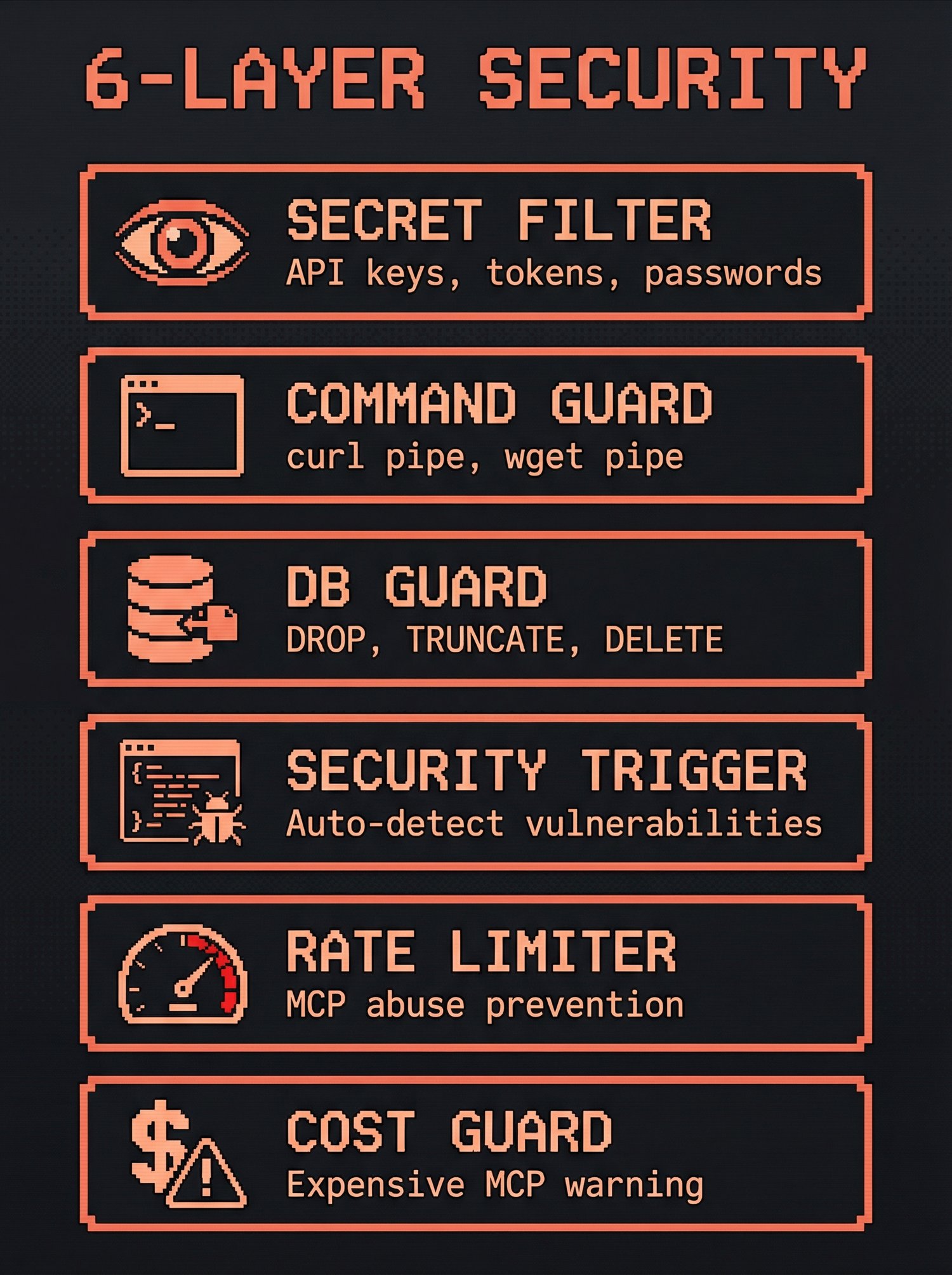
| Hook | When it runs | What it blocks |
|---|---|---|
output-secret-filter.sh |
After every tool use | Leaked API keys, tokens, passwords in output |
remote-command-guard.sh |
Before Bash commands | Unsafe remote commands (curl pipe, wget pipe) |
db-guard.sh |
Before database commands | Destructive SQL (DROP, TRUNCATE, DELETE without WHERE) |
security-auto-trigger.sh |
After file edits | Vulnerabilities in code changes |
rate-limiter.sh |
Before MCP tool use | MCP server abuse / excessive calls |
mcp-usage-tracker.sh |
Before MCP tool use | Tracks MCP usage for monitoring |
Reliability Hooks — v4.0, unattended-session safety net
| Hook | When it runs | What it does |
|---|---|---|
api-error-auto-resume.sh |
Session ends on a retryable API error (StopFailure) |
Classifies the failure, then schedules an unattended resume under fork-bomb-style caps. Full contract: rules/api-error-recovery.md |
loop-detection.sh |
After 5/10+ edits to the same file in one session | Nudges a rethink instead of letting the session spin — see docs/RELIABILITY.md |
auto-verify-fix.sh |
After editing a .ts/.tsx/.js/.jsx/.py file |
Lightweight type/syntax check, surfaces fixable errors immediately |
pre-compact-snapshot.sh |
Before context compaction (PreCompact) |
Snapshots the pointer to the most recent relay skill baton |
post-compact-restore.sh |
Right after /compact (SessionStart, matcher compact) |
Restores that pointer into the fresh session's context, exactly once |
emdash-slop-guard.sh |
After editing a .md file whose content is substantially Korean |
Flags em-dash AI-tell interjections — see rules/korean-writing-quality.md |
Utility Hooks — helpful nudges in the background
| Hook | When it runs | What it does |
|---|---|---|
code-quality-reminder.sh |
After file edits | Reminds about immutability, small files, error handling |
context-sync-suggest.sh |
Session start | Suggests syncing docs at session start |
forge-update-check.sh |
Session start | Tells you when a newer claude-forge release is available |
session-wrap-suggest.sh |
Before session end | Suggests session wrap-up before ending |
session-time-report.sh |
Session ends, replayed at your next session start | Reports end time, how long it ran, and prompt/tool/file-change counts — see End-of-session report |
work-tracker-prompt.sh |
When you submit a prompt | Tracks work for analytics |
work-tracker-tool.sh |
After tool use | Tracks tool usage for analytics |
work-tracker-stop.sh |
On stop | Finalizes work tracking data |
task-completed.sh |
When subagent finishes | Notifies on subagent task completion |
expensive-mcp-warning.sh |
Before costly operations | Warns about expensive MCP calls |
An opt-in pre-commit secret guard (scripts/install-precommit.sh) also ships as of v4.0
— it protects git commits in any repo you point it at, separately from the hooks above.
See docs/RELIABILITY.md.
End-of-session report
session-time-report.sh measures a session as it closes and hands you the summary the next time you open one:
[Claude Forge] Previous session ended 21:34 KST
2h 17m elapsed · 18 prompts · 143 tool calls · 9 files changed
Log: ~/.claude/work-log/session-time-.json
Why it is wired to two events. SessionEnd is where the numbers are, but it cannot talk to you: Claude Code forwards a SessionEnd hook's output only when that hook failed, so a successful report is thrown away. SessionStart is a channel that does reach you. So the same script records on the way out and reports on the way in, exactly once per session.
It reads only the session transcript, so there is no network call and no extra dependency beyond python3.
It also reads Codex. Codex 0.150 has the same hook events and writes its own rollout log; the hook works out which dialect a transcript is in and counts either one, naming the agent in the line it prints. install.sh only wires Claude Code, so the two Codex entries are yours to add: hooks/README.md has them.
Elapsed time is resume-aware. A transcript you reopened days later spans hundreds of hours of wall clock, which is not what you worked. The hook splits the timeline wherever there is a long idle gap and reports the latest stretch; if the session was resumed, it appends (resumed 3x, 9h 40m total).
| Environment variable | Default | Effect |
|---|---|---|
FORGE_SESSION_TIME_REPORT |
1 |
Set to 0 to turn the hook off |
FORGE_SESSION_GAP_MIN |
60 |
Idle minutes that start a new stretch |
FORGE_SESSION_MAX_MB |
128 |
Transcript megabytes to scan, up to 512; larger files are read from the tail |
FORGE_SESSION_MAX_SEC |
4 |
Wall-clock budget for the scan. Past it the report is dropped rather than reported half-read |
FORGE_SESSION_REPORT_LANG |
auto | en or ko; auto-detects from LANG / LC_ALL |
Every run also appends to ~/.claude/work-log/session-times.jsonl (mode 600, rotated at 1 MB), so you can chart your own sessions later. Reports queue in ~/.claude/work-log/.session-time-pending.jsonl until a session drains them, so ending several sessions before starting a new one does not lose any of them. Log files are created 0600 and the hook refuses to follow a symlink planted at one of those paths.
Opt-in Examples (9 extra, v3.0+)
9 additional .example files live in hooks/examples/, one per event: PostCompact, PostToolUseFailure, PreCompact, StopFailure, SubagentStart, SubagentStop, TaskCreated, WorktreeCreate, WorktreeRemove. Full 21-event coverage; 27-event catalog: hooks/README.md. To activate: rename *.example → *.sh and register in settings.json.
🔄 How to Use It
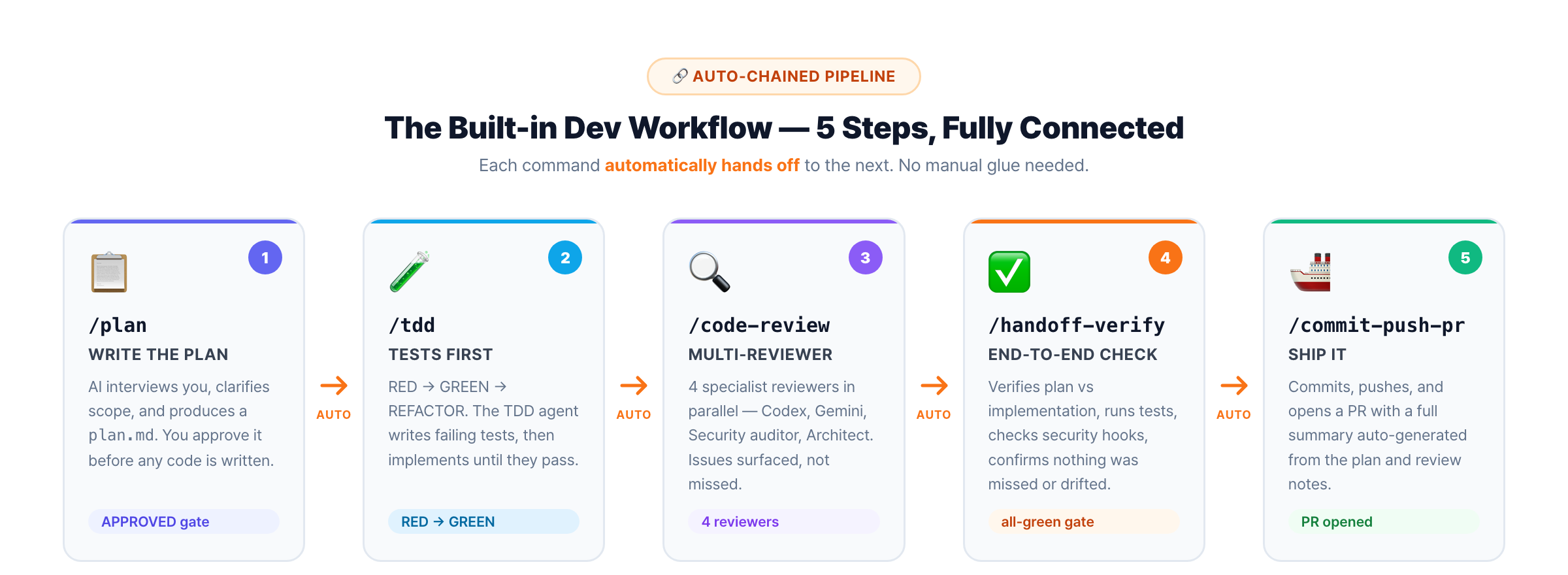
The main development pipeline
Claude Forge's commands are designed to chain together. Here is the recommended flow for building any new feature:
/plan → /tdd → /code-review → /handoff-verify → /commit-push-pr
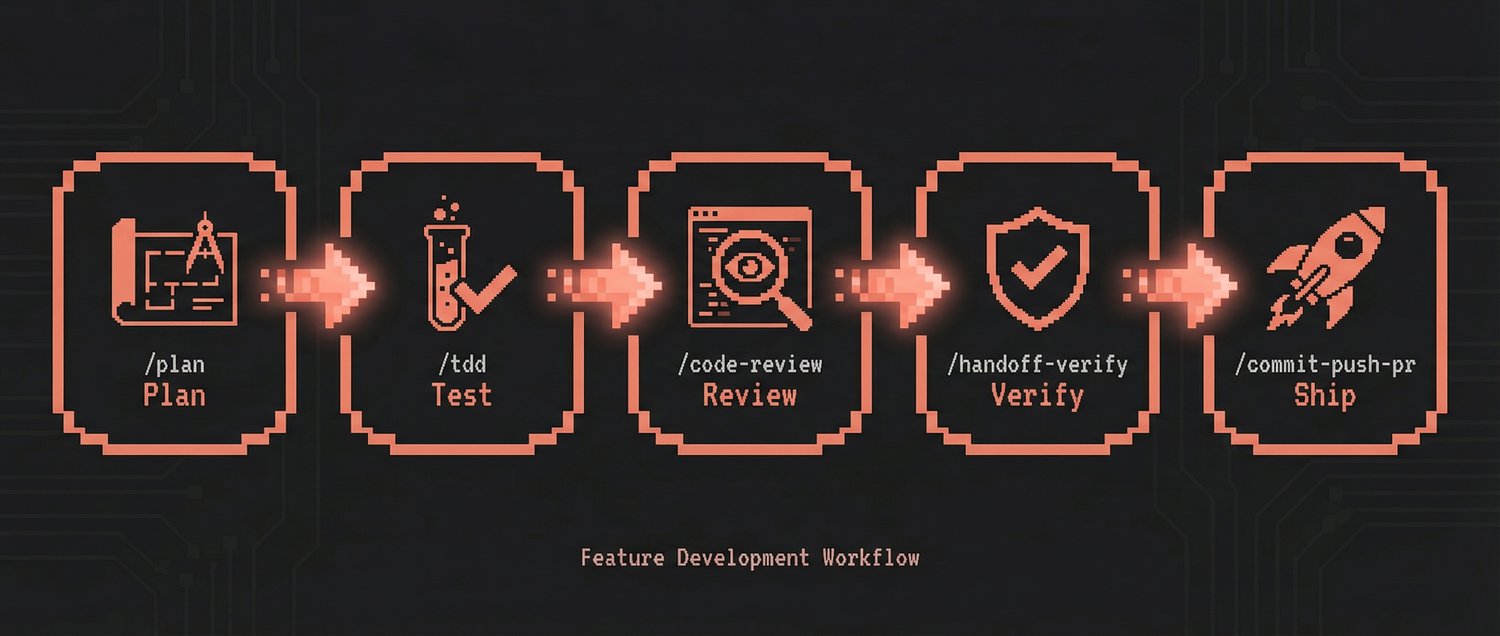
| Step | What Claude does | Why |
|---|---|---|
/plan |
Writes an implementation plan and waits for your go-ahead | No code is written until you approve the approach |
/tdd |
Writes the tests first, then writes the code to pass them | Catches mistakes before they become bugs |
/code-review |
Checks the finished code for security holes and quality issues | A second pair of eyes, automatically |
/handoff-verify |
Runs build, tests, and lint in a fresh session to confirm everything passes | Catches "works on my machine" problems |
/commit-push-pr |
Commits the code, pushes to GitHub, creates a pull request, and optionally merges it | One command to ship |
Other common workflows
Fixing a bug:
/explore → /tdd → /verify-loop → /quick-commit → /sync
Security audit:
/security-review → /stride-analysis-patterns → /security-compliance
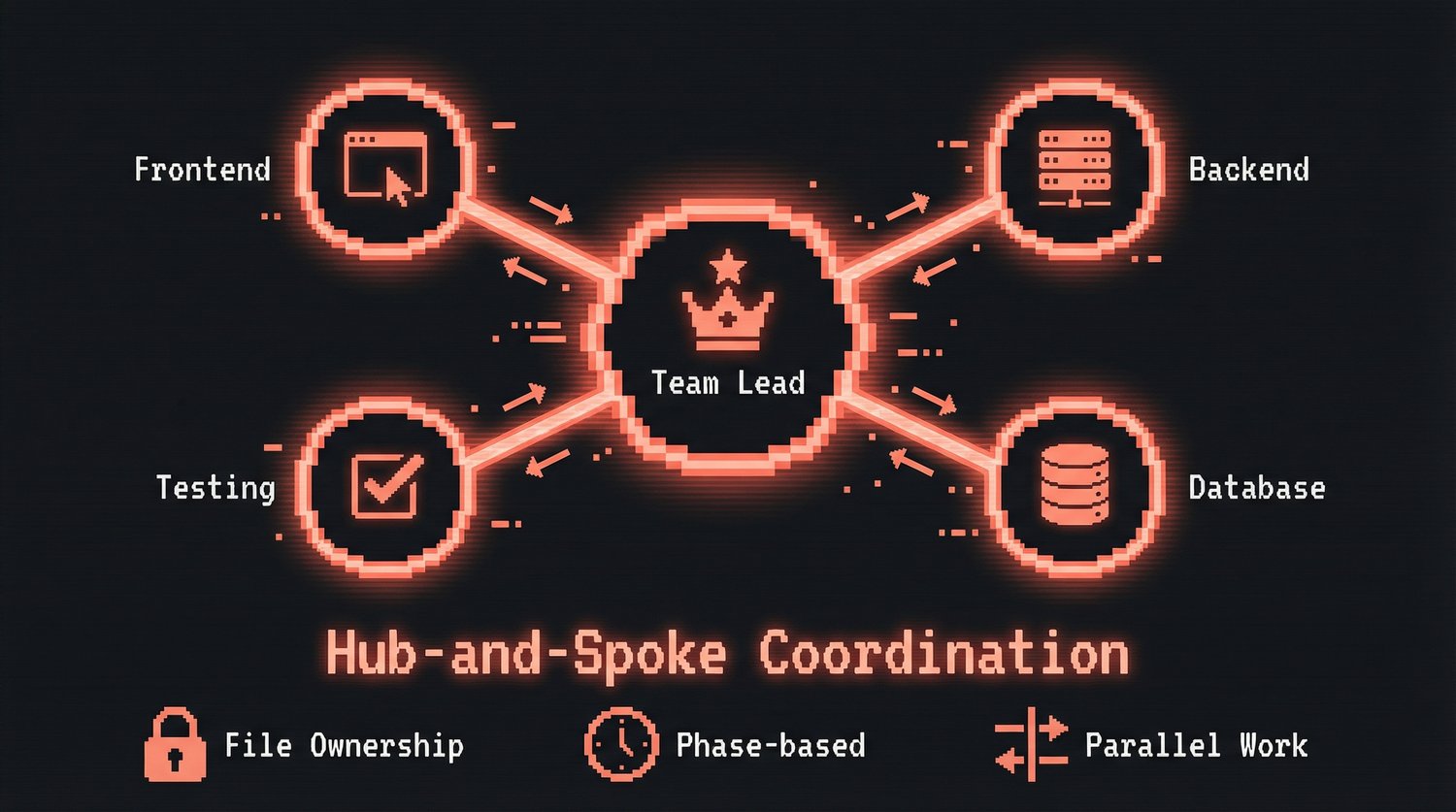
Parallel team work (multiple agents at once):
/orchestrate → Agent Teams (working in parallel) → /commit-push-pr
Not sure where to start?
After installing, type /guide for an interactive 3-minute tour. Or just type:
/auto login page
Claude Forge will handle the entire plan-to-PR pipeline for you automatically.
Prefer to read first? docs/FIRST-STEPS.md walks through your first
session step by step, and docs/WORKFLOW-RECIPES.md collects the
command sequences for common jobs.
🏗 Architecture
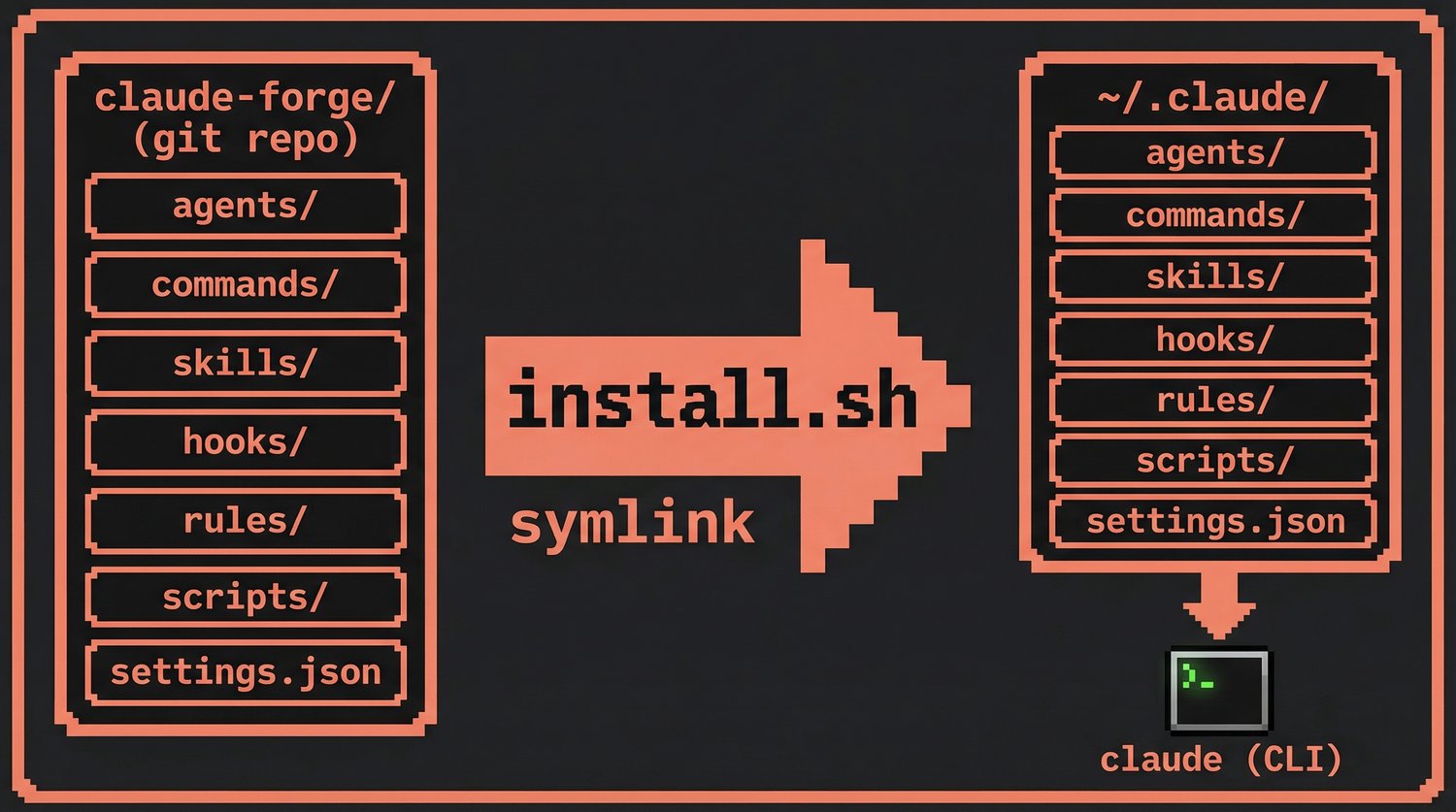
The installer creates symbolic links (shortcuts) from the claude-forge folder to ~/.claude/ — the folder Claude Code reads. This means git pull in the repo updates everything instantly, with no reinstall needed.
graph LR
    REPO["claude-forge repo
(git pull to update)"]
    INSTALL["./install.sh
(one-time setup)"]
    HOME["~/.claude/
(Claude reads this)"]
    CLAUDE["Claude Code"]

    REPO --> INSTALL
    INSTALL -->|"creates symlinks"| HOME
    HOME --> CLAUDE
Skills vs Commands:
skills/are knowledge and procedures Claude discovers and follows automatically.commands/are explicit actions you trigger by typing/name. See docs/SKILLS-VS-COMMANDS.md.
Full Directory Tree
claude-forge/
  ├── agents/                    Agent definitions (16 .md files, frontmatter v2)
  ├── cc-chips/                  Status bar submodule
  ├── cc-chips-custom/           Custom status bar overlay
  ├── commands/                  Slash commands (35 .md, 8 dirs moved to skills/)
  ├── docs/                      Screenshots, diagrams, policy docs (v3.0+ guides, incl. RELIABILITY.md / VERIFICATION-LOOP.md)
  ├── hooks/                     Event-driven shell scripts (22)
  │   └── examples/              Opt-in .example samples for 21 lifecycle events (9)
  ├── knowledge/                 Knowledge base entries
  ├── libs/                      Shared shell libraries hooks source (hook-guard.sh)
  ├── reference/                 Reference docs (+ agent-schema.json, ai-tell-taxonomy.md)
  ├── rules/                     Auto-loaded rule files (14)
  ├── scripts/                   Utility scripts (incl. install-precommit.sh, api-error-resume-runner.sh)
  ├── setup/                     Installation guides + CLAUDE.md template
  ├── skills/                    Multi-step skill workflows (33, hybrid policy)
  ├── install.sh                 macOS/Linux installer (--upgrade supported)
  ├── install.ps1                Windows installer (--upgrade supported)
  ├── mcp-servers.json           MCP server defaults (4 minimal)
  ├── mcp-servers.optional.json  Optional MCP servers (memory/exa/github/fetch/time/...)
  ├── .claude-plugin/plugin.json Plugin manifest (4.3.0)
  ├── .claude-plugin/marketplace.json  Marketplace entry (4.3.0)
  ├── settings.json              Claude Code settings (2026 fields)
  ├── MIGRATION.md               v2.1 → v4.0 migration guide (EN)
  ├── MIGRATION.ko.md            v2.1 → v4.0 migration guide (KO)
  ├── CONTRIBUTING.md            Contribution guide
  ├── SECURITY.md                Security policy
  └── LICENSE                    MIT License
🔧 What's New in v4.0
v4.0 changes (click to collapse)
| Change | Description |
|---|---|
| Adversarial verification loop | adversarial-reviewer + skeptical-auditor agents, review-loop skill, rules/adversarial-review.md. Maker≠checker: a fresh, independent reviewer that did not write the change reproduces the claim rather than reading it, and returns APPROVE / REQUEST_CHANGES / UNVERIFIED. Worked example from this release's own PRs: docs/VERIFICATION-LOOP.md. |
| Reliability pack | Unattended API-error auto-resume (StopFailure), session relay across /compact, doom-loop + edit-time verify hooks, an opt-in pre-commit secret guard, and the shared libs/hook-guard.sh they build on. Full wiring guide: docs/RELIABILITY.md. |
| Debugging escalation chain | systematic-debugger → rca-debugger → escalation-fixer. Each step only fires when the one before it couldn't close the case. |
| Task-grade routing | /workflow-classify sizes a task S/M/L/XL and routes documentation depth and verification rigor accordingly (rules/task-grade-routing.md). |
| Korean prose quality guardrails | Translation-ese and AI-idiom avoidance at generation time, not just a cleanup pass — rules/korean-writing-quality.md, reference/ai-tell-taxonomy.md, emdash-slop-guard.sh, plus humanize-korean / korean-character-count / korean-spell-check skills. |
Inventory: 11 → 16 agents, 34 → 35 commands, 26 → 32 skills, 15 → 21 hooks, 10 → 14 rules. See MIGRATION.md for the full v3 → v4 upgrade guide.
🔧 What's New in v3.0 (historical)
v3.0 → v3.1.0 changes (click to expand)
v3.1.0 (feature, June 2026)
- loop-forge skill + command — turn a one-line repetitive task into a reusable, self-guarding slash command (5 loop shapes + auto verifier & hardstop). Skills 24 → 25, commands 33 → 34.
- Beginner-friendly README — full rewrite for non-developers (plain-language analogies, terms explained in parentheses) + 3 diagrams (what's inside / install in 3 steps / development workflow), in English & Korean.
v3.0.2 (docs patch, May 2026)
LLM-readable install paths (root INSTALL.md + above-the-fold one-liner) and multi-channel distribution. See Release v3.0.2.
v3.0.1 (patch)
| Change | Description |
|---|---|
| Plugin Manifest shipped | /plugin marketplace add sangrokjung/claude-forge + /plugin install claude-forge now work for Commands + Skills. |
| Chrome DevTools promoted | Lighthouse / Core Web Vitals / memory snapshots now in the default 4-server set. Pinned at chrome-devtools-mcp@0.23.0. |
hooks/_lib/timing.sh |
Records SessionEnd hook timing into ~/.claude/logs/hook-timing.jsonl. |
| CI expanded | Runs on every PR and on main/feat/**/fix/**/chore/**/docs/**/ci/** pushes. 6 jobs total. |
| Tier 0 spec corrections | Hook types, timeout units, Auto Memory path all corrected. |
| New governance docs | ADR-001, SETTINGS-COMPATIBILITY, MARKETPLACE-SUBMISSION. |
v3.0 (major)
| Change | Description |
|---|---|
| Hooks 21 Events | Lifecycle hooks expanded from 5 to 21 events. Opt-in samples in hooks/examples/. |
| Subagent Frontmatter v2 | 10 optional fields: isolation, background, memory, maxTurns, skills, mcpServers, effort, hooks, permissionMode, disallowedTools. Schema: reference/agent-schema.json. |
| Skills/Commands Hybrid Policy | Clear boundary documented at docs/SKILLS-VS-COMMANDS.md. |
| MCP Minimal (4 servers) | Default set: playwright · context7 · jina-reader · chrome-devtools-mcp@0.23.0. Legacy full set in mcp-servers.optional.json. |
| CLAUDE.md Template | New setup/CLAUDE.md.template with @import pattern. |
| Upgrade in One Command | ./install.sh --upgrade safely migrates v2.1 installs with backup and diff preview. |
Breaking Changes in v3.0
- MCP defaults cut —
memory,exa,github, andfetchremoved frommcp-servers.json. Restore frommcp-servers.optional.jsonif needed. - 8 commands moved to
skills/— Symlink compatibility maintained until 2027-04-01. Affected:debugging-strategies,dependency-upgrade,evaluating-code-models,evaluating-llms-harness,extract-errors,security-compliance,stride-analysis-patterns,summarize. - settings.json allowlist — Removed
mcp__memory,mcp__exa,mcp__github,mcp__fetch. Addedmcp__playwright.
🛠 MCP Servers (External Tool Connections)
| Server | What it does | Required setup |
|---|---|---|
| playwright | Controls a real browser for end-to-end tests | None — auto-installed |
| context7 | Fetches live library documentation while coding | None — auto-installed |
| jina-reader | Reads web pages and converts them to clean text | None — auto-installed |
| chrome-devtools | Runs Lighthouse audits and Core Web Vitals checks | None — auto-installed |
Additional servers (memory, exa search, GitHub, fetch) are available opt-in via mcp-servers.optional.json. Full recipes: docs/MCP-MIGRATION.md.
⚙️ Customization
Override any setting without modifying tracked files:
cp setup/settings.local.template.json ~/.claude/settings.local.json
# Edit ~/.claude/settings.local.json with your preferences
settings.local.json merges on top of settings.json automatically — your changes survive git pull.
🆚 Claude Forge vs. Starting From Scratch
| Feature | Claude Forge | Basic .claude/ setup |
Individual plugins |
|---|---|---|---|
| Specialist agents | 16 ready | Manual setup | Varies |
| Slash commands | 35 ready | None | Per-plugin |
| Skill workflows | 33 ready | None | Per-plugin |
| Safety hooks | 22 + 9 examples | None by default | Per-plugin |
| External tool connections | 4 default (8+ optional) | None | Per-plugin |
| Setup time | ~5 minutes | Hours | Per-plugin install |
| Updates | git pull |
Manual per-file | Per-plugin update |
| End-to-end pipeline | Plan → Test → Review → Ship | Disconnected tools | Not integrated |
❓ FAQ
Do I need to know how to code to use Claude Forge?
Claude Forge is built for developers working with Claude Code, so some familiarity with the terminal is needed. That said, you do not need to understand all the internals — most workflows start with a simple one-word command like /plan or /auto, and Claude Forge handles the rest.
If you are new, start with /guide after installing. It gives you an interactive 3-minute tour.
What is Claude Code?
Claude Code is Anthropic's official AI coding assistant that runs in your terminal. It reads your codebase, writes code, runs tests, and more — all through a conversation. Claude Forge is the add-on kit that gives it specialist helpers, shortcuts, and safety checks.
How is Claude Forge different from other Claude Code plugins?
Most Claude Code plugins solve one problem at a time. Claude Forge is a complete development environment — 16 agents, 35 commands, 33 skills, 22 hooks, and 14 rules that work together as a cohesive system. Instead of assembling individual plugins, you get a pre-wired pipeline: /plan feeds into /tdd, which feeds into /code-review, which feeds into /handoff-verify, which feeds into /commit-push-pr — and, new in v4.0, an adversarial verification loop that a fresh reviewer must APPROVE before any behavioral change is considered done. The 6-layer security hook system also runs automatically without extra configuration.
Is Claude Forge compatible with the official Claude Code plugin system?
Yes. Claude Forge installs via symlinks to ~/.claude/ and works alongside official Claude Code plugins. Your existing settings.local.json overrides are preserved, and you can add or remove individual components without affecting the rest of the system.
How do I update Claude Forge?
Run git pull in the claude-forge directory. Because the installer uses symlinks (on macOS/Linux), updates take effect immediately — no re-install needed. On Windows, re-run install.ps1 after pulling to copy the updated files.
Does Claude Forge work on Windows?
Yes. Run install.ps1 in PowerShell as Administrator. Windows uses file copies instead of symlinks, so re-run install.ps1 after each git pull to apply updates. Agents, commands, and skills work the same on Windows, macOS, and Linux. The v4.0.0 reliability hooks (auto-resume, session relay, doom-loop detection, and the rest of S1-S5) were built and verified on macOS only — Linux/WSL was addressed at the source level but not exercised, and two of the auto-resume paths were never fired on any platform in this release. See the platform matrix in docs/RELIABILITY.md for the exact breakdown.
What does /sync do?
/sync pulls the latest changes from your remote repository and then synchronizes all project documentation — prompt_plan.md, spec.md, CLAUDE.md, and rule files. Run it after completing any workflow (feature, bug fix, refactor) or at the start of a new session to make sure Claude has the latest context about your project.
How does Claude Forge handle memory across sessions?
Claude Forge uses a 4-layer memory system:
- Project docs (
CLAUDE.md,prompt_plan.md,spec.md) — Project-level instructions and plans that persist in the repository./synckeeps these up to date. - Rule files (
rules/) — Coding style, security, and workflow conventions loaded automatically each session. - MCP memory server — A persistent knowledge graph that stores entities and relations across sessions (opt-in).
- Agent memory (
~/.claude/agent-memory/) — Core agents record learnings after each task, improving their recommendations over time.
Running /sync at session start ensures layers 1 and 2 are current.
🤝 Contributing
See CONTRIBUTING.md for guidelines on adding agents, commands, skills, and hooks.
Use Claude Forge? Show it!
[](https://github.com/sangrokjung/claude-forge)
Add this badge to your project's README to let others know you use Claude Forge.
⭐ Star History
Contributors
📄 License
MIT — use it, fork it, build on it.
If Claude Forge improved your workflow, a star helps others find it too.
Made with ❤️ by QJC (Quantum Jump Club)