An agent meta-harness for Claude Code and Codex.


 Get started with Ruflo
 Start in Claude Code with core tools, the visual console and runtime mods. Requires Claude Code 2.1.287 or later. Run inside Claude Code:
/plugin marketplace add ruvnet/ruflo
/plugin install ruflo-core@ruflo
/plugin install ruflo-console@ruflo
/plugin install ruflo-mods@ruflo
/reload-plugins
/ruflo
Core provides foundation tools. Console opens the agent cockpit. Mods add routing and policy enforcement inside Claude Code. Mods run with your account's permissions; review their code before installing.
Using Codex or another MCP enabled tool? Use NPX for Ruflo project setup and connect your client to the Ruflo MCP server. Run the setup wizard in your project terminal:
npx ruflo@latest init wizard
For clients that support local stdio MCP servers, configure command npx and arguments ["-y", "ruflo@latest", "mcp", "start"]. The equivalent server command is:
npx -y ruflo@latest mcp start
MCP exposes Ruflo tools to your client. The console and mods above are Claude Code integrations; hook support depends on the client.
Compare install paths · Open the console · User guide
Optional: ruOS Desktop

Connect ruOS to ChatGPT or Claude via MCP:
https://ruos.cognitum.one/mcp
npx ruvector
Ruflo

📖 RuFlo Explained — Build an AI Team That Plans, Remembers, Tests, and Improves A 14-chapter guide: from the basic idea to a first useful task, then memory, agent teams, plugins, cost and verification.
Agent = Model + Harness. The model writes; the harness gives it tools, memory, loops, sandboxes, and controls so it can actually work. Ruflo is the harness — the execution layer around Claude Code and Codex that adds 100+ specialized agents, coordinated swarms, self-learning memory, federated comms across machines, and enterprise security guardrails. So agents don't just run, they collaborate.
One npx ruflo init gives Claude Code a nervous system: agents self-organize into swarms, learn from every task, remember across sessions, and — with federation — securely talk to agents on other machines without leaking data. You keep writing code. Ruflo handles the coordination.

Conceptual learning loop. Local vector retrieval and contrastive updates can run without an LLM; embeddings and configured learning modules are still required. See the RuVector training integration and trajectory contrastive learning.
Architecture in text
User → Ruflo (CLI/MCP) → Router → Swarm → Agents → Memory → LLM providers. Memory feeds useful experience back into routing. This is a conceptual flow, not a live execution trace.
New to Ruflo? You don't need to learn 314 MCP tools or 26 CLI commands. After
init, just use Claude Code normally — the hooks system automatically routes tasks, learns from successful patterns, and coordinates agents in the background.
📖 Background — where the name comes from
Claude Flow is now Ruflo — named by
rUv, who loves Rust, flow states, and building things that feel inevitable. The "Ru" is the rUv. The "flo" is working until 3am. Underneath, powered byCognitum.Oneagentic architecture, running a supercharged Rust-based AI engine, embeddings, memory, and plugin system.
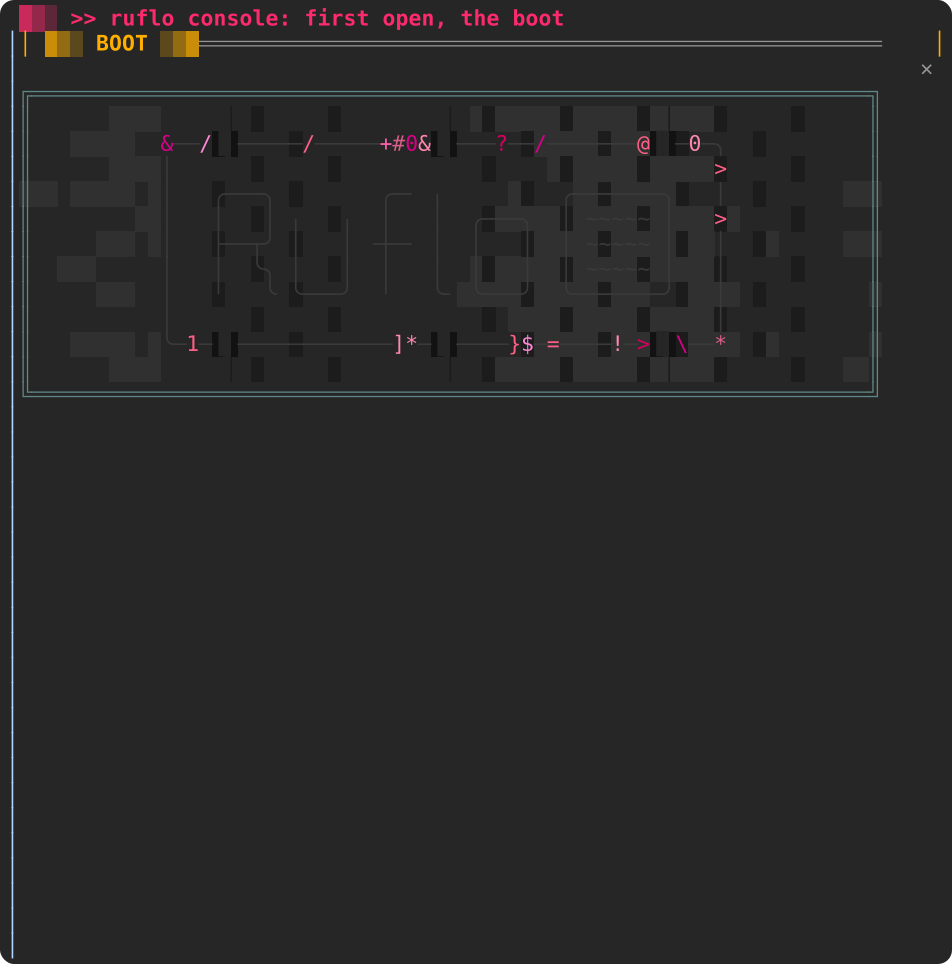
 Your agent cockpit. Track workflows, agents, models, tokens and cost beside Claude Code. The animation shows startup checks and a sample workflow, not a live session.
 Inspect any run. Open agent logs and results, search, triage failures, replay and compare. Start with
 npx ruflo init, restart Claude Code, then /ruflo. Full console tour.
 Let Claude drive. You set the limits. Enable Settings → Claude control to navigate and run console actions. Choose
 read, write, manage or full, with ask or auto approval. The current default is read + ask; raising the level is your choice. Actions above your permission level are refused, and network, spending and destructive actions require confirmation even in auto. Review the live action log or press Take back control to stop Claude control. Details.
One task: create a mission with Claude
Watch the recorded console session below. Claude creates a mission, opens the Learning and Security pages, and reports its actions in Overview.
- Set the boundary. Install the console using the commands below, open
/ruflo, then choose Settings → Claude control → write + ask. - Give a concrete request. Try: “Create a mission to add a dark mode toggle. Show me the mission and its status.”
- Approve creation. Claude opens Missions and sets the goal. Confirm the pending create action in the console.
- Verify the result. Check that Missions contains the goal and Overview records the action. Creating a mission does not mean the feature has been implemented.
- Keep control. Take back control pauses Claude's console tools. A later call should be refused until you restore control.
What the recording demonstrates: a real Claude Haiku session with write + auto, mission creation, page navigation, a refused swarm stop, and control being taken back. The steps above use ask so you approve creation yourself. The separate workflow animation uses sample data; neither is evidence of completed swarm work or memory recall.
Implementation and recorded test findings · Reproduction script

Install the mods from the ruflo marketplace (Claude Code 2.1.287 or later; mods run with your account's permissions and are not sandboxed, so read the code first):
/plugin marketplace add ruvnet/ruflo
/plugin install ruflo-console@ruflo
/plugin install ruflo-mods@ruflo
/reload-plugins
ruflo-console is the cockpit above, ruflo-mods routes prompts and enforces policy in-process, ruflo-swarm shows the swarm in a pane, and ruflo-ruos adds the ruOS status segment. Open /plugin to confirm they appear in the active mods line. Inside the console, /ruflo market is the Plugin Catalog: every ruflo plugin, mod and skill with what it ships, and buttons to install, enable, disable and update (each asks first).
Quick Start
There are two different install paths with very different surface areas. Pick based on what you need (#1744):
| Claude Code Plugin | CLI install (npx ruflo init) |
|
|---|---|---|
| What it gives you | Slash commands + a few skills + agent definitions per-plugin | Full Ruflo loop — 98 agents, 60+ commands, 30 skills, MCP server, hooks, daemon |
| Files in your workspace | Zero | .claude/, .claude-flow/, CLAUDE.md, helpers, settings |
| MCP server registered | Only if ruflo-core is installed (it ships its own .mcp.json) — most other plugins don't |
Yes |
| Hooks installed | No | Yes |
| Best for | Try a single plugin's commands without committing to the full install | Production use — everything works as documented |
Path A — Claude Code Plugins (lite, slash commands only)
# Add the marketplace
/plugin marketplace add ruvnet/ruflo

# Install core + any plugins you need
/plugin install ruflo-core@ruflo
/plugin install ruflo-swarm@ruflo
/plugin install ruflo-rag-memory@ruflo
/plugin install ruflo-neural-trader@ruflo
This adds slash commands and agent definitions. ruflo-core (installed above) does register its own MCP server on install — its tools are callable as mcp__plugin_ruflo-core_ruflo__* (e.g. mcp__plugin_ruflo-core_ruflo__memory_store), not the bare memory_store/swarm_init/agent_spawn names the CLI-track scaffold uses. Other plugins generally don't ship their own MCP server. For the full loop with the CLI-track tool names, use Path B below.
🔌 All 35 plugins
Core & Orchestration
| Plugin | What it does |
|---|---|
| ruflo-core | Foundation — server, health checks, plugin discovery |
| ruflo-swarm | Coordinate multiple agents as a team |
| ruflo-autopilot | Let agents run autonomously in a loop |
| ruflo-loop-workers | Schedule background tasks on a timer |
| ruflo-workflows | Reusable multi-step task templates |
| ruflo-federation | Agents on different machines collaborate securely |
Memory & Knowledge
| Plugin | What it does |
|---|---|
| ruflo-agentdb | Fast vector database for agent memory |
| ruflo-rag-memory | Smart retrieval — hybrid search, graph hops, diversity ranking |
| ruflo-rvf | Save and restore agent memory across sessions |
| ruflo-ruvector | ruvector — GPU-accelerated search, Graph RAG, 103 tools |
| ruflo-knowledge-graph | Build and traverse entity relationship maps |
Intelligence & Learning
| Plugin | What it does |
|---|---|
| ruflo-intelligence | Agents learn from past successes and get smarter |
| ruflo-graph-intelligence | Sublinear graph reasoning — PageRank, delta updates, complexity-aware execution (ADR-123) |
| ruflo-daa | Dynamic agent behavior and cognitive patterns |
| ruflo-ruvllm | Run local LLMs (Ollama, etc.) with smart routing |
| ruflo-goals | Break big goals into plans and track progress |
Code Quality & Testing
| Plugin | What it does |
|---|---|
| ruflo-testgen | Find missing tests and generate them automatically |
| ruflo-browser | Automate browser testing with Playwright |
| ruflo-jujutsu | Analyze git diffs, score risk, suggest reviewers |
| ruflo-docs | Generate and maintain documentation automatically |
Security & Compliance
| Plugin | What it does |
|---|---|
| ruflo-security-audit | Scan for vulnerabilities and CVEs |
| ruflo-aidefence | Block prompt injection, detect PII, safety scanning |
Architecture & Methodology
| Plugin | What it does |
|---|---|
| ruflo-adr | Track architecture decisions with a living record |
| ruflo-ddd | Scaffold domain-driven design — contexts, aggregates, events |
| ruflo-sparc | Guided 5-phase development methodology with quality gates |
| ruflo-metaharness | Grade your agent setup, scan tool configs for security risks, and track changes over time (guide) |
| ruflo-arena | Competitive ruliology — pit agent strategies against each other in tournaments, hill-climb and co-evolve the winners (ADR-147/148) |
DevOps & Observability
| Plugin | What it does |
|---|---|
| ruflo-migrations | Manage database schema changes safely |
| ruflo-observability | Structured logs, traces, and metrics in one place |
| ruflo-cost-tracker | Track token usage, set budgets, get cost alerts |
Extensibility
| Plugin | What it does |
|---|---|
| ruflo-agent | Run agents — local WASM sandbox (rvagent) + Anthropic Claude Managed Agents (cloud) |
| ruflo-plugin-creator | Scaffold, validate, and publish your own plugins |
Domain-Specific
| Plugin | What it does |
|---|---|
| ruflo-iot-cognitum | IoT device management — trust scoring, anomaly detection, fleets |
| ruflo-neural-trader | neural-trader — AI trading with 4 agents, backtesting, 112+ tools |
| ruflo-market-data | Ingest market data, vectorize OHLCV, detect patterns |
CLI Install
macOS / Linux / WSL / Git-Bash:
# One-line install (POSIX shells only — see Windows note below)
curl -fsSL https://cdn.jsdelivr.net/gh/ruvnet/ruflo@main/scripts/install.sh | bash
All platforms (including native Windows PowerShell / cmd):
# Interactive setup wizard — runs identically on every platform
npx ruflo@latest init wizard

# Quick non-interactive init
# npx ruflo@latest init

# Or install globally
npm install -g ruflo@latest
💡 Windows users: the
curl ... | bashform needs a POSIX shell (Git-Bash, WSL, MSYS). Thenpx ruflo@latest init wizardline works natively in PowerShell and cmd. If you hit an'bash' is not recognizederror, use thenpxline instead — both end up running the same init flow.
 MCP Server
# Add Ruflo as an MCP server in Claude Code
claude mcp add claude-flow -- npx ruflo@latest mcp start
What You Get
| Capability | Description |
|---|---|
 100+ Agents 100+ Agents |
Specialized agents for coding, testing, security, docs, architecture |
| Comms Layer |
Zero-trust federation — agents across machines/orgs discover, authenticate, and exchange work securely |
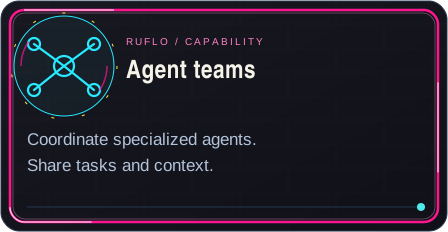
 Swarm Coordination Swarm Coordination |
Hierarchical, mesh, and adaptive topologies with consensus |
 Self-Learning Self-Learning |
SONA neural patterns, ReasoningBank, trajectory learning |
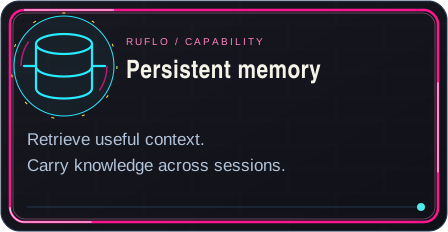
 Vector Memory Vector Memory |
HNSW-indexed AgentDB — measured ~1.9x faster at N=20k, ~3.2x–4.7x at N=5k vs brute force (recall@10 ~0.99); ANN wins above the crossover, ties/loses at small N. See audit + scripts/benchmark-intelligence.mjs |
 Background Workers Background Workers |
12 auto-triggered workers (audit, optimize, testgaps, etc.) |
| Plugin Marketplace |
33 native Claude Code plugins + 21 npm plugins |
 Multi-Provider Multi-Provider |
Claude, GPT, Gemini, Cohere, Ollama with smart routing |
 Security Security |
AIDefence, input validation, CVE remediation, path traversal prevention |
 Agent Federation Agent Federation |
Cross-installation agent collaboration with zero-trust security |
 MetaHarness MetaHarness |
Audit your AI agent setup before you ship. Grade readiness (1-100), scan tool configs for security issues, snapshot the whole project to catch regressions over time, and find templates that match your repo. ruflo eject turns a ruflo project into a standalone agent toolkit with its own name. Full guide. |
Learning from experience
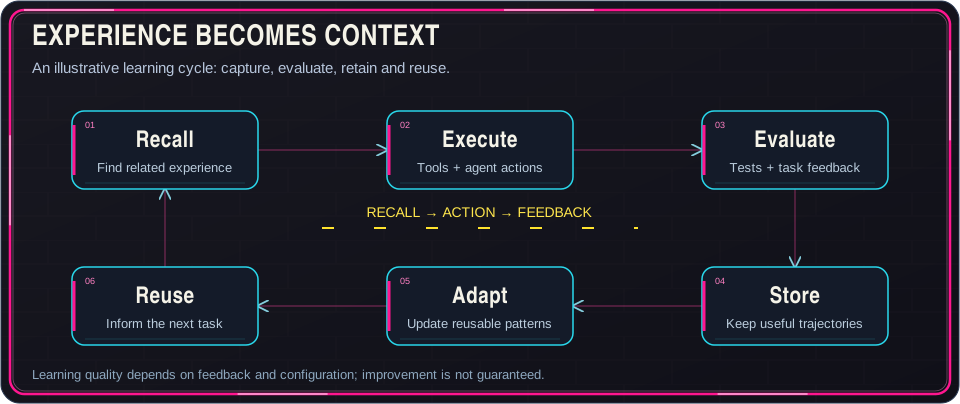
Useful trajectories and task feedback can inform future work. Results depend on the configured memory, learning components and quality of feedback. Learning plugin.
Agent Federation — Slack for Agents
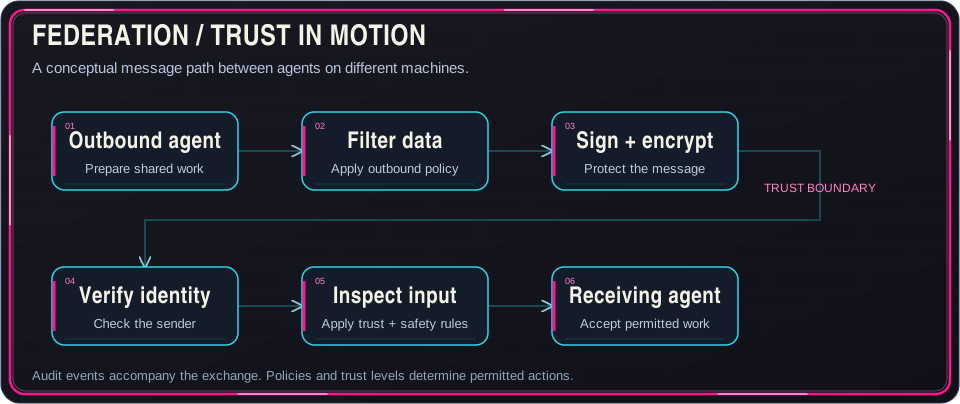
Slack gave teams channels. Federation gives agents the same thing — shared workspaces across trust boundaries, where agents on different machines, orgs, or cloud regions can discover each other, prove who they are, and collaborate on tasks.
The difference: some channels are trusted, some aren't. @claude-flow/plugin-agent-federation handles that automatically. Your agents join a federation, get verified via mTLS + ed25519, and start exchanging work — with PII stripped before anything leaves your node and every message auditable. Untrusted agents can still participate at lower privilege: they see discovery info, not your memory. As they prove reliable, trust upgrades. If they misbehave, they get downgraded instantly — no human in the loop required.
You don't configure handshakes or manage certificates. You federation init, federation join, and your agents start talking. The protocol handles identity, the PII pipeline handles data safety, and the audit trail handles compliance.
📘 Full user guide:
docs/federation/— setup, MCP tools, trust levels, circuit breaker, and the (opt-in) WireGuard mesh layer that ties packet-layer reachability to federation trust. ADR-111 deep-dive atdocs/federation/phase7-mesh-bringup.md.
Federation capabilities
| Capability | How it works | |
|---|---|---|
| 🔒 | Zero-trust federation | Remote agents start untrusted. Identity proven via mTLS + ed25519 challenge-response. No API keys, no shared secrets. |
| 🛡️ | PII-gated data flow | 14-type detection pipeline scans every outbound message. Per-trust-level policies: BLOCK, REDACT, HASH, or PASS. Adaptive calibration reduces false positives. |
| 📊 | Behavioral trust scoring | Formula (0.4×success + 0.2×uptime + 0.2×threat + 0.2×integrity) continuously evaluates peers. Upgrades require history; downgrades are instant. |
| 📋 | Compliance built-in | HIPAA, SOC2, GDPR audit trails as compliance modes. Every federation event produces a structured record searchable via HNSW. |
| 🤝 | 9 MCP tools + 10 CLI commands | Full lifecycle: federation_init, federation_send, federation_trust, federation_audit, and more. |
Example: two teams sharing fraud signals without sharing customer data
# Team A: initialize federation and generate keypair
npx claude-flow@latest federation init

# Team A: join Team B's federation endpoint
npx claude-flow@latest federation join wss://team-b.example.com:8443

# Team A: send a task — PII is stripped automatically before it leaves
npx claude-flow@latest federation send --to team-b --type task-request \
  --message "Analyze transaction patterns for account anomalies"

# Team A: check peer trust levels and session health
npx claude-flow@latest federation status
See issue #1669 for the complete architecture, trust model, and implementation roadmap.
# Claude Code plugin
/plugin install ruflo-federation@ruflo

# Or via CLI
npx claude-flow@latest plugins install @claude-flow/plugin-agent-federation
Claude Code: With vs Without Ruflo
| Capability | Claude Code Alone | + Ruflo |
|---|---|---|
| Agent Collaboration | Isolated, no shared context | Swarms with shared memory and consensus |
| Coordination | Manual orchestration | Queen-led hierarchy (Raft, Byzantine, Gossip) |
| Memory | Session-only | HNSW vector memory with sub-ms retrieval |
| Learning | Static behavior | SONA self-learning with pattern matching |
| Task Routing | You decide | Intelligent routing (89% accuracy) |
| Background Workers | None | 12 auto-triggered workers |
| LLM Providers | Anthropic only | 5 providers with failover |
| Security | Standard | CVE-hardened with AIDefence |
Architecture overview
User --> Claude Code / CLI
          |
          v
    Orchestration Layer
    (MCP Server, Router, 27 Hooks)
          |
          v
    Swarm Coordination
    (Queen, Topology, Consensus)
          |
          v
    100+ Specialized Agents
    (coder, tester, reviewer, architect, security...)
          |
          v
    Memory & Learning
    (AgentDB, HNSW, SONA, ReasoningBank)
          |
          v
    LLM Providers
    (Claude, GPT, Gemini, Cohere, Ollama)
Documentation

Four docs for four audiences:
| Doc | When to read it |
|---|---|
| Status | See what currently works — capability counts, test baselines, recent fixes, what's next. The is-it-ready doc. |
| User Guide | Daily reference — every command, every config flag, every plugin. The how-do-I doc. |
| MetaHarness Guide | How to grade your agent setup, scan tool configs for security, detect changes between runs, and eject a project into a standalone agent toolkit. The audit-my-setup doc. |
| Benchmarks | v3.8.0 SOTA matrix vs LangGraph / AutoGen / CrewAI on darwin-arm64 + linux-x64. ruflo wins cold start, single turn, RSS by 1.3×–1953×. The is-it-fast doc. |
| Verification | Cryptographically prove your installed bytes match the signed witness — ruflo verify. The trust-but-verify doc. |
| Team Gateway Checklist | Before-merge gates, dual-mode handoff, memory namespace sharing, and witness manifest entry per merge. The safer-team-workflows doc. |
Benchmark internals (for reproduction): sota-workload-spec.md · SOTA-PROGRESS.md · raw matrix JSON: darwin · linux
User Guide section index:
| Section | Topics |
|---|---|
| Quick Start | Installation, prerequisites, install profiles |
| Core Features | MCP tools, agents, memory, neural learning |
| Intelligence & Learning | Hooks, workers, SONA, model routing |
| Swarm & Coordination | Topologies, consensus, hive mind |
| Security | AIDefence, CVE remediation, validation |
| Ecosystem | RuVector, agentic-flow, Flow Nexus |
| Configuration | Environment variables, config schema |
| Plugin Marketplace | Browse and install plugins |
Support
| Resource | Link |
|---|---|
| Documentation | User Guide |
| Issues & Bugs | GitHub Issues |
| Enterprise | ruv.io |
| Community | Agentics Foundation Discord |
| Powered by | Cognitum.one |

License
MIT - RuvNet