Implementation of "FLUX-Text: A Simple and Advanced Diffusion Transformer Baseline for Scene Text Editing"
关键参数与规格
关键参数与规格
参数
值
语言
Python
类别
Models
子类别
Foundation models
关键词
Creative writing, Education, LocalAI, Model architecture
星标数
929
分叉数
90
贡献者
1
创建日期
2025-10-21
更新日期
2026-10-06
1 天星标数
0
7 天星标数
0
排名
12,582
上次排名
12,499
排名变化
-83
7 天星标排名
13,493
上次 7 天星标排名
13,503
7 天星标排名变化
10
总星标排名
11,788
上次总星标排名
11,773
总星标排名变化
-15
README 摘录
tiny-diffusion A character-level language diffusion model for text generation trained on Tiny Shakespeare, in 365 lines of code! 7 million parameters, so you can also try it out locally! This repo also contains a tiny gpt implementation in 313 lines of code. ~80% of the code between the two files are the exact same. This is of this project, which simplified the diffusion code from ~1,000 lines to ~400, and slightly altered the architecture. To view the
original version, view the branch. Quick Start Installation Generation Generate text with the trained models: Both models generate 2,000 characters by default and use the first 16 characters of as the initial context. These are parameters in the function and can be easily modified. Training To train both models from scratch, run: The model trains for 5,000 iterations while the model trains for 10,000, taking ~10 and ~20 minutes respectively on an A100 GPU. The diffusion model
trains for twice as long because half as many tokens count towards the loss during training (only masked tokens contribute to the loss). Visualization Visualize the generation process step-by-step: Differences Between The Models GPT (Autoregressive) Predicts the next token given all previous tokens Uses **causal attention** (can only look at past tokens) Generates text **sequentially** (one token at a time, left-to-right) Training: minimize cross-entropy loss on next token prediction Diffusion (Non-Autoregressive) Predicts original tokens
given partially masked sequences Uses **bidirectional attention** (can look at all tokens) Generates text **in parallel** and in blocks: fills in masked tokens iteratively, then moves to the next block Training: minimize cross-entropy loss on denoising masked tokens Key Modifications The diffusion model makes **5 key changes** to the GPT architecture: 1. **Add mask token** to vocabulary ( ) for representing noised tokens 2. **Change attention** from causal to bidirectional ( ) 3. **Change generation** from sequential to confidence-based parallel decoding 4
. **Change training objective** from next token prediction to unmasking 5. **Only masked tokens** contribute to the loss during training Acknoledgements The code for and take heavy inspiration from the Andrej Karpathy GPT implementations listed below: nanochat GPT implementation "Let's build GPT" video GPT implementation My GPT implemenation, , aims to strike a balance between simplicity and good generation quality. The file is a modified version of with as few modifications as possible to get it to do language diffusion.
A character-level language diffusion model for text generation trained on Tiny Shakespeare, in 365 lines of code! It is only 10.7 million parameters, so you can also try it out locally!
This repo also contains a tiny gpt implementation in 313 lines of code. ~80% of the code between the two files are the exact same.
This is v2 of this project, which simplified the diffusion code from ~1,000 lines to ~400, and slightly altered the architecture. To view the original version, view the old branch.
Quick Start
Installation
# Install dependencies (Python 3.10+)
uv sync

# Download the dataset
wget https://github.com/nathan-barry/tiny-diffusion/releases/download/v2.0.0/data.txt

# Download the trained model weights (if you don't want to train it from scratch)
mkdir -p weights && wget -P weights https://github.com/nathan-barry/tiny-diffusion/releases/download/v2.0.0/{gpt,diffusion}.pt
Generation
Generate text with the trained models:
# Diffusion (parallel decoding)
uv run diffusion.py

# GPT (autoregressive)
uv run gpt.py
Both models generate 2,000 characters by default and use the first 16 characters of data.txt as the initial context. These are parameters in the generate function and can be easily modified.
Training
To train both models from scratch, run:
# Train diffusion model
uv run diffusion.py --train

# Train GPT model
uv run gpt.py --train
The gpt model trains for 5,000 iterations while the diffusion model trains for 10,000, taking ~10 and ~20 minutes respectively on an A100 GPU. The weights are saved to the weights/ directory.
The diffusion model trains for twice as long because half as many tokens count towards the loss during training (only masked tokens contribute to the loss).
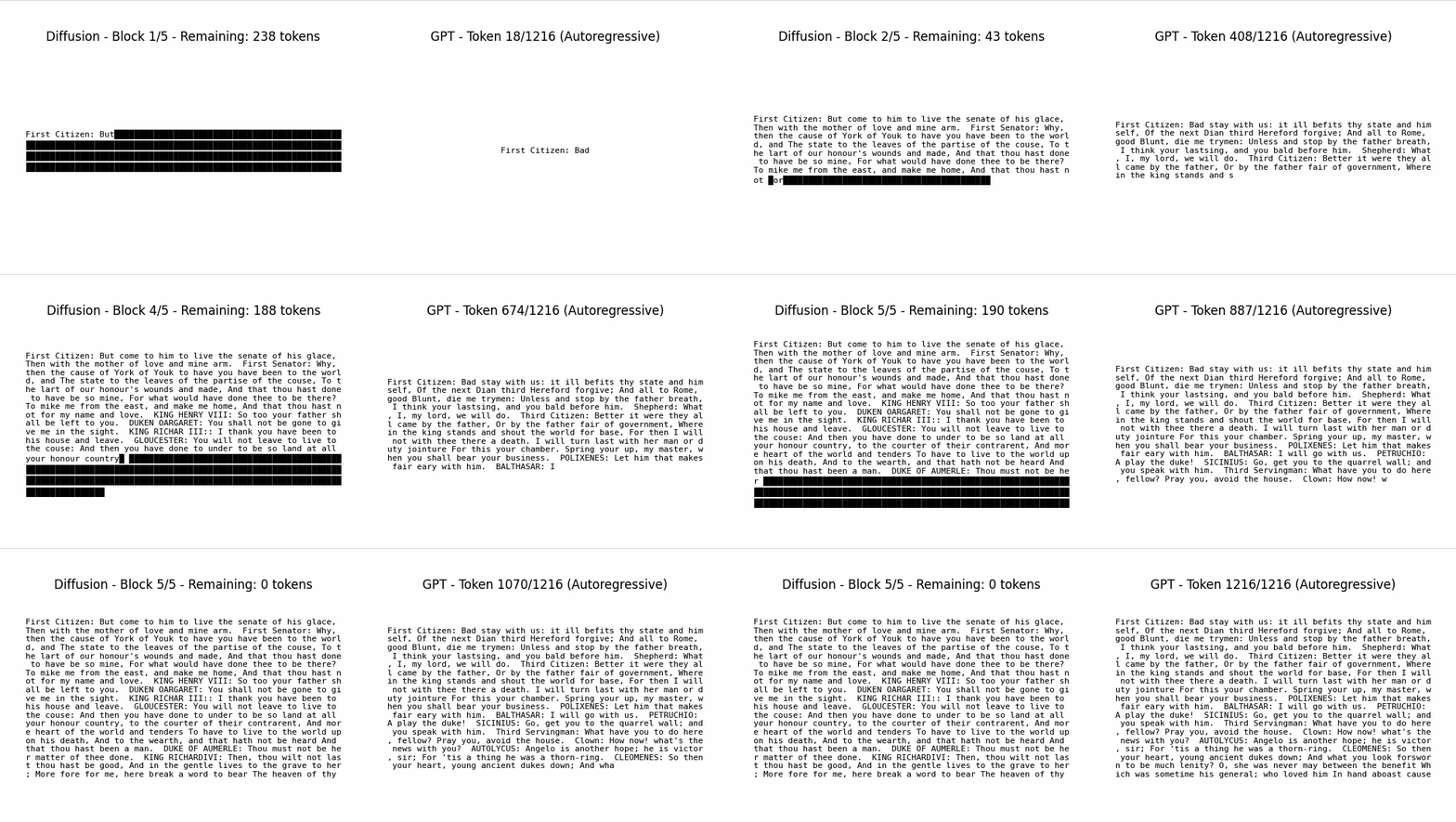
Visualization
Visualize the generation process step-by-step:
# Visualize diffusion model only
uv run visualize.py

# Compare diffusion and GPT side-by-side
uv run visualize.py --compare

# Generate more blocks
uv run visualize.py --blocks 10
Differences Between The Models
GPT (Autoregressive)
Predicts the next token given all previous tokens
Uses causal attention (can only look at past tokens)
Generates text sequentially (one token at a time, left-to-right)
Training: minimize cross-entropy loss on next token prediction
Diffusion (Non-Autoregressive)
Predicts original tokens given partially masked sequences
Uses bidirectional attention (can look at all tokens)
Generates text in parallel and in blocks: fills in masked tokens iteratively, then moves to the next block
Training: minimize cross-entropy loss on denoising masked tokens
Key Modifications
The diffusion model makes 5 key changes to the GPT architecture:
Add mask token to vocabulary (_) for representing noised tokens
Change attention from causal to bidirectional (is_causal=False)
Change generation from sequential to confidence-based parallel decoding
Change training objective from next token prediction to unmasking
Only masked tokens contribute to the loss during training
Acknoledgements
The code for gpt.py and diffusion.py take heavy inspiration from the Andrej Karpathy GPT implementations listed below: