godot-dodo
The godot-dodo project presents a pipeline to finetune open source language models on human-created, language-specific code retrieved from GitHub.
In this case, the targeted language is GDScript, but the same methodology can be applied to other languages.
This repository includes the following:
- Scripts to assemble the finetuning dataset
- Pre-assembled, raw datasets (up to a size of 60k rows)
- Scripts to finetune a model
- Links to model weights
- Performance report comparing finetuned models
Performance
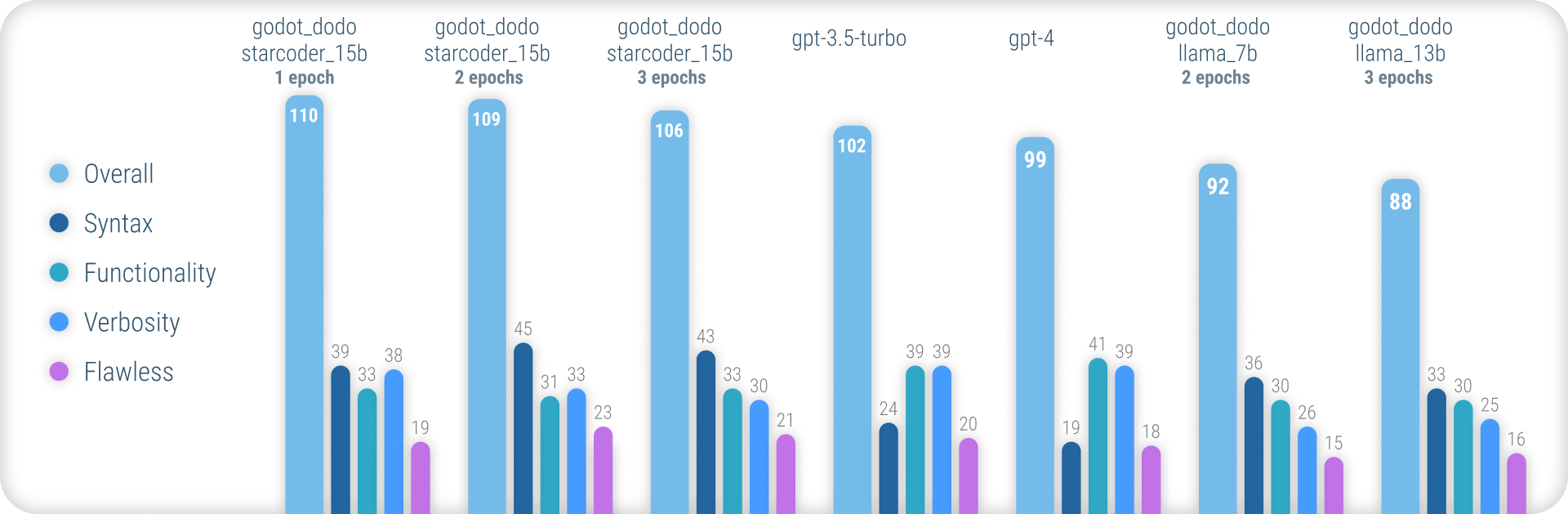
For comprehensive results explaining the methodology used and a full list of all result, please refer to the full performance report here.
In summary, godot_dodo models achieve significantly greater consistency than gpt-4/gpt-3.5-turbo when it comes to generating accurate GDScript syntax, and variants trained on code-specific base-models can even outperform them on complex instructions.
The major remaining weakpoint of this approach is the loss in appropriate verbosity when writing methods. Since human-written samples will often include references to objects initialized outside of the scope of the sample method, the model learns to do the same, resulting in cases where functionality relevant to the instruction is assumed to be already implemented. This can most likely be improved significantly by a more sophisticated dataset.
Concept
How?
Unlike other, similar approaches to finetuning models such as stanford-alpaca, this approach does not use existing, larger language models for the output-values of the finetuning-dataset. All code used is human-created. Language models are instead only used to label each code snippet.
As such, we can assemble comment:code data-pairs in the style of CodeSearchNet, making use of powerful existing models to annotate high-quality human-created code.
Why?
Some existing language models such as gpt-4 are excellent coders. However, a lot of their ability is concentrated in only the most popular languages, such as Python or Javascript.
Less widely used languages are underrepresented in the training data and experience a massive performance drop-off, where models routinely mistake syntax or hallucinate language features that do not exist.
This aims to provide much more robust language-specific models that can be used to reliably generate code that compiles on first try.
Demo
To try out the pre-trained models, you can use the inference_demo.ipynb notebook.
In order to use that notebook on Google Colab, follow this link.
Dataset Generation
Due to this approach relying on human-created data, we scrape GitHub repositories using the GitHub search API.
Using the language:gdscript search term, we retrieve a list of repositories including GDScript code.
We also use license:mit to limit the dataset to suitable repositories. Only MIT-licensed code is used for training!
We then clone each one and apply the following logic:
- Find
project.godotfile - Detect whether project is made for
3.xor4.xGodot engine versions - Iterate through all
.gdfiles found in the repository - For each one, split file into individual functions
- For each function found, ask existing LLM (
gpt-3.5-turbo) for a detailed comment describing the functions purpose - Add
instruction:responsedata pair to dataset
Note that existing, human-written comments located above the code-block are not used for the instruction value. We are interested in consistent detail for comments, rather than trying to preserve some potentially higher-quality human-written ones.
Human comments within the code block however are preserved.
Run
To assemble a dataset yourself, follow these instructions:
- Run
python data/generate_unlabeled_dataset.py - Run
python data/label_dataset.py
Please do note that you'll need GitHub and OpenAI API keys in order to use these scripts.
Pre-assembled datasets
Pre-assembled datasets included in this repository:
- godot_dodo_4x_60k
- Assembled using
4.xGodot projects - ~60k rows
- Assembled using
Further datasets may be added in the future (particularly regarding 3.x data)
Finetuning
The fine-tuning process closely mirrors the one introduced by stanford_alpaca.
To reproduce a fine-tuned version of LLaMA, please follow the steps below.
Hardware Requirements
In order to effectively finetune a llama-7b or llama-13b model, it is highly recommended to use at least two A100 80GB GPUs. You may otherwise encounter out of memory errors or experience extremely long training times, and will need to adjust the training parameters.
For finetuning godot_dodo_4x_60k_llama_13b, eight A100 80GB GPUs were used.
Another important consideration is the protocol used for GPU communication. It is recommended to use NVLink setups rather than PCIe.
Should you only have access to PCIe setups, please replace full-shard with shard_grad_op in the torchrun command. This may severely speed up your training runs at the cost of potentially higher memory usage.
Setup
Before finetuning, make sure to install all requirements using:
pip install -r requirements.txt
Run
For exact commands used for finetuning models, please refer to the individual model pages:
Inference
To test out your finetuned model, you can use the eval.py script. Simply run:
python finetune/eval.py --model_name_or_path PATH_TO_FINETUNED_MODEL/
Publishing to Huggingface
To easily upload a finetuned model to Huggingface, you can use:
python finetune/push_to_hub.py --model_name_or_path PATH_TO_FINETUNED_MODEL/ --push_name HF_MODEL_NAME --auth_token HF_ACCESS_TOKEN
Finetuned model weights
Links to model weights hosted on Huggingface are provided in the respective model pages:
Cost
Below the dollar-cost of assembling each available dataset and finetuning each model.
Datasets
- godot_dodo_4x_60k
30$(gpt-3.5-turboAPI costs)
Finetuned Models
- models/godot_dodo_4x_60k_llama_7b
24$(8x A100 80GB instance costs)
- models/godot_dodo_4x_60k_llama_13b
84$(8x A100 80GB instance costs)
Use with godot-copilot
Usage of finetuned models with godot-copilot for in-editor, fully local code generation may be supported in the future.
Acknowledegments
Thank you to all MIT-licensed Godot projects! This would not be possible without you.
All projects that were scraped during assembly of the included finetuning data are listed in the respective dataset folders in data.
Another thank you goes to fluidstack.io for their reliable, cheap GPU instances that were used for finetuning these models.
Citation
If you wish to cite this project, please use:
@misc{godot-dodo,
  author = {Markus Sobkowski},
  title = {Godot-Dodo: Finetuned language models for GDScript generation},
  year = {2023},
  publisher = {GitHub},
  journal = {GitHub repository},
  howpublished = {\url{https://github.com/minosvasilias/godot-dodo}},
}
You should also cite the original LLaMA paper as well as stanford-alpaca.