Neuromorphic Computing Guide
A guide covering Neuromorphic Computing including the applications, libraries and tools that will make you better and more efficient with Neuromorphic Computing development.
Note: You can easily convert this markdown file to a PDF in VSCode using this handy extension Markdown PDF. Also, checkout the mdBook version Neuromorphic Computing Guide mdBook (Special thanks to jonathanwoollett-light).

Types of Neural Networks
Table of Contents
-
Electric charge, field, and potential
- Charge and electric force (Coulomb's law): Electric charge, field, and potential
- Electric field: Electric charge, field, and potential
- Electric potential energy, electric potential, and voltage: Electric charge, field, and potential
-
- Ohm's law and circuits with resistors: Circuits
- Circuits with capacitors: Circuits
-
Magnetic forces, magnetic fields, and Faraday's law
- Magnets and Magnetic Force: Magnetic forces, magnetic fields, and Faraday's law
- Magnetic field created by a current: Magnetic forces, magnetic fields, and Faraday's law
- Electric motors: Magnetic forces, magnetic fields, and Faraday's law
- Magnetic flux and Faraday's law
-
Electromagnetic waves and interference
- Introduction to electromagnetic waves: Electromagnetic waves and interference
- Interference of electromagnetic waves
Getting Started with Neuromorphic Computing
Neuromorphic Computing is the use of very large scale integration (VLSI) systems containing electronic analog circuits to simulate the neuro-biological architectures present in the human brain ad nervous system.

Intel Loihi 2, its second-generation neuromorphic research chip.
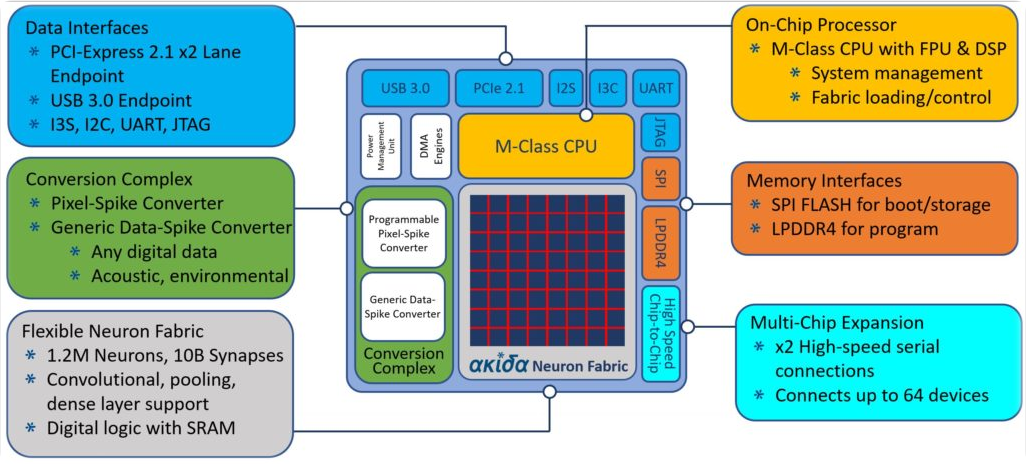
The Akida Neuromorphic System-on-Chip (NSoC) developed by BrainChip.
Developer Resources
-
Next-Level Neuromorphic Computing: Intel Lab's Loihi 2 Chip | Intel
-
Light-Emitting Artificial Synapses for Neuromorphic Computing (Research Paper PDF)
Online Training Courses
-
Computational Neuroscience: Neuronal Dynamics of Cognition Course Online | edX
-
Fundamentals of Neuroscience, Part 2: Neurons and Networks | Harvard Online Learning
-
Fundamentals of Neuroscience, Part 3: The Brain | Harvard Online Learning
-
Introduction to Computational Neuroscience | MIT OpenCourseWare
-
Brain and Cognitive Sciences Online Course | MIT OpenCourseWare
-
PyTorch on Azure - Deep Learning with PyTorch | Microsoft Azure
Books
-
Neuromorphic Computing Principles and Organization by Abderazek Ben Abdallah and Khanh N. Dang
-
Memristors for Neuromorphic Circuits and Artificial Intelligence Applications by Jordi Suñé
-
Neuromorphic Photonics by Bhavin J. Shastri, Paul R. Prucnal
YouTube videos
-
Neuromorphic Computing Explained | Jeffrey Shainline and Lex Fridman
-
Brains Behind the Brains: Mike Davies and Neuromorphic Computing at Intel Labs | Intel
-
How Neuromorphic Computing Uses the Human Brain as a Model | Intel Labs
-
ESWEEK 2021 Education - Introduction to Neuromorphic Computing
-
Stanford Seminar: Neuromorphic Chips: Addressing the Nanostransistor Challenge
-
Photonic Neuromorphic Computing: The Future of AI? | ExplainingComputers
-
Machine learning + neuroscience = biologically feasible computing | Benjamin Migliori | TEDxSanDiego
Neuromorphic Computing Tools, Libraries, and Frameworks
Lava is an open-source software framework for developing neuro-inspired applications and mapping them to neuromorphic hardware. Lava provides developers with the tools and abstractions to develop applications that fully exploit the principles of neural computation. Constrained in this way, like the brain, Lava applications allow neuromorphic platforms to intelligently process, learn from, and respond to real-world data with great gains in energy efficiency and speed compared to conventional computer architectures.
Lava DL is an enhanced version of SLAYER. Some enhancements include support for recurrent network structures, a wider variety of neuron models and synaptic connections (complete list of features here). This version of SLAYER is built on top of the PyTorch deep learning framework, similar to its predecessor.
Lava Dynamic Neural Fields (DNF) are neural attractor networks that generate stabilized activity patterns in recurrently connected populations of neurons. These activity patterns form the basis of neural representations, decision making, working memory, and learning. DNFs are the fundamental building block of dynamic field theory, a mathematical and conceptual framework for modeling cognitive processes in a closed behavioral loop.
Neuromorphic Constraint Optimization is a library of solvers that leverage neuromorphic hardware for constrained optimization. Constrained optimization searches for the values of input variables that minimize or maximize a given objective function, while the variables are subject to constraints. This kind of problem is ubiquitous throughout scientific domains and industries. Constrained optimization is a promising application for neuromorphic computing as it naturally aligns with the dynamics of spiking neural networks.
NeuroKit2 is a user-friendly Python package providing easy access to advanced biosignal processing routines.
Neuro Digital Signal Processing(NeuroDSP) Toolbox is a collection of approaches for applying digital signal processing to neural time series, including algorithms that have been proposed for the analysis of neural time series. It also includes simulation tools for generating plausible simulations of neural time series.
Norse is a deep learning tool with spiking neural networks (SNNs) in PyTorch. It expands PyTorch with primitives for bio-inspired neural components, bringing you two advantages: a modern and proven infrastructure based on PyTorch and deep learning-compatible spiking neural network components.
JAX is Autograd and XLA, brought together for high-performance numerical computing and machine learning research. It provides composable transformations of Python+NumPy programs such as differentiate, vectorize, parallelize, Just-In-Time (JIT) compile to GPU/TPU, and more.
XLA (Accelerated Linear Algebra) is a domain-specific compiler for linear algebra that can accelerate TensorFlow models with potentially no source code changes.
MNE-Python is an open-source Python package for exploring, visualizing, and analyzing human neurophysiological data such as Magnetoencephalography (MEG) , Electroencephalography (EEG), sEEG, ECoG, and more. It includes modules for data input/output, preprocessing, visualization, source estimation, time-frequency analysis, connectivity analysis, machine learning, and statistics.
Nengo is a Python library for building and simulating large-scale neural models. It can create sophisticated spiking and non-spiking neural simulations with sensible defaults in a few lines of code.
Keras is a high-level neural networks API, written in Python and capable of running on top of TensorFlow, CNTK, or Theano.It was developed with a focus on enabling fast experimentation. It is capable of running on top of TensorFlow, Microsoft Cognitive Toolkit, R, Theano, or PlaidML.
ONNX Runtime is a cross-platform, high performance ML inferencing and training accelerator. It supports models from deep learning frameworks such as PyTorch and TensorFlow/Keras as well as classical machine learning libraries such as scikit-learn, LightGBM, XGBoost, etc.
TorchScript is a way to create serializable and optimizable models from PyTorch code. This allows any TorchScript program to be saved from a Python process and loaded in a process where there is no Python dependency.
TorchServe is a flexible and easy to use tool for serving PyTorch models.
TensorFlow Model Optimization Toolkit is a suite of tools that users, both novice and advanced, can use to optimize machine learning models for deployment and execution. It provides supported techniques that include quantization and pruning for sparse weights. Along with APIs built specifically for Keras.
DeepSpars is an inference runtime offering GPU-class performance on CPUs and APIs to integrate ML into your application.
Intel® Neural Compressor is a Low Precision Optimization Tool, targeting to provide unified APIs for network compression technologies, such as low precision quantization, sparsity, pruning, knowledge distillation, across different deep learning frameworks to pursue optimal inference performance.
Kornia is a differentiable computer vision library that consists of a set of routines and differentiable modules to solve generic CV (Computer Vision) problems.
PyTorch-NLP is a library for Natural Language Processing (NLP) in Python. It’s built with the very latest research in mind, and was designed from day one to support rapid prototyping. PyTorch-NLP comes with pre-trained embeddings, samplers, dataset loaders, metrics, neural network modules and text encoders.
Ignite is a high-level library to help with training and evaluating neural networks in PyTorch flexibly and transparently.
Hummingbird is a library for compiling trained traditional ML models into tensor computations. It allows users to seamlessly leverage neural network frameworks (such as PyTorch) to accelerate traditional ML models.
Deep Graph Library (DGL) is a Python package built for easy implementation of graph neural network model family, on top of PyTorch and other frameworks.
TensorLy is a high level API for tensor methods and deep tensorized neural networks in Python that aims to make tensor learning simple.
GPyTorch is a Gaussian process library implemented using PyTorch, designed for creating scalable, flexible Gaussian process models.
Poutyne is a Keras-like framework for PyTorch and handles much of the boilerplating code needed to train neural networks.
Forte is a toolkit for building NLP pipelines featuring composable components, convenient data interfaces, and cross-task interaction.
TorchMetrics is a Machine learning metrics for distributed, scalable PyTorch applications.
Captum is an open source, extensible library for model interpretability built on PyTorch.
Transformer is a State-of-the-art Natural Language Processing for Pytorch, TensorFlow, and JAX.
Hydra is a framework for elegantly configuring complex applications.
Accelerate is a simple way to train and use PyTorch models with multi-GPU, TPU, mixed-precision.
Ray is a fast and simple framework for building and running distributed applications.
ParlAI is a unified platform for sharing, training, and evaluating dialog models across many tasks.
PyTorchVideo is a deep learning library for video understanding research. Hosts various video-focused models, datasets, training pipelines and more.
Opacus is a library that enables training PyTorch models with Differential Privacy.
PyTorch Lightning is a Keras-like ML library for PyTorch. It leaves core training and validation logic to you and automates the rest.
PyTorch Geometric Temporal is a temporal (dynamic) extension library for PyTorch Geometric.
PyTorch Geometric is a library for deep learning on irregular input data such as graphs, point clouds, and manifolds.
Raster Vision is an open source framework for deep learning on satellite and aerial imagery.
CrypTen is a framework for Privacy Preserving ML. Its goal is to make secure computing techniques accessible to ML practitioners.
Optuna is an open source hyperparameter optimization framework to automate hyperparameter search.
Pyro is a universal probabilistic programming language (PPL) written in Python and supported by PyTorch on the backend.
Albumentations is a fast and extensible image augmentation library for different CV tasks like classification, segmentation, object detection and pose estimation.
Skorch is a high-level library for PyTorch that provides full scikit-learn compatibility.
MMF is a modular framework for vision & language multimodal research from Facebook AI Research (FAIR).
AdaptDL is a resource-adaptive deep learning training and scheduling framework.
Polyaxon is a platform for building, training, and monitoring large-scale deep learning applications.
TextBrewer is a PyTorch-based knowledge distillation toolkit for natural language processing
AdverTorch is a toolbox for adversarial robustness research. It contains modules for generating adversarial examples and defending against attacks.
NeMo is a a toolkit for conversational AI.
ClinicaDL is a framework for reproducible classification of Alzheimer's Disease
Stable Baselines3 (SB3) is a set of reliable implementations of reinforcement learning algorithms in PyTorch.
TorchIO is a set of tools to efficiently read, preprocess, sample, augment, and write 3D medical images in deep learning applications written in PyTorch.
PySyft is a Python library for encrypted, privacy preserving deep learning.
Flair is a very simple framework for state-of-the-art natural language processing (NLP).
Glow is a ML compiler that accelerates the performance of deep learning frameworks on different hardware platforms.
FairScale is a PyTorch extension library for high performance and large scale training on one or multiple machines/nodes.
MONAI is a deep learning framework that provides domain-optimized foundational capabilities for developing healthcare imaging training workflows.
PFRL is a deep reinforcement learning library that implements various state-of-the-art deep reinforcement algorithms in Python using PyTorch.
Einops is a flexible and powerful tensor operations for readable and reliable code.
PyTorch3D is a deep learning library that provides efficient, reusable components for 3D Computer Vision research with PyTorch.
Ensemble Pytorch is a unified ensemble framework for PyTorch to improve the performance and robustness of your deep learning model.
Lightly is a computer vision framework for self-supervised learning.
Higher is a library which facilitates the implementation of arbitrarily complex gradient-based meta-learning algorithms and nested optimisation loops with near-vanilla PyTorch.
Horovod is a distributed training library for deep learning frameworks. Horovod aims to make distributed DL fast and easy to use.
PennyLane is a library for quantum ML, automatic differentiation, and optimization of hybrid quantum-classical computations.
Detectron2 is FAIR's next-generation platform for object detection and segmentation.
Fastai is a library that simplifies training fast and accurate neural nets using modern best practices.
Algorithms
Fuzzy logic is a heuristic approach that allows for more advanced decision-tree processing and better integration with rules-based programming.

Architecture of a Fuzzy Logic System. Source: ResearchGate
Support Vector Machine (SVM) is a supervised machine learning model that uses classification algorithms for two-group classification problems.

Support Vector Machine (SVM). Source:OpenClipArt
Neural networks are a subset of machine learning and are at the heart of deep learning algorithms. The name/structure is inspired by the human brain copying the process that biological neurons/nodes signal to one another.

Deep neural network. Source: IBM
Convolutional Neural Networks (R-CNN) is an object detection algorithm that first segments the image to find potential relevant bounding boxes and then run the detection algorithm to find most probable objects in those bounding boxes.
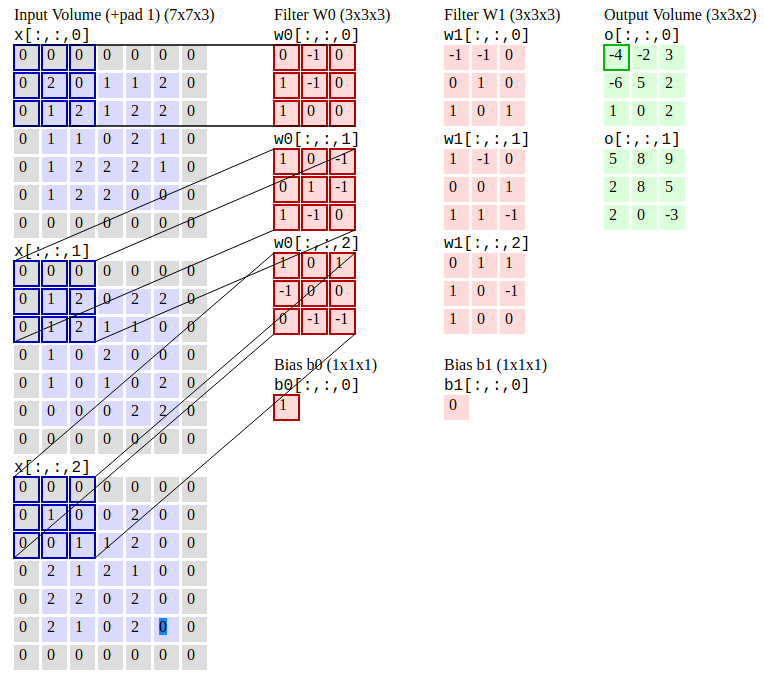
Convolutional Neural Networks. Source:CS231n
Recurrent neural networks (RNNs) is a type of artificial neural network which uses sequential data or time series data.

Recurrent Neural Networks. Source: Slideteam
Multilayer Perceptrons (MLPs) is multi-layer neural networks composed of multiple layers of perceptrons with a threshold activation.

Multilayer Perceptrons. Source: DeepAI
Random forest is a commonly-used machine learning algorithm, which combines the output of multiple decision trees to reach a single result. A decision tree in a forest cannot be pruned for sampling and therefore, prediction selection. Its ease of use and flexibility have fueled its adoption, as it handles both classification and regression problems.

Random forest. Source: wikimedia
Decision trees are tree-structured models for classification and regression.

**Decision Trees. Source: CMU
Naive Bayes is a machine learning algorithm that is used solved calssification problems. It's based on applying Bayes' theorem with strong independence assumptions between the features.

Bayes' theorem. Source:mathisfun
Machine Learning

Learning Resources for ML
Machine Learning is a branch of artificial intelligence (AI) focused on building apps using algorithms that learn from data models and improve their accuracy over time without needing to be programmed.
Machine Learning by Stanford University from Coursera
AWS Training and Certification for Machine Learning (ML) Courses
Machine Learning Scholarship Program for Microsoft Azure from Udacity
Microsoft Certified: Azure Data Scientist Associate
Microsoft Certified: Azure AI Engineer Associate
Azure Machine Learning training and deployment
Learning Machine learning and artificial intelligence from Google Cloud Training
Machine Learning Crash Course for Google Cloud
Scheduling Jupyter notebooks on Amazon SageMaker ephemeral instances
How to run Jupyter Notebooks in your Azure Machine Learning workspace
Machine Learning Courses Online from Udemy
Machine Learning Courses Online from Coursera
Learn Machine Learning with Online Courses and Classes from edX
ML Frameworks, Libraries, and Tools
TensorFlow is an end-to-end open source platform for machine learning. It has a comprehensive, flexible ecosystem of tools, libraries and community resources that lets researchers push the state-of-the-art in ML and developers easily build and deploy ML powered applications.
Keras is a high-level neural networks API, written in Python and capable of running on top of TensorFlow, CNTK, or Theano.It was developed with a focus on enabling fast experimentation. It is capable of running on top of TensorFlow, Microsoft Cognitive Toolkit, R, Theano, or PlaidML.
PyTorch is a library for deep learning on irregular input data such as graphs, point clouds, and manifolds. Primarily developed by Facebook's AI Research lab.
Amazon SageMaker is a fully managed service that provides every developer and data scientist with the ability to build, train, and deploy machine learning (ML) models quickly. SageMaker removes the heavy lifting from each step of the machine learning process to make it easier to develop high quality models.
Azure Databricks is a fast and collaborative Apache Spark-based big data analytics service designed for data science and data engineering. Azure Databricks, sets up your Apache Spark environment in minutes, autoscale, and collaborate on shared projects in an interactive workspace. Azure Databricks supports Python, Scala, R, Java, and SQL, as well as data science frameworks and libraries including TensorFlow, PyTorch, and scikit-learn.
Microsoft Cognitive Toolkit (CNTK) is an open-source toolkit for commercial-grade distributed deep learning. It describes neural networks as a series of computational steps via a directed graph. CNTK allows the user to easily realize and combine popular model types such as feed-forward DNNs, convolutional neural networks (CNNs) and recurrent neural networks (RNNs/LSTMs). CNTK implements stochastic gradient descent (SGD, error backpropagation) learning with automatic differentiation and parallelization across multiple GPUs and servers.
Apple CoreML is a framework that helps integrate machine learning models into your app. Core ML provides a unified representation for all models. Your app uses Core ML APIs and user data to make predictions, and to train or fine-tune models, all on the user's device. A model is the result of applying a machine learning algorithm to a set of training data. You use a model to make predictions based on new input data.
Tensorflow_macOS is a Mac-optimized version of TensorFlow and TensorFlow Addons for macOS 11.0+ accelerated using Apple's ML Compute framework.
Apache OpenNLP is an open-source library for a machine learning based toolkit used in the processing of natural language text. It features an API for use cases like Named Entity Recognition, Sentence Detection, POS(Part-Of-Speech) tagging, Tokenization Feature extraction, Chunking, Parsing, and Coreference resolution.
Apache Airflow is an open-source workflow management platform created by the community to programmatically author, schedule and monitor workflows. Install. Principles. Scalable. Airflow has a modular architecture and uses a message queue to orchestrate an arbitrary number of workers. Airflow is ready to scale to infinity.
Open Neural Network Exchange(ONNX) is an open ecosystem that empowers AI developers to choose the right tools as their project evolves. ONNX provides an open source format for AI models, both deep learning and traditional ML. It defines an extensible computation graph model, as well as definitions of built-in operators and standard data types.
Apache MXNet is a deep learning framework designed for both efficiency and flexibility. It allows you to mix symbolic and imperative programming to maximize efficiency and productivity. At its core, MXNet contains a dynamic dependency scheduler that automatically parallelizes both symbolic and imperative operations on the fly. A graph optimization layer on top of that makes symbolic execution fast and memory efficient. MXNet is portable and lightweight, scaling effectively to multiple GPUs and multiple machines. Support for Python, R, Julia, Scala, Go, Javascript and more.
AutoGluon is toolkit for Deep learning that automates machine learning tasks enabling you to easily achieve strong predictive performance in your applications. With just a few lines of code, you can train and deploy high-accuracy deep learning models on tabular, image, and text data.
Anaconda is a very popular Data Science platform for machine learning and deep learning that enables users to develop models, train them, and deploy them.
PlaidML is an advanced and portable tensor compiler for enabling deep learning on laptops, embedded devices, or other devices where the available computing hardware is not well supported or the available software stack contains unpalatable license restrictions.
OpenCV is a highly optimized library with focus on real-time computer vision applications. The C++, Python, and Java interfaces support Linux, MacOS, Windows, iOS, and Android.
Scikit-Learn is a Python module for machine learning built on top of SciPy, NumPy, and matplotlib, making it easier to apply robust and simple implementations of many popular machine learning algorithms.
Weka is an open source machine learning software that can be accessed through a graphical user interface, standard terminal applications, or a Java API. It is widely used for teaching, research, and industrial applications, contains a plethora of built-in tools for standard machine learning tasks, and additionally gives transparent access to well-known toolboxes such as scikit-learn, R, and Deeplearning4j.
Caffe is a deep learning framework made with expression, speed, and modularity in mind. It is developed by Berkeley AI Research (BAIR)/The Berkeley Vision and Learning Center (BVLC) and community contributors.
Theano is a Python library that allows you to define, optimize, and evaluate mathematical expressions involving multi-dimensional arrays efficiently including tight integration with NumPy.
nGraph is an open source C++ library, compiler and runtime for Deep Learning. The nGraph Compiler aims to accelerate developing AI workloads using any deep learning framework and deploying to a variety of hardware targets.It provides the freedom, performance, and ease-of-use to AI developers.
NVIDIA cuDNN is a GPU-accelerated library of primitives for deep neural networks. cuDNN provides highly tuned implementations for standard routines such as forward and backward convolution, pooling, normalization, and activation layers. cuDNN accelerates widely used deep learning frameworks, including Caffe2, Chainer, Keras, MATLAB, MxNet, PyTorch, and TensorFlow.
Jupyter Notebook is an open-source web application that allows you to create and share documents that contain live code, equations, visualizations and narrative text. Jupyter is used widely in industries that do data cleaning and transformation, numerical simulation, statistical modeling, data visualization, data science, and machine learning.
Apache Spark is a unified analytics engine for large-scale data processing. It provides high-level APIs in Scala, Java, Python, and R, and an optimized engine that supports general computation graphs for data analysis. It also supports a rich set of higher-level tools including Spark SQL for SQL and DataFrames, MLlib for machine learning, GraphX for graph processing, and Structured Streaming for stream processing.
Apache Spark Connector for SQL Server and Azure SQL is a high-performance connector that enables you to use transactional data in big data analytics and persists results for ad-hoc queries or reporting. The connector allows you to use any SQL database, on-premises or in the cloud, as an input data source or output data sink for Spark jobs.
Apache PredictionIO is an open source machine learning framework for developers, data scientists, and end users. It supports event collection, deployment of algorithms, evaluation, querying predictive results via REST APIs. It is based on scalable open source services like Hadoop, HBase (and other DBs), Elasticsearch, Spark and implements what is called a Lambda Architecture.
Cluster Manager for Apache Kafka(CMAK) is a tool for managing Apache Kafka clusters.
BigDL is a distributed deep learning library for Apache Spark. With BigDL, users can write their deep learning applications as standard Spark programs, which can directly run on top of existing Spark or Hadoop clusters.
Eclipse Deeplearning4J (DL4J) is a set of projects intended to support all the needs of a JVM-based(Scala, Kotlin, Clojure, and Groovy) deep learning application. This means starting with the raw data, loading and preprocessing it from wherever and whatever format it is in to building and tuning a wide variety of simple and complex deep learning networks.
Tensorman is a utility for easy management of Tensorflow containers by developed by System76.Tensorman allows Tensorflow to operate in an isolated environment that is contained from the rest of the system. This virtual environment can operate independent of the base system, allowing you to use any version of Tensorflow on any version of a Linux distribution that supports the Docker runtime.
Numba is an open source, NumPy-aware optimizing compiler for Python sponsored by Anaconda, Inc. It uses the LLVM compiler project to generate machine code from Python syntax. Numba can compile a large subset of numerically-focused Python, including many NumPy functions. Additionally, Numba has support for automatic parallelization of loops, generation of GPU-accelerated code, and creation of ufuncs and C callbacks.
Chainer is a Python-based deep learning framework aiming at flexibility. It provides automatic differentiation APIs based on the define-by-run approach (dynamic computational graphs) as well as object-oriented high-level APIs to build and train neural networks. It also supports CUDA/cuDNN using CuPy for high performance training and inference.
XGBoost is an optimized distributed gradient boosting library designed to be highly efficient, flexible and portable. It implements machine learning algorithms under the Gradient Boosting framework. XGBoost provides a parallel tree boosting (also known as GBDT, GBM) that solve many data science problems in a fast and accurate way. It supports distributed training on multiple machines, including AWS, GCE, Azure, and Yarn clusters. Also, it can be integrated with Flink, Spark and other cloud dataflow systems.
cuML is a suite of libraries that implement machine learning algorithms and mathematical primitives functions that share compatible APIs with other RAPIDS projects. cuML enables data scientists, researchers, and software engineers to run traditional tabular ML tasks on GPUs without going into the details of CUDA programming. In most cases, cuML's Python API matches the API from scikit-learn.
Deep Learning Development

Deep Learning Learning Resources
Deep Learning is a subset of machine learning, which is essentially a neural network with three or more layers. These neural networks attempt to simulate the behavior of the human brain,though, far from matching its ability. This allows the neural networks to "learn" from large amounts of data. The Learning can be supervised, semi-supervised or unsupervised.
Deep Learning Online Courses | NVIDIA
Top Deep Learning Courses Online | Coursera
Top Deep Learning Courses Online | Udemy
Learn Deep Learning with Online Courses and Lessons | edX
Deep Learning Online Course Nanodegree | Udacity
Machine Learning Course by Andrew Ng | Coursera
Machine Learning Engineering for Production (MLOps) course by Andrew Ng | Coursera
Data Science: Deep Learning and Neural Networks in Python | Udemy
Understanding Machine Learning with Python | Pluralsight
How to Think About Machine Learning Algorithms | Pluralsight
Deep Learning Courses | Stanford Online
Deep Learning - UW Professional & Continuing Education
Deep Learning Online Courses | Harvard University
Machine Learning for Everyone Courses | DataCamp
Artificial Intelligence Expert Course: Platinum Edition | Udemy
Top Artificial Intelligence Courses Online | Coursera
Learn Artificial Intelligence with Online Courses and Lessons | edX
Professional Certificate in Computer Science for Artificial Intelligence | edX
Artificial Intelligence Nanodegree program
Artificial Intelligence (AI) Online Courses | Udacity
Intro to Artificial Intelligence Course | Udacity
Edge AI for IoT Developers Course | Udacity
Reasoning: Goal Trees and Rule-Based Expert Systems | MIT OpenCourseWare
Expert Systems and Applied Artificial Intelligence
Autonomous Systems - Microsoft AI
Introduction to Microsoft Project Bonsai
Machine teaching with the Microsoft Autonomous Systems platform
Autonomous Maritime Systems Training | AMC Search
Top Autonomous Cars Courses Online | Udemy
Applied Control Systems 1: autonomous cars: Math + PID + MPC | Udemy
Learn Autonomous Robotics with Online Courses and Lessons | edX
Artificial Intelligence Nanodegree program
Autonomous Systems Online Courses & Programs | Udacity
Edge AI for IoT Developers Course | Udacity
Autonomous Systems MOOC and Free Online Courses | MOOC List
Robotics and Autonomous Systems Graduate Program | Standford Online
Mobile Autonomous Systems Laboratory | MIT OpenCourseWare
Deep Learning Tools, Libraries, and Frameworks
NVIDIA cuDNN is a GPU-accelerated library of primitives for deep neural networks. cuDNN provides highly tuned implementations for standard routines such as forward and backward convolution, pooling, normalization, and activation layers. cuDNN accelerates widely used deep learning frameworks, including Caffe2, Chainer, Keras, MATLAB, MxNet, PyTorch, and TensorFlow.
NVIDIA DLSS (Deep Learning Super Sampling) is a temporal image upscaling AI rendering technology that increases graphics performance using dedicated Tensor Core AI processors on GeForce RTX™ GPUs. DLSS uses the power of a deep learning neural network to boost frame rates and generate beautiful, sharp images for your games.
AMD FidelityFX Super Resolution (FSR) is an open source, high-quality solution for producing high resolution frames from lower resolution inputs. It uses a collection of cutting-edge Deep Learning algorithms with a particular emphasis on creating high-quality edges, giving large performance improvements compared to rendering at native resolution directly. FSR enables “practical performance” for costly render operations, such as hardware ray tracing for the AMD RDNA™ and AMD RDNA™ 2 architectures.
Intel Xe Super Sampling (XeSS) is a temporal image upscaling AI rendering technology that increases graphics performance similar to NVIDIA's DLSS (Deep Learning Super Sampling). Intel's Arc GPU architecture (early 2022) will have GPUs that feature dedicated Xe-cores to run XeSS. The GPUs will have Xe Matrix eXtenstions matrix (XMX) engines for hardware-accelerated AI processing. XeSS will be able to run on devices without XMX, including integrated graphics, though, the performance of XeSS will be lower on non-Intel graphics cards because it will be powered by DP4a instruction.
Jupyter Notebook is an open-source web application that allows you to create and share documents that contain live code, equations, visualizations and narrative text. Jupyter is used widely in industries that do data cleaning and transformation, numerical simulation, statistical modeling, data visualization, data science, and machine learning.
Apache Spark is a unified analytics engine for large-scale data processing. It provides high-level APIs in Scala, Java, Python, and R, and an optimized engine that supports general computation graphs for data analysis. It also supports a rich set of higher-level tools including Spark SQL for SQL and DataFrames, MLlib for machine learning, GraphX for graph processing, and Structured Streaming for stream processing.
Apache Spark Connector for SQL Server and Azure SQL is a high-performance connector that enables you to use transactional data in big data analytics and persists results for ad-hoc queries or reporting. The connector allows you to use any SQL database, on-premises or in the cloud, as an input data source or output data sink for Spark jobs.
Apache PredictionIO is an open source machine learning framework for developers, data scientists, and end users. It supports event collection, deployment of algorithms, evaluation, querying predictive results via REST APIs. It is based on scalable open source services like Hadoop, HBase (and other DBs), Elasticsearch, Spark and implements what is called a Lambda Architecture.
Cluster Manager for Apache Kafka(CMAK) is a tool for managing Apache Kafka clusters.
BigDL is a distributed deep learning library for Apache Spark. With BigDL, users can write their deep learning applications as standard Spark programs, which can directly run on top of existing Spark or Hadoop clusters.
Eclipse Deeplearning4J (DL4J) is a set of projects intended to support all the needs of a JVM-based(Scala, Kotlin, Clojure, and Groovy) deep learning application. This means starting with the raw data, loading and preprocessing it from wherever and whatever format it is in to building and tuning a wide variety of simple and complex deep learning networks.
Deep Learning Toolbox™ is a tool that provides a framework for designing and implementing deep neural networks with algorithms, pretrained models, and apps. You can use convolutional neural networks (ConvNets, CNNs) and long short-term memory (LSTM) networks to perform classification and regression on image, time-series, and text data. You can build network architectures such as generative adversarial networks (GANs) and Siamese networks using automatic differentiation, custom training loops, and shared weights. With the Deep Network Designer app, you can design, analyze, and train networks graphically. It can exchange models with TensorFlow™ and PyTorch through the ONNX format and import models from TensorFlow-Keras and Caffe. The toolbox supports transfer learning with DarkNet-53, ResNet-50, NASNet, SqueezeNet and many other pretrained models.
Reinforcement Learning Toolbox™ is a tool that provides an app, functions, and a Simulink® block for training policies using reinforcement learning algorithms, including DQN, PPO, SAC, and DDPG. You can use these policies to implement controllers and decision-making algorithms for complex applications such as resource allocation, robotics, and autonomous systems.
Deep Learning HDL Toolbox™ is a tool that provides functions and tools to prototype and implement deep learning networks on FPGAs and SoCs. It provides pre-built bitstreams for running a variety of deep learning networks on supported Xilinx® and Intel® FPGA and SoC devices. Profiling and estimation tools let you customize a deep learning network by exploring design, performance, and resource utilization tradeoffs.
Parallel Computing Toolbox™ is a tool that lets you solve computationally and data-intensive problems using multicore processors, GPUs, and computer clusters. High-level constructs such as parallel for-loops, special array types, and parallelized numerical algorithms enable you to parallelize MATLAB® applications without CUDA or MPI programming. The toolbox lets you use parallel-enabled functions in MATLAB and other toolboxes. You can use the toolbox with Simulink® to run multiple simulations of a model in parallel. Programs and models can run in both interactive and batch modes.
XGBoost is an optimized distributed gradient boosting library designed to be highly efficient, flexible and portable. It implements machine learning algorithms under the Gradient Boosting framework. XGBoost provides a parallel tree boosting (also known as GBDT, GBM) that solve many data science problems in a fast and accurate way. It supports distributed training on multiple machines, including AWS, GCE, Azure, and Yarn clusters. Also, it can be integrated with Flink, Spark and other cloud dataflow systems.
LIBSVM is an integrated software for support vector classification, (C-SVC, nu-SVC), regression (epsilon-SVR, nu-SVR) and distribution estimation (one-class SVM). It supports multi-class classification.
Scikit-Learn is a simple and efficient tool for data mining and data analysis. It is built on NumPy,SciPy, and mathplotlib.
TensorFlow is an end-to-end open source platform for machine learning. It has a comprehensive, flexible ecosystem of tools, libraries and community resources that lets researchers push the state-of-the-art in ML and developers easily build and deploy ML powered applications.
Keras is a high-level neural networks API, written in Python and capable of running on top of TensorFlow, CNTK, or Theano.It was developed with a focus on enabling fast experimentation. It is capable of running on top of TensorFlow, Microsoft Cognitive Toolkit, R, Theano, or PlaidML.
PyTorch is a library for deep learning on irregular input data such as graphs, point clouds, and manifolds. Primarily developed by Facebook's AI Research lab.
Azure Databricks is a fast and collaborative Apache Spark-based big data analytics service designed for data science and data engineering. Azure Databricks, sets up your Apache Spark environment in minutes, autoscale, and collaborate on shared projects in an interactive workspace. Azure Databricks supports Python, Scala, R, Java, and SQL, as well as data science frameworks and libraries including TensorFlow, PyTorch, and scikit-learn.
Microsoft Cognitive Toolkit (CNTK) is an open-source toolkit for commercial-grade distributed deep learning. It describes neural networks as a series of computational steps via a directed graph. CNTK allows the user to easily realize and combine popular model types such as feed-forward DNNs, convolutional neural networks (CNNs) and recurrent neural networks (RNNs/LSTMs). CNTK implements stochastic gradient descent (SGD, error backpropagation) learning with automatic differentiation and parallelization across multiple GPUs and servers.
Tensorflow_macOS is a Mac-optimized version of TensorFlow and TensorFlow Addons for macOS 11.0+ accelerated using Apple's ML Compute framework.
Apache Airflow is an open-source workflow management platform created by the community to programmatically author, schedule and monitor workflows. Install. Principles. Scalable. Airflow has a modular architecture and uses a message queue to orchestrate an arbitrary number of workers. Airflow is ready to scale to infinity.
Open Neural Network Exchange(ONNX) is an open ecosystem that empowers AI developers to choose the right tools as their project evolves. ONNX provides an open source format for AI models, both deep learning and traditional ML. It defines an extensible computation graph model, as well as definitions of built-in operators and standard data types.
Apache MXNet is a deep learning framework designed for both efficiency and flexibility. It allows you to mix symbolic and imperative programming to maximize efficiency and productivity. At its core, MXNet contains a dynamic dependency scheduler that automatically parallelizes both symbolic and imperative operations on the fly. A graph optimization layer on top of that makes symbolic execution fast and memory efficient. MXNet is portable and lightweight, scaling effectively to multiple GPUs and multiple machines. Support for Python, R, Julia, Scala, Go, Javascript and more.
AutoGluon is toolkit for Deep learning that automates machine learning tasks enabling you to easily achieve strong predictive performance in your applications. With just a few lines of code, you can train and deploy high-accuracy deep learning models on tabular, image, and text data.
Anaconda is a very popular Data Science platform for machine learning and deep learning that enables users to develop models, train them, and deploy them.
PlaidML is an advanced and portable tensor compiler for enabling deep learning on laptops, embedded devices, or other devices where the available computing hardware is not well supported or the available software stack contains unpalatable license restrictions.
OpenCV is a highly optimized library with focus on real-time computer vision applications. The C++, Python, and Java interfaces support Linux, MacOS, Windows, iOS, and Android.
Scikit-Learn is a Python module for machine learning built on top of SciPy, NumPy, and matplotlib, making it easier to apply robust and simple implementations of many popular machine learning algorithms.
Weka is an open source machine learning software that can be accessed through a graphical user interface, standard terminal applications, or a Java API. It is widely used for teaching, research, and industrial applications, contains a plethora of built-in tools for standard machine learning tasks, and additionally gives transparent access to well-known toolboxes such as scikit-learn, R, and Deeplearning4j.
Caffe is a deep learning framework made with expression, speed, and modularity in mind. It is developed by Berkeley AI Research (BAIR)/The Berkeley Vision and Learning Center (BVLC) and community contributors.
Theano is a Python library that allows you to define, optimize, and evaluate mathematical expressions involving multi-dimensional arrays efficiently including tight integration with NumPy.
Microsoft Project Bonsai is a low-code AI platform that speeds AI-powered automation development and part of the Autonomous Systems suite from Microsoft. Bonsai is used to build AI components that can provide operator guidance or make independent decisions to optimize process variables, improve production efficiency, and reduce downtime.
Microsoft AirSim is a simulator for drones, cars and more, built on Unreal Engine (with an experimental Unity release). AirSim is open-source, cross platform, and supports software-in-the-loop simulation with popular flight controllers such as PX4 & ArduPilot and hardware-in-loop with PX4 for physically and visually realistic simulations. It is developed as an Unreal plugin that can simply be dropped into any Unreal environment. AirSim is being developed as a platform for AI research to experiment with deep learning, computer vision and reinforcement learning algorithms for autonomous vehicles.
CARLA is an open-source simulator for autonomous driving research. CARLA has been developed from the ground up to support development, training, and validation of autonomous driving systems. In addition to open-source code and protocols, CARLA provides open digital assets (urban layouts, buildings, vehicles) that were created for this purpose and can be used freely.
ROS/ROS2 bridge for CARLA(package) is a bridge that enables two-way communication between ROS and CARLA. The information from the CARLA server is translated to ROS topics. In the same way, the messages sent between nodes in ROS get translated to commands to be applied in CARLA.
ROS Toolbox is a tool that provides an interface connecting MATLAB® and Simulink® with the Robot Operating System (ROS and ROS 2), enabling you to create a network of ROS nodes. The toolbox includes MATLAB functions and Simulink blocks to import, analyze, and play back ROS data recorded in rosbag files. You can also connect to a live ROS network to access ROS messages.
Robotics Toolbox™ provides a toolbox that brings robotics specific functionality(designing, simulating, and testing manipulators, mobile robots, and humanoid robots) to MATLAB, exploiting the native capabilities of MATLAB (linear algebra, portability, graphics). The toolbox also supports mobile robots with functions for robot motion models (bicycle), path planning algorithms (bug, distance transform, D*, PRM), kinodynamic planning (lattice, RRT), localization (EKF, particle filter), map building (EKF) and simultaneous localization and mapping (EKF), and a Simulink model a of non-holonomic vehicle. The Toolbox also including a detailed Simulink model for a quadrotor flying robot.
Image Processing Toolbox™ is a tool that provides a comprehensive set of reference-standard algorithms and workflow apps for image processing, analysis, visualization, and algorithm development. You can perform image segmentation, image enhancement, noise reduction, geometric transformations, image registration, and 3D image processing.
Computer Vision Toolbox™ is a tool that provides algorithms, functions, and apps for designing and testing computer vision, 3D vision, and video processing systems. You can perform object detection and tracking, as well as feature detection, extraction, and matching. You can automate calibration workflows for single, stereo, and fisheye cameras. For 3D vision, the toolbox supports visual and point cloud SLAM, stereo vision, structure from motion, and point cloud processing.
Robotics Toolbox™ is a tool that provides a toolbox that brings robotics specific functionality(designing, simulating, and testing manipulators, mobile robots, and humanoid robots) to MATLAB, exploiting the native capabilities of MATLAB (linear algebra, portability, graphics). The toolbox also supports mobile robots with functions for robot motion models (bicycle), path planning algorithms (bug, distance transform, D*, PRM), kinodynamic planning (lattice, RRT), localization (EKF, particle filter), map building (EKF) and simultaneous localization and mapping (EKF), and a Simulink model a of non-holonomic vehicle. The Toolbox also including a detailed Simulink model for a quadrotor flying robot.
Model Predictive Control Toolbox™ is a tool that provides functions, an app, and Simulink® blocks for designing and simulating controllers using linear and nonlinear model predictive control (MPC). The toolbox lets you specify plant and disturbance models, horizons, constraints, and weights. By running closed-loop simulations, you can evaluate controller performance.
Predictive Maintenance Toolbox™ is a tool that lets you manage sensor data, design condition indicators, and estimate the remaining useful life (RUL) of a machine. The toolbox provides functions and an interactive app for exploring, extracting, and ranking features using data-based and model-based techniques, including statistical, spectral, and time-series analysis.
Vision HDL Toolbox™ is a tool that provides pixel-streaming algorithms for the design and implementation of vision systems on FPGAs and ASICs. It provides a design framework that supports a diverse set of interface types, frame sizes, and frame rates. The image processing, video, and computer vision algorithms in the toolbox use an architecture appropriate for HDL implementations.
Automated Driving Toolbox™ is a MATLAB tool that provides algorithms and tools for designing, simulating, and testing ADAS and autonomous driving systems. You can design and test vision and lidar perception systems, as well as sensor fusion, path planning, and vehicle controllers. Visualization tools include a bird’s-eye-view plot and scope for sensor coverage, detections and tracks, and displays for video, lidar, and maps. The toolbox lets you import and work with HERE HD Live Map data and OpenDRIVE® road networks. It also provides reference application examples for common ADAS and automated driving features, including FCW, AEB, ACC, LKA, and parking valet. The toolbox supports C/C++ code generation for rapid prototyping and HIL testing, with support for sensor fusion, tracking, path planning, and vehicle controller algorithms.
UAV Toolbox is an application that provides tools and reference applications for designing, simulating, testing, and deploying unmanned aerial vehicle (UAV) and drone applications. You can design autonomous flight algorithms, UAV missions, and flight controllers. The Flight Log Analyzer app lets you interactively analyze 3D flight paths, telemetry information, and sensor readings from common flight log formats.
Navigation Toolbox™ is a tool that provides algorithms and analysis tools for motion planning, simultaneous localization and mapping (SLAM), and inertial navigation. The toolbox includes customizable search and sampling-based path planners, as well as metrics for validating and comparing paths. You can create 2D and 3D map representations, generate maps using SLAM algorithms, and interactively visualize and debug map generation with the SLAM map builder app.
Lidar Toolbox™ is a tool that provides algorithms, functions, and apps for designing, analyzing, and testing lidar processing systems. You can perform object detection and tracking, semantic segmentation, shape fitting, lidar registration, and obstacle detection. Lidar Toolbox supports lidar-camera cross calibration for workflows that combine computer vision and lidar processing.
Mapping Toolbox™ is a tool that provides algorithms and functions for transforming geographic data and creating map displays. You can visualize your data in a geographic context, build map displays from more than 60 map projections, and transform data from a variety of sources into a consistent geographic coordinate system.
Reinforcement Learning Development
Reinforcement Learning Learning Resources
Reinforcement Learning is a subset of machine learning, which is a neural network with three or more layers. These neural networks attempt to simulate the behavior of the human brain,though, far from matching its ability. This allows the neural networks to "learn" from a process in which a model learns to become more accurate for performing an action in an environment based on feedback in order to maximize the reward. The Learning can be supervised, semi-supervised or unsupervised.
Top Reinforcement Learning Courses | Coursera
Top Reinforcement Learning Courses | Udemy
Top Reinforcement Learning Courses | Udacity
Reinforcement Learning Courses | Stanford Online
Deep Learning Online Courses | NVIDIA
Top Deep Learning Courses Online | Coursera
Top Deep Learning Courses Online | Udemy
Learn Deep Learning with Online Courses and Lessons | edX
Deep Learning Online Course Nanodegree | Udacity
Machine Learning Course by Andrew Ng | Coursera
Machine Learning Engineering for Production (MLOps) course by Andrew Ng | Coursera
Data Science: Deep Learning and Neural Networks in Python | Udemy
Understanding Machine Learning with Python | Pluralsight
How to Think About Machine Learning Algorithms | Pluralsight
Deep Learning Courses | Stanford Online
Deep Learning - UW Professional & Continuing Education
Deep Learning Online Courses | Harvard University
Machine Learning for Everyone Courses | DataCamp
Artificial Intelligence Expert Course: Platinum Edition | Udemy
Top Artificial Intelligence Courses Online | Coursera
Learn Artificial Intelligence with Online Courses and Lessons | edX
Professional Certificate in Computer Science for Artificial Intelligence | edX
Artificial Intelligence Nanodegree program
Artificial Intelligence (AI) Online Courses | Udacity
Intro to Artificial Intelligence Course | Udacity
Edge AI for IoT Developers Course | Udacity
Reasoning: Goal Trees and Rule-Based Expert Systems | MIT OpenCourseWare
Expert Systems and Applied Artificial Intelligence
Autonomous Systems - Microsoft AI
Introduction to Microsoft Project Bonsai
Machine teaching with the Microsoft Autonomous Systems platform
Autonomous Maritime Systems Training | AMC Search
Top Autonomous Cars Courses Online | Udemy
Applied Control Systems 1: autonomous cars: Math + PID + MPC | Udemy
Learn Autonomous Robotics with Online Courses and Lessons | edX
Artificial Intelligence Nanodegree program
Autonomous Systems Online Courses & Programs | Udacity
Edge AI for IoT Developers Course | Udacity
Autonomous Systems MOOC and Free Online Courses | MOOC List
Robotics and Autonomous Systems Graduate Program | Standford Online
Mobile Autonomous Systems Laboratory | MIT OpenCourseWare
Reinforcement Learning Tools, Libraries, and Frameworks
OpenAI is an open source Python library for developing and comparing reinforcement learning algorithms by providing a standard API to communicate between learning algorithms and environments, as well as a standard set of environments compliant with that API.
ReinforcementLearning.jl is a collection of tools for doing reinforcement learning research in Julia.
Reinforcement Learning Toolbox™ is a tool that provides an app, functions, and a Simulink® block for training policies using reinforcement learning algorithms, including DQN, PPO, SAC, and DDPG. You can use these policies to implement controllers and decision-making algorithms for complex applications such as resource allocation, robotics, and autonomous systems.
Amazon SageMaker is a fully managed service that provides every developer and data scientist with the ability to build, train, and deploy machine learning (ML) models quickly.
AWS RoboMaker is a service that provides a fully-managed, scalable infrastructure for simulation that customers use for multi-robot simulation and CI/CD integration with regression testing in simulation.
TensorFlow is an end-to-end open source platform for machine learning. It has a comprehensive, flexible ecosystem of tools, libraries and community resources that lets researchers push the state-of-the-art in ML and developers easily build and deploy ML powered applications.
Keras is a high-level neural networks API, written in Python and capable of running on top of TensorFlow, CNTK, or Theano.It was developed with a focus on enabling fast experimentation. It is capable of running on top of TensorFlow, Microsoft Cognitive Toolkit, R, Theano, or PlaidML.
PyTorch is a library for deep learning on irregular input data such as graphs, point clouds, and manifolds. Primarily developed by Facebook's AI Research lab.
Scikit-Learn is a simple and efficient tool for data mining and data analysis. It is built on NumPy,SciPy, and mathplotlib.
NVIDIA cuDNN is a GPU-accelerated library of primitives for deep neural networks. cuDNN provides highly tuned implementations for standard routines such as forward and backward convolution, pooling, normalization, and activation layers. cuDNN accelerates widely used deep learning frameworks, including Caffe2, Chainer, Keras, MATLAB, MxNet, PyTorch, and TensorFlow.
Jupyter Notebook is an open-source web application that allows you to create and share documents that contain live code, equations, visualizations and narrative text. Jupyter is used widely in industries that do data cleaning and transformation, numerical simulation, statistical modeling, data visualization, data science, and machine learning.
Apache Spark is a unified analytics engine for large-scale data processing. It provides high-level APIs in Scala, Java, Python, and R, and an optimized engine that supports general computation graphs for data analysis. It also supports a rich set of higher-level tools including Spark SQL for SQL and DataFrames, MLlib for machine learning, GraphX for graph processing, and Structured Streaming for stream processing.
Apache Spark Connector for SQL Server and Azure SQL is a high-performance connector that enables you to use transactional data in big data analytics and persists results for ad-hoc queries or reporting. The connector allows you to use any SQL database, on-premises or in the cloud, as an input data source or output data sink for Spark jobs.
Apache PredictionIO is an open source machine learning framework for developers, data scientists, and end users. It supports event collection, deployment of algorithms, evaluation, querying predictive results via REST APIs. It is based on scalable open source services like Hadoop, HBase (and other DBs), Elasticsearch, Spark and implements what is called a Lambda Architecture.
Cluster Manager for Apache Kafka(CMAK) is a tool for managing Apache Kafka clusters.
BigDL is a distributed deep learning library for Apache Spark. With BigDL, users can write their deep learning applications as standard Spark programs, which can directly run on top of existing Spark or Hadoop clusters.
Eclipse Deeplearning4J (DL4J) is a set of projects intended to support all the needs of a JVM-based(Scala, Kotlin, Clojure, and Groovy) deep learning application. This means starting with the raw data, loading and preprocessing it from wherever and whatever format it is in to building and tuning a wide variety of simple and complex deep learning networks.
Deep Learning Toolbox™ is a tool that provides a framework for designing and implementing deep neural networks with algorithms, pretrained models, and apps. You can use convolutional neural networks (ConvNets, CNNs) and long short-term memory (LSTM) networks to perform classification and regression on image, time-series, and text data. You can build network architectures such as generative adversarial networks (GANs) and Siamese networks using automatic differentiation, custom training loops, and shared weights. With the Deep Network Designer app, you can design, analyze, and train networks graphically. It can exchange models with TensorFlow™ and PyTorch through the ONNX format and import models from TensorFlow-Keras and Caffe. The toolbox supports transfer learning with DarkNet-53, ResNet-50, NASNet, SqueezeNet and many other pretrained models.
Deep Learning HDL Toolbox™ is a tool that provides functions and tools to prototype and implement deep learning networks on FPGAs and SoCs. It provides pre-built bitstreams for running a variety of deep learning networks on supported Xilinx® and Intel® FPGA and SoC devices. Profiling and estimation tools let you customize a deep learning network by exploring design, performance, and resource utilization tradeoffs.
Parallel Computing Toolbox™ is a tool that lets you solve computationally and data-intensive problems using multicore processors, GPUs, and computer clusters. High-level constructs such as parallel for-loops, special array types, and parallelized numerical algorithms enable you to parallelize MATLAB® applications without CUDA or MPI programming. The toolbox lets you use parallel-enabled functions in MATLAB and other toolboxes. You can use the toolbox with Simulink® to run multiple simulations of a model in parallel. Programs and models can run in both interactive and batch modes.
XGBoost is an optimized distributed gradient boosting library designed to be highly efficient, flexible and portable. It implements machine learning algorithms under the Gradient Boosting framework. XGBoost provides a parallel tree boosting (also known as GBDT, GBM) that solve many data science problems in a fast and accurate way. It supports distributed training on multiple machines, including AWS, GCE, Azure, and Yarn clusters. Also, it can be integrated with Flink, Spark and other cloud dataflow systems.
LIBSVM is an integrated software for support vector classification, (C-SVC, nu-SVC), regression (epsilon-SVR, nu-SVR) and distribution estimation (one-class SVM). It supports multi-class classification.
Azure Databricks is a fast and collaborative Apache Spark-based big data analytics service designed for data science and data engineering. Azure Databricks, sets up your Apache Spark environment in minutes, autoscale, and collaborate on shared projects in an interactive workspace. Azure Databricks supports Python, Scala, R, Java, and SQL, as well as data science frameworks and libraries including TensorFlow, PyTorch, and scikit-learn.
Microsoft Cognitive Toolkit (CNTK) is an open-source toolkit for commercial-grade distributed deep learning. It describes neural networks as a series of computational steps via a directed graph. CNTK allows the user to easily realize and combine popular model types such as feed-forward DNNs, convolutional neural networks (CNNs) and recurrent neural networks (RNNs/LSTMs). CNTK implements stochastic gradient descent (SGD, error backpropagation) learning with automatic differentiation and parallelization across multiple GPUs and servers.
Tensorflow_macOS is a Mac-optimized version of TensorFlow and TensorFlow Addons for macOS 11.0+ accelerated using Apple's ML Compute framework.
Apache Airflow is an open-source workflow management platform created by the community to programmatically author, schedule and monitor workflows. Install. Principles. Scalable. Airflow has a modular architecture and uses a message queue to orchestrate an arbitrary number of workers. Airflow is ready to scale to infinity.
Open Neural Network Exchange(ONNX) is an open ecosystem that empowers AI developers to choose the right tools as their project evolves. ONNX provides an open source format for AI models, both deep learning and traditional ML. It defines an extensible computation graph model, as well as definitions of built-in operators and standard data types.
Apache MXNet is a deep learning framework designed for both efficiency and flexibility. It allows you to mix symbolic and imperative programming to maximize efficiency and productivity. At its core, MXNet contains a dynamic dependency scheduler that automatically parallelizes both symbolic and imperative operations on the fly. A graph optimization layer on top of that makes symbolic execution fast and memory efficient. MXNet is portable and lightweight, scaling effectively to multiple GPUs and multiple machines. Support for Python, R, Julia, Scala, Go, Javascript and more.
AutoGluon is toolkit for Deep learning that automates machine learning tasks enabling you to easily achieve strong predictive performance in your applications. With just a few lines of code, you can train and deploy high-accuracy deep learning models on tabular, image, and text data.
Anaconda is a very popular Data Science platform for machine learning and deep learning that enables users to develop models, train them, and deploy them.
PlaidML is an advanced and portable tensor compiler for enabling deep learning on laptops, embedded devices, or other devices where the available computing hardware is not well supported or the available software stack contains unpalatable license restrictions.
OpenCV is a highly optimized library with focus on real-time computer vision applications. The C++, Python, and Java interfaces support Linux, MacOS, Windows, iOS, and Android.
Scikit-Learn is a Python module for machine learning built on top of SciPy, NumPy, and matplotlib, making it easier to apply robust and simple implementations of many popular machine learning algorithms.
Weka is an open source machine learning software that can be accessed through a graphical user interface, standard terminal applications, or a Java API. It is widely used for teaching, research, and industrial applications, contains a plethora of built-in tools for standard machine learning tasks, and additionally gives transparent access to well-known toolboxes such as scikit-learn, R, and Deeplearning4j.
Caffe is a deep learning framework made with expression, speed, and modularity in mind. It is developed by Berkeley AI Research (BAIR)/The Berkeley Vision and Learning Center (BVLC) and community contributors.
Theano is a Python library that allows you to define, optimize, and evaluate mathematical expressions involving multi-dimensional arrays efficiently including tight integration with NumPy.
Microsoft Project Bonsai is a low-code AI platform that speeds AI-powered automation development and part of the Autonomous Systems suite from Microsoft. Bonsai is used to build AI components that can provide operator guidance or make independent decisions to optimize process variables, improve production efficiency, and reduce downtime.
Microsoft AirSim is a simulator for drones, cars and more, built on Unreal Engine (with an experimental Unity release). AirSim is open-source, cross platform, and supports software-in-the-loop simulation with popular flight controllers such as PX4 & ArduPilot and hardware-in-loop with PX4 for physically and visually realistic simulations. It is developed as an Unreal plugin that can simply be dropped into any Unreal environment. AirSim is being developed as a platform for AI research to experiment with deep learning, computer vision and reinforcement learning algorithms for autonomous vehicles.
CARLA is an open-source simulator for autonomous driving research. CARLA has been developed from the ground up to support development, training, and validation of autonomous driving systems. In addition to open-source code and protocols, CARLA provides open digital assets (urban layouts, buildings, vehicles) that were created for this purpose and can be used freely.
ROS/ROS2 bridge for CARLA(package) is a bridge that enables two-way communication between ROS and CARLA. The information from the CARLA server is translated to ROS topics. In the same way, the messages sent between nodes in ROS get translated to commands to be applied in CARLA.
ROS Toolbox is a tool that provides an interface connecting MATLAB® and Simulink® with the Robot Operating System (ROS and ROS 2), enabling you to create a network of ROS nodes. The toolbox includes MATLAB functions and Simulink blocks to import, analyze, and play back ROS data recorded in rosbag files. You can also connect to a live ROS network to access ROS messages.
Robotics Toolbox™ provides a toolbox that brings robotics specific functionality(designing, simulating, and testing manipulators, mobile robots, and humanoid robots) to MATLAB, exploiting the native capabilities of MATLAB (linear algebra, portability, graphics). The toolbox also supports mobile robots with functions for robot motion models (bicycle), path planning algorithms (bug, distance transform, D*, PRM), kinodynamic planning (lattice, RRT), localization (EKF, particle filter), map building (EKF) and simultaneous localization and mapping (EKF), and a Simulink model a of non-holonomic vehicle. The Toolbox also including a detailed Simulink model for a quadrotor flying robot.
Image Processing Toolbox™ is a tool that provides a comprehensive set of reference-standard algorithms and workflow apps for image processing, analysis, visualization, and algorithm development. You can perform image segmentation, image enhancement, noise reduction, geometric transformations, image registration, and 3D image processing.
Computer Vision Toolbox™ is a tool that provides algorithms, functions, and apps for designing and testing computer vision, 3D vision, and video processing systems. You can perform object detection and tracking, as well as feature detection, extraction, and matching. You can automate calibration workflows for single, stereo, and fisheye cameras. For 3D vision, the toolbox supports visual and point cloud SLAM, stereo vision, structure from motion, and point cloud processing.
Robotics Toolbox™ is a tool that provides a toolbox that brings robotics specific functionality(designing, simulating, and testing manipulators, mobile robots, and humanoid robots) to MATLAB, exploiting the native capabilities of MATLAB (linear algebra, portability, graphics). The toolbox also supports mobile robots with functions for robot motion models (bicycle), path planning algorithms (bug, distance transform, D*, PRM), kinodynamic planning (lattice, RRT), localization (EKF, particle filter), map building (EKF) and simultaneous localization and mapping (EKF), and a Simulink model a of non-holonomic vehicle. The Toolbox also including a detailed Simulink model for a quadrotor flying robot.
Model Predictive Control Toolbox™ is a tool that provides functions, an app, and Simulink® blocks for designing and simulating controllers using linear and nonlinear model predictive control (MPC). The toolbox lets you specify plant and disturbance models, horizons, constraints, and weights. By running closed-loop simulations, you can evaluate controller performance.
Predictive Maintenance Toolbox™ is a tool that lets you manage sensor data, design condition indicators, and estimate the remaining useful life (RUL) of a machine. The toolbox provides functions and an interactive app for exploring, extracting, and ranking features using data-based and model-based techniques, including statistical, spectral, and time-series analysis.
Vision HDL Toolbox™ is a tool that provides pixel-streaming algorithms for the design and implementation of vision systems on FPGAs and ASICs. It provides a design framework that supports a diverse set of interface types, frame sizes, and frame rates. The image processing, video, and computer vision algorithms in the toolbox use an architecture appropriate for HDL implementations.
Automated Driving Toolbox™ is a MATLAB tool that provides algorithms and tools for designing, simulating, and testing ADAS and autonomous driving systems. You can design and test vision and lidar perception systems, as well as sensor fusion, path planning, and vehicle controllers. Visualization tools include a bird’s-eye-view plot and scope for sensor coverage, detections and tracks, and displays for video, lidar, and maps. The toolbox lets you import and work with HERE HD Live Map data and OpenDRIVE® road networks. It also provides reference application examples for common ADAS and automated driving features, including FCW, AEB, ACC, LKA, and parking valet. The toolbox supports C/C++ code generation for rapid prototyping and HIL testing, with support for sensor fusion, tracking, path planning, and vehicle controller algorithms.
Navigation Toolbox™ is a tool that provides algorithms and analysis tools for motion planning, simultaneous localization and mapping (SLAM), and inertial navigation. The toolbox includes customizable search and sampling-based path planners, as well as metrics for validating and comparing paths. You can create 2D and 3D map representations, generate maps using SLAM algorithms, and interactively visualize and debug map generation with the SLAM map builder app.
UAV Toolbox is an application that provides tools and reference applications for designing, simulating, testing, and deploying unmanned aerial vehicle (UAV) and drone applications. You can design autonomous flight algorithms, UAV missions, and flight controllers. The Flight Log Analyzer app lets you interactively analyze 3D flight paths, telemetry information, and sensor readings from common flight log formats.
Lidar Toolbox™ is a tool that provides algorithms, functions, and apps for designing, analyzing, and testing lidar processing systems. You can perform object detection and tracking, semantic segmentation, shape fitting, lidar registration, and obstacle detection. Lidar Toolbox supports lidar-camera cross calibration for workflows that combine computer vision and lidar processing.
Mapping Toolbox™ is a tool that provides algorithms and functions for transforming geographic data and creating map displays. You can visualize your data in a geographic context, build map displays from more than 60 map projections, and transform data from a variety of sources into a consistent geographic coordinate system.
Computer Vision Development

Computer Vision Learning Resources
Computer Vision is a field of Artificial Intelligence (AI) that focuses on enabling computers to identify and understand objects and people in images and videos.
Exploring Computer Vision in Microsoft Azure
Top Computer Vision Courses Online | Coursera
Top Computer Vision Courses Online | Udemy
Learn Computer Vision with Online Courses and Lessons | edX
Computer Vision and Image Processing Fundamentals | edX
Introduction to Computer Vision Courses | Udacity
Computer Vision Nanodegree program | Udacity
Machine Vision Course |MIT Open Courseware
Computer Vision Training Courses | NobleProg
Visual Computing Graduate Program | Stanford Online
Computer Vision Tools, Libraries, and Frameworks
OpenCV is a highly optimized library with focus on real-time computer vision applications. The C++, Python, and Java interfaces support Linux, MacOS, Windows, iOS, and Android.
Microsoft Cognitive Toolkit (CNTK) is an open-source toolkit for commercial-grade distributed deep learning. It describes neural networks as a series of computational steps via a directed graph. CNTK allows the user to easily realize and combine popular model types such as feed-forward DNNs, convolutional neural networks (CNNs) and recurrent neural networks (RNNs/LSTMs). CNTK implements stochastic gradient descent (SGD, error backpropagation) learning with automatic differentiation and parallelization across multiple GPUs and servers.
Scikit-Learn is a Python module for machine learning built on top of SciPy, NumPy, and matplotlib, making it easier to apply robust and simple implementations of many popular machine learning algorithms.
NVIDIA cuDNN is a GPU-accelerated library of primitives for deep neural networks. cuDNN provides highly tuned implementations for standard routines such as forward and backward convolution, pooling, normalization, and activation layers. cuDNN accelerates widely used deep learning frameworks, including Caffe2, Chainer, Keras, MATLAB, MxNet, PyTorch, and TensorFlow.
Automated Driving Toolbox™ is a MATLAB tool that provides algorithms and tools for designing, simulating, and testing ADAS and autonomous driving systems. You can design and test vision and lidar perception systems, as well as sensor fusion, path planning, and vehicle controllers. Visualization tools include a bird’s-eye-view plot and scope for sensor coverage, detections and tracks, and displays for video, lidar, and maps. The toolbox lets you import and work with HERE HD Live Map data and OpenDRIVE® road networks. It also provides reference application examples for common ADAS and automated driving features, including FCW, AEB, ACC, LKA, and parking valet. The toolbox supports C/C++ code generation for rapid prototyping and HIL testing, with support for sensor fusion, tracking, path planning, and vehicle controller algorithms.
LRSLibrary is a Low-Rank and Sparse Tools for Background Modeling and Subtraction in Videos. The library was designed for moving object detection in videos, but it can be also used for other computer vision and machine learning problems.
Image Processing Toolbox™ is a tool that provides a comprehensive set of reference-standard algorithms and workflow apps for image processing, analysis, visualization, and algorithm development. You can perform image segmentation, image enhancement, noise reduction, geometric transformations, image registration, and 3D image processing.
Computer Vision Toolbox™ is a tool that provides algorithms, functions, and apps for designing and testing computer vision, 3D vision, and video processing systems. You can perform object detection and tracking, as well as feature detection, extraction, and matching. You can automate calibration workflows for single, stereo, and fisheye cameras. For 3D vision, the toolbox supports visual and point cloud SLAM, stereo vision, structure from motion, and point cloud processing.
Statistics and Machine Learning Toolbox™ is a tool that provides functions and apps to describe, analyze, and model data. You can use descriptive statistics, visualizations, and clustering for exploratory data analysis; fit probability distributions to data; generate random numbers for Monte Carlo simulations, and perform hypothesis tests. Regression and classification algorithms let you draw inferences from data and build predictive models either interactively, using the Classification and Regression Learner apps, or programmatically, using AutoML.
Lidar Toolbox™ is a tool that provides algorithms, functions, and apps for designing, analyzing, and testing lidar processing systems. You can perform object detection and tracking, semantic segmentation, shape fitting, lidar registration, and obstacle detection. Lidar Toolbox supports lidar-camera cross calibration for workflows that combine computer vision and lidar processing.
Mapping Toolbox™ is a tool that provides algorithms and functions for transforming geographic data and creating map displays. You can visualize your data in a geographic context, build map displays from more than 60 map projections, and transform data from a variety of sources into a consistent geographic coordinate system.
UAV Toolbox is an application that provides tools and reference applications for designing, simulating, testing, and deploying unmanned aerial vehicle (UAV) and drone applications. You can design autonomous flight algorithms, UAV missions, and flight controllers. The Flight Log Analyzer app lets you interactively analyze 3D flight paths, telemetry information, and sensor readings from common flight log formats.
Parallel Computing Toolbox™ is a tool that lets you solve computationally and data-intensive problems using multicore processors, GPUs, and computer clusters. High-level constructs such as parallel for-loops, special array types, and parallelized numerical algorithms enable you to parallelize MATLAB® applications without CUDA or MPI programming. The toolbox lets you use parallel-enabled functions in MATLAB and other toolboxes. You can use the toolbox with Simulink® to run multiple simulations of a model in parallel. Programs and models can run in both interactive and batch modes.
Partial Differential Equation Toolbox™ is a tool that provides functions for solving structural mechanics, heat transfer, and general partial differential equations (PDEs) using finite element analysis.
ROS Toolbox is a tool that provides an interface connecting MATLAB® and Simulink® with the Robot Operating System (ROS and ROS 2), enabling you to create a network of ROS nodes. The toolbox includes MATLAB functions and Simulink blocks to import, analyze, and play back ROS data recorded in rosbag files. You can also connect to a live ROS network to access ROS messages.
Robotics Toolbox™ provides a toolbox that brings robotics specific functionality(designing, simulating, and testing manipulators, mobile robots, and humanoid robots) to MATLAB, exploiting the native capabilities of MATLAB (linear algebra, portability, graphics). The toolbox also supports mobile robots with functions for robot motion models (bicycle), path planning algorithms (bug, distance transform, D*, PRM), kinodynamic planning (lattice, RRT), localization (EKF, particle filter), map building (EKF) and simultaneous localization and mapping (EKF), and a Simulink model a of non-holonomic vehicle. The Toolbox also including a detailed Simulink model for a quadrotor flying robot.
Deep Learning Toolbox™ is a tool that provides a framework for designing and implementing deep neural networks with algorithms, pretrained models, and apps. You can use convolutional neural networks (ConvNets, CNNs) and long short-term memory (LSTM) networks to perform classification and regression on image, time-series, and text data. You can build network architectures such as generative adversarial networks (GANs) and Siamese networks using automatic differentiation, custom training loops, and shared weights. With the Deep Network Designer app, you can design, analyze, and train networks graphically. It can exchange models with TensorFlow™ and PyTorch through the ONNX format and import models from TensorFlow-Keras and Caffe. The toolbox supports transfer learning with DarkNet-53, ResNet-50, NASNet, SqueezeNet and many other pretrained models.
Reinforcement Learning Toolbox™ is a tool that provides an app, functions, and a Simulink® block for training policies using reinforcement learning algorithms, including DQN, PPO, SAC, and DDPG. You can use these policies to implement controllers and decision-making algorithms for complex applications such as resource allocation, robotics, and autonomous systems.
Deep Learning HDL Toolbox™ is a tool that provides functions and tools to prototype and implement deep learning networks on FPGAs and SoCs. It provides pre-built bitstreams for running a variety of deep learning networks on supported Xilinx® and Intel® FPGA and SoC devices. Profiling and estimation tools let you customize a deep learning network by exploring design, performance, and resource utilization tradeoffs.
Model Predictive Control Toolbox™ is a tool that provides functions, an app, and Simulink® blocks for designing and simulating controllers using linear and nonlinear model predictive control (MPC). The toolbox lets you specify plant and disturbance models, horizons, constraints, and weights. By running closed-loop simulations, you can evaluate controller performance.
Vision HDL Toolbox™ is a tool that provides pixel-streaming algorithms for the design and implementation of vision systems on FPGAs and ASICs. It provides a design framework that supports a diverse set of interface types, frame sizes, and frame rates. The image processing, video, and computer vision algorithms in the toolbox use an architecture appropriate for HDL implementations.
Data Acquisition Toolbox™ is a tool that provides apps and functions for configuring data acquisition hardware, reading data into MATLAB® and Simulink®, and writing data to DAQ analog and digital output channels. The toolbox supports a variety of DAQ hardware, including USB, PCI, PCI Express®, PXI®, and PXI Express® devices, from National Instruments® and other vendors.
Microsoft AirSim is a simulator for drones, cars and more, built on Unreal Engine (with an experimental Unity release). AirSim is open-source, cross platform, and supports software-in-the-loop simulation with popular flight controllers such as PX4 & ArduPilot and hardware-in-loop with PX4 for physically and visually realistic simulations. It is developed as an Unreal plugin that can simply be dropped into any Unreal environment. AirSim is being developed as a platform for AI research to experiment with deep learning, computer vision and reinforcement learning algorithms for autonomous vehicles.
NLP Development

NLP Learning Resources
Natural Language Processing (NLP) is a branch of artificial intelligence (AI) focused on giving computers the ability to understand text and spoken words in much the same way human beings can. NLP combines computational linguistics rule-based modeling of human language with statistical, machine learning, and deep learning models.
Natural Language Processing With Python's NLTK Package
Cognitive Services—APIs for AI Developers | Microsoft Azure
Artificial Intelligence Services - Amazon Web Services (AWS)
Google Cloud Natural Language API
Top Natural Language Processing Courses Online | Udemy
Introduction to Natural Language Processing (NLP) | Udemy
Top Natural Language Processing Courses | Coursera
Natural Language Processing | Coursera
Natural Language Processing in TensorFlow | Coursera
Learn Natural Language Processing with Online Courses and Lessons | edX
Build a Natural Language Processing Solution with Microsoft Azure | Pluralsight
Natural Language Processing (NLP) Training Courses | NobleProg
Natural Language Processing with Deep Learning Course | Standford Online
Advanced Natural Language Processing - MIT OpenCourseWare
Certified Natural Language Processing Expert Certification | IABAC
Natural Language Processing Course - Intel
NLP Tools, Libraries, and Frameworks
Natural Language Toolkit (NLTK) is a leading platform for