Symbiotic AI
Your AI's context should belong to you, not a platform. Symbiotic AI keeps it in plain files you own.
Your identity, commitments, and current direction live in a handful of Markdown files you can read, edit, version, and carry to any model. Native platform memory is opaque, automatic, and locked to one vendor. This is the opposite: you own it, and it moves with you.
Symbiotic AI is also a reference implementation of AI for better thinking loops, a category built around the claim that AI can help people think better in ways that survive commitment, action, and review. See proof, methods, and adjacent workflows at Thinking Loops.
Fastest start
Install the symbiotic-onboard skill and run it. A short interview, then you own your files.
gh skill install lout33/symbiotic-ai symbiotic-onboard
Then invoke symbiotic-onboard in your agent and answer the questions. Full walkthrough (plus the manual path): Get your agent to understand you in 10 minutes.
The System
The system is simple on purpose: a small set of files that turns one useful session into ongoing context.
| File | Purpose | Changes |
|---|---|---|
SOUL.md |
Agent personality, identity, values, how it thinks and talks | Monthly |
USER.md |
Your profile: identity, psychology, wiring, mission, energy patterns | Monthly |
AGENTS.md |
How the agent operates: protocols, tools, patterns, interventions | Weekly |
NOW.md |
Current state: tasks, queue, log, active projects, deadlines | Daily |
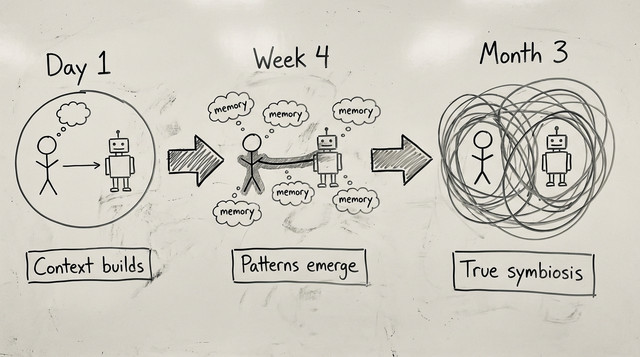
The agent reads all 4 at session start. Updates NOW.md as you work. The system gets smarter the longer you use it -- not because of AI improvements, but because the files accumulate real context about you.
Want to scale beyond one main agent? See the Multi-Agent Hierarchy Guide for a simple human -> orchestrator -> leads -> specialists pattern.
Guides
- Multi-Agent Hierarchy Guide -- run a human -> orchestrator -> leads -> specialists system without losing clarity
- HEARTBEAT Setup Guide -- add screen-aware accountability through OpenClaw, Telegram, and what-did-i-do
What Makes It Different
It challenges you. From a real conversation:
AI: "You find something valuable -> People want it -> You feel repulsed by the exchange -> You give it away for free -> You have no money -> Repeat. That's not idealism. That's self-punishment."
You own it. Your context lives in plain files you control, not a vendor's black box. Read it, edit it, version it in git, and carry it to any model. Unlike native platform memory, nothing is opaque, automatic, or locked to one tool.
It acts. Writes code, researches, creates files. Not just advice.
It evolves. After 100+ sessions, your files contain hard-won insights about what works for you specifically. No generic advice. Your patterns, your bugs, your wins.
Symbiotic AI vs native memory
| Native platform memory | Symbiotic AI | |
|---|---|---|
| Ownership | Vendor owns it, lives in their account | You own it: plain Markdown files on your disk |
| Portability | Locked to one platform | Runs on any model (Claude Code, Hermes, OpenClaw, opencode) |
| Transparency | Opaque and automatic: you can't see or edit what it stored | You read, edit, delete, and version every line |
Installation
Try without installing: the Personal AI Hub gives you a chat-based setup that generates your files in minutes, with no terminal needed.
Want it set up with you, 1:1? I'll build your Guardian Angel with you in one screen-share session, and you keep the system. Book the 1:1 setup.
Hermes Agent (recommended)
Install Hermes, clone this repo as your workspace, then start Hermes inside it:
# 1) Install Hermes Agent
curl -fsSL https://raw.githubusercontent.com/NousResearch/hermes-agent/main/scripts/install.sh | bash
source ~/.bashrc  # or: source ~/.zshrc

# 2) Clone your Symbiotic workspace
git clone https://github.com/lout33/symbiotic-ai ~/symbiotic-ai
cd ~/symbiotic-ai

# 3) Optional but recommended: use the Symbiotic voice globally in Hermes
mkdir -p ~/.hermes
cp SOUL.md ~/.hermes/SOUL.md

# 4) Start Hermes from inside the workspace
hermes
What goes where with Hermes:
SOUL.md-> global voice at~/.hermes/SOUL.mdAGENTS.md,USER.md,NOW.md-> live in your workspace/project root- Run
hermesfrom that workspace so the agent starts with your current context
If you already have a ~/.hermes/SOUL.md, merge it instead of overwriting it.
Claude Code / opencode quick installer
curl -fsSL https://raw.githubusercontent.com/lout33/symbiotic-ai/main/install.sh | bash
Manual clone
git clone https://github.com/lout33/symbiotic-ai
cd symbiotic-ai
How It Evolves
- Week 1-2: Fill in SOUL.md (who is the agent?), USER.md (who are you?), AGENTS.md (basic rules), NOW.md (what are you doing?)
- Month 1: The agent starts noticing your patterns. NOW.md log grows. You learn what works.
- Month 2+: Optional files appear as needed. Milestones accumulate naturally.
- Ongoing: SOUL.md and USER.md get refined as you learn more about yourself and what agent personality works.
Examples
Not sure what filled-in files look like? The examples/ folder has 3 complete setups showing what the system looks like after weeks of real use:
- jamie/ -- 22yo CS student juggling classes, internship apps, and a side project
- sam/ -- 30yo mid-level dev focused on career growth and interview prep
- morgan/ -- 35yo marketing manager integrating AI into their workflow
Each has all 4 files filled in with realistic data. Start from the root templates and make them yours.
The Memory Log
In NOW.md, the agent maintains a dated log of patterns, quotes, and insights:
### Jan 10
- Avoided user call. Rescheduled twice. Pattern: building = safe, talking = scary.

### Jan 15
- Had first user call. Quote: 'I've been building what I think they want instead of asking'

### Feb 1
- Pattern confirmed: 3 weeks on feature nobody asked for. This is the 3rd time.
Commands
| Command | What it does |
|---|---|
/start-day |
Morning kickoff. Sets MIT for the day. |
/check-day |
Quick accountability check-in. |
/end-day |
Evening review. Captures wins, lessons. |
/reflect |
Deep reflection. Surfaces patterns. Creates journal entry. |
Commands work manually or scheduled via cron. See commands/README.md.
Optional Files
The system grows with you. Just create the file. The agent discovers and uses it.
Tier-1 Optional
These are the first files to add after the core 4.
| File | Purpose | When to Add |
|---|---|---|
COMMITMENTS.md |
Said vs Did tracking | First optional file to add if you want stronger accountability, pattern detection, and "you said this before" interventions |
WINS.md |
Shipped projects, milestones, pattern breaks | When you need evidence you're making progress |
IDEAS.md |
Quick idea capture | When ideas come faster than you can act |
LOG_ARCHIVE.md |
Archived memory logs from NOW.md | When NOW.md gets too long |
Other Optional
| File | Purpose | When to Add |
|---|---|---|
JOURNAL.md |
Longer-form reflections | When sessions aren't enough depth |
HEARTBEAT: Screen-Aware Accountability
Optional. Your AI monitors your screen activity, compares it against your tasks in NOW.md, and pings you on Telegram when you drift.
[14:30] DOING: VS Code - building landing page components
SHOULD: Ship landing page
Flow state. Keep going.
[15:15] DOING: YouTube - watching programming streams (45 min)
SHOULD: Ship landing page
You know what you should be doing.
Powered by OpenClaw + what-did-i-do screen tracker. Setup guide
Interoperability
One directory, multiple interfaces:
| Framework | Config | Best For |
|---|---|---|
| Hermes Agent | Put AGENTS.md, USER.md, and NOW.md in your workspace. Optionally copy SOUL.md to ~/.hermes/SOUL.md for a stable global voice. Run hermes from the workspace root. |
Full agent runtime: tools, memory, web, code execution, automation |
| OpenClaw | Set workspace in ~/.openclaw/openclaw.json |
HEARTBEAT, Telegram, scheduled check-ins |
| Claude Code | ~/.claude/CLAUDE.md (concatenate the 4 files) |
Deep coding sessions |
| opencode | ~/.config/opencode/ or project root |
Terminal-based sessions |
What Goes Where
| Question | Answer |
|---|---|
| "Will this change next week?" | Yes -> NOW.md. No -> the stable file it belongs to. |
| "Is this about the agent or the user?" | Agent -> SOUL.md. User -> USER.md. |
| "Is this a protocol or personality?" | Protocol -> AGENTS.md. Personality -> SOUL.md. |
| "Not sure?" | Put it in NOW.md. Move it later. |
Community
GitHub Discussions -- Ask questions, share your setup, propose ideas.
Show Your Symbiosis: Post your configuration in Show and tell. Your SOUL.md personality, conversation screenshots, custom commands. Think r/unixporn but for AI agents.
Want to contribute? See CONTRIBUTING.md.
Philosophy
Symbiotic > Assistive. Challenge > Validate. Memory compounds. Ship ugly.
The Ecosystem
| Project | What it does |
|---|---|
| OpenClaw | Personal AI assistant runtime. Powers HEARTBEAT, Telegram, cron. |
| what-did-i-do | Passive screen tracker with Gemini Vision |
| writing-style-skill | Make AI write like you |
Created by @lout33