JoyVASA: Portrait and Animal Image Animation with Diffusion-Based Audio-Driven Facial Dynamics and Head Motion Generation
[Xuyang Cao](https://github.com/xuyangcao)1* 
Guoxin Wang12* 
[Sheng Shi](https://github.com/DBDXSS)1* 
[Jun Zhao](https://github.com/zhaojun060708)1 
Yang Yao1
Jintao Fei1 
Minyu Gao1 
Pei Xie1
1JD Health International Inc. 2Zhejiang University
[](https://github.com/jdh-algo/JoyVASA)
[](https://jdh-algo.github.io/JoyVASA)
[](https://arxiv.org/abs/2411.09209)
[](https://huggingface.co/jdh-algo/JoyVASA)
📖 Introduction
Audio-driven portrait animation has made significant advances with diffusion-based models, improving video quality and lipsync accuracy. However, the increasing complexity of these models has led to inefficiencies in training and inference, as well as constraints on video length and inter-frame continuity. In this paper, we propose JoyVASA, a diffusion-based method for generating facial dynamics and head motion in audio-driven facial animation. Specifically, in the first stage, we introduce a decoupled facial representation framework that separates dynamic facial expressions from static 3D facial representations. This decoupling allows the system to generate longer videos by combining any static 3D facial representation with dynamic motion sequences. Then, in the second stage, a diffusion transformer is trained to generate motion sequences directly from audio cues, independent of character identity. Finally, a generator trained in the first stage uses the 3D facial representation and the generated motion sequences as inputs to render high-quality animations. With the decoupled facial representation and the identity-independent motion generation process, JoyVASA extends beyond human portraits to animate animal faces seamlessly. The model is trained on a hybrid dataset of private Chinese and public English data, enabling multilingual support. Experimental results validate the effectiveness of our approach. Future work will focus on improving real-time performance and refining expression control, further expanding the framework’s applications in portrait animation.
🧳 Framework
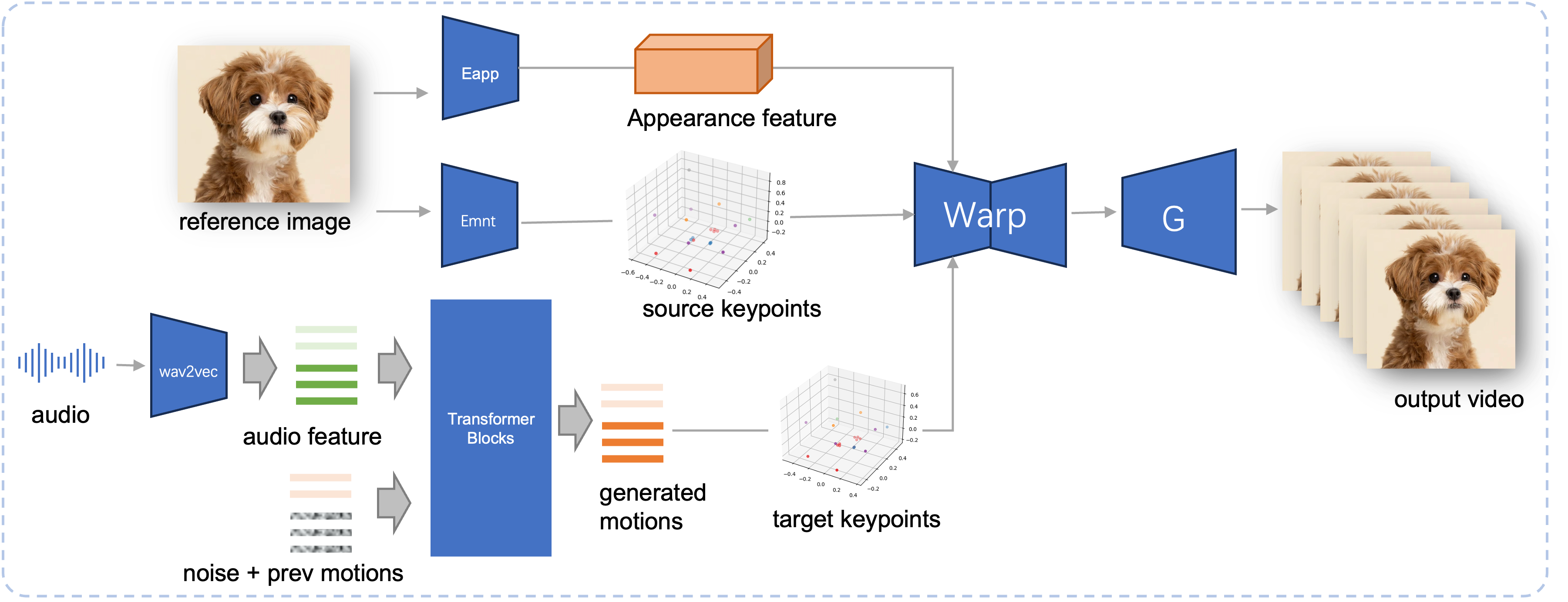
Inference Pipeline of the proposed JoyVASA. Given a reference image, we first extract the 3D facial appearance feature using the appearance encoder in LivePortrait, and also a series of learned 3D keypoints using the motion encoder. For the input speech, the audio features are initially extracted using the wav2vec2 encoder. The audio-driven motion sequences are then sampled using a diffusion model trained in the second stage in a sliding window fashion. Using the 3D keypoints of reference image, and the sampled target motion sequences, the target keypoints are computed. Finally, the 3D facial appearance feature is warped based on the source and target keypoints and rendered by a generator to produce the final output video.
⚙️ Installation
System requirements:
Ubuntu:
- Tested on Ubuntu 20.04, CUDA 12.1
- Tested GPUs: A100
Windows:
- Tested on Windows 11, CUDA 12.1
- Tested GPUs: RTX 4060 Laptop 8GB VRAM GPU
Create environment:
# 1. Create base environment
conda create -n joyvasa python=3.10 -y
conda activate joyvasa

# 2. Install requirements
pip install -r requirements.txt

# 3. Install ffmpeg
sudo apt-get update
sudo apt-get install ffmpeg -y

# 4. Optional: Install MultiScaleDeformableAttention for animal image animation
cd src/utils/dependencies/XPose/models/UniPose/ops
python setup.py build install
cd - # equal to cd ../../../../../../../
🎒 Prepare model checkpoints
Make sure you have git-lfs installed and download all the following checkpoints to pretrained_weights:
1. Download JoyVASA motion generator checkpoints
git lfs install
git clone https://huggingface.co/jdh-algo/JoyVASA
2. Download audio encoder checkpoints
We suport two types of audio encoders, including wav2vec2-base, and hubert-chinese.
Run the following commands to download hubert-chinese pretrained weights:
git lfs install
git clone https://huggingface.co/TencentGameMate/chinese-hubert-base
To get the wav2vec2-base pretrained weights, run the following commands:
git lfs install
git clone https://huggingface.co/facebook/wav2vec2-base-960h
[!NOTE] The motion generation model with wav2vec2 encoder will be supported later.
3. Download LivePortraits checkpoints
# !pip install -U "huggingface_hub[cli]"
huggingface-cli download KwaiVGI/LivePortrait --local-dir pretrained_weights --exclude "*.git*" "README.md" "docs"
Refering to Liveportrait for more download methods.
4. pretrained_weights contents
The final pretrained_weights directory should look like this:
./pretrained_weights/
├── insightface
│   └── models
│       └── buffalo_l
│           ├── 2d106det.onnx
│           └── det_10g.onnx
├── JoyVASA
│   ├── motion_generator
│   │   └── iter_0020000.pt
│   └── motion_template
│       └── motion_template.pkl
├── liveportrait
│   ├── base_models
│   │   ├── appearance_feature_extractor.pth
│   │   ├── motion_extractor.pth
│   │   ├── spade_generator.pth
│   │   └── warping_module.pth
│   ├── landmark.onnx
│   └── retargeting_models
│       └── stitching_retargeting_module.pth
├── liveportrait_animals
│   ├── base_models
│   │   ├── appearance_feature_extractor.pth
│   │   ├── motion_extractor.pth
│   │   ├── spade_generator.pth
│   │   └── warping_module.pth
│   ├── retargeting_models
│   │   └── stitching_retargeting_module.pth
│   └── xpose.pth
├── TencentGameMate:chinese-hubert-base
│   ├── chinese-hubert-base-fairseq-ckpt.pt
│   ├── config.json
│   ├── gitattributes
│   ├── preprocessor_config.json
│   ├── pytorch_model.bin
│   └── README.md
└── wav2vec2-base-960h
    ├── config.json
    ├── feature_extractor_config.json
    ├── model.safetensors
    ├── preprocessor_config.json
    ├── pytorch_model.bin
    ├── README.md
    ├── special_tokens_map.json
    ├── tf_model.h5
    ├── tokenizer_config.json
    └── vocab.json
[!NOTE] The folder
TencentGameMate:chinese-hubert-basein Windows should be renamedchinese-hubert-base.
🚀 Inference
1. Inference with command line
Animal:
python inference.py -r assets/examples/imgs/joyvasa_001.png -a assets/examples/audios/joyvasa_001.wav --animation_mode animal --cfg_scale 2.0
Human:
python inference.py -r assets/examples/imgs/joyvasa_003.png -a assets/examples/audios/joyvasa_003.wav --animation_mode human --cfg_scale 2.0
You can change cfg_scale to get results with different expressions and poses.
[!NOTE] Mismatching Animation Mode and Reference Image may result in incorrect results.
2. Inference with web demo
Use the following command to start web demo:
python app.py
The demo will be create at http://127.0.0.1:7862.
⚓️ Train Motion Generator with Your Own Data
The motion generater should be trained using human talking face videos.
1. Prepare train and validation data
Chnage the root_dir in 01_extract_motions.py with you own dataset path, then run the following commands to generate training and validation data:
cd src/prepare_data
python 01_extract_motions.py
python 05_extract_audio.py
python 02_gen_labels.py
pyhton 03_merge_motions.py
python 04_gen_template.py

mv motion_templete.pkl motions.pkl train.json test.json ../../data
cd ../..
2. Train
python train.py
The experimental results is located in experiments/.
📝 Citations
If you find our work helpful, please consider citing us:
@misc{cao2024joyvasaportraitanimalimage,
      title={JoyVASA: Portrait and Animal Image Animation with Diffusion-Based Audio-Driven Facial Dynamics and Head Motion Generation},
      author={Xuyang Cao and Guoxin Wang and Sheng Shi and Jun Zhao and Yang Yao and Jintao Fei and Minyu Gao},
      year={2024},
      eprint={2411.09209},
      archivePrefix={arXiv},
      primaryClass={cs.CV},
      url={https://arxiv.org/abs/2411.09209},
}
🤝 Acknowledgments
We would like to thank the contributors to the LivePortrait, Open Facevid2vid, InsightFace, X-Pose, DiffPoseTalk, Hallo, wav2vec 2.0, Chinese Speech Pretrain, Q-Align, Syncnet, and VBench repositories, for their open research and extraordinary work.