
Lightweight optimization with local, global, population-based and sequential techniques across mixed search spaces
Documentation
▸
  [Homepage](https://gradient-free-optimizers.readthedocs.io/en/latest/) ·
  [Optimizers](https://gradient-free-optimizers.readthedocs.io/en/latest/user_guide/optimizers/index.html) ·
  [API Reference](https://gradient-free-optimizers.readthedocs.io/en/latest/api_reference.html) ·
  [Examples](https://gradient-free-optimizers.readthedocs.io/en/latest/examples.html)
On this page
▸
  [Features](#key-features) ·
  [Examples](#examples) ·
  [Concepts](#core-concepts) ·
  [Citation](#citation)
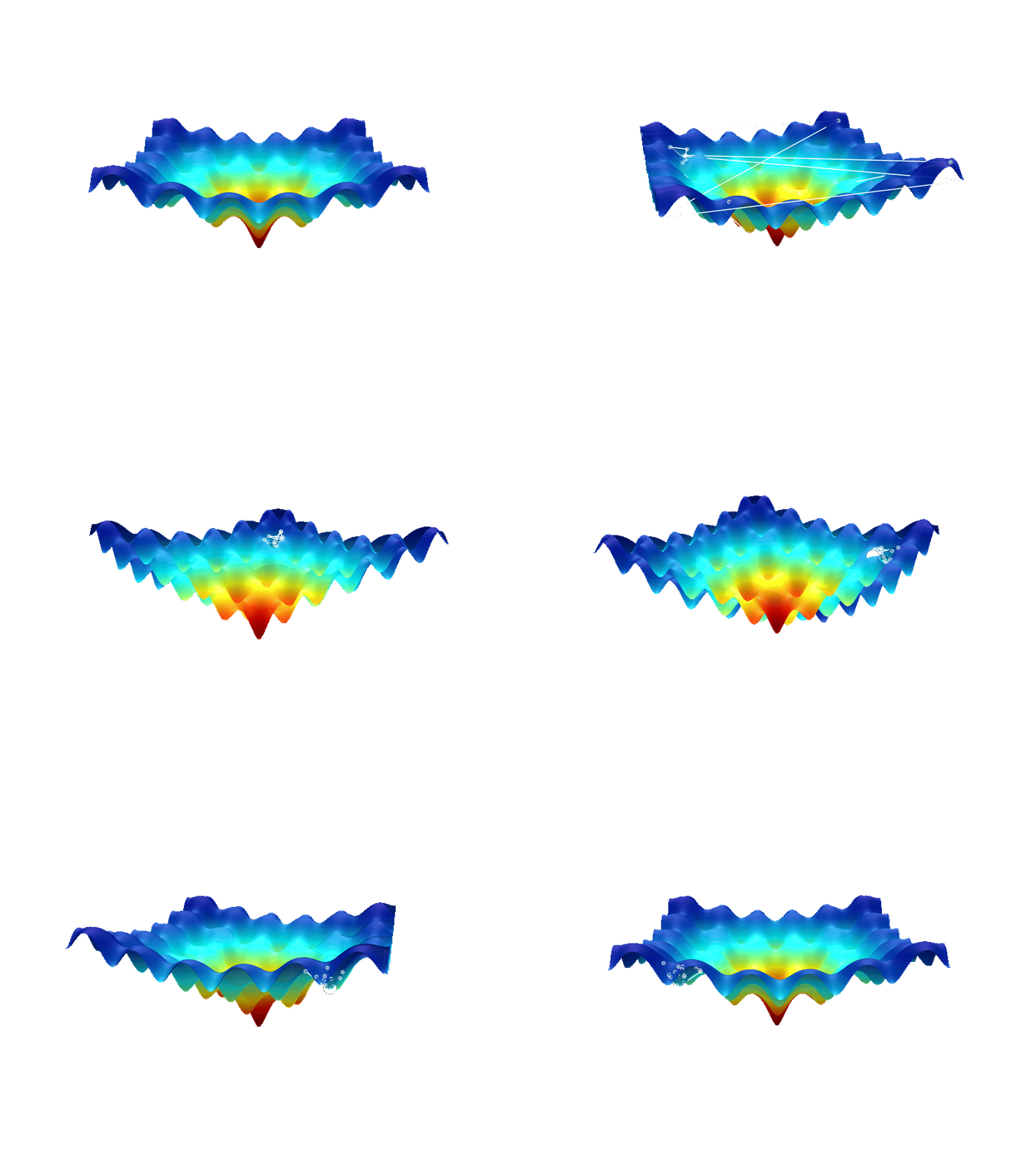
Gradient-Free-Optimizers is a Python library for gradient-free optimization of black-box functions. It provides a unified interface to 23 optimization algorithms, from simple hill climbing to Bayesian optimization, all operating on mixed search spaces that combine continuous ranges, discrete grids, categorical choices, and SciPy distribution-backed dimensions.
Designed for hyperparameter tuning, simulation optimization, feature selection, engineering design, and any scenario where gradients are unavailable or impractical. The library prioritizes simplicity: define your objective function, specify the search space, and run. All algorithms share one consistent API, so switching from hill climbing to Bayesian optimization is a one-line change. SciPy is optional; GFO only requires NumPy and pandas, making it suitable as an optimization backend or for minimal environments, containers, and embedded systems.
Installation
pip install gradient-free-optimizers
Optional dependencies
pip install gradient-free-optimizers[progress]  # Progress bar with tqdm
pip install gradient-free-optimizers[sklearn]   # scikit-learn for surrogate models
pip install gradient-free-optimizers[full]      # All optional dependencies
Key Features
  [23 Optimization Algorithms](https://gradient-free-optimizers.readthedocs.io/en/latest/user_guide/optimizers/index.html)

  Local, global, population-based, and sequential model-based optimizers. Switch algorithms with one line of code.


  [Zero Configuration](https://gradient-free-optimizers.readthedocs.io/en/latest/api_reference.html)

  Sensible defaults for all parameters. Start optimizing immediately without tuning the optimizer itself.


  [Memory System](https://gradient-free-optimizers.readthedocs.io/en/latest/user_guide/memory.html)

  Built-in caching prevents redundant evaluations. Critical for expensive objective functions like ML models.


  [Mixed Search Spaces](https://gradient-free-optimizers.readthedocs.io/en/latest/user_guide/search_spaces.html)

  Combine continuous ranges, discrete grids, categorical choices, and SciPy distributions in a single search space.


  [Constraints Support](https://gradient-free-optimizers.readthedocs.io/en/latest/user_guide/constraints.html)

  Define constraint functions to restrict the search space. Invalid regions are automatically avoided.


  [Minimal Dependencies](https://github.com/SimonBlanke/Gradient-Free-Optimizers)

  Only NumPy and pandas required. Optional integrations for progress bars (tqdm), SciPy distributions, and surrogate models (scikit-learn).
Quick Start
import numpy as np
from gradient_free_optimizers import HillClimbingOptimizer

def objective(params):
    x, y = params["x"], params["y"]
    return -(x**2 + y**2)

search_space = {
    "x": (-5.0, 5.0),            # continuous range
    "y": np.arange(-5, 5, 0.1),  # discrete grid
}

opt = HillClimbingOptimizer(search_space)
opt.search(objective, n_iter=1000)

print(f"Best score: {opt.best_score}")
print(f"Best params: {opt.best_para}")
Core Concepts
flowchart LR
    O["Optimizer
    ━━━━━━━━━━
    23 algorithms"]

    S["Search Space
    ━━━━━━━━━━━━
    mixed dimensions"]

    F["Objective
    ━━━━━━━━━━
    f(params) → score"]

    D[("Search Data
    ━━━━━━━━━━━
    history")]

    O -->|propose| S
    S -->|params| F
    F -->|score| O

    O -.-> D
    D -.->|warm start| O
Optimizer: Implements the search strategy. Choose from 23 algorithms across four categories: local search, global search, population-based, and sequential model-based.
Search Space: Defines valid parameter ranges and choices. Each key is a parameter name, each value is a tuple (min, max) for continuous, a NumPy array for discrete, a list for categorical, or a SciPy distribution.
Objective Function: Your function to maximize. Takes a dictionary of parameters, returns a score. Use negation to minimize.
Search Data: Complete history of all evaluations accessible via opt.search_data for analysis and warm-starting future searches.
Examples
Hyperparameter Optimization
from sklearn.ensemble import GradientBoostingClassifier
from sklearn.model_selection import cross_val_score
from sklearn.datasets import load_wine
import numpy as np

from gradient_free_optimizers import BayesianOptimizer

X, y = load_wine(return_X_y=True)

def objective(params):
    model = GradientBoostingClassifier(
        n_estimators=params["n_estimators"],
        max_depth=params["max_depth"],
        learning_rate=params["learning_rate"],
    )
    return cross_val_score(model, X, y, cv=5).mean()

search_space = {
    "n_estimators": np.arange(50, 300, 10),
    "max_depth": np.arange(2, 10),
    "learning_rate": np.logspace(-3, 0, 20),
}

opt = BayesianOptimizer(search_space)
opt.search(objective, n_iter=50)
Bayesian Optimization
import numpy as np
from gradient_free_optimizers import BayesianOptimizer

def ackley(params):
    x, y = params["x"], params["y"]
    return -(
        -20 * np.exp(-0.2 * np.sqrt(0.5 * (x**2 + y**2)))
        - np.exp(0.5 * (np.cos(2 * np.pi * x) + np.cos(2 * np.pi * y)))
        + np.e + 20
    )

search_space = {
    "x": np.arange(-5, 5, 0.01),
    "y": np.arange(-5, 5, 0.01),
}

opt = BayesianOptimizer(search_space)
opt.search(ackley, n_iter=100)
Particle Swarm Optimization
import numpy as np
from gradient_free_optimizers import ParticleSwarmOptimizer

def rastrigin(params):
    A = 10
    values = [params[f"x{i}"] for i in range(5)]
    return -sum(v**2 - A * np.cos(2 * np.pi * v) + A for v in values)

search_space = {f"x{i}": np.arange(-5.12, 5.12, 0.1) for i in range(5)}

opt = ParticleSwarmOptimizer(search_space, population=20)
opt.search(rastrigin, n_iter=500)
Simulated Annealing
import numpy as np
from gradient_free_optimizers import SimulatedAnnealingOptimizer

def sphere(params):
    return -(params["x"]**2 + params["y"]**2)

search_space = {
    "x": np.arange(-10, 10, 0.1),
    "y": np.arange(-10, 10, 0.1),
}

opt = SimulatedAnnealingOptimizer(
    search_space,
    start_temp=1.2,
    annealing_rate=0.99,
    cooling="exponential",
    acceptance="metropolis",
)
opt.search(sphere, n_iter=1000)
Constrained Optimization
import numpy as np
from gradient_free_optimizers import RandomSearchOptimizer

def objective(params):
    return params["x"] + params["y"]

def constraint(params):
    # Only positions where x + y < 5 are valid
    return params["x"] + params["y"] < 5

search_space = {
    "x": np.arange(0, 10, 0.1),
    "y": np.arange(0, 10, 0.1),
}

opt = RandomSearchOptimizer(search_space, constraints=[constraint])
opt.search(objective, n_iter=1000)
Mixed Search Space
import numpy as np
from scipy import stats
from gradient_free_optimizers import BayesianOptimizer

def objective(params):
    x = params["x"]
    n_layers = params["n_layers"]
    lr = params["learning_rate"]
    activation_scores = {"relu": 0.0, "tanh": 0.1, "gelu": 0.3}
    return -(x**2) - 0.1 * n_layers + activation_scores[params["activation"]] - abs(lr - 0.001)

search_space = {
    "x": (-5.0, 5.0),                          # continuous
    "n_layers": np.arange(1, 6),                # discrete
    "activation": ["relu", "tanh", "gelu"],     # categorical
    "learning_rate": stats.loguniform(1e-5, 1),  # distribution
}

opt = BayesianOptimizer(search_space)
opt.search(objective, n_iter=100)
Memory and Warm Starting
import numpy as np
from gradient_free_optimizers import HillClimbingOptimizer

def expensive_function(params):
    # Simulating an expensive computation
    return -(params["x"]**2 + params["y"]**2)

search_space = {
    "x": np.arange(-10, 10, 0.1),
    "y": np.arange(-10, 10, 0.1),
}

# First search
opt1 = HillClimbingOptimizer(search_space)
opt1.search(expensive_function, n_iter=100, memory=True)

# Continue with warm start using previous search data
opt2 = HillClimbingOptimizer(search_space)
opt2.search(expensive_function, n_iter=100, memory_warm_start=opt1.search_data)
Ask/Tell Interface
import numpy as np
from gradient_free_optimizers import BayesianOptimizer

def objective(params):
    return -(params["x"]**2 + params["y"]**2)

search_space = {
    "x": np.arange(-10, 10, 0.1),
    "y": np.arange(-10, 10, 0.1),
}

# Manual control over the optimization loop
opt = BayesianOptimizer(search_space)
opt.setup_search(objective, n_iter=100)

for _ in range(100):
    params = opt.ask()           # Get next parameters to evaluate
    score = objective(params)
    opt.tell(params, score)      # Report result back
Early Stopping
import numpy as np
from gradient_free_optimizers import BayesianOptimizer

def objective(params):
    return -(params["x"]**2 + params["y"]**2)

search_space = {
    "x": np.arange(-10, 10, 0.1),
    "y": np.arange(-10, 10, 0.1),
}

opt = BayesianOptimizer(search_space)
opt.search(
    objective,
    n_iter=1000,
    max_time=60,           # Stop after 60 seconds
    max_score=-0.01,       # Stop when score reaches -0.01
    early_stopping={       # Stop if no improvement for 50 iterations
        "n_iter_no_change": 50,
    },
)
Ecosystem
GFO is used as the optimization engine in other packages and integrates with the broader Python optimization ecosystem. For updates, follow on GitHub.
| Package | Description |
|---|---|
| Hyperactive | High-level hyperparameter optimization framework, uses GFO as its optimization backend |
| Surfaces | Test functions and benchmark surfaces for optimization algorithm evaluation |
Documentation
| Resource | Description |
|---|---|
| User Guide | Comprehensive tutorials and explanations |
| API Reference | Complete API documentation |
| Optimizers | Detailed description of all 23 algorithms |
| Examples | Code examples for various use cases |
Contributing
Contributions welcome! See CONTRIBUTING.md for guidelines.
- Bug reports: GitHub Issues
- Feature requests: GitHub Discussions
- Questions: GitHub Issues
Citation
If you use this software in your research, please cite:
@software{gradient_free_optimizers,
  author = {Simon Blanke},
  title = {Gradient-Free-Optimizers: Simple and reliable optimization with local, global, population-based and sequential techniques in mixed search spaces},
  year = {2020},
  url = {https://github.com/SimonBlanke/Gradient-Free-Optimizers},
}
License
MIT License - Free for commercial and academic use.