DeePMD-kit
Start from a pretrained Deep Potential model, fine-tune it for your system, and deploy it at simulation scale.
Pretrained models · Fine-tuning · Documentation · Quick start · Model guide · Tutorials · Examples · Releases
[!IMPORTANT] A pretrained model can be your starting point, not just your end result. Download a built-in pretrained DPA4 checkpoint, fine-tune the full model for your system, then test, export, and deploy it through the same DeePMD-kit workflow.
DeePMD-kit turns quantum-mechanical reference data into fast, scalable interatomic potentials. Use it across molecular and materials science—from finite molecules and covalent systems to periodic solids and metals—and scale from laptop fine-tuning to distributed training and MPI-parallel molecular dynamics.
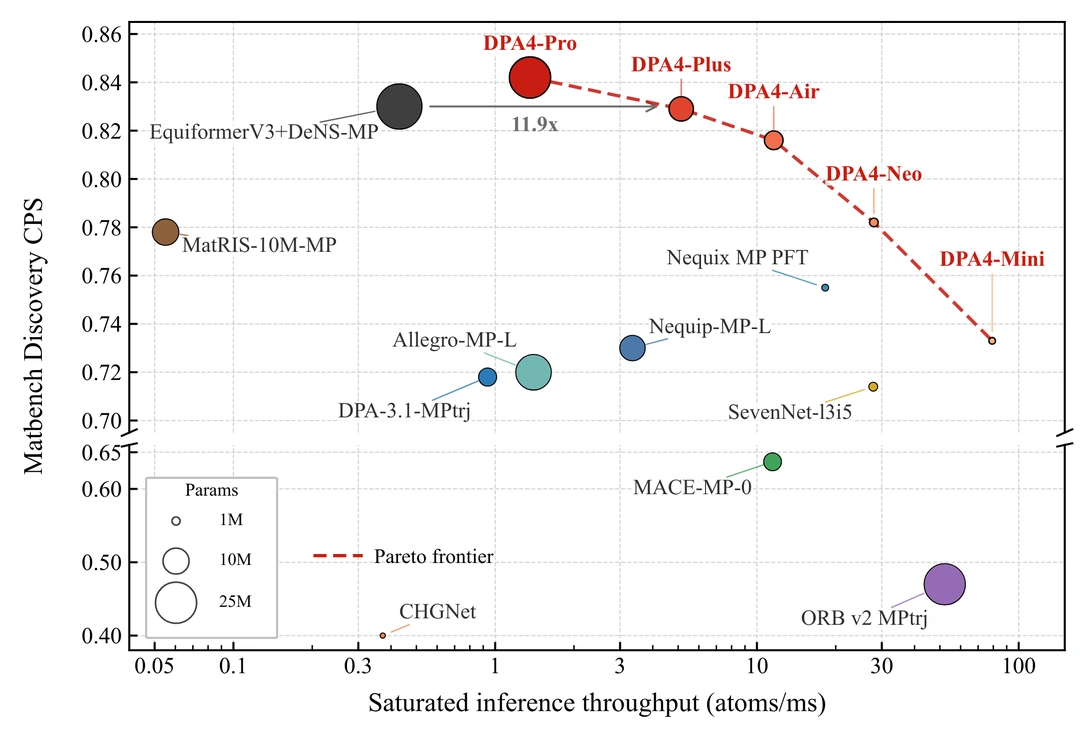
The DPA4 model family traces a Pareto frontier across Matbench Discovery CPS and saturated inference throughput.
⚡ Why DeePMD-kit
| Advantage | What it unlocks | |
|---|---|---|
| 🧬 | Pretrained-first workflows | Download pretrained DPA4 models, fine-tune full models, or adapt supported pretrained representations to downstream properties with DPA-ADAPT. |
| 🏗️ | Training from scratch | Design a model for a new system or physical target, then train it with single-task, multi-task, and distributed workflows across supported backends. |
| 🧠 | Modern model portfolio | For conservative energy/force interatomic potentials, start with DPA4 for accuracy or DPA4C for simulation throughput and scale. |
| 🧲 | More than energy and force | Model virials, Hessians, spin and magnetic forces, dipoles, polarizabilities, electronic density of states, atomic populations, and arbitrary intensive or extensive properties. |
| 🔄 | Backend flexibility | Train or run supported models with TensorFlow, PyTorch, JAX, or Paddle, with backend-aware model formats and conversion paths for compatible architectures. |
| 🚀 | Performance from training to MD | Use CPUs, CUDA GPUs, ROCm source builds, distributed training, compiled DPA4 paths, compressed DPA4C CUDA inference, AOTInductor .pt2 export, and MPI-enabled simulation. |
| 🔌 | Deploy where science happens | Use the CLI, Python, C, C++, or Node.js, then connect models to LAMMPS, i-PI, ASE, GROMACS, JAX MD, nvalchemi, OpenMM, Amber, CP2K, ABACUS, and more. |
| 🧩 | Open and extensible | Compose hybrid potentials, add analytical ZBL or long-range corrections, create custom models and operators, or connect external GNNs such as MACE and NequIP through plugins. |
[!TIP] On supported descriptors and workloads, model compression can deliver more than 10× inference speedup and reduce memory usage by as much as 20×. Actual gains depend on the model, system, and hardware.
Backend and interface support varies by model and feature. The web documentation marks compatibility and limitations on each feature page.
🧭 Two starting points, one path to dynamics
flowchart LR
    A["Pretrained DPA4 model"] --> C["Fine-tune on target data"]
    B["Model configuration"] --> D["Train from scratch"]
    E["Target reference data"] --> C
    E --> D
    C --> F["Test, compress, export"]
    D --> F
    F --> G["Python and native APIs"]
    F --> H["Molecular dynamics"]
- Choose a starting point: download a pretrained DPA4 checkpoint for adaptation, or configure DPA4 or DPA4C to train from scratch.
- Prepare target data in DeePMD's NumPy format or convert structures and trajectories with dpdata.
- Fine-tune or train: adapt the full pretrained DPA4 model, or optimize a new DPA4 or DPA4C model with single-task, multi-task, and distributed training workflows.
- Validate and export with
dp test,dp freeze, backend conversion, embedding extraction, and supported compression paths. - Run simulation through Python or native APIs, or load the model into a supported molecular-dynamics engine.
🚀 Start in minutes
DeePMD-kit requires Python 3.10 or later. The fastest installation path is:
curl -fsSL https://dp1s.deepmodeling.com | bash
dp --version
dp -h
The installation guide covers pip, conda-forge, containers, offline packages, GPU builds, LAMMPS, i-PI, and source installation.
Fine-tune a pretrained DPA4 model
Download a built-in checkpoint, start from its matching released training configuration, and fine-tune it on your target data. This example uses DPA4-Neo, one of the recommended general-purpose sizes:
dp pretrained download DPA4-Neo-OMat24-v20260805
curl -fsSL \
    https://huggingface.co/deepmodelingcommunity/DPA4-OMat24/resolve/main/DPA4-Neo-OMat24-v20260805.json \
    -o input_finetune.json
The DPA4 OMat24 release provides Nano, Mini, Neo, Air, and Plus
checkpoints together with their matching training configurations. The downloaded
input_finetune.json matches the Neo checkpoint above; for another size or
version, use the correspondingly named JSON file. Keep its complete model
section unchanged, including the full-periodic-table type_map; replace the
training and validation data, and use a smaller learning rate for fine-tuning.
Then run:
dp --pt train input_finetune.json \
    --finetune ~/.cache/deepmd/pretrained/models/DPA4-Neo-OMat24-v20260805.pt
These are PyTorch single-task checkpoints, so no model branch selection is needed. They target inorganic materials in the OMat24 chemical space; validate accuracy before using them outside that domain.
The fine-tuning guide covers full-model adaptation. DPA-ADAPT reuses supported pretrained DPA representations for downstream property-prediction tasks.
Pretrained model names can also be resolved and cached automatically by Python:
from deepmd.infer import DeepPot

potential = DeepPot("DPA4-Neo-OMat24-v20260805")
Train a model from scratch
Training from scratch remains a first-class workflow for new architectures, fully custom systems, and physical targets without a suitable pretrained checkpoint. Clone the examples and start with the compact water system:
git clone https://github.com/deepmodeling/deepmd-kit.git
cd deepmd-kit/examples/water/dpa4

# Accuracy-first DPA4 model
dp --pt train input.json

# Or the throughput-first DPA4C model
cd ../dpa4c
dp --pt-expt train input.json
Ready-to-run inputs include:
- DPA4 water training
- DPA4C high-throughput water training
- DPA4 multi-task training
- DPA-ADAPT property prediction
For a guided end-to-end example, open the web quick-start notebook.
🧠 Choose a model family
For conservative energy/force interatomic potentials, start with the DPA4 family. The choice between its two primary models follows the constraint that matters most for your workload:
| Priority | Start with | Why |
|---|---|---|
| Highest accuracy | DPA4 | SO(3)-equivariant message passing targets the accuracy frontier. |
| Highest throughput or system scale | DPA4C | A compact one-hop descriptor targets the throughput frontier and supports compressed CUDA inference. |
DPA4 uses the PyTorch backend (dp --pt). DPA4C currently uses the PyTorch
Exportable backend (dp --pt-expt); its compressed CUDA path requires
float32.
For other physical targets, use the model guide to select a compatible model and backend. The guide also compares data formats, precision, compression, and deployment constraints.
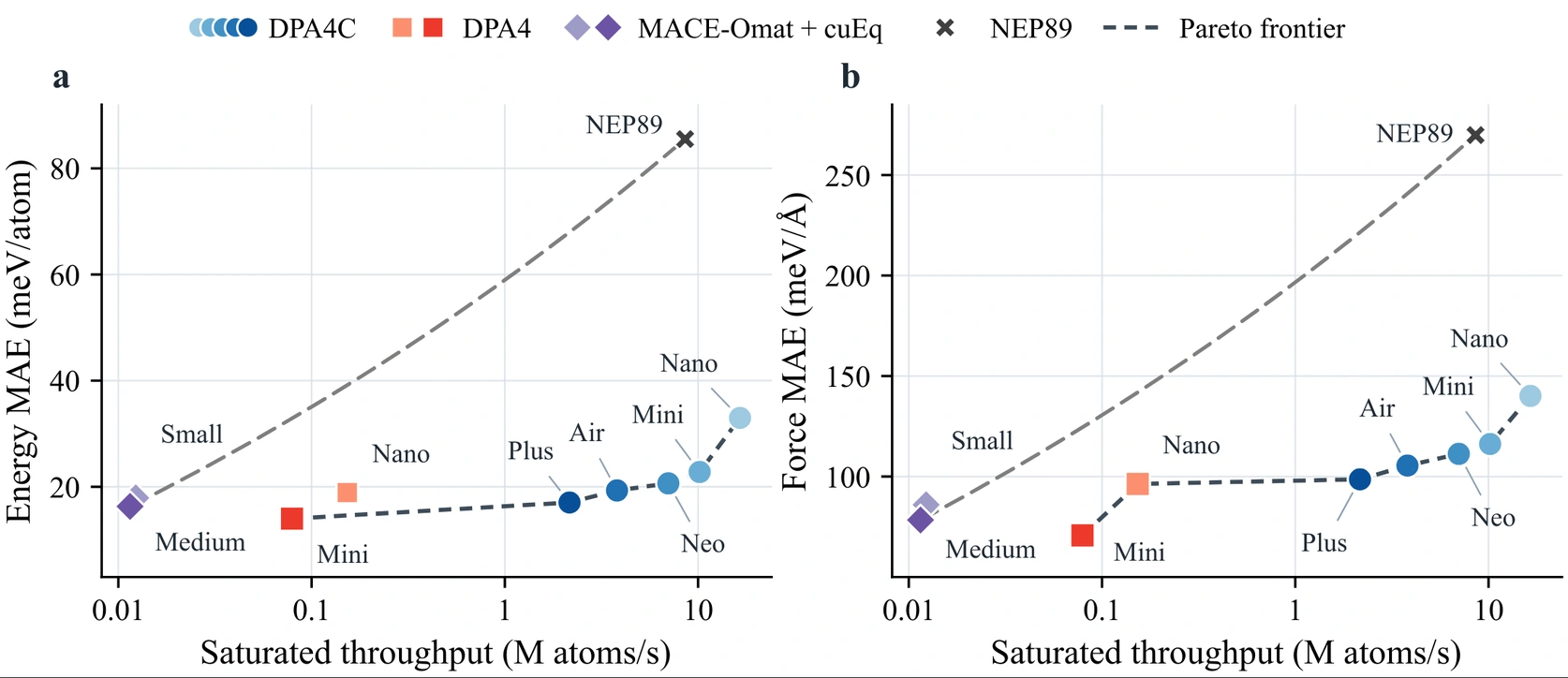
For energy/force potentials, DPA4 and DPA4C span accuracy–throughput trade-offs for different deployment budgets.
🔬 Go beyond conventional force fields
| Goal | DeePMD-kit capabilities |
|---|---|
| Potential-energy surfaces | Energy, atomic forces, virials, Hessians, hybrid descriptors, pair tables, and linear model combinations |
| Magnetic systems | Spin-aware descriptors, atomic and magnetic forces, and spin-capable molecular dynamics |
| Electronic and response properties | Dipoles, polarizabilities, density of states, atomic charge populations, and custom property heads |
| Long- and short-range physics | DPLR electrostatics, DPRc range correction for QM/MM, and analytical ZBL bridging |
| Representation learning | Per-atom descriptors, fitting-network features, structural embeddings, clustering, and downstream auxiliary models |
Explore the complete set of models and physical targets in the web documentation.
🔌 Deploy into the scientific ecosystem
Inference interfaces
Simulation and workflow integrations
- LAMMPS, i-PI, ASE, JAX MD, and nvalchemi
- Ecosystem integrations for OpenMM, Amber, CP2K, GROMACS, ABACUS, DP-GEN, and MLatom
- External MACE and NequIP models through the DeePMD-GNN plugin
See the integration hub for maintained interfaces, third-party projects, supported scope, and installation guidance.
The native C and C++ interfaces load machine-learning backends as runtime plugins. Applications can therefore open the backend required by a model without directly linking every framework.
[!NOTE] Working with an AI coding or scientific agent? Start with Install with an AI agent, or browse the official Agent Skills for model selection, training, fine-tuning, Python inference, and LAMMPS workflows.
npx -y skills add https://github.com/deepmodeling/deepmd-kit/tree/master/skills \
    --skill deepmd-install -y
If direct GitHub access fails, clone the official Gitee mirror and install from the local checkout:
git clone --depth 1 \
    https://gitee.com/deepmodeling/deepmd-kit.git \
    deepmd-kit-skill-source
npx -y skills add ./deepmd-kit-skill-source/skills \
    --skill deepmd-install -y
📚 Documentation and community
- Read the full web documentation.
- Follow hands-on material in the DeepModeling tutorials.
- Browse examples for training, inference, and integrations.
- Ask questions or report problems in GitHub Issues.
- Join development through the contributing guide.
Citation
If DeePMD-kit contributes to published work, cite the general software paper that matches the version used and the method-specific papers listed in CITATIONS.bib:
- Wang et al., “DeePMD-kit: A deep learning package for many-body potential
energy representation and molecular dynamics,” Computer Physics
Communications 228 (2018), 178–184 (describes the initial version).
- Zeng et al., “DeePMD-kit v2: A software package for Deep Potential models,”
The Journal of Chemical Physics 159 (2023), 054801 (covers features until
v2.2.3).
- Zeng et al., “DeePMD-kit v3: A Multiple-Backend Framework for Machine
Learning Potentials,” Journal of Chemical Theory and Computation 21
(2025), 4375–4385 (covers features until v3.0).
License
DeePMD-kit is licensed under the GNU Lesser General Public License v3.0 or later.