Real-time audio translation, captures system audio + mic, runs ASR (Whisper/SenseVoice), translates via LLM API with streaming display. Perfect for VTubers, livestreamers, and watching foreign content. Windows 实时音频翻译,ASR 语音识别后 LLM 流式翻译显示,适合 VTuber、主播和外语视频观看。
Self-hosted dark web OSINT platform. Automated threat intelligence from query to graph in 13 steps. Free alternative to Recorded Future, DarkOwl, and Flare.
An AI agent that can get things done across iPhone apps.
关键参数与规格
关键参数与规格
参数
值
语言
JavaScript
类别
Applications
子类别
Content creation
关键词
Client integration, Computer vision, Design
星标数
819
分叉数
77
贡献者
1
创建日期
2026-07-22
更新日期
2026-10-16
1 天星标数
1
7 天星标数
6
排名
6,209
上次排名
4,260
排名变化
-1,949
7 天星标排名
5,231
上次 7 天星标排名
5,249
7 天星标排名变化
18
总星标排名
13,075
上次总星标排名
13,065
总星标排名变化
-10
README 摘录
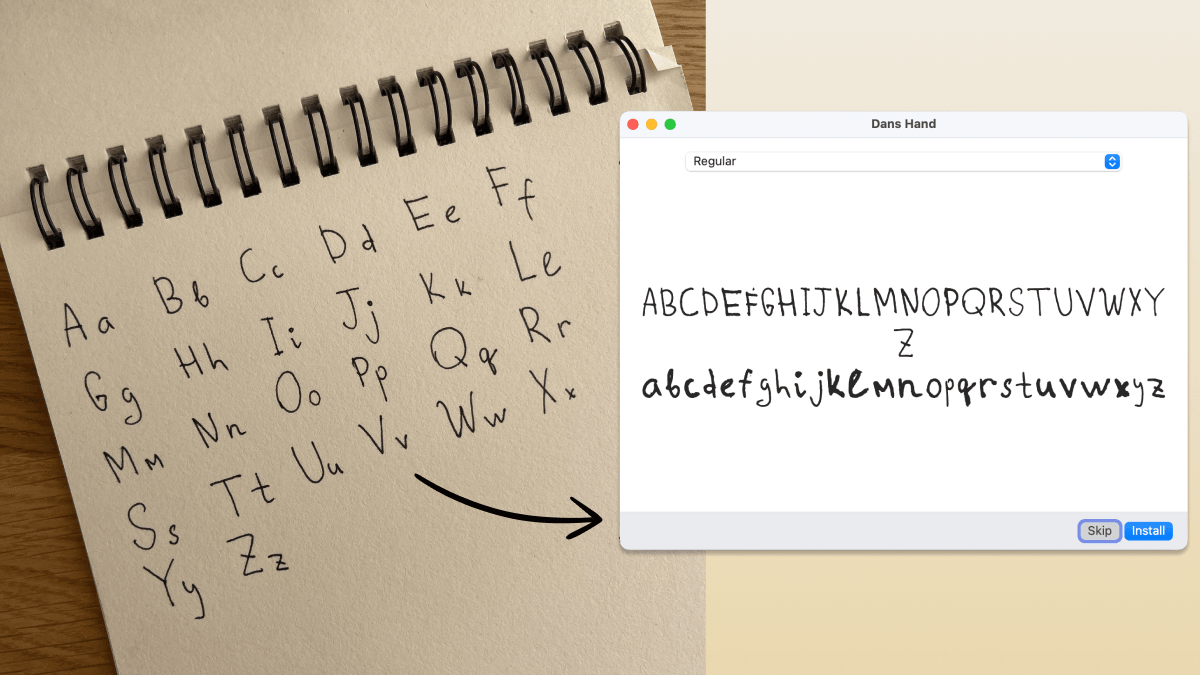
draw-your-font **Turn a photo of your handwriting into a real font (TTF/WOFF/WOFF2) - free, open source, no uploads, no credits. *This is a real one-shot result: dim light, spiral binding, page shadow. * Use it as a Claude Code skill (the fun way) Then in Claude Code, invoke the skill and hand it your photo: */draw-your-font* *"here's a photo of my handwriting - make my font"* (drag the photo into the terminal) Claude finds your letters
in the photo, labels them with vision, builds the font, shows you a preview, and critiques its own work. Iterate by talking: *"make it rounder"* / *"a bit bolder"* *"the g looks bad"* - it shows you the crop and fixes or asks for a re-shoot *"give me woff2 + css for my website"* *"how readable is it? "* - a legibility score and the two worst letter pairs No photo yet? Say *"give me a font template"* and you get a printable PDF
grid: write your alphabet with a dark pen, photograph the pages, and hand them back. Napkins, notebooks, spiral binding, bad lighting: that's what the vision step is for. Everything runs locally on your machine. Use it as a CLI (no AI at all) The skill is a thin layer over a deterministic npm CLI. It works on its own when you can tell it what you wrote: Pure npm, zero system dependencies: no FontForge, no ImageMagick, no potrace binary. Works
on macOS / Linux / Windows wherever Node ≥ 18 runs. How it works The craft is in the metrics step: every character has a vertical band in a shared 1000-unit em square (cap height, x-height, descender depth), so your hangs below the line and your stays small. That's what makes it feel like a font instead of a ransom note. Vectorization is potrace, the same engine inside FontForge and Inkscape. AI never draws your letters; it only finds, labels, and
judges them. **Why is this free when Calligraphr charges $8/month? ** Their cost is servers and a browser editor. Here your machine does the work and the agent is the editor. **Kerning, ligatures, letter randomization? The pipeline (fonttools ) is planned; the current output is a clean single-variant font.
Then in Claude Code, invoke the skill and hand it your photo:
/draw-your-font"here's a photo of my handwriting - make my font" (drag the photo into the terminal)
Claude finds your letters in the photo, labels them with vision, builds the
font, shows you a preview, and critiques its own work. Iterate by talking:
"make it rounder" / "a bit bolder"
"the g looks bad" - it shows you the crop and fixes or asks for a re-shoot
"give me woff2 + css for my website"
"how readable is it?" - a legibility score and the two worst letter pairs
No photo yet? Say "give me a font template" and you get a printable PDF grid:
write your alphabet with a dark pen, photograph the pages, and hand them back.
Messy freeform photos work too. Napkins, notebooks, spiral binding, bad
lighting: that's what the vision step is for.
Everything runs locally on your machine. Your handwriting never leaves it.
Use it as a CLI (no AI at all)
The skill is a thin layer over a deterministic npm CLI. It works on its own
when you can tell it what you wrote:
# freeform photo, you know the order you wrote in:
npx draw-your-font make photo.jpg --chars "ABCabc" --name "My Hand"
# → MyHand.ttf - double-click, install, done.

# best quality: print a template, fill it, photograph:
npx draw-your-font template -o template.pdf --charset minimal   # or: spanish
npx draw-your-font make page1.jpg page2.jpg --charset minimal --name "My Hand"
Pure npm, zero system dependencies: no FontForge, no ImageMagick, no potrace
binary. Works on macOS / Linux / Windows wherever Node ≥ 18 runs.
The craft is in the metrics step: every character has a vertical band in a
shared 1000-unit em square (cap height, x-height, descender depth), so your
g hangs below the line and your o stays small. That's what makes it feel
like a font instead of a ransom note. Vectorization is potrace, the same
engine inside FontForge and Inkscape. AI never draws your letters; it only
finds, labels, and judges them.
FAQ
Who owns the font? You. 100%, commercial use included. It's your
handwriting.
Why is this free when Calligraphr charges $8/month? Their cost is
servers and a browser editor. Here your machine does the work and the agent
is the editor.
Kerning, ligatures, letter randomization? v2. The pipeline (fonttools
calt) is planned; the current output is a clean single-variant font.