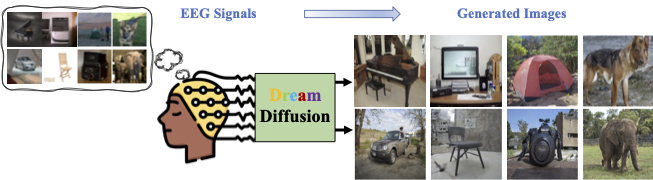
DreamDiffusion: Generating High-Quality Images from Brain EEG Signals Update **[2025. Since they were only tested on the previous server, they were not noticed and have been corrected. The pre-trained encoder does not need to be loaded separately during inference DreamDiffusion **DreamDiffusion** is a framework for generating high-quality images from brain EEG signals. This document introduces the precesedures required for replicating the results in *DreamDiffusion: Generating High-Quality Images from Brain EEG Signals* Abstract This paper introduces DreamDiffusion
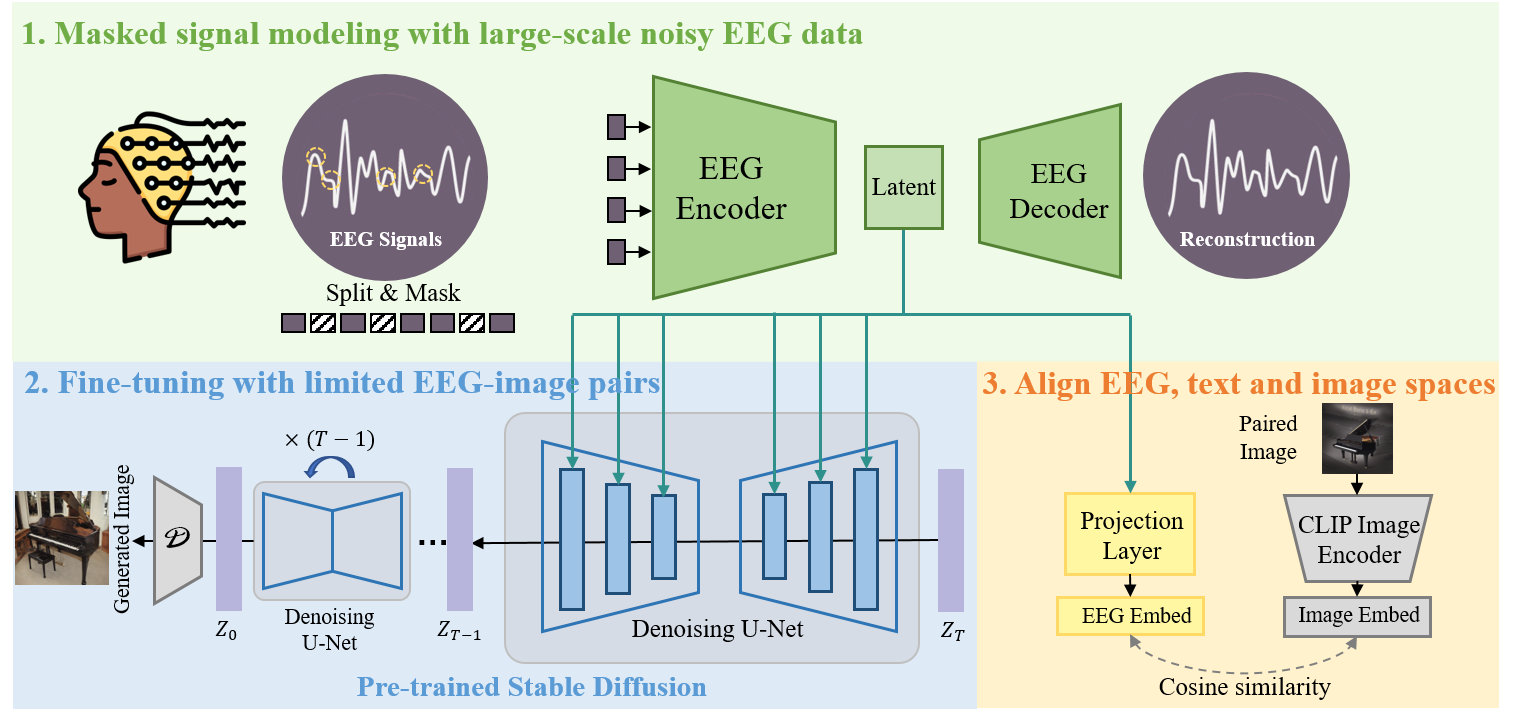
, a novel method for generating high-quality images directly from brain electroencephalogram (EEG) signals, without the need to translate thoughts into text. DreamDiffusion leverages pre-trained text-to-image models and employs temporal masked signal modeling to pre-train the EEG encoder for effective and robust EEG representations. Additionally, the method further leverages the CLIP image encoder to provide extra supervision to better align EEG, text, and image embeddings with limited EEG-image pairs. Overall, the proposed method overcomes the
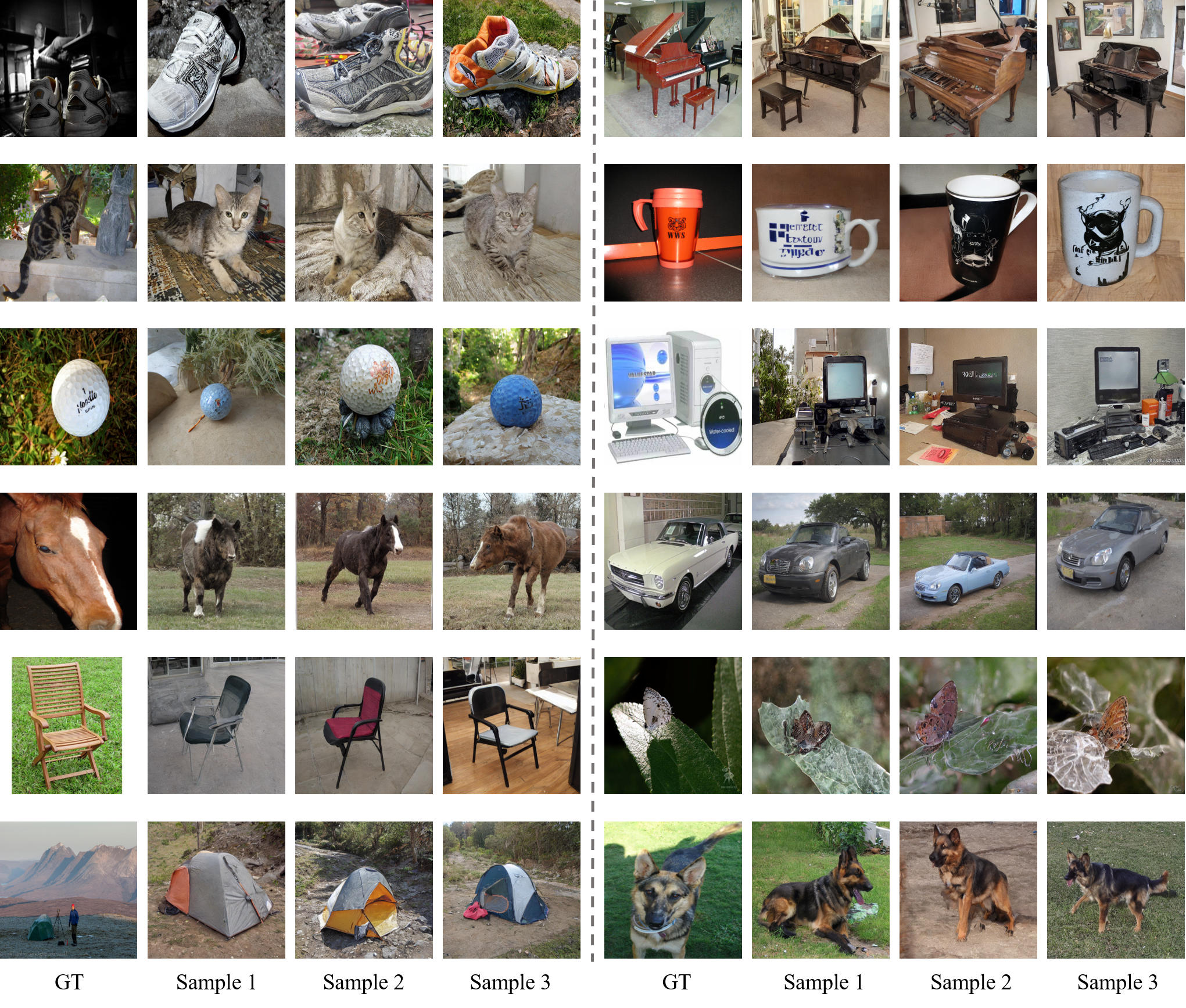
challenges of using EEG signals for image generation, such as noise, limited information, and individual differences, and achieves promising results. Quantitative and qualitative results demonstrate the effectiveness of the proposed method as a significant step towards portable and low-cost "thoughts-to-image", with potential applications in neuroscience and computer vision. Overview The **datasets** folder and **pretrains** folder are not included in this repository. Please download them from eeg and put them in the root directory of this repository as
shown below. We also provide a copy of the Imagenet subset imagenet. For Stable Diffusion, we just use standard SD1. You can download it from the official page of Stability. File path | Description Environment setup Create and activate conda environment named from the Generating Images with Trained Checkpoints Run this stage with our provided checkpoints: Here we provide a checkpoint ckpt, which you may want to try. Acknowledgement This code is built upon the publicly available code Mind-vis and
StableDiffusion. Thanks these authors for making their excellent work and codes publicly available. Citation ## Please cite the following paper if you use this repository in your reseach. ` @article{bai2023dreamdiffusion, title={DreamDiffusion: Generating High-Quality Images from Brain EEG Signals}, author={Bai, Yunpeng and Wang, Xintao and Cao, Yanpei and Ge, Yixiao and Yuan, Chun and Shan, Ying}, journal={arXiv preprint arXiv:2306.
常见问题
记录了多少星标和分叉?
bbaaii/DreamDiffusion 有 660 个星标和 80 个分叉。
仓库排名是多少?
bbaaii/DreamDiffusion 排名第 15,356。
记录的语言和类别是什么?
bbaaii/DreamDiffusion 有 660 个星标,语言为 Python,类别为 Model Development。
DreamDiffusion: Generating High-Quality Images from Brain EEG Signals
Update
[2025.9.30] Some paths were set incorrectly. Since they were only tested on the previous server, they were not noticed and have been corrected.
The pre-trained encoder does not need to be loaded separately during inference
DreamDiffusion
DreamDiffusion is a framework for generating high-quality images from brain EEG signals.
This document introduces the precesedures required for replicating the results in DreamDiffusion: Generating High-Quality Images from Brain EEG Signals
Abstract
This paper introduces DreamDiffusion, a novel method for generating high-quality images directly from brain electroencephalogram (EEG) signals, without the need to translate thoughts into text. DreamDiffusion leverages pre-trained text-to-image models and employs temporal masked signal modeling to pre-train the EEG encoder for effective and robust EEG representations. Additionally, the method further leverages the CLIP image encoder to provide extra supervision to better align EEG, text, and image embeddings with limited EEG-image pairs. Overall, the proposed method overcomes the challenges of using EEG signals for image generation, such as noise, limited information, and individual differences, and achieves promising results. Quantitative and qualitative results demonstrate the effectiveness of the proposed method as a significant step towards portable and low-cost "thoughts-to-image", with potential applications in neuroscience and computer vision.
Overview
The datasets folder and pretrains folder are not included in this repository.
Please download them from eeg and put them in the root directory of this repository as shown below. We also provide a copy of the Imagenet subset imagenet.
This code is built upon the publicly available code Mind-vis and StableDiffusion. Thanks these authors for making their excellent work and codes publicly available.
Citation
Please cite the following paper if you use this repository in your reseach.
@article{bai2023dreamdiffusion,
  title={DreamDiffusion: Generating High-Quality Images from Brain EEG Signals},
  author={Bai, Yunpeng and Wang, Xintao and Cao, Yanpei and Ge, Yixiao and Yuan, Chun and Shan, Ying},
  journal={arXiv preprint arXiv:2306.16934},
  year={2023}
}