English | 简体中文

Train LLMs, VLMs, diffusion, and embodied models — faster.
Docs · Blog · Quick Start · Performance · Supported Models


⭐ Star LoongForge to help more people discover it and grow the community.
🐉 LoongForge
LoongForge is an open-source training framework developed by the Baidu AI Cloud Baige team, built to deliver faster training for mainstream LLMs, VLMs, diffusion, and embodied models.
- Easy to Use — Ready-to-run configs and launch examples for every supported model, spanning pre-training, continued pre-training, SFT, and LoRA.
- High Performance — Built on multiple backends (Megatron-LM and torch-native) with deep training-speed optimizations that keep training loss aligned with the baseline.
- Production-Proven — Open-sourced from AIAK-Training-LLM, a training suite that serves enterprise customers' proprietary models and powers open-source model releases, with production runs reaching 5,000+ XPUs.
Example: embodied-model DreamZero at 4.38× baseline throughput, loss curves aligned
🏗️ Architecture
Since optimal training strategies differ across model families and scales, LoongForge adopts a multi-backend architecture.

- Megatron Stack — For LLMs, VLMs, and diffusion models. Powered by a patched Megatron-LM and extended with MoE parallelism, per-component heterogeneous parallelism, long-sequence optimizations, etc.
- Torch-Native Stack — For embodied models (VLA and WAM). A standalone torch-native subsystem featuring DDP / ZeRO-1 / FSDP / HSDP, with deep optimizations for representative models across I/O, communication strategy, kernel efficiency, etc.
🔥 Latest News
- [2026/09] ✨ Added training support for GLM-5.3-flash.
- [2026/09] ✨ Added Kimi-K3 BF16 training support for both LLMs and VLMs.
- [2026/09] ⚡ Added an optimized DreamZero Wan2.2-5B FSDP recipe with cache-aware data loading, compiled attention blocks, frozen-module handling, and FSDP2 Delta-FP8 Param AllGather.
- [2026/08] 🤖 Added VLA training support for Wall-OSS-0.5, with custom fused operators for higher training throughput.
- [2026/08] 📄 Released the TAOT paper — topology-aware dynamic expert replica placement that tackles expert-parallel (EP) load imbalance in MoE training, cutting overhead by up to 74% over industry solutions, with 1.43× speedup measured on a real training case. [blog]
- [2026/08] ✨ Added training support for GLM-5.2, along with a GLM-5.2 + MoonViT custom-composition example for extending GLM with multimodal capabilities.
- [2026/08] ✨ Added training support for MiniCPM-V-4.6 and Qwen3.8-27B.
- [2026/08] 🧪 Introduced a unified evaluation module for the embodied stack, currently covering Pi0.5 / xVLA / GR00T, with more models on the way.
- [2026/07] 🐳 Unified the prebuilt Docker images — all model families (LLM / VLM / VLA / Diffusion) now share a single image.
- [2026/07] 🤖 Released LoongForge-Embodied, a torch-native DDP/FSDP training subsystem for embodied models (Pi0.5, GR00T-N1.6/N1.7, xVLA, LingBot-VA, FastWAM, DreamZero, and Cosmos3), with up to 4.38× speedup. [blog]
- [2026/07] ✨ Added training support for DeepSeek-V4-Flash / DeepSeek-V4-Pro.
📅 More
- [2026/07] ✨ Added training support for Qwen-Image-Edit-2511.
- [2026/06] 🤖 Expanded VLA coverage with GR00T N1.6; 2.3× speedup on GR00T training. [blog]
- [2026/05] ⚡ Accelerated Wan 2.2 training by 116%, and added CP and data packing support.
- [2026/05] ✨ Added training support for Kimi K2.5 / K2.6, and introduced INT4 / NVFP4 PTQ.
- [2026/05] 🎉 v0.1.0 — first official tagged release of LoongForge.
- [2026/05] 🌟 Powered the training and public release of LLaVA-OneVision-2.0.
- [2026/04] 🧩 Added training support for MiniMax-M2.7 on both NVIDIA GPU and Kunlun XPU.
- [2026/04] 🚀 LoongForge source code publicly available on GitHub. [blog]
- [2025/10] 🌟 Powered the training and public release of LLaVA-OneVision-1.5 under AIAK-Training-LLM, the predecessor of LoongForge. [blog]
✨ Key Features
🚀 Foundation Models
- MoE EP Communication Optimization — Overlapped All2All / activation offload / compute, with further memory reduction beyond upstream Megatron-LM. [Usage]
- MoE Expert Load Balancing — Topology-aware dynamic replication of hot experts to balance EP workloads, with up to 74% lower overhead than industry solutions. [TAOT Paper]
- Adaptive FP8 Training — End-to-end FP8 for LLMs and VLMs with standard blockwise FP8; an optional adaptive mode picks per-operator precision by GEMM shape and efficiency. [Usage]
- Custom Fused Operators — Fused kernels like FusedDSA for DSA-style models — TileLang version open-sourced, high-performance CUDA version available on Baidu Baige platform.
- Long-Sequence Training — Scales LLM training to long sequences via Context Parallel (CP) and chunked-pipeline scheduling.
🧩 Multi-Modal Models
- Flexible Composition — Assemble VLMs from interchangeable ViT and LLM components (e.g. GLM-5.2 + MoonViT) straight from config — no custom model code. [Usage]
- Heterogeneous Parallelism — Independent TP / DP / recompute / freeze per model component (e.g. ViT vs. LLM) for optimal throughput and memory. [blog] [Usage]
- Decoupled Encoder-Decoder Training — Eliminates encoder-induced pipeline bubbles by separating ViT and LLM into independent tasks. [Usage]
- DP Load Balancing — Improves multi-node scaling efficiency with load-aware data redistribution that mitigates sequence-packing imbalance. [blog] [Usage]
- Flexible Data Pipeline — Energon WebDataset input for multimodal data, with both online and offline sequence packing. [Usage]
🤖 Embodied Models
- VLA & WAM Training — A dedicated torch-native DDP/FSDP subsystem for VLA and world-action (WAM) models, decoupled from the Megatron core, with flexible DDP / ZeRO-1 / FSDP / HSDP strategies. [README]
- Per-Model Deep Optimization — 1.79×–4.38× over official baselines in our benchmarks, from training code customized per model across I/O, communication strategy, and kernel efficiency.
- FP8 Communication Optimization — Cuts cross-rank traffic on supported NVIDIA GPUs across both parallel strategies: blockwise FP8 delta AllGather for FSDP2 parameters, and FP8 grad all-reduce for DDP gradients. [Usage]
- Unified Evaluation — Evaluate trained policies on LIBERO / CALVIN / SimplerEnv / RoboTwin, with coverage expanding continuously. [README]
- Ego2Robot Data Conversion — Turn first-person videos of human manipulation into LeRobot v3.0 training data across 16 dual-arm robot morphologies. [README]
🔌 Compatibility
- Mcore Bridge — Supports both offline bidirectional Megatron ↔ HuggingFace conversion and online native HF load/save. [Usage]
- Heterogeneous Hardware — Native support for NVIDIA GPUs and Kunlun XPUs via a minimally-intrusive plugin design.
📖 Deep-dive: LLM · VLM · Embodied Model
📊 Performance
Training throughput speedups over mainstream open-source baselines — each model and its baseline were benchmarked on the same machine type with the same training hyperparameters:
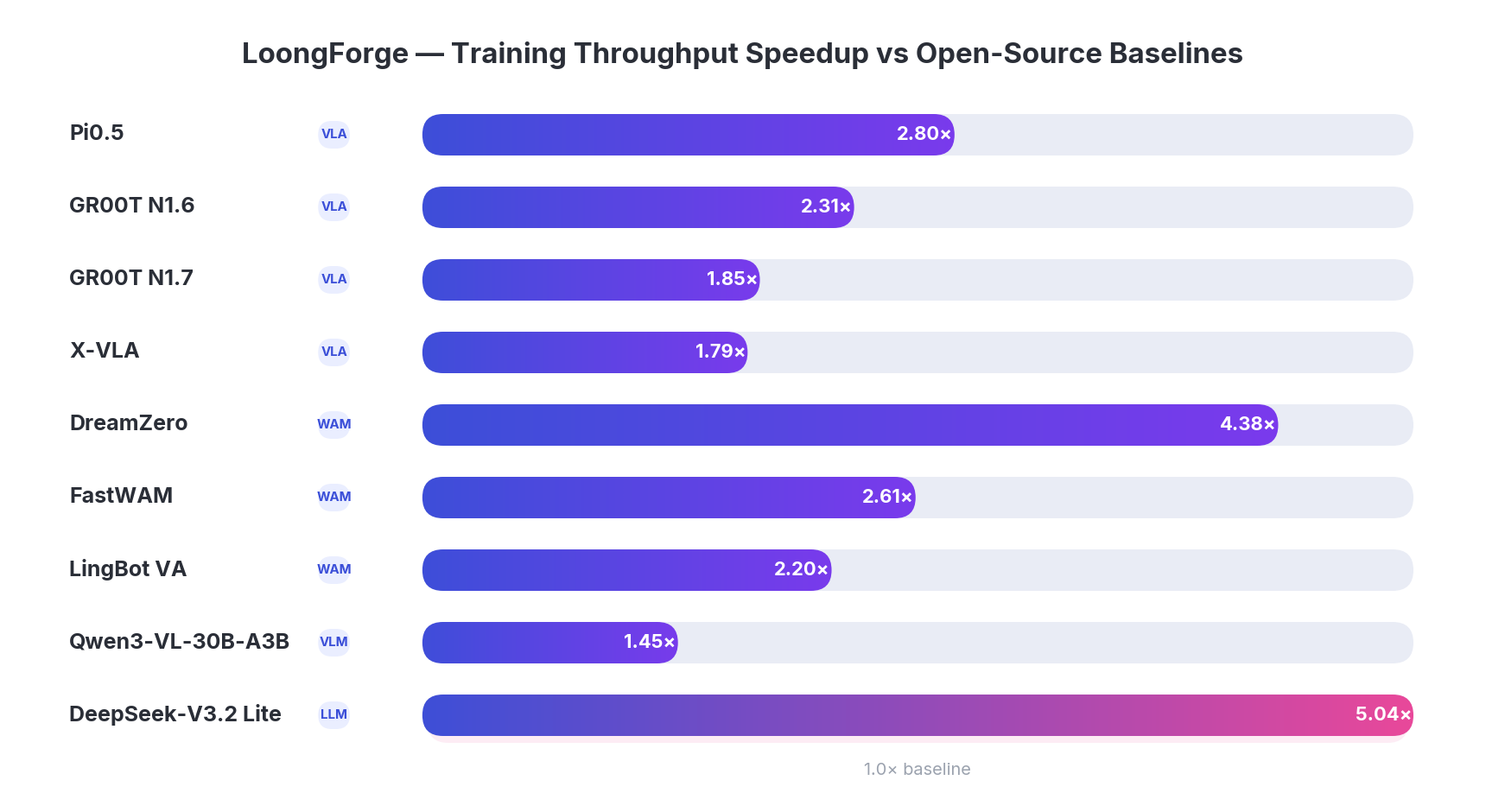
DeepSeek-V3.2 Lite reflects DSA operator-level optimizations and was validated on a reduced-layer configuration due to test-bed scale limits.
Numbers were measured at a point in time and may evolve as implementations change on both sides.
⚡ Quick Start
1. Install
Use the latest prebuilt NVIDIA GPU image with NVIDIA Container Toolkit installed:
docker pull loongforge/loongforge:latest
mkdir -p workspace
docker run --gpus all --ipc=host -it --rm \
  -v "$(pwd)/workspace:/workspace/data" \
  -w /workspace/LoongForge \
  loongforge/loongforge:latest bash
Source installation · Kunlun XPU installation.
2. Pick a tutorial — by hardware and modality
- NVIDIA GPU: LLM · VLM · VLA & WAM · Diffusion
- Kunlun XPU: Kunlun XPU Tutorials
3. Find your model's scripts
Launch scripts are available under examples/ (NVIDIA GPU) and examples_xpu/ (Kunlun XPU), with configs in configs/models/.
Example: DreamZero LoRA fine-tuning
This example uses DreamZero Wan2.2-5B LoRA on a single node with 8 GPUs and FSDP. Follow the tutorial to prepare weights (including Wan2.1 CLIP) and DROID data in LeRobot v2 format, then run inside the container:
cd /workspace/LoongForge
export WAN22_CKPT_DIR=/workspace/data/dreamzero/checkpoints/Wan2.2-TI2V-5B
export WAN21_CKPT_DIR=/workspace/data/dreamzero/checkpoints/Wan2.1-I2V-14B-480P
export TOKENIZER_PATH="$WAN22_CKPT_DIR/google/umt5-xxl"
export DATA_PATH=/workspace/data/dreamzero/data/droid_lerobot

EMBODIMENT_TAG=oxe_droid \
  bash examples/embodied/dreamzero/prepare_dreamzero_dataset.sh

GPUS_PER_NODE=8 TRAIN_ITERS=20 SAVE_INTERVAL=20 \
OUTPUT_DIR=/workspace/data/dreamzero/outputs/lora \
  bash examples/embodied/dreamzero/run_dreamzero_wan22_5b_lora_fsdp_finetune.sh
The example runs 20 steps and saves outputs under OUTPUT_DIR.
🏛️ Supported Models
Click any model for its training examples. See the User Guide for full instructions and the model support matrix for all variants.
LLM
VLM
Diffusion
Embodied
DeepSeek-V2 ✅ DeepSeek-V3/V3.2 ✅ DeepSeek-V4 ✅ LLaMA2 ✅ LLaMA3 ✅ LLaMA3.1 ✅ Qwen ✅ Qwen1.5 ✅ Qwen2 ✅ Qwen2.5 ✅ Qwen3 ✅ Qwen3-Next ✅ MiniMax-M2.1/2.5/2.7 ✅ MIMO ✅ GLM-5 ✅ GLM-5.2 ✅ Kimi-K3 ✅
Qwen2.5-VL ✅ Qwen3-VL ✅ Qwen3.5 ✅ Qwen3.6 ✅ Qwen3.8 ✅ Kimi-K2.5/2.6 ✅ Kimi-K3 ✅ MiniCPM-V-4.6 ✅ GLM-5.2 + MoonViT ✅ GLM-5.3-flash ✅ ERNIE4.5-VL ✅ LLaVA-OneVision-1.5 ✅ InternVL2.5 ✅ InternVL3.5 ✅ CustomCombinedModel Example ✅
Wan2.1 ✅ Wan2.2 ✅ Qwen-Image-Edit-2511 ✅
Pi0.5 ✅ GR00T-N1.6 ✅ GR00T-N1.7 ✅ xVLA ✅ Wall-OSS-0.5 ✅ FastWAM ✅ LingBot-VA ✅ Cosmos3 ✅ DreamZero ✅
🌟 Powered by LoongForge
Open-source models trained with LoongForge or its predecessor AIAK-Training-LLM:
| Model | Highlights |
|---|---|
| LLaVA-OneVision-2.0 | Next-generation multimodal model, with new VideoCaption and Spatial datasets |
| Innovator-VL | Scientific multimodal LLM for advanced reasoning |
| LLaVA-OneVision-1.5 | Fully open framework for democratized multimodal training |
| Qianfan-VL | Domain-enhanced vision-language models for enterprise, 3B–70B parameters |
📂 Repository Layout
📁 Directory tree
LoongForge/
├── loongforge/                   # Core training framework
│   ├── train/                    # Training entry points and trainers
│   │   ├── pretrain/             #   Pretraining
│   │   ├── sft/                  #   Supervised fine-tuning
│   │   └── diffusion/            #   Diffusion training
│   ├── models/                   # Unified model abstractions
│   │   ├── foundation/           #   LLM backbones
│   │   ├── encoder/              #   Vision encoders
│   │   ├── omni_models/          #   Multimodal composition (encoder + projector + decoder)
│   │   ├── diffusion/            #   Diffusion models
│   │   └── common/               #   Shared base configs, layers and utilities
│   ├── embodied/                 # LoongForge-Embodied: standalone torch-native
│                                 #   embodied (VLA + world-action) training subsystem, see loongforge/embodied/README.md
│   ├── data/                     # Data loading and processing pipelines
│   ├── tokenizer/                # Tokenizers
│   └── utils/                    # Config registry, constants and shared helpers
├── third_party/Loong-Megatron/   # Patched Megatron-LM (git submodule)
├── configs/                      # Hydra YAML configs (models, data)
├── examples/                     # Launch scripts for NVIDIA GPUs
├── examples_xpu/                 # Launch scripts for Kunlun XPUs
├── tools/                        # Standalone dev tools: checkpoint conversion, data preprocessing, etc. (see tools/README.md)
├── ops/                          # Custom fused operators (incl. open-sourced TileLang)
├── patches/                      # TransformerEngine patches
├── docker/                       # Dockerfiles (GPU & XPU)
├── tests/                        # Test suites (E2E, regression, unit)
└── docs/                         # Documentation
📝 Citation
If you find LoongForge helpful, please cite this project:
@software{LoongForge2026,
  title  = {LoongForge: A high-performance framework for training LLMs, VLMs, diffusion, and embodied models},
  author = {{The LoongForge Authors}},
  year   = {2026},
  url    = {https://github.com/baidu-baige/LoongForge}
}
If you use TAOT for MoE training in LoongForge, you can cite our paper:
@article{zhang2026taot,
  title   = {{TAOT}: Topology-Aware Optimal Transport for Dynamic Expert Replica Placement in {MoE} Training},
  author  = {Zhang, Lingyun and Zhang, Henghua and Gu, Shilei and Mo, Kai and Han, Shuai and Li, Shiyong and Wang, Yanpeng and Shen, Dou},
  journal = {arXiv preprint arXiv:2608.03676},
  year    = {2026},
  url     = {https://arxiv.org/abs/2608.03676}
}
🤝 Contributing
We warmly welcome community contributions — bug reports, feature proposals, and PRs alike. Please read our Contributing Guidelines before submitting.
Thanks to all our contributors:
🙏 Acknowledgments
LoongForge stands on the shoulders of the open-source community. Its Megatron stack builds on NVIDIA's Megatron-LM, and the project also draws on HuggingFace Transformers, LLaMA-Factory, Megatron-Bridge, LeRobot, and the official implementations of the models we support (e.g. OpenPI, NVIDIA Isaac GR00T).
We also thank the LINUX DO community for providing a welcoming space for technical discussion, and AtomGit for hosting LoongForge's official mirror.
💬 Contact Us
| Channel | What it's for |
|---|---|
| GitHub Issues | Bug reports, usage questions, and feature requests |
| Developer Communities | WeChat group, Xiaohongshu, and more |
| Enterprise adoption, large-scale deployment, partnership, or any other topic |
📄 License
LoongForge is released under the Apache License 2.0; some files derive from third-party projects — see their file headers.