← 开源
atulapra

Emotion-detection

Real-time Facial Emotion Detection using deep learning

ApplicationsOtherPython
在 GitHub 打开
增长势头
+024 小时新增 Star0.0%
1.36k
Star
550
Fork
+0
本周
3
贡献者
创建于 2017-08-06 · 更新于 2026-10-12 · 今日第 10582 名
主要开发者
atulaprakarthikkec

atulapra/Emotion-detection 排名第 10,582,有 1,359 个星标。

同类别比较

atulapra/Emotion-detection 排名第 10,582,此处有 8 个同类条目;fofr/cog-face-to-many 排名第 10,583。

同类别比较
名称排名指标
Kuingsmile/word-GPT-Plus10,555
语言:
TypeScript
星标数:
1,368
分叉数:
231
简介:
Word GPT Plus is a word add-in which integrates the AI&Agent into Microsoft Word.
LuckyHookin/edge-TTS-record10,564
语言:
HTML
星标数:
1,366
分叉数:
173
简介:
一个可以录制 Microsoft Edge 浏览器的语音合成(TTS)语音并输出为 .wav 音频的(windows平台)工具。
Team-Commonly/commonly10,572
语言:
TypeScript
星标数:
1,363
分叉数:
189
79E/ChatGpt-Web10,575
语言:
TypeScript
星标数:
1,361
分叉数:
438
简介:
A commercially-viable ChatGpt web application built with React. 使用React搭建的一款可商业化的ChatGpt Web应用。
fofr/cog-face-to-many10,583
语言:
Python
星标数:
1,359
分叉数:
205
简介:
Turn any face into a video game character, pixel art, claymation, 3D or toy
mishl-dev/Discord-AI-Chatbot10,586
语言:
Python
星标数:
1,358
分叉数:
422
简介:
This Discord chatbot is incredibly versatile. Powered incredibly fast Groq API
zanllp/infinite-image-browsing10,588
语言:
Vue
星标数:
1,358
分叉数:
180
简介:
A full-featured image/video management app with AI-powered organization and semantic search. Supports metadata from SD-webui, ComfyUI, Fooocus, NovelAI, StableSwarmUI, and more. Available as standalone app, SD-webui extension, or library.
yinguobing/head-pose-estimation10,593
语言:
Python
星标数:
1,357
分叉数:
293
简介:
Realtime human head pose estimation with ONNXRuntime and OpenCV.
关键参数与规格
关键参数与规格
参数值
语言Python
类别Applications
子类别Other
星标数1,359
分叉数550
贡献者3
创建日期2017-08-06
更新日期2026-10-12
1 天星标数0
7 天星标数0
排名10,582
上次排名10,572
排名变化-10
7 天星标排名12,677
上次 7 天星标排名12,703
7 天星标排名变化26
总星标排名8,780
上次总星标排名8,771
总星标排名变化-9
国家USA
README 摘录

Emotion detection using deep learning Introduction This project aims to classify the emotion on a person's face into one of **seven categories**, using deep convolutional neural networks. The model is trained on the **FER-2013** dataset which was published on International Conference on Machine Learning (ICML). This dataset consists of 35887 grayscale, 48x48 sized face images with **seven emotions** - angry, disgusted, fearful, happy, neutral, sad and surprised. Dependencies Python 3, OpenCV, Tensorflow To install the required packages, run . Basic Usage

The repository is currently compatible with and makes use of the Keras API using the library. First, clone the repository and enter the folder Download the FER-2013 dataset inside the folder. If you want to train this model, use: If you want to view the predictions without training again, you can download the pre-trained model from here and then run: The folder structure is of the form: src: data (folder) (file) (file) (file) This implementation by default detects

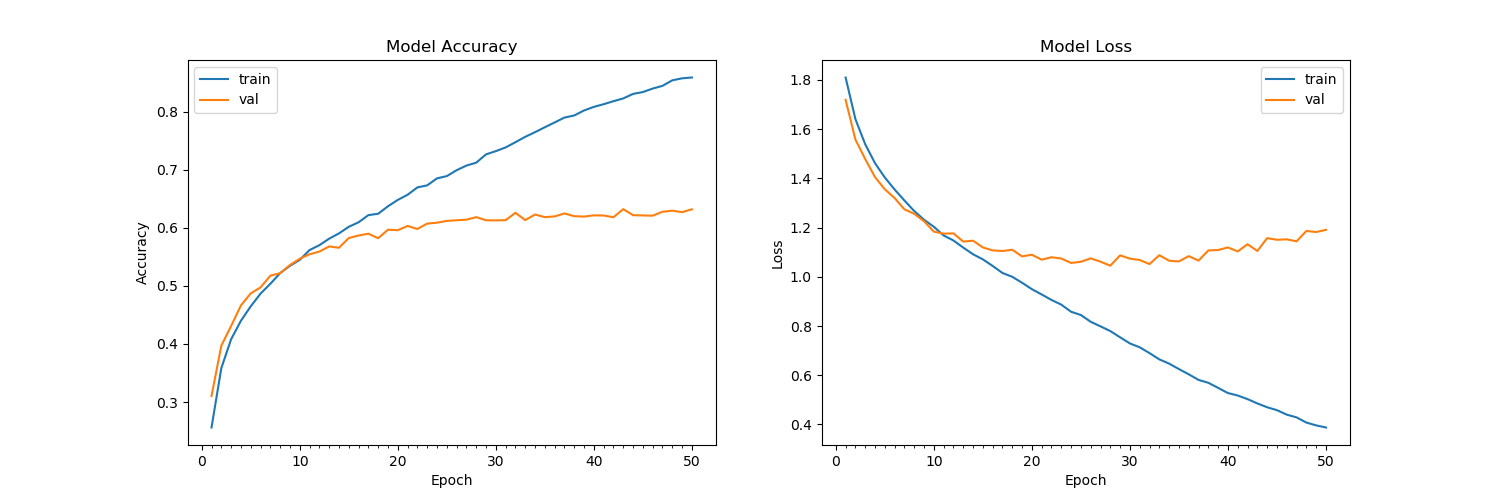
emotions on all faces in the webcam feed. With a simple 4-layer CNN, the test accuracy reached 63. Data Preparation (optional) The original FER2013 dataset in Kaggle is available as a single csv file. I had converted into a dataset of images in the PNG format for training/testing. In case you are looking to experiment with new datasets, you may have to deal with data in the csv format. I have provided the code I wrote for data

preprocessing in the file which can be used for reference. Algorithm First, the **haar cascade** method is used to detect faces in each frame of the webcam feed. The region of image containing the face is resized to **48x48** and is passed as input to the CNN. The network outputs a list of **softmax scores** for the seven classes of emotions. The emotion with maximum score is displayed on the screen. References "Challenges in Representation Learning: A report on three

machine learning contests. " I Goodfellow, D Erhan, PL Carrier, A Courville, M Mirza, B Hamner, W Cukierski, Y Tang, DH Lee, Y Zhou, C Ramaiah, F Feng, R Li, X Wang, D Athanasakis, J Shawe-Taylor, M Milakov, J Park, R Ionescu, M Popescu, C Grozea, J Bergstra, J Xie, L Romaszko, B Xu, Z Chuang, and Y.

常见问题

记录了多少星标和分叉?

atulapra/Emotion-detection 有 1,359 个星标和 550 个分叉。

仓库排名是多少?

atulapra/Emotion-detection 排名第 10,582。

记录的语言和类别是什么?

atulapra/Emotion-detection 有 1,359 个星标,语言为 Python,类别为 Applications。

哪个仓库排名最接近?

atulapra/Emotion-detection 与 fofr/cog-face-to-many 比较,后者排名第 10,583,有 1,359 个星标。

README

Emotion detection using deep learning

Introduction

This project aims to classify the emotion on a person's face into one of seven categories, using deep convolutional neural networks. The model is trained on the FER-2013 dataset which was published on International Conference on Machine Learning (ICML). This dataset consists of 35887 grayscale, 48x48 sized face images with seven emotions - angry, disgusted, fearful, happy, neutral, sad and surprised.

Dependencies

  • Python 3, OpenCV, Tensorflow
  • To install the required packages, run pip install -r requirements.txt.

Basic Usage

The repository is currently compatible with tensorflow-2.0 and makes use of the Keras API using the tensorflow.keras library.

  • First, clone the repository and enter the folder
git clone https://github.com/atulapra/Emotion-detection.git
cd Emotion-detection
  • Download the FER-2013 dataset inside the src folder.

  • If you want to train this model, use:

cd src
python emotions.py --mode train
  • If you want to view the predictions without training again, you can download the pre-trained model from here and then run:
cd src
python emotions.py --mode display
  • The folder structure is of the form:
    src:

    • data (folder)
    • emotions.py (file)
    • haarcascade_frontalface_default.xml (file)
    • model.h5 (file)
  • This implementation by default detects emotions on all faces in the webcam feed. With a simple 4-layer CNN, the test accuracy reached 63.2% in 50 epochs.
Data Preparation (optional)

  • The original FER2013 dataset in Kaggle is available as a single csv file. I had converted into a dataset of images in the PNG format for training/testing.

  • In case you are looking to experiment with new datasets, you may have to deal with data in the csv format. I have provided the code I wrote for data preprocessing in the dataset_prepare.py file which can be used for reference.

Algorithm

  • First, the haar cascade method is used to detect faces in each frame of the webcam feed.

  • The region of image containing the face is resized to 48x48 and is passed as input to the CNN.

  • The network outputs a list of softmax scores for the seven classes of emotions.

  • The emotion with maximum score is displayed on the screen.

References

  • "Challenges in Representation Learning: A report on three machine learning contests." I Goodfellow, D Erhan, PL Carrier, A Courville, M Mirza, B Hamner, W Cukierski, Y Tang, DH Lee, Y Zhou, C Ramaiah, F Feng, R Li,
    X Wang, D Athanasakis, J Shawe-Taylor, M Milakov, J Park, R Ionescu, M Popescu, C Grozea, J Bergstra, J Xie, L Romaszko, B Xu, Z Chuang, and Y. Bengio. arXiv 2013.
排名相邻
同类项目