← 开源
ali-vilab

dreamtalk

Official implementations for paper: DreamTalk: When Expressive Talking Head Generation Meets Diffusion Probabilistic Models

ModelsVision modelsAudio/Speech modelsPython
在 GitHub 打开
增长势头
+024 小时新增 Star0.0%
1.79k
Star
218
Fork
+-1
本周
4
贡献者
创建于 2023-12-28 · 更新于 2026-10-12 · 今日第 9485 名
主要开发者
YifengMa9lukevsalibaba-oss

ali-vilab/dreamtalk 排名第 9,485,有 1,788 个星标。

同类别比较

ali-vilab/dreamtalk 排名第 9,485,此处有 8 个同类条目;NVlabs/few-shot-vid2vid 排名第 9,471。

同类别比较
名称排名指标
MCG-NJU/VideoMAE9,462
语言:
Python
星标数:
1,802
分叉数:
173
简介:
[NeurIPS 2022 Spotlight] VideoMAE: Masked Autoencoders are Data-Efficient Learners for Self-Supervised Video Pre-Training
zai-org/CogView9,465
语言:
Python
星标数:
1,801
分叉数:
175
简介:
Text-to-Image generation. The repo for NeurIPS 2021 paper "CogView: Mastering Text-to-Image Generation via Transformers".
Standard-Intelligence/hertz-dev9,466
语言:
Python
星标数:
1,800
分叉数:
115
简介:
first base model for full-duplex conversational audio
NVlabs/few-shot-vid2vid9,471
语言:
Python
星标数:
1,795
分叉数:
274
简介:
Pytorch implementation for few-shot photorealistic video-to-video translation.
baaivision/Emu9,510
语言:
Python
星标数:
1,777
分叉数:
82
简介:
Emu Series: Generative Multimodal Models from BAAI
OpenCodeInterpreter/OpenCodeInterpreter9,521
语言:
Python
星标数:
1,771
分叉数:
223
简介:
OpenCodeInterpreter is a suite of open-source code generation systems aimed at bridging the gap between large language models and sophisticated proprietary systems like the GPT-4 Code Interpreter. It significantly enhances code generation capabilities by integrating execution and iterative refinement functionalities.
huggingface/transfer-learning-conv-ai9,542
语言:
Python
星标数:
1,757
分叉数:
428
简介:
🦄 State-of-the-Art Conversational AI with Transfer Learning
salesforce/ALBEF9,550
语言:
Python
星标数:
1,753
分叉数:
222
简介:
Code for ALBEF: a new vision-language pre-training method
关键参数与规格
关键参数与规格
参数值
语言Python
类别Models
子类别Vision models,Audio/Speech models
关键词Text-to-speech, Video production
星标数1,788
分叉数218
贡献者4
创建日期2023-12-28
更新日期2026-10-12
1 天星标数0
7 天星标数-1
排名9,485
上次排名9,522
排名变化37
7 天星标排名17,026
上次 7 天星标排名17,025
7 天星标排名变化-1
总星标排名6,977
上次总星标排名6,970
总星标排名变化-7
国家China
README 摘录

DreamTalk: When Expressive Talking Head Generation Meets Diffusion Probabilistic Models DreamTalk is a diffusion-based audio-driven expressive talking head generation framework that can produce high-quality talking head videos across diverse speaking styles. DreamTalk exhibits robust performance with a diverse array of inputs, including songs, speech in multiple languages, noisy audio, and out-of-domain portraits. 12]__ Release inference code and pretrained checkpoint. Installation Download Checkpoints In light of the social impact, we have ceased public download access to

checkpoints. If you want to obtain the checkpoints, please request it by emailing mayf18@mails. It is important to note that sending this email implies your consent to use the provided method **solely for academic research purposes**. Put the downloaded checkpoints into folder. Inference Run the script: specifies the input audio. The input audio file extensions such as wav, mp3, m4a, and mp4 (video with sound) should all be compatible. specifies the reference speaking style and specifies head pose. They

are 3DMM parameter sequences extracted from reference videos. You can follow PIRenderer to extract 3DMM parameters from your own videos. Note that the video frame rate should be 25 FPS. Besides, videos used for head pose reference should be first cropped to $256\times256$ using scripts in FOMM video preprocessing. Its resolution should be larger than $256\times256$. Frontal portraits, with the face directly facing forward and not tilted to one side, usually achieve satisfactory results. The input portrait will

be cropped to $256\times256$. If your portrait is already cropped to $256\times256$ and you want to disable cropping, use option like this: controls the scale of classifer-free guidance. It can adjust the intensity of speaking styles. is the maximum video generation duration, measured in seconds. If the input audio exceeds this length, it will be truncated. The generated video will be named and put in the output_video folder. Intermediate results, including the cropped portrait, will be

in the folder. Due to copyright issues, we are unable to include the songs we have used in this folder. If you want to run this program on CPU, please add to the command line arguments. ) Ad-hoc solutions to improve resolution The main goal of this method is to achieve accurate lip-sync and produce vivid expressions across diverse speaking styles. The resolution was not considered in the initial design process. There are two ad-hoc solutions to improve

resolution. The first option is to utilize CodeFormer, which can achieve a resolution of $1024\times1024$; however, it is relatively slow, processing only one frame per second on an A100 GPU, and suffers from issues with temporal inconsistency. The second option is to employ the Temporal Super-Resolution Model from MetaPortrait, which attains a resolution of $512\times512$, offers a faster performance of 10 frames per second, and maintains temporal coherence. However, these super-resolution modules may reduce the intensity

of facial emotions. The sample results after super-resolution processing are in the folder. Acknowledgements We extend our heartfelt thanks

常见问题

记录了多少星标和分叉?

ali-vilab/dreamtalk 有 1,788 个星标和 218 个分叉。

仓库排名是多少?

ali-vilab/dreamtalk 排名第 9,485。

记录的语言和类别是什么?

ali-vilab/dreamtalk 有 1,788 个星标,语言为 Python,类别为 Models。

哪个仓库排名最接近?

ali-vilab/dreamtalk 与 NVlabs/few-shot-vid2vid 比较,后者排名第 9,471,有 1,795 个星标。

README

DreamTalk: When Expressive Talking Head Generation
Meets Diffusion Probabilistic Models

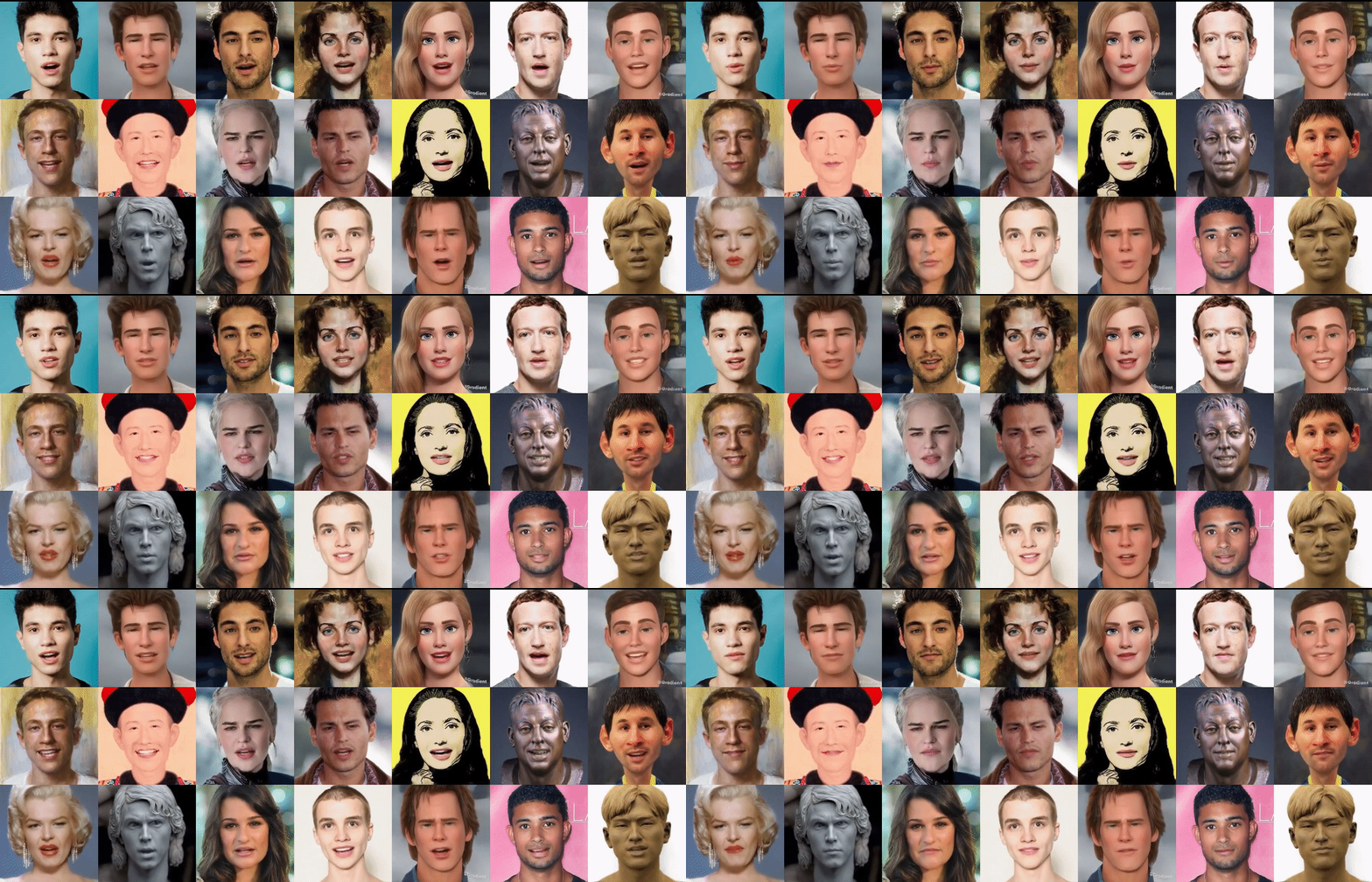
DreamTalk is a diffusion-based audio-driven expressive talking head generation framework that can produce high-quality talking head videos across diverse speaking styles. DreamTalk exhibits robust performance with a diverse array of inputs, including songs, speech in multiple languages, noisy audio, and out-of-domain portraits.

News

  • [2023.12] Release inference code and pretrained checkpoint.

Installation

conda create -n dreamtalk python=3.7.0
conda activate dreamtalk
pip install -r requirements.txt
conda install pytorch==1.8.0 torchvision==0.9.0 torchaudio==0.8.0 cudatoolkit=11.1 -c pytorch -c conda-forge
conda update ffmpeg

pip install urllib3==1.26.6
pip install transformers==4.28.1
pip install dlib

Download Checkpoints

In light of the social impact, we have ceased public download access to checkpoints. If you want to obtain the checkpoints, please request it by emailing mayf18@mails.tsinghua.edu.cn . It is important to note that sending this email implies your consent to use the provided method solely for academic research purposes.

Put the downloaded checkpoints into checkpoints folder.

Inference

Run the script:

python inference_for_demo_video.py \
--wav_path data/audio/acknowledgement_english.m4a \
--style_clip_path data/style_clip/3DMM/M030_front_neutral_level1_001.mat \
--pose_path data/pose/RichardShelby_front_neutral_level1_001.mat \
--image_path data/src_img/uncropped/male_face.png \
--cfg_scale 1.0 \
--max_gen_len 30 \
--output_name acknowledgement_english@M030_front_neutral_level1_001@male_face

wav_path specifies the input audio. The input audio file extensions such as wav, mp3, m4a, and mp4 (video with sound) should all be compatible.

style_clip_path specifies the reference speaking style and pose_path specifies head pose. They are 3DMM parameter sequences extracted from reference videos. You can follow PIRenderer to extract 3DMM parameters from your own videos. Note that the video frame rate should be 25 FPS. Besides, videos used for head pose reference should be first cropped to $256\times256$ using scripts in FOMM video preprocessing.

image_path specifies the input portrait. Its resolution should be larger than $256\times256$. Frontal portraits, with the face directly facing forward and not tilted to one side, usually achieve satisfactory results. The input portrait will be cropped to $256\times256$. If your portrait is already cropped to $256\times256$ and you want to disable cropping, use option --disable_img_crop like this:

python inference_for_demo_video.py \
--wav_path data/audio/acknowledgement_chinese.m4a \
--style_clip_path data/style_clip/3DMM/M030_front_surprised_level3_001.mat \
--pose_path data/pose/RichardShelby_front_neutral_level1_001.mat \
--image_path data/src_img/cropped/zp1.png \
--disable_img_crop \
--cfg_scale 1.0 \
--max_gen_len 30 \
--output_name acknowledgement_chinese@M030_front_surprised_level3_001@zp1

cfg_scale controls the scale of classifer-free guidance. It can adjust the intensity of speaking styles.

max_gen_len is the maximum video generation duration, measured in seconds. If the input audio exceeds this length, it will be truncated.

The generated video will be named $(output_name).mp4 and put in the output_video folder. Intermediate results, including the cropped portrait, will be in the tmp/$(output_name) folder.

Sample inputs are presented in data folder. Due to copyright issues, we are unable to include the songs we have used in this folder.

If you want to run this program on CPU, please add --device=cpu to the command line arguments. (Thank lukevs for adding CPU support.)

Ad-hoc solutions to improve resolution

The main goal of this method is to achieve accurate lip-sync and produce vivid expressions across diverse speaking styles. The resolution was not considered in the initial design process. There are two ad-hoc solutions to improve resolution. The first option is to utilize CodeFormer, which can achieve a resolution of $1024\times1024$; however, it is relatively slow, processing only one frame per second on an A100 GPU, and suffers from issues with temporal inconsistency. The second option is to employ the Temporal Super-Resolution Model from MetaPortrait, which attains a resolution of $512\times512$, offers a faster performance of 10 frames per second, and maintains temporal coherence. However, these super-resolution modules may reduce the intensity of facial emotions.

The sample results after super-resolution processing are in the output_video folder.

Acknowledgements

We extend our heartfelt thanks for the invaluable contributions made by preceding works to the development of DreamTalk. This includes, but is not limited to: PIRenderer ,AVCT ,StyleTalk ,Deep3DFaceRecon_pytorch ,Wav2vec2.0 ,diffusion-point-cloud ,FOMM video preprocessing. We are dedicated to advancing upon these foundational works with the utmost respect for their original contributions.

Citation

If you find this codebase useful for your research, please use the following entry.

@article{ma2023dreamtalk,
  title={DreamTalk: When Expressive Talking Head Generation Meets Diffusion Probabilistic Models},
  author={Ma, Yifeng and Zhang, Shiwei and Wang, Jiayu and Wang, Xiang and Zhang, Yingya and Deng, Zhidong},
  journal={arXiv preprint arXiv:2312.09767},
  year={2023}
}

Disclaimer

This method is intended for RESEARCH/NON-COMMERCIAL USE ONLY.

排名相邻
同类项目