Visualkeras is a Python package to help visualize Keras (either standalone or included in TensorFlow) neural network architectures. It allows easy styling to fit most needs. This module supports layered style architecture generation which is great for CNNs (Convolutional Neural Networks), and a graph style architecture, which works great for most models including plain feed-forward networks.
Dress Code Dataset This repository presents the virtual try-on dataset proposed in: *D. Cucchiara* **Dress Code: High-Resolution Multi-Category Virtual Try-On** **[Paper]** **[Dataset Request Form]** **[Try-On Demo]** **IMPORTANT! ** By making any use of the Dress Code Dataset, you accept and agree to comply with the terms and conditions reported here. The dataset will not be released to private companies. When filling the dataset request form, non-institutional emails (e. The signed release agreement form is mandatory
(see the dataset request form for more details). Incomplete or unsigned release agreement forms are not accepted and will not receive a response. **Requests are manually validated on a weekly basis. If you do not receive a response, your request does not meet the outlined requirements. ** Please cite with the following BibTeX: Dataset We collected a new dataset for image-based virtual try-on composed of image pairs coming from different catalogs of YOOX NET-A-PORTER. The dataset contains
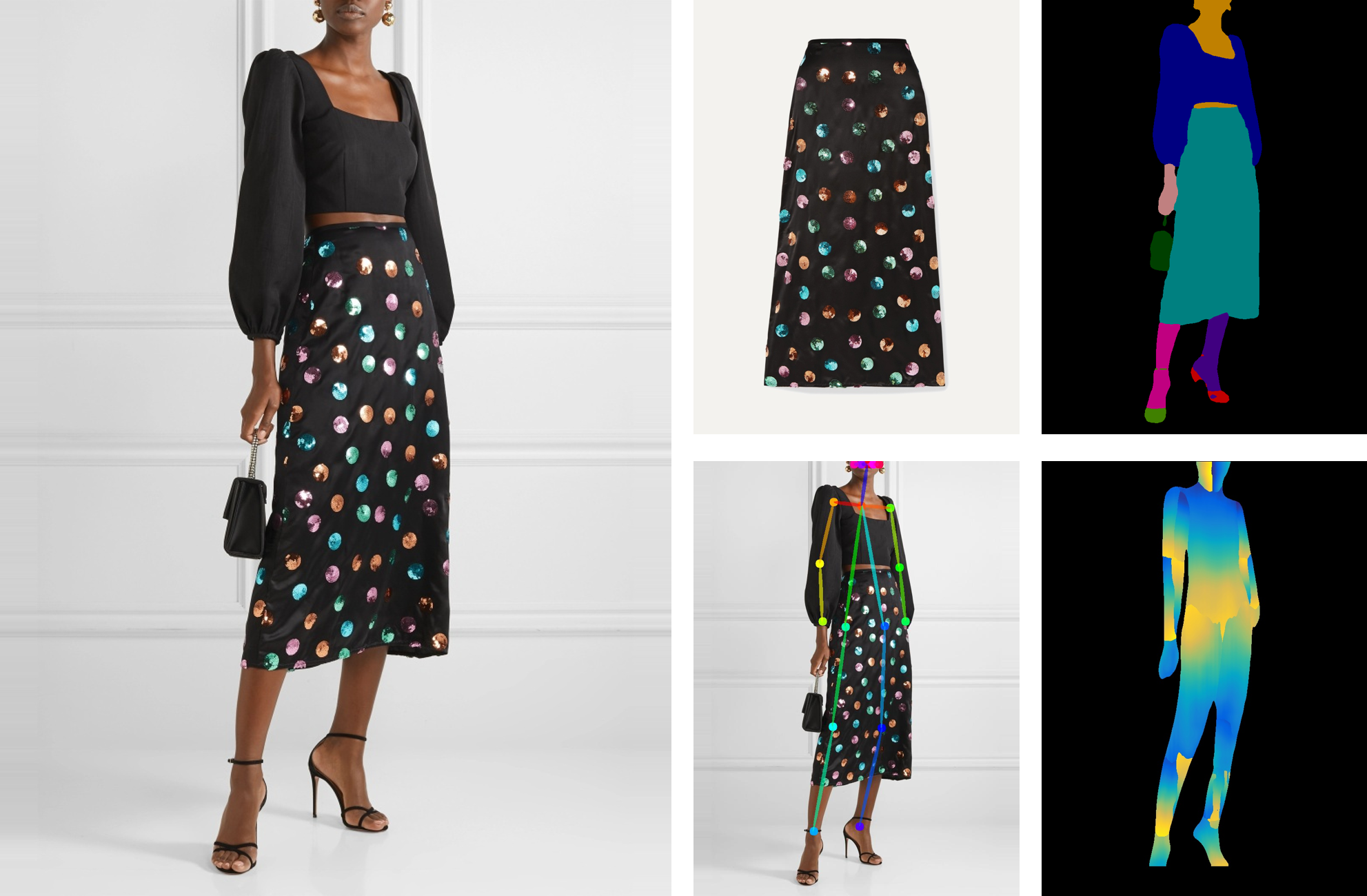
more than 50k high resolution model clothing images pairs divided into three different categories (*i. * dresses, upper-body clothes, lower-body clothes). Summary 53792 garments 107584 images 3 categories upper body lower body dresses 1024 x 768 image resolution additional info keypoints skeletons human label maps human dense poses Additional Info Along with model and garment image pair, we provide also the keypoints, skeleton, human label map, and dense pose. More info Keypoints For all image pairs of the dataset
, we stored the joint coordinates of human poses. In particular, we used OpenPose [1] to extract 18 keypoints for each human body. For each image, we provided a json file containing a dictionary with the key. The value of this key is a list of 18 elements, representing the joints of the human body. Each element is a list of 4 values, where the first two indicate the coordinates on the x and y axis respectively. Skeletons Skeletons are RGB
images obtained connecting keypoints with lines. Human Label Map We employed a human parser to assign each pixel of the image to a specific category thus obtaining a segmentation mask for each target model. Specifically, we used the SCHP model [2] trained on the ATR dataset, a large single person human parsing dataset focused on fashion images with 18 classes. Obtained images are composed of 1 channel filled with the category label value. Categories are mapped as follows: Human Dense
Pose We also extracted dense label and UV mapping from all the model images using DensePose [3]. Experimental Results Low Resolution 256 x 192 Code Due to a firm collaboration, we cannot release the code. However, we supply an empty Pytorch project to load data. "OpenPose: Realtime Multi-Person 2D Pose Estimation using Part Affinity Fields. "Densepose: Dense human pose estimation in the wild. "Toward Characteristic-Preserving Image-based Virtual Try-On Network. "CP-VTON+: Clothing Shape and Texture Preserving
Image-Based Virtual Try-On. "Parser-Free Virtual Try-On via Distilling Appearance Flows. "VITON-GT: An Image-based Virtual
常见问题
记录了多少星标和分叉?
aimagelab/dress-code 有 663 个星标和 80 个分叉。
仓库排名是多少?
aimagelab/dress-code 排名第 15,312。
记录的语言和类别是什么?
aimagelab/dress-code 有 663 个星标,语言为 Python,类别为 Model Development。
By making any use of the Dress Code Dataset, you accept and agree to comply with the terms and conditions reported here.
The dataset will not be released to private companies.
When filling the dataset request form, non-institutional emails (e.g. gmail.com, qq.com, etc.) are not allowed.
The signed release agreement form is mandatory (see the dataset request form for more details). Incomplete or unsigned release agreement forms are not accepted and will not receive a response. Typed signatures are not allowed.
Requests are manually validated on a weekly basis. If you do not receive a response, your request does not meet the outlined requirements.
Please cite with the following BibTeX:
@inproceedings{morelli2022dresscode,
  title={{Dress Code: High-Resolution Multi-Category Virtual Try-On}},
  author={Morelli, Davide and Fincato, Matteo and Cornia, Marcella and Landi, Federico and Cesari, Fabio and Cucchiara, Rita},
  booktitle={Proceedings of the European Conference on Computer Vision},
  year={2022}
}

Dataset
We collected a new dataset for image-based virtual try-on composed of image pairs coming from different catalogs of YOOX NET-A-PORTER.
The dataset contains more than 50k high resolution model clothing images pairs divided into three different categories (i.e. dresses, upper-body clothes, lower-body clothes).

Summary
53792 garments
107584 images
3 categories
upper body
lower body
dresses
1024 x 768 image resolution
additional info
keypoints
skeletons
human label maps
human dense poses
Additional Info
Along with model and garment image pair, we provide also the keypoints, skeleton, human label map, and dense pose.
More info
Keypoints
For all image pairs of the dataset, we stored the joint coordinates of human poses.
In particular, we used OpenPose [1] to extract 18 keypoints for each human body.
For each image, we provided a json file containing a dictionary with the keypoints key.
The value of this key is a list of 18 elements, representing the joints of the human body. Each element is a list of 4 values, where the first two indicate the coordinates on the x and y axis respectively.
Skeletons
Skeletons are RGB images obtained connecting keypoints with lines.
Human Label Map
We employed a human parser to assign each pixel of the image to a specific category thus obtaining a segmentation mask for each target model.
Specifically, we used the SCHP model [2] trained on the ATR dataset, a large single person human parsing dataset focused on fashion images with 18 classes.
Obtained images are composed of 1 channel filled with the category label value.
Categories are mapped as follows:
 0    background
 1    hat
 2    hair
 3    sunglasses
 4    upper_clothes
 5    skirt
 6    pants
 7    dress
 8    belt
 9    left_shoe
10    right_shoe
11    head
12    left_leg
13    right_leg
14    left_arm
15    right_arm
16    bag
17    scarf
Human Dense Pose
We also extracted dense label and UV mapping from all the model images using DensePose [3].
Experimental Results
Low Resolution 256 x 192
Name
SSIM
FID
KID
CP-VTON [4]
0.803
35.16
2.245
CP-VTON+ [5]
0.902
25.19
1.586
CP-VTON* [4]
0.874
18.99
1.117
PFAFN [6]
0.902
14.38
0.743
VITON-GT [7]
0.899
13.80
0.711
WUTON [8]
0.902
13.28
0.771
ACGPN [9]
0.868
13.79
0.818
OURS
0.906
11.40
0.570
Code
Due to a firm collaboration, we cannot release the code. However, we supply an empty Pytorch project to load data.
References
[1] Cao, et al. "OpenPose: Realtime Multi-Person 2D Pose Estimation using Part Affinity Fields." IEEE TPAMI, 2019.
[2] Li, et al. "Self-Correction for Human Parsing." arXiv, 2019.
[3] Güler, et al. "Densepose: Dense human pose estimation in the wild." CVPR, 2018.
[5] Minar, et al. "CP-VTON+: Clothing Shape and Texture Preserving Image-Based Virtual Try-On." CVPR Workshops, 2020.
[6] Ge, et al. "Parser-Free Virtual Try-On via Distilling Appearance Flows." CVPR, 2021.
[7] Fincato, et al. "VITON-GT: An Image-based Virtual Try-On Model with Geometric Transformations." ICPR, 2020.
[8] Issenhuth, el al. "Do Not Mask What You Do Not Need to Mask: a Parser-Free Virtual Try-On." ECCV, 2020.
[9] Yang, et al. "Towards Photo-Realistic Virtual Try-On by Adaptively Generating-Preserving Image Content." CVPR, 2020.
Contact
If you have any general doubt about our dataset, please use the public issues section on this github repo. Alternatively, drop us an e-mail at davide.morelli [at] unimore.it or marcella.cornia [at] unimore.it.